



Cities are becoming more complex at exactly the moment when they can least afford inefficiency. Population growth, aging infrastructure, climate pressure, rising service expectations, and constrained public budgets are all converging at once. For many municipalities, the old operating model of waiting for something to break and then reacting is no longer sustainable. This is where predictive infrastructure enters the conversation, not as a buzzword, but as a practical shift in how urban systems are monitored, managed, and improved.
Table Of Content
- What Predictive Infrastructure Actually Means
- Why Cities Need a Predictive Model Now
- The Building Blocks of Predictive Infrastructure
- Common Components Found in Predictive Infrastructure Systems
- Where Predictive Infrastructure Delivers the Most Value
- High-Impact Use Cases in Smart Cities
- Predictive Infrastructure as a Governance Tool
- The Role of Geospatial AI, Digital Twins, and Urban Data Platforms
- The Risks: Privacy, Cybersecurity, Bias, and Public Trust
- What Successful Adoption Looks Like
- A Practical Adoption Sequence for Municipalities
- The Future of Smart Cities Is Proactive, Not Merely Connected
At its core, predictive infrastructure means using connected sensors, software platforms, geospatial systems, analytics, and increasingly artificial intelligence to anticipate infrastructure conditions, demand changes, and potential failures before they become disruptive events. Instead of fixing a water main after it bursts, a city can identify pressure anomalies and intervene earlier. Instead of discovering transit overcrowding only when riders are delayed, operators can forecast demand and adjust service before bottlenecks form. Instead of treating every road, bridge, pump, and transformer with the same urgency, municipal teams can focus resources on the assets with the highest likelihood of failure and the greatest public impact.
This matters because smart cities are no longer defined simply by how much technology they install. They are increasingly judged by whether technology improves real outcomes such as reliability, resilience, affordability, equity, safety, and environmental performance. The National Institute of Standards and Technology, or NIST, describes smart city technologies as cyber-physical systems connected through the Internet of Things and related technologies, with the potential to improve services, support economic growth, and enhance quality of life. That definition is useful because it frames smart infrastructure as part of a broader public-value system rather than a gadget layer placed on top of urban life.
Predictive infrastructure is one of the clearest expressions of that shift. It turns raw data into an operational advantage and helps cities act earlier, plan better, and measure results more intelligently. For residents, that can mean fewer service interruptions, more reliable transportation, safer streets, and more resilient neighborhoods. For governments, it can mean better capital planning, less emergency spending, and stronger evidence for why one investment should happen before another.
In Canada and across North America, the timing is especially important. Statistics Canada has reported that rapid population growth in large urban centres is increasing demand for infrastructure, transportation, and services. At the same time, the World Bank notes that nearly 60% of the world’s population now lives in urban areas and that urban built-up area is expected to grow by more than 50% over the next 25 years. Those numbers point to a future in which infrastructure systems will carry more pressure, more volatility, and more interdependence than before.
This article examines what predictive infrastructure actually is, why it matters now, where it creates the most value, and what cities need to get right if they want these systems to work. The real story is not about turning cities into autonomous machines. It is about building a decision-support layer that helps human operators, planners, and policymakers make better choices sooner.
What Predictive Infrastructure Actually Means
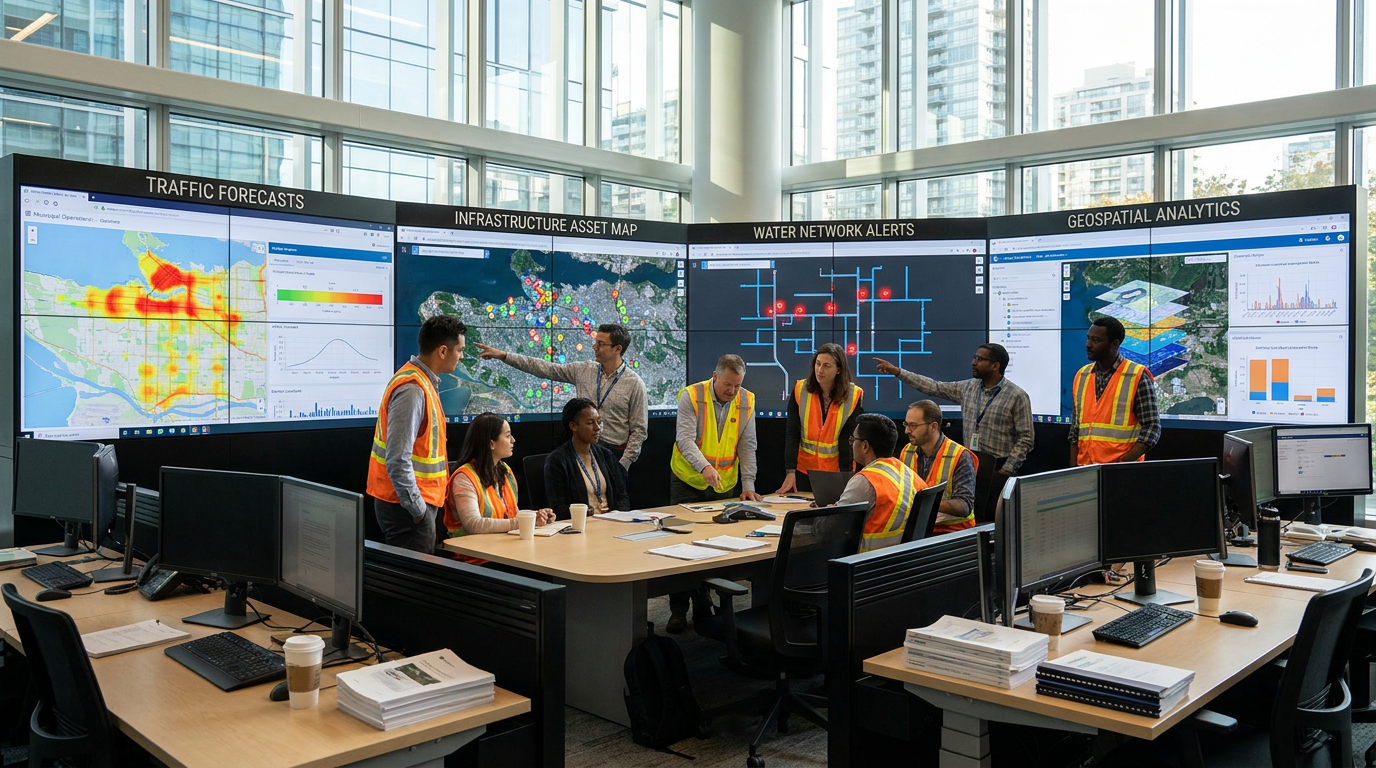
Predictive infrastructure is best understood as the intelligence layer behind physical assets and public services. Roads, transit fleets, bridges, pipes, substations, drainage networks, and emergency systems all generate signals. Some signals come from dedicated sensors, some from administrative records, some from satellite or aerial imagery, and some from public-facing systems such as transit apps or service requests. Predictive infrastructure combines these data streams and uses analytical models to estimate what is likely to happen next.
That future-facing orientation is the key distinction. Traditional infrastructure management often relies on scheduled inspections, historical averages, and reactive repairs. Those methods still matter, but they are limited in environments where asset conditions change quickly or where system demand can spike unexpectedly. Predictive systems make it possible to move from static planning toward adaptive management. They do not eliminate uncertainty, but they can reduce it enough to improve timing, prioritization, and resource allocation.
It is also important to separate predictive infrastructure from a common misconception. It is not the same thing as fully autonomous infrastructure. In most real-world municipal settings, predictive tools support human decision-making rather than replacing it. Engineers still validate risk. Transit managers still approve service changes. Emergency teams still set response priorities. The difference is that those professionals can act with earlier warnings and better evidence.
Another misconception is that predictive infrastructure starts with sensors alone. Sensors matter, but data collection by itself does not produce value. The value comes from converting signals into ranked risks, maintenance schedules, service adjustments, and policy actions. A city that installs thousands of devices without strong analytics, interoperability, governance, and performance measurement may end up with more information but not more intelligence.
This is why frameworks such as NIST’s Smart Cities and Communities KPI work are so relevant. Published on June 14, 2022, the framework addresses the lack of robust measurement methods for evaluating whether smart-city technologies actually deliver public benefit. In practice, that means asking whether predictive systems reduce downtime, prevent costly failures, improve response times, lower emissions, support service equity, or strengthen capital planning. Technology should be assessed through outcomes, not novelty.
Why Cities Need a Predictive Model Now
The pressure on urban systems is no longer linear. Population growth, climate volatility, aging assets, and rising resident expectations are interacting in ways that expose the weaknesses of reactive operations. A road network that once tolerated delayed maintenance may now fail under heavier traffic and more intense freeze-thaw cycles. A stormwater system designed for historical rainfall patterns may struggle under new climate conditions. Transit networks may face unpredictable crowding due to changing work patterns, events, or tourism spikes. These are not isolated problems. They are signals of a management model that needs to become more anticipatory.
Urban growth adds another layer of urgency. The World Bank’s urban development data shows that the scale of urbanization globally is still increasing, while more than 1 billion people live in slums and urban built-up area is projected to rise sharply over the coming decades. Growth at this scale creates direct pressure on transportation, utilities, waste systems, emergency management, and land use planning. It also increases the cost of getting infrastructure decisions wrong. When cities delay action until visible failure, the consequences tend to be larger, more expensive, and more disruptive.
In Canada, the policy direction already reflects this reality. Housing, Infrastructure and Communities Canada has framed the Smart Cities Challenge around innovation, data, connected technology, and outcomes for residents. The program launched in November 2017, announced its first-round winners in May 2019, and is scheduled to continue through 2027. That timeline is significant because it shows smart-city capacity building as a sustained public priority rather than a short-lived experiment.
Canada’s geospatial strategy reinforces the same trajectory. Modern geospatial infrastructure, interoperability, near-real-time emergency response, and AI-enabled analysis are all foundational to predictive infrastructure. Natural Resources Canada has emphasized that the Canadian Geospatial Data Infrastructure supports seamless data sharing, informed decision-making, resilient communities, and even Indigenous data governance. For cities, that means predictive infrastructure is not just an engineering issue. It is also a spatial data issue, a governance issue, and a public-sector modernization issue.
The growth of connected devices makes the timing even more practical. The International Energy Agency notes that connected sensors and devices are expanding rapidly and may rise from roughly 13 billion today to more than 25 billion by 2030. More sensors do not guarantee smarter cities, but they do create a richer environment for forecasting demand, detecting anomalies, and building system-level awareness across infrastructure networks.
Predictive infrastructure is not about making cities more digital for its own sake. It is about making cities more capable of seeing risk, demand, and opportunity before those signals become crises.
The Building Blocks of Predictive Infrastructure
Most predictive infrastructure systems are built from a combination of physical, digital, and institutional components. The physical layer includes sensors, meters, cameras, connected vehicles, weather stations, structural monitors, and other devices that capture real-time conditions. The digital layer includes cloud platforms, municipal dashboards, geographic information systems, digital twins, asset management software, and analytical models. The institutional layer includes governance rules, procurement standards, cybersecurity controls, privacy practices, and the operational teams that translate insight into action.
These layers have to work together. A city may have excellent sensor coverage but weak data integration. Another city may have clean geospatial data but no process for routing predictive alerts to maintenance crews. A third may have advanced AI models but insufficient transparency to explain why those models are recommending one intervention over another. Predictive infrastructure succeeds when technical capacity is matched by operational discipline and public trust.
Interoperability is especially important. Roads, water systems, energy infrastructure, public works, emergency response, planning departments, and transit agencies often operate on different data platforms and reporting standards. Yet real-world problems cross those boundaries all the time. A flood event can affect roads, basements, transit lines, and substations at once. A major event downtown can alter traffic demand, public safety needs, and waste collection patterns. Predictive infrastructure becomes far more useful when cities can connect datasets across departments and create a shared operating picture.
Geospatial intelligence is often the glue that binds these systems together. Predictive signals gain meaning when they are placed on a map and tied to context. A pipe with rising leak probability matters more if it sits near hospitals, schools, or dense housing. Heat risk becomes more actionable when overlaid with tree cover, surface temperature, housing vulnerability, and power infrastructure exposure. Transportation demand forecasting improves when it is integrated with land use, event calendars, weather, and demographic shifts.
Common Components Found in Predictive Infrastructure Systems
- IoT sensors and edge devices that monitor conditions such as vibration, pressure, occupancy, flow, temperature, and energy use.
- Asset management platforms that track maintenance history, condition, replacement cycles, and service criticality.
- Geospatial data infrastructure that connects operational data to location, land use, risk zones, and public assets.
- Predictive analytics and machine learning models that estimate failure probability, demand surges, and service disruptions.
- Digital twins and simulation tools that test scenarios before cities commit money or operational changes.
- Dashboards and alerting systems that turn forecasts into understandable decisions for municipal teams.
- Governance and security frameworks that set rules for privacy, access, quality, accountability, and cyber resilience.
When these elements are connected, predictive infrastructure can act as a decision-support platform rather than a fragmented set of projects. That distinction matters because many cities already have pieces of the puzzle. The challenge is often less about inventing new technology and more about integrating existing systems into a coherent urban intelligence model.
Where Predictive Infrastructure Delivers the Most Value
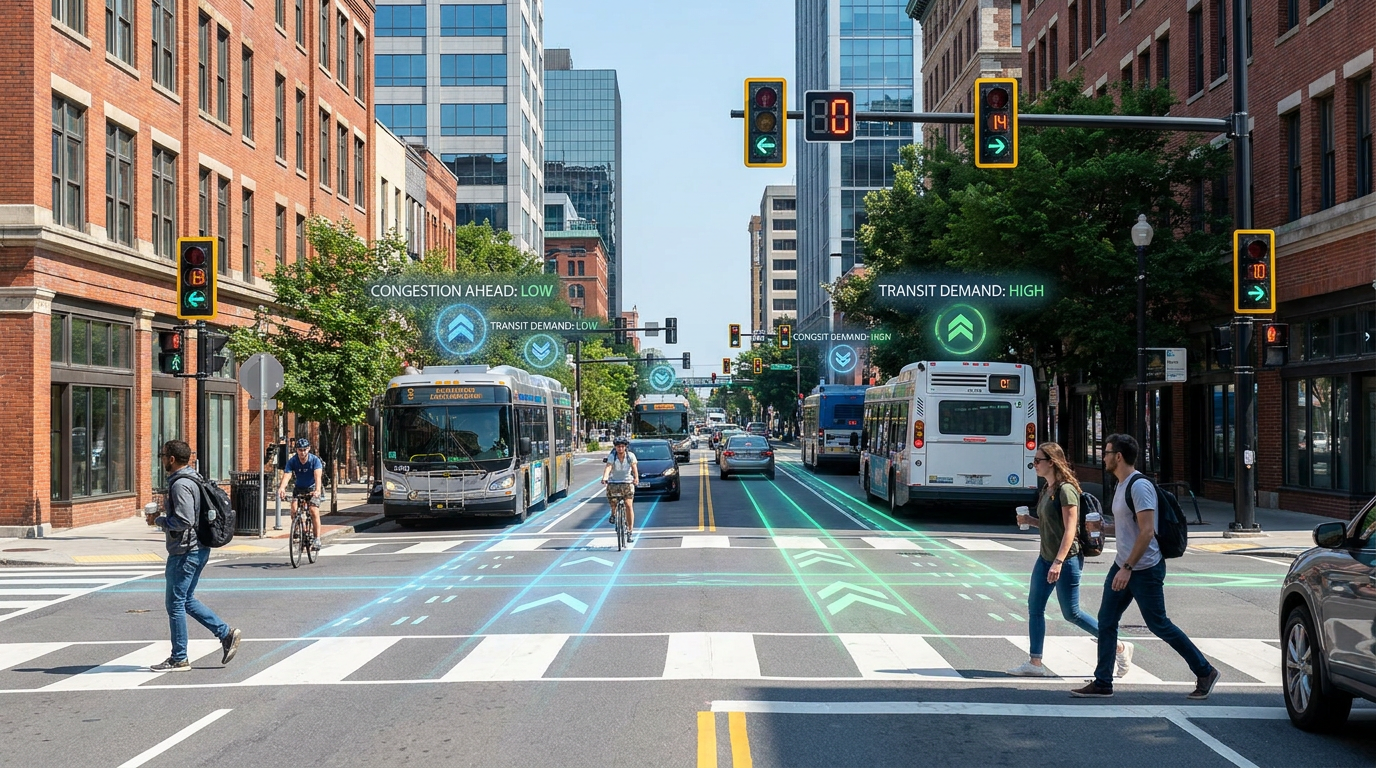
The strongest use cases for predictive infrastructure appear in sectors where failure is costly, demand is variable, and conditions can be monitored continuously. Transportation is one of the clearest examples. Traffic congestion can be forecast using sensor feeds, GPS traces, weather data, event schedules, and historical patterns. Signal timing can then be adjusted proactively, transit can be rescheduled based on expected crowding, and incident response can be positioned more strategically. This does not make congestion disappear, but it can reduce avoidable delay and improve network reliability.
Transit agencies also benefit from predictive maintenance. Buses, trains, track systems, escalators, and signaling equipment all show measurable indicators before failure. If operators can detect abnormal vibration, heat, braking issues, or power inconsistencies early, they can plan maintenance before breakdowns create cascading service interruptions. For riders, that often matters more than flashy digital features. Reliability is one of the most tangible forms of urban intelligence.
Water systems are another major opportunity. Aging pipes, hidden leaks, pressure fluctuations, pump failures, and stormwater overflows can create large financial and public-health risks. Predictive analytics can identify where water loss is most likely, where equipment is under stress, and where rainfall patterns may overwhelm drainage capacity. In climate-sensitive cities, this can support both everyday efficiency and resilience during extreme weather events.
Energy infrastructure is moving in a similar direction. Smart grids and distributed energy systems produce vast amounts of data on consumption, voltage, outages, and load peaks. Predictive models help utilities anticipate demand, balance loads, detect stress points, and improve the integration of renewable energy sources. As urban electrification expands through electric vehicles, heat pumps, and digital devices, the ability to forecast demand and manage capacity intelligently becomes increasingly valuable.
Public safety and climate resilience may be the most strategically important categories of all. Geospatial modeling can identify where flood, wildfire, storm, or heat risks intersect with vulnerable infrastructure and populations. Emergency response systems can use near-real-time data to monitor changing conditions and deploy resources earlier. The value here is not just operational. It is profoundly civic. Better prediction can protect lives, reduce disruption, and direct investment toward neighborhoods facing the highest cumulative risk.
High-Impact Use Cases in Smart Cities
- Traffic forecasting and signal optimization to reduce congestion and improve trip reliability.
- Transit demand prediction to reschedule service before crowding or delays escalate.
- Bridge, tunnel, and road maintenance forecasting to prevent major failures and lower lifecycle costs.
- Water leak detection and pressure analysis to reduce losses and avoid service disruptions.
- Grid stress and energy demand prediction to support reliability and cleaner urban energy management.
- Flood, heat, and wildfire risk modeling to guide climate adaptation and emergency planning.
- Capital planning and asset prioritization to align limited budgets with the highest-risk interventions.
What ties these use cases together is not the technology itself. It is the ability to move from observation to anticipation, and from anticipation to action. That is where predictive infrastructure becomes transformative rather than merely informative.
Predictive Infrastructure as a Governance Tool
One of the most underappreciated aspects of predictive infrastructure is that its biggest value may lie in governance rather than automation. Good governance depends on knowing what to prioritize, where to intervene, how to allocate scarce resources, and whether public investments are producing measurable outcomes. Predictive systems can improve each of those decisions by making tradeoffs more visible and more evidence-based.
For example, municipal leaders are constantly deciding between urgent repairs and long-term upgrades. Without predictive insight, these choices often rely heavily on complaints, visible deterioration, or political pressure. Those inputs matter, but they do not always capture hidden risk. A predictive model that combines asset age, maintenance history, service criticality, environmental stress, and failure probability can create a much stronger basis for deciding which assets should move to the front of the capital queue.
NIST’s KPI framing is particularly useful here because it emphasizes measurement against community goals. A city should not ask only whether its systems are collecting data. It should ask whether the data-driven system reduces emergency callouts, lowers non-revenue water loss, shortens commute times, improves resilience in underserved neighborhoods, or cuts emissions through better network efficiency. Predictive infrastructure becomes more credible when it is linked to these public outcomes.
This also creates a more disciplined model for return on investment. Smart-city projects have sometimes struggled because they promised transformation without defining success clearly enough. Predictive infrastructure is easier to justify when it is attached to operational metrics and policy metrics at the same time. A city can evaluate avoided failures, reduced maintenance costs, better asset lifespan, improved service continuity, and stronger resident satisfaction. Those are not abstract benefits. They are measurable changes in how a city performs.
Smaller municipalities can benefit as well. Predictive infrastructure is often assumed to be a megacity agenda, but that is misleading. Regional governments and mid-sized municipalities may gain substantial value from predictive asset management, especially where staffing is limited and infrastructure replacement budgets are tight. In these contexts, even modest forecasting tools can help teams focus on the most consequential risks rather than spreading attention too thinly across every asset.
The Role of Geospatial AI, Digital Twins, and Urban Data Platforms
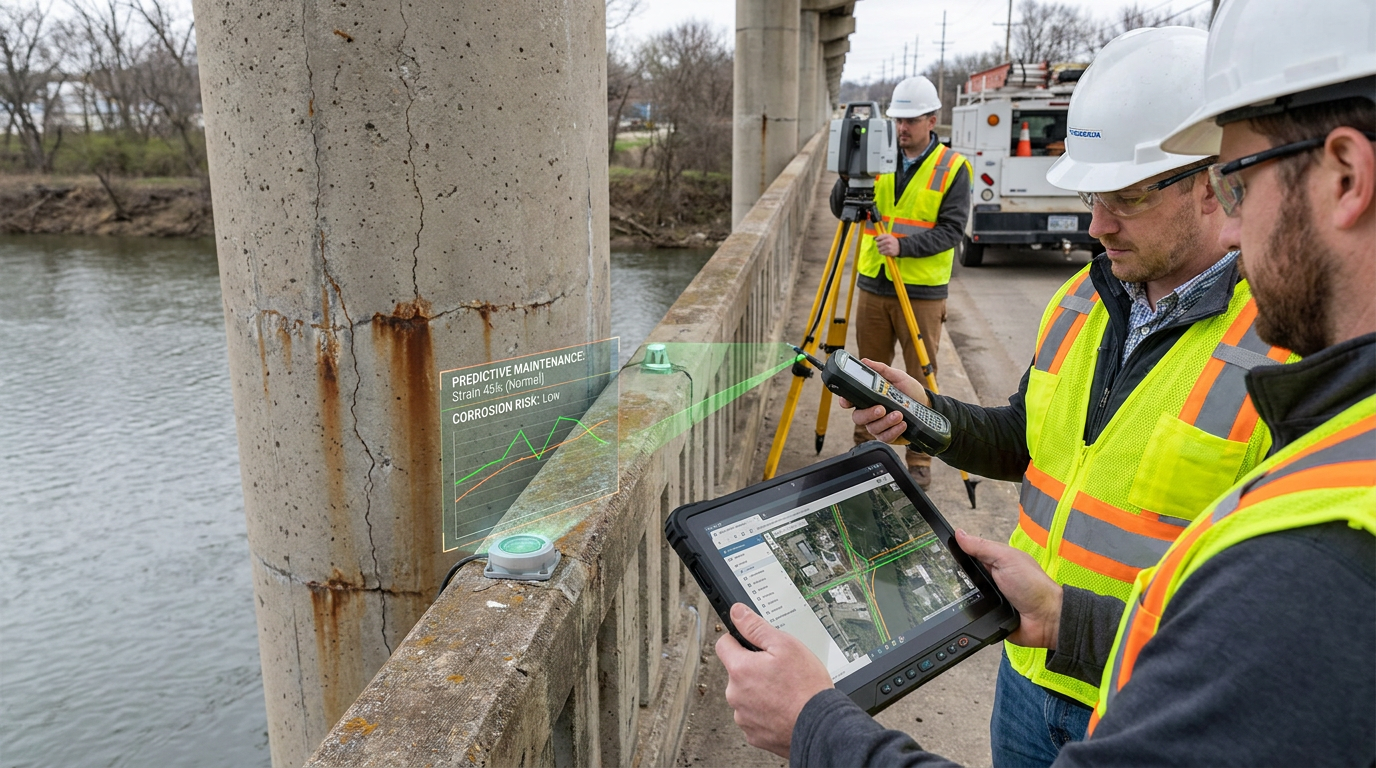
As predictive infrastructure matures, several technologies are becoming especially influential. One is geospatial AI, which applies machine learning and advanced analytics to spatial datasets such as satellite imagery, lidar, parcel data, road networks, weather maps, and infrastructure layers. This allows cities to identify patterns that are difficult to detect through tabular data alone. For example, geospatial AI can help detect urban heat islands, model flood pathways, identify informal land-use change, or estimate how infrastructure vulnerability varies across neighborhoods.
Another important concept is the digital twin. A digital twin is a dynamic virtual representation of a physical system, such as a building, district, utility network, or transportation corridor. When fed with current and historical data, digital twins can help cities simulate scenarios before they intervene in the real world. A municipality might test how a road closure affects bus delay, how a new tower development changes local traffic and drainage, or how storm intensity could impact a critical corridor. This adds a scenario-planning layer to predictive infrastructure and strengthens long-term decision-making.
Urban data platforms and municipal spatial data infrastructure are also central. Predictive systems need reliable, shareable, and interoperable data environments. If planning data is disconnected from utility data, and utility data is disconnected from climate risk maps, predictive capabilities remain limited. This is one reason Canada’s modern geospatial infrastructure agenda is so relevant. Seamless data sharing and interoperability are not technical footnotes. They are prerequisites for infrastructure intelligence.
Open data can also play a constructive role when used responsibly. Public access to selected non-sensitive datasets can support civic innovation, academic research, startup experimentation, and greater accountability around city performance. At the same time, not every dataset should be open, especially where safety, privacy, or system security are involved. The challenge is to design a data environment that is open where possible and protected where necessary.
The Risks: Privacy, Cybersecurity, Bias, and Public Trust
No serious discussion of predictive infrastructure is complete without addressing its risks. Smart-city systems collect data, and the Government of Canada has explicitly warned that such systems can be compromised. This means the future of predictive infrastructure depends not just on analytics quality, but on security-by-design, strong governance, and public trust. If residents believe infrastructure intelligence is being built in opaque or unsafe ways, adoption will slow and legitimacy will weaken.
Privacy is one of the first concerns. Cities must be clear about what data is collected, why it is collected, how long it is retained, who has access to it, and how it is protected. Infrastructure monitoring does not always involve personally identifiable information, but transportation systems, mobility apps, camera feeds, and connected public services can create privacy-sensitive conditions quickly. Municipalities need data minimization practices, anonymization where appropriate, and transparent communication with the public.
Cybersecurity is equally critical because predictive infrastructure is connected infrastructure. The more operational systems are networked, the more potential attack surfaces exist. Water systems, energy assets, transit platforms, traffic controls, and emergency networks all require resilient security architecture. A city cannot treat digital convenience as more important than system integrity. Predictive capability must be paired with authentication controls, network segmentation, incident response planning, vendor scrutiny, and continuous monitoring.
Bias in data and models is another challenge, particularly when predictive systems influence resource allocation. If historical datasets reflect unequal service patterns, complaint reporting gaps, or incomplete neighborhood coverage, models may reproduce those distortions. This can lead to underinvestment in communities that were already less visible to municipal systems. To avoid this, cities need model validation, fairness checks, representative data practices, and human review of high-stakes decisions.
Trust is built when cities explain how systems work, how outcomes are measured, and what safeguards are in place. Predictive infrastructure should feel accountable, not mysterious. Residents do not need every technical detail, but they do need confidence that the intelligence layer guiding public decisions is secure, transparent, and aligned with community goals.
What Successful Adoption Looks Like
Successful adoption rarely begins with a citywide technology rollout. It usually starts with a defined service problem, a clear operational owner, a measurable outcome, and a dataset good enough to support action. For one city, that may be reducing water loss. For another, it may be forecasting bus overcrowding. For a third, it may be targeting road resurfacing based on failure probability rather than routine cycle alone. The smartest entry point is often the one where data quality, operational need, and public value already align.
From there, cities can scale by building repeatable practices. Those practices include data standards, cross-department coordination, procurement models that avoid vendor lock-in, and measurement frameworks that distinguish between pilot excitement and actual performance improvement. A predictive pilot is useful only if it changes decisions or operations in a durable way. Otherwise, it remains a demonstration rather than an infrastructure capability.
Leadership matters as well. Predictive infrastructure sits at the intersection of engineering, planning, IT, procurement, finance, and public communication. That makes ownership difficult unless there is executive alignment around purpose. The goal should not be technology deployment in the abstract. The goal should be better urban outcomes supported by a stronger intelligence layer. Cities that keep that principle in view are more likely to invest in the right architecture and avoid fragmented implementation.
Measurement should remain visible from the beginning. Municipal teams should define what success looks like before deployment, not afterward. That can include metrics such as avoided downtime, reduced emergency repairs, lower operational costs, higher service reliability, faster incident response, improved climate resilience, or more equitable infrastructure prioritization. These indicators help city leaders defend investment decisions and refine systems over time.
A Practical Adoption Sequence for Municipalities
- Identify a high-cost or high-risk operational problem with available data.
- Map the relevant assets, departments, and data flows involved in the issue.
- Establish governance rules for privacy, security, data quality, and accountability.
- Build a predictive model or dashboard tied to one clear operational decision.
- Test the model against real outcomes and refine it with frontline staff input.
- Measure results using service, cost, resilience, and equity indicators.
- Scale gradually into adjacent systems once trust and value are established.
The Future of Smart Cities Is Proactive, Not Merely Connected
The next phase of smart-city development will be defined less by connectivity alone and more by what cities can do with connected intelligence. Installing sensors is easier than redesigning operations around foresight. Collecting data is easier than converting it into better capital planning. Building a dashboard is easier than earning public trust in how data-driven decisions are made. Predictive infrastructure matters because it pushes cities beyond visibility toward anticipation and action.
This shift is especially relevant as climate adaptation, housing growth, and infrastructure renewal increasingly overlap. A city deciding where to extend roads, water capacity, transit service, or flood mitigation cannot rely on historical patterns alone. It needs live signals, spatial context, scenario modeling, and stronger evidence about where stress is building. In that sense, predictive infrastructure is part of a broader intelligence transition in urban governance. It helps cities understand not just where they are, but where they are heading.
For Canada, the combination of Smart Cities Challenge momentum, geospatial infrastructure development, urban population pressure, and growing awareness of digital risk makes this a timely field to watch. The opportunity is real, but so is the responsibility. Predictive infrastructure can create more efficient, resilient, and responsive cities only if it is designed around outcomes, interoperability, governance, and trust. More technology is not the destination. Better decisions are.
That is why predictive infrastructure deserves attention within the broader category of future intelligence systems. It represents a practical evolution in how cities think. Instead of reacting to failure after citizens feel the impact, municipalities can detect risk sooner, prioritize action more intelligently, and align investments with measurable public benefit. In a century defined by urban complexity, that may become one of the most valuable capabilities a city can build.
The future smart city will not be the one with the most devices. It will be the one that best understands its own signals and uses them to serve people earlier, more fairly, and with greater resilience. Predictive infrastructure is how that future begins.



No Comment! Be the first one.