



Infrastructure is often discussed as a cost line in a public budget, a political promise, or a construction program. In reality, it is one of the most powerful tools a city has to shape land value, productivity, housing supply, and long term economic resilience. Roads, transit, water systems, public spaces, and digital networks do more than support daily life. They determine where growth can happen, how efficiently people and goods move, and whether urban expansion becomes an asset or a liability over time.
Table Of Content
- Why infrastructure ROI is bigger than direct revenue
- The core channels of return in urban infrastructure
- Productivity and agglomeration
- Housing supply and land activation
- Land value uplift and fiscal return
- Avoided costs and system efficiency
- How infrastructure ROI should actually be measured
- Why governance and coordination matter so much
- Case study 1: Canadian transit investment as a housing and growth strategy
- Case study 2: Value capture and transformative transit adjacent development in the United States
- Case study 3: Klyde Warren Park and the ROI of public realm infrastructure
- Common misconceptions that weaken infrastructure decisions
- What high ROI infrastructure looks like in practice
- A practical framework for evaluating infrastructure ROI
- The future of infrastructure ROI in North American cities
- Conclusion
- Sources and references
Infrastructure ROI is the total economic, fiscal, and social value that a road, transit, utility, or public realm project generates for a city, not just the revenue the asset collects directly. That is why the idea of return on investment in infrastructure needs to be understood in a broader and more strategic way. A narrow financial lens asks whether a project pays for itself through direct user fees, fares, or tolls. An urban development lens asks a bigger question: what growth constraints does the project remove, and what new economic and social value does that unlock across the city or region? That value shows up in housing supply, productivity, land value, and long-term fiscal capacity, not only in fares or tolls. The difference between those two approaches is the difference between evaluating infrastructure as a line item and evaluating it as a city building platform.
Across North America, and especially in Canada, this distinction is becoming more important. Cities are under pressure to grow faster, deliver more housing, upgrade aging systems, and reduce emissions at the same time. In this environment, infrastructure ROI is no longer just about engineering output. It is about whether investments are aligned with land use, approvals, public policy, and long term metropolitan planning.
The strongest evidence shows that infrastructure produces the highest returns when it is coordinated with development strategy. Public transit linked to housing intensification can raise land values, improve labor market access, and reduce household transportation costs. Water and wastewater capacity can unlock entire districts for residential and employment growth. Public realm upgrades can transform underperforming land into high value mixed use districts. Digital infrastructure can support business productivity, flexible work, and more competitive regional economies. In each case, the return is not confined to the asset itself. It spreads across land markets, tax bases, household mobility, and economic performance.
This article offers a strategic overview of how infrastructure investments impact urban development ROI. It explains what counts as return, how cities should evaluate it, what misconceptions still distort decision making, and why governance matters as much as capital spending. It also looks at case studies that show how integrated infrastructure planning can deliver substantial value over time.
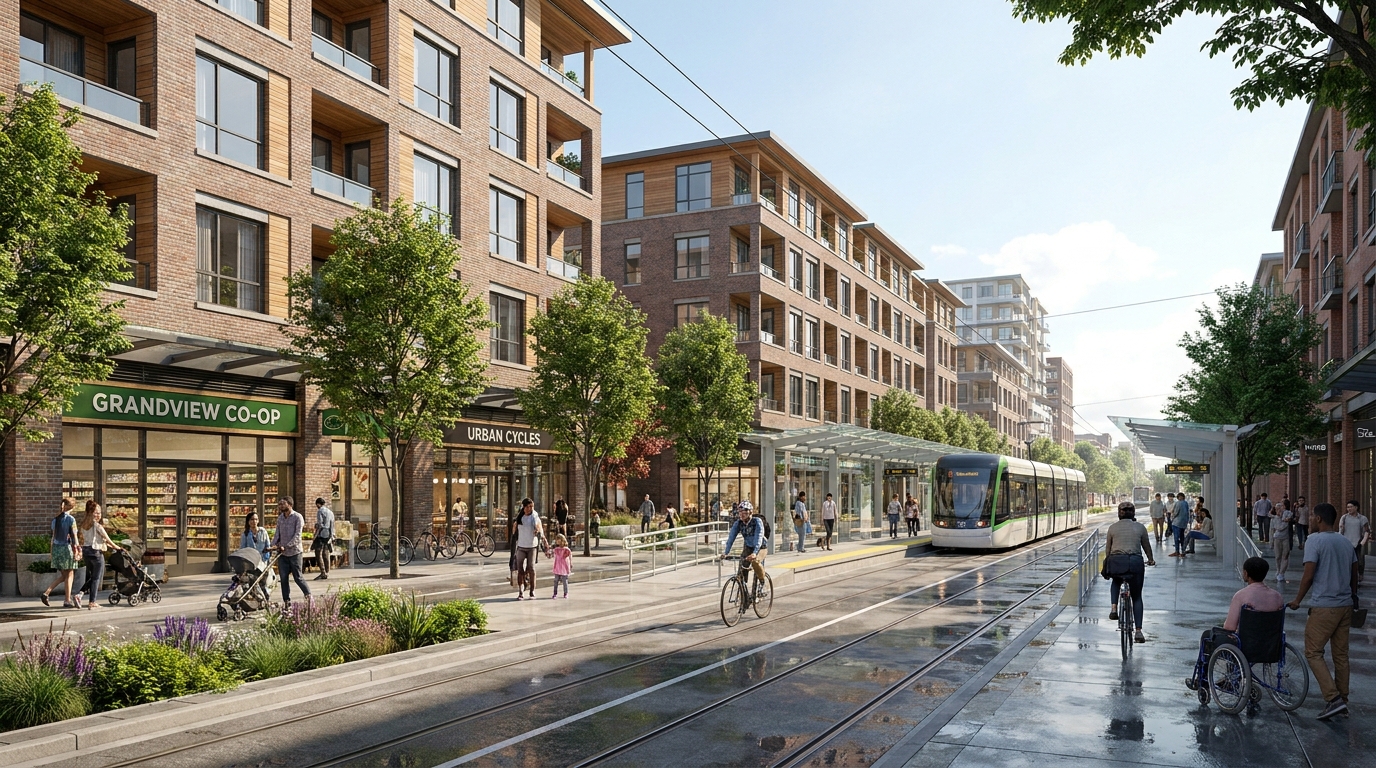
Why infrastructure ROI is bigger than direct revenue
One of the most common mistakes in infrastructure analysis is assuming that return on investment is only visible through direct revenue streams. That approach may work for a toll bridge or a utility system with predictable user charges, but it misses how cities actually function. Urban infrastructure creates value by reducing friction. It shortens travel time, lowers service costs, expands developable land, supports denser settlement patterns, and improves reliability for households and businesses.
The World Bank has emphasized that well chosen infrastructure investment can support structural transformation, trade integration, and urban agglomeration. In city terms, that means infrastructure can expand the effective size of labor markets, improve access to jobs, and allow firms to benefit from proximity. These effects are often more important than the direct cash flow tied to the physical asset. A transit line that never fully recovers operating costs through fares can still produce a very high urban ROI if it enables thousands of homes, raises corridor productivity, and avoids expensive sprawl related servicing costs.
That broader framing is especially relevant in large metropolitan regions where growth is constrained by congestion, fragmented land use, and infrastructure bottlenecks. In those contexts, infrastructure is less about creating isolated facilities and more about unlocking metropolitan efficiency. The return shows up through more housing in accessible locations, stronger employment clustering, reduced delays, better service reliability, and greater fiscal capacity over time.
In practice, this means cities and governments should evaluate infrastructure through a mix of direct and indirect measures. Those measures include land value uplift, tax assessment growth, private investment leverage, travel time savings, emissions reduction, job access, and lifecycle operating performance. When those metrics are considered together, the strategic case for integrated infrastructure becomes much clearer.
The core channels of return in urban infrastructure
Infrastructure investment generates return through several channels at once. Some are immediate and measurable. Others emerge over years or decades. The challenge for decision makers is that the largest benefits are often the least visible at the time of approval, which is why short horizon thinking tends to underinvest in transformative systems.
Productivity and agglomeration
OECD research finds that city productivity rises with city size, but also that fragmented metropolitan governance is associated with lower productivity. This insight matters because infrastructure is one of the main tools that determines whether urban scale becomes an advantage or a burden. If transportation, servicing, and planning are coordinated across a metropolitan region, larger labor and consumer markets can create meaningful economic gains. If governance is fragmented, the same region can suffer from duplicated systems, mismatched land use, and inefficient investment timing.
A reliable transit network, for example, increases access to jobs and talent across a wider geography. That creates agglomeration benefits, which are the productivity advantages that come when firms and workers are better connected. A business district supported by strong transit can draw from a larger labor pool, while households gain access to more employment choices without needing to relocate. These network effects are difficult to capture in a simple payback calculation, but they are central to urban economic performance.
Housing supply and land activation
Infrastructure determines how much land can realistically support housing. Water capacity, sewer upgrades, stormwater systems, substations, roads, and transit all affect whether development can proceed and at what density. In many growth constrained cities, the housing conversation is really an infrastructure conversation in disguise. Land may be designated for growth, but without servicing capacity and mobility investment, supply cannot materialize at scale.
This is one reason recent Canadian policy has tied transit spending to housing supply and complete communities. The Government of Canada has described the Canada Public Transit Fund as approximately $25 billion over 10 years, the largest public transit investment in Canadian history. Importantly, the policy case is not limited to mobility. It explicitly links transit to transit oriented communities, affordability, housing delivery, and emissions reduction. That is a more mature understanding of infrastructure ROI because it recognizes that transportation value is inseparable from land use outcomes.
Land value uplift and fiscal return
When infrastructure improves access, reduces risk, or enhances place quality, surrounding land often becomes more valuable. This uplift is not accidental. It reflects the market pricing of better connectivity, stronger amenities, improved development certainty, and higher future revenue potential. Cities that understand this dynamic can use tools such as tax increment financing, density bonusing, special assessments, or joint development to capture part of the value created and recycle it into future infrastructure.
The U.S. Federal Transit Administration has noted that value capture strategies can generate long term revenue streams to repay infrastructure debt, and it cites examples where returns exceeded 34 times the original federal investment. That type of outcome does not happen because a single station or street was built in isolation. It happens because infrastructure investment is paired with land market opportunity, supportive zoning, and development intensity.
Avoided costs and system efficiency
Another major component of ROI is what cities avoid spending in the future. Compact growth supported by transit and coordinated servicing can reduce per capita infrastructure costs compared with low density expansion. Sprawl typically requires more lane kilometers, more pipe length, greater service dispersion, and higher long term maintenance liabilities. Even where upfront land costs look cheaper, the public cost of servicing dispersed development can be far higher over time.
Infrastructure that improves resilience also generates avoided costs. Flood protection, redundant utility capacity, climate adapted public works, and reliable transit systems reduce the economic losses associated with disruption. In a changing climate, resilience is no longer a separate agenda from infrastructure ROI. It is part of the return calculation itself.
How infrastructure ROI should actually be measured
If infrastructure creates multiple forms of value, then it follows that it should be measured through multiple methods. Traditional cost benefit analysis still matters, but it is no longer sufficient on its own. Urban infrastructure is a long duration asset class with complex spillovers. That requires a more complete framework.
A strong evaluation model usually includes direct financial analysis, lifecycle costing, economic impact assessment, social return on investment, and environmental performance. Lifecycle costing matters because some projects look efficient upfront but create large operating and replacement burdens later. Social return on investment matters because access, health, travel reliability, and inclusion all shape the lived value of urban systems. Environmental accounting matters because carbon intensity, emissions reduction, and climate risk influence long term cost and competitiveness.
Canada is moving toward better measurement in this area. Statistics Canada released infrastructure economic account estimates that cover investment, stock, average age, remaining useful service life, and economic and environmental impacts, including supply chain greenhouse gas emissions. This kind of accounting is important because it helps governments understand whether they are building new assets while quietly accumulating future liabilities. It also supports better timing on rehabilitation, replacement, and system modernization.
For developers, planners, and municipal leaders, the lesson is straightforward. Infrastructure ROI should be evaluated over a long horizon and across a portfolio of outcomes. Some assets generate direct cash flow. Others generate fiscal stability, land readiness, or resilience. The strongest investment programs balance these categories rather than expecting every project to behave like a standalone commercial asset.
Strategic takeaway: The most valuable infrastructure projects are often the ones that make other investments possible. Their return is measured not just in revenue, but in the growth capacity they unlock.
Why governance and coordination matter so much
Infrastructure can be technically sound and still deliver weak ROI if governance is fragmented. Metropolitan regions often include multiple municipalities, agencies, utilities, transit operators, and approval bodies. When these actors do not align, cities can end up with transit stations without density, growth areas without servicing, or housing targets without mobility capacity. Capital is spent, but the intended urban outcome does not materialize.
The OECD finding that fragmented governance lowers productivity is especially relevant here. Large urban regions should benefit from scale, specialization, and shared labor markets. But those benefits are diluted when infrastructure and land use decisions are made in silos. An outer municipality may approve employment land without adequate regional transit. A core municipality may intensify housing without corresponding school, utility, or public realm upgrades. A province or federal government may fund a major line without synchronized zoning reform. Each move may be rational in isolation, yet collectively they reduce ROI.
By contrast, integrated metropolitan planning creates compounding returns. Transit investment linked to corridor zoning, utility capacity planning, housing targets, and public realm design creates a much stronger development platform. Investors gain certainty. Municipalities gain a clearer path to assessment growth. Residents gain better access and more complete neighborhoods. The infrastructure serves not only movement or servicing needs, but the entire growth strategy of the region.
This is why predictable long term funding can matter as much as project specific grants. When cities know capital programs are durable, they can align land use plans, station area policies, and private sector timelines with greater confidence. Short term or one off infrastructure decisions rarely create the same level of development response.
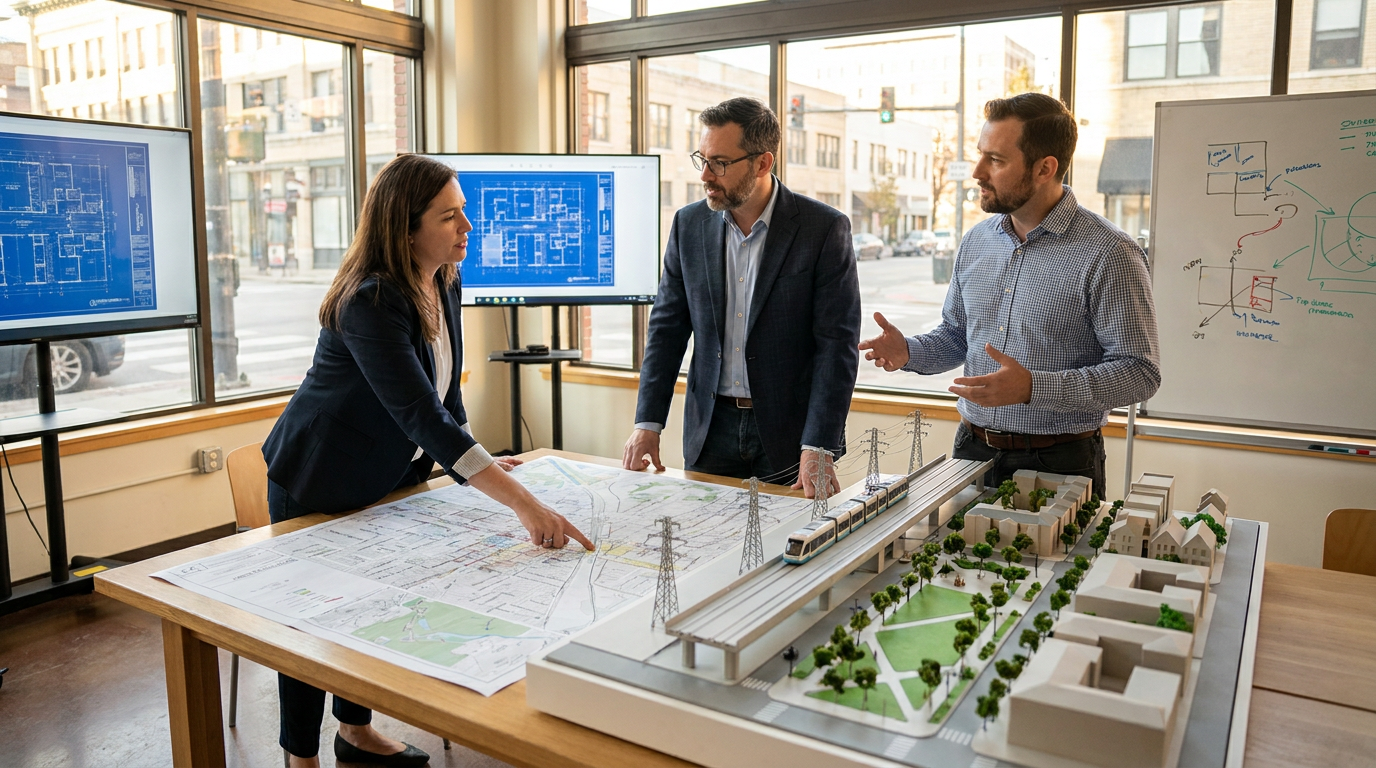
Case study 1: Canadian transit investment as a housing and growth strategy
Canada offers one of the clearest contemporary examples of how infrastructure ROI is being reframed. Historically, transit projects were often defended on congestion relief, ridership, or emissions grounds. Those remain important. But recent federal policy has explicitly connected transit funding to broader urban development outcomes, especially housing supply and complete communities.
The Canada Public Transit Fund, described by the federal government as approximately $25 billion over 10 years, signals a major shift in how infrastructure value is understood. Rather than treating transit as a transport silo, the policy links investment to transit oriented communities, affordability, and lower emissions. This matters because it aligns the capital program with the actual pressures facing Canadian cities: constrained housing supply, growing commuter burdens, and the need to accommodate population growth without replicating high cost sprawl.
The urban ROI logic is powerful. A transit corridor that supports higher density housing near stations can lower household transportation costs, reduce land consumption at the urban edge, improve access to jobs, and increase the efficiency of public services. Over time, municipalities may benefit from stronger assessment growth per hectare than they would from auto oriented expansion. Developers gain from clearer growth nodes and more marketable product in accessible locations. Households benefit from shorter trips and more complete neighborhoods.
However, the return is not automatic. Transit investment alone does not guarantee housing delivery. Station areas need enabling land use policy, realistic density permissions, timely approvals, utility capacity, and a functioning development market. This is where many regions succeed or fail. The infrastructure can create opportunity, but policy must convert that opportunity into actual supply.
That is also why simplified solutions often fall short. CMHC has cautioned that lowering development charges alone will not solve Canada’s housing crisis. The deeper issue is system alignment. Land, infrastructure, approvals, labor, financing, and market absorption all interact. Infrastructure ROI improves when those pieces move together.
Case study 2: Value capture and transformative transit adjacent development in the United States
North American examples of value capture show how infrastructure can generate returns far beyond direct operating revenue. The Federal Transit Administration has documented how value capture tools can create long term funding streams by leveraging the increase in land and development value that often follows major transit investment. This is a critical concept for cities facing funding constraints because it turns part of the uplift into a financing mechanism rather than allowing all of it to remain passive private gain.
The most important lesson from these examples is not the financing tool itself. It is the development structure behind it. Value capture works where transit is connected to zoning flexibility, development intensity, and a clear market response. A station in a low growth area with rigid land use controls may improve mobility, but it is unlikely to produce substantial value capture revenue. A station in a strong urban corridor with supportive planning can catalyze new residential, office, retail, and mixed use investment.
Where returns have reached multiples of original public investment, the common pattern is integration. Infrastructure is used to shape a district, not just a route. Public agencies think about access, parcels, phasing, public realm, and private investment leverage together. That district scale mindset is what turns a capital project into an urban growth engine.
For Canadian cities, this is especially relevant as they look for ways to fund major expansion while supporting housing goals. The question is no longer whether land value uplift exists. It clearly does in the right locations. The strategic question is whether governance systems are sophisticated enough to capture part of that uplift and reinvest it without undermining delivery.
Case study 3: Klyde Warren Park and the ROI of public realm infrastructure
Not all infrastructure ROI comes from utilities or transit. Public realm investments can also produce significant economic returns when they repair urban fragmentation and reshape market perception. Klyde Warren Park in Dallas is a notable example often referenced in infrastructure and urban development research. Built over a recessed freeway, the park reconnected districts that had been physically separated and created a new civic focal point in the urban core.
The World Bank has highlighted Klyde Warren Park as a case where early economic assessment helped secure funding and where the project later generated more than $2 billion in broader economic impact. That scale of return illustrates a vital point. Public space can function as infrastructure when it changes access, walkability, identity, and adjacent development performance. It is not merely an amenity. In the right setting, it becomes a market making asset.
The project’s success also reinforces the importance of timing and context. A major public realm investment has the greatest ROI where surrounding land is underutilized but development demand is present, where connectivity is impaired, and where place quality can unlock private capital. In those conditions, the public investment does not just beautify the city. It changes the economics of nearby land.
For urban leaders, this expands the infrastructure conversation. The highest return project in a district may not always be a larger road or a conventional utility upgrade. Sometimes it is the intervention that reconnects street networks, improves pedestrian conditions, creates identity, and raises confidence in long term investment.

Common misconceptions that weaken infrastructure decisions
Several recurring misconceptions continue to distort how infrastructure ROI is discussed in public and private settings. The first is the belief that more infrastructure always means better returns. In reality, returns depend on project selection, sequencing, governance, and integration with land use. Poorly timed or poorly located investment can lock in inefficiency for decades.
The second misconception is that transit ROI should be judged only by ridership. Ridership matters, but it is not the full story. Transit can support housing delivery, lower emissions, improve labor market access, and create more complete communities. A corridor with moderate ridership but strong housing and land use outcomes may produce greater long term urban return than a corridor with higher ridership but weak development integration.
The third misconception is that reducing development charges alone can solve infrastructure financing and housing affordability challenges. Charges are one part of a much larger system. If zoning is restrictive, approvals are slow, servicing is constrained, and construction economics are weak, fee reductions by themselves will not unlock enough supply. Infrastructure ROI improves when cost structure, land readiness, and policy certainty are addressed together.
The fourth misconception is that the benefits of infrastructure can be measured quickly. Many of the most important gains emerge over long periods through cumulative market response. A major transit line may take years to realize full corridor intensification. A utility upgrade may unlock land incrementally as projects move through approvals and financing cycles. Patience and disciplined measurement are essential.
What high ROI infrastructure looks like in practice
When infrastructure investments perform well in urban development terms, they usually share a recognizable set of characteristics. They are connected to a clear growth strategy. They address a known constraint to housing, mobility, resilience, or productivity. They are supported by governance structures that can align land use and delivery. And they are measured over an appropriately long horizon.
High ROI infrastructure also tends to be place specific. The same asset type can produce very different outcomes depending on location and policy context. A transit station in an intensification area with strong market demand can unlock major housing and mixed use growth. The same station in a low intensity district with restrictive zoning may produce limited urban return. A water upgrade serving a strategic growth node can create huge land activation benefits, while the same investment in a stagnant area may be necessary but not transformative.
Another hallmark of strong ROI is sequencing. Cities often assume that planning designations create growth. In practice, infrastructure capacity often determines whether those designations are real. When servicing, transit, and public realm improvements are timed to coincide with development readiness, private capital can move faster. When they arrive too early or too late, the return is weaker.
Finally, high ROI infrastructure is usually paired with some mechanism to recycle value. That does not mean every project needs a formal value capture program, but it does mean cities should understand who benefits financially from public investment and whether part of that upside can support future growth. Without that discipline, cities risk creating value that they cannot reinvest, even as replacement and maintenance obligations continue to rise.
A practical framework for evaluating infrastructure ROI
For city builders, a strategic evaluation framework is more useful than a single formula. The following questions help test whether an infrastructure project is likely to deliver strong urban development return.
- What specific growth constraint does the project remove? If the answer is unclear, the project may lack strategic focus. The strongest investments solve a real bottleneck in mobility, servicing, resilience, or access.
- What land use response is expected? Infrastructure without a realistic development pathway often underperforms. Cities should identify how much housing, employment space, or public benefit the investment enables.
- Is governance aligned? Funding, approvals, utility planning, and zoning need to point in the same direction. Fragmented delivery reduces return.
- What are the lifecycle costs and replacement implications? Good ROI is not only about opening day impact. It is about durable performance, manageable maintenance, and long term financial sustainability.
- What value can be captured or recycled? If public investment creates large land value gains, governments should consider tools to recover part of that uplift for future infrastructure.
- How does the project perform on climate and resilience metrics? Low carbon, durable, climate adapted infrastructure is increasingly essential to long term value.
These questions encourage decision makers to move beyond the old model of cost versus benefit in isolation. They place infrastructure inside the wider development system where its actual return is created.
The future of infrastructure ROI in North American cities
The next phase of urban infrastructure investment in North America will likely be defined by integration. Cities cannot afford to treat housing, transit, utilities, climate adaptation, and public realm as separate agendas. Population growth, fiscal pressure, and aging assets are forcing a more strategic view. The best returns will come from programs that connect these systems rather than funding them in parallel silos.
There is also growing recognition that infrastructure ROI is fundamentally about shaping city form. Dense development near transit generally lowers per capita infrastructure costs, improves service efficiency, and supports lower emission lifestyles. Dispersed growth tends to expand maintenance obligations and increase transport dependency. That does not mean every neighborhood should be high rise or every project should be transit led. It means infrastructure choices should reinforce a coherent long term urban structure.
Better data will also improve decision making. Economic accounts, lifecycle carbon analysis, and more advanced impact modeling are making it easier to evaluate tradeoffs across time. That should help governments shift away from short term optics and toward a more disciplined asset strategy. When cities understand the age, condition, useful life, emissions profile, and economic role of infrastructure, capital planning becomes more proactive and less reactive.
Finally, public expectations are changing. Residents increasingly expect infrastructure to do more than move traffic or manage pipes. They want systems that support affordability, access, safety, sustainability, and quality of life. In that sense, infrastructure ROI is becoming more democratic. The return is not only measured in balance sheets. It is measured in whether growth produces better urban living conditions at scale.
Conclusion
Return on investment in infrastructure for urban development is best understood as a portfolio of outcomes rather than a single metric. Some projects produce direct revenue. Others generate their real value through land activation, housing supply, productivity gains, avoided costs, resilience, and long term fiscal strength. The common thread is that infrastructure delivers the highest returns when it is integrated with land use, governance, and long horizon growth planning.
The evidence from Canada and across North America points in the same direction. Transit linked to complete communities, utilities aligned with housing delivery, and public realm investments tied to district transformation consistently outperform standalone capital spending. OECD findings on metropolitan productivity, World Bank research on agglomeration and structural transformation, federal Canadian policy on transit oriented communities, and practical examples of value capture all support one strategic conclusion: infrastructure works best when it is treated as a city shaping investment, not just a construction project.
For governments, developers, planners, and investors, this means asking better questions. Not simply what an asset costs, but what it unlocks. Not simply whether it pays back directly, but whether it expands the capacity of a city to grow more productively, more affordably, and more sustainably. In an era defined by housing pressure, climate risk, and fiscal constraint, that broader definition of ROI is not optional. It is the only one that matches how cities actually create value.
Sources and references
- OECD, What Makes Cities More Productive?
- World Bank, Infrastructure Foundations from Current Assets to Future Growth
- Government of Canada, Canada Public Transit Fund
- Government of Canada, announcements on long term transit funding and transit oriented communities
- Statistics Canada, infrastructure economic account estimates released March 2026
- U.S. Federal Transit Administration, value capture resources and case examples
- World Bank urban development materials including references to Klyde Warren Park
- CMHC commentary on development charges and housing supply conditions



No Comment! Be the first one.