



Lighting has always held a poetic role in interiors. It reveals texture, deepens color, softens architecture, and gives a room its emotional register. Yet in recent years, lighting has also entered a more profound conversation, one that reaches beyond aesthetics and into the rhythms of the body itself. Wellness lighting design asks us to look at illumination not only as a decorative element, but as a daily influence on sleep, mood, alertness, and comfort.
Table Of Content
- What Wellness Lighting Really Means
- The Science of Light and Circadian Rhythm
- Why Light Quality Matters More Than Brightness Alone
- The Essential Role of Daylight
- Layered Lighting as a Wellness Strategy
- Color Temperature, Spectrum, and the Myth of One Perfect Bulb
- Placement and Vertical Light Exposure
- The Importance of Glare Control and Visual Calm
- Room by Room Wellness Lighting Ideas
- Living Room
- Kitchen and Dining Area
- Home Office
- Bedroom
- Bathroom
- Smart Controls, Dimmers, and Tunable Systems
- Common Misconceptions About Healthy Home Lighting
- A Practical Checklist for Creating a Wellness Lighting Scheme
- The Emotional Beauty of Light That Supports Life
In the modern home, this shift matters more than ever. Our interiors are no longer neatly separated into spaces for work, leisure, and rest. A kitchen may become an office at noon, a dining room may double as a study corner, and a bedroom may glow with screens long after sunset. Because we spend so much of life indoors, artificial light now shapes our biological experience almost as much as architecture does. Thoughtful lighting design can support the body’s natural timing, while poorly considered lighting can flatten it into a constant state of stimulation.
At its heart, wellness lighting is about harmony. It draws from science, certainly, but also from intuition. We know instinctively that crisp morning light energizes a room and that a low, warm lamp can quiet the spirit at day’s end. Research from institutions such as NIH and Harvard Health helps explain why. Light is the most important external cue for the body’s internal clock, and the timing, spectrum, intensity, and placement of light all affect how that clock stays aligned.
This means that wellness lighting is not simply a matter of choosing a warm bulb and hoping for the best. It requires a layered understanding of daylight, electric light, glare, vertical eye-level exposure, and how each room supports a different rhythm of living. It is as much about what the eye feels as it is about what the brain receives. The most successful schemes are elegant because they are responsive. They know when to brighten, when to soften, and when to recede.
In this guide, we will explore the principles behind wellness lighting design and translate them into practical ideas for the home. We will look at circadian rhythm, light quality, color temperature, fixture placement, dimming, layering, and room-by-room strategies. The aim is not to turn every house into a laboratory, but to create interiors that feel calmer, more intelligent, and more deeply attuned to the way we actually live.
Wellness lighting is not about making every room brighter. It is about creating a stronger contrast between day and night so the home supports energy when you need it and rest when you deserve it.
What Wellness Lighting Really Means
The term wellness lighting can sometimes sound like a marketing phrase, wrapped in vague promises of healthier living. In reality, the most credible understanding of wellness lighting is quite specific. It refers to lighting design that considers both visual comfort and non visual biological effects. In other words, it aims to help you see comfortably while also respecting how light influences circadian rhythm, sleep, alertness, and emotional well-being.
This dual role is important because the body responds to light in more than one way. We tend to think of illumination as something that helps us navigate a room or complete a task. That visual function is essential, of course, but light also reaches retinal receptors linked to the circadian system. These receptors help regulate the timing of melatonin, the hormone associated with sleep onset, and they participate in the larger orchestration of the body clock. When lighting patterns conflict with natural day and night signals, the internal rhythm can become less stable.
A wellness approach therefore does not treat all hours as equal. Stronger, brighter, more blue enriched light is generally beneficial during the daytime, when the body needs cues for wakefulness and alertness. In the evening, the ideal atmosphere shifts. Lower intensity, warmer tones, and reduced glare help preserve the body’s wind down response. This contrast is a cornerstone of human-centric lighting design and is increasingly reflected in WELL and IES guidance.
Designers also emphasize that wellness lighting cannot be reduced to one variable. A room may have a low color temperature and still feel biologically overstimulating if the light is too bright, poorly placed, or aimed directly at the eyes. Likewise, a bright daytime room can feel unpleasant if glare is uncontrolled or if the light is distributed unevenly. Good design lies in orchestration. It balances intensity, tone, timing, angle, and reflection so the home feels supportive at every hour.
The Science of Light and Circadian Rhythm
The circadian rhythm is the body’s internal 24 hour timing system, helping to regulate sleep and wake cycles, hormone release, alertness, digestion, and temperature. One of its strongest external signals is light. Morning and daytime light help anchor this rhythm, telling the body that it is time to be awake, engaged, and metabolically active. Evening darkness, by contrast, helps prepare the body for rest and the natural rise of melatonin.
Research consistently shows that nighttime light exposure can interfere with this process. Even relatively low levels of light in the evening may suppress melatonin and shift circadian timing, especially when that light is rich in shorter wavelengths often associated with cooler or blue enriched illumination. This does not mean blue light is inherently harmful. It means context matters. During the day, blue enriched light can support alertness and synchronization. At night, the same quality of light can become disruptive.
That nuance is one of the most important ideas in wellness lighting. Many oversimplified claims suggest that all blue light is bad or that a warm bulb is automatically healthy. Both ideas miss the larger picture. What matters most is the relationship between light and time. The body benefits from brighter and more stimulating light during the day, then gentler and less activating light in the evening. The sequence matters as much as the source.
Contemporary guidance increasingly uses metrics such as melanopic equivalent daylight illuminance, often shortened to melanopic EDI, to describe circadian effectiveness more precisely. While most homeowners do not need to measure these values themselves, the principle behind them is useful. Lighting should not only illuminate the floor or countertop. It should also consider vertical eye level exposure, because the biological response depends on light reaching the eyes. This is why fixture placement, reflection, and sightlines are so critical.
Seen through a design lens, circadian support is not sterile or technical. It is deeply atmospheric. It means allowing mornings to feel bright and expansive, afternoons to stay visually clear without fatigue, and evenings to gather into softness. In a beautifully lit home, wellness is experienced not as a concept but as a rhythm.
Why Light Quality Matters More Than Brightness Alone
For many years, residential lighting conversations revolved around wattage, brightness, and decorative effect. While these still matter, wellness design asks a more sophisticated question. How does the light feel in the body and in the room? Light quality includes color rendering, diffusion, glare control, contrast, and the way illumination shapes surfaces and faces. A room can be technically bright yet psychologically exhausting if the light is harsh or uneven.
Visual comfort is one of the most immediate dimensions of wellness lighting. When glare is excessive, eyes work harder. Reflections on glossy surfaces, exposed bulbs in the line of sight, or a strong ceiling fixture over a seating area can create subtle but persistent tension. You may not consciously identify the problem, yet the room never quite feels restful. In contrast, a well diffused source, shaded fixture, or carefully directed wall wash creates a sense of ease that allows the eye to settle.
Color rendering also contributes to well-being in a quieter way. High quality light reveals skin tones accurately, preserves the richness of natural materials, and makes food, fabrics, and artwork appear alive rather than flat. This may sound like a luxury issue, but it is deeply practical. When interiors look natural, they feel trustworthy and comforting. The room reads with emotional clarity, which is part of what makes a home nourishing rather than merely functional.
Brightness alone can also be misleading because the body does not interpret all brightness equally. A brightly illuminated floor does not necessarily provide the same circadian signal as light that reaches the eyes from windows, lamps, or reflected vertical surfaces. This is why modern lighting guidance increasingly looks beyond ceiling plane lux. A wellness strategy is concerned with how light is perceived from the occupant’s position, not just how it measures on a horizontal surface.
The most elegant homes understand this intuitively. They do not flood every corner with uniform overhead light. They compose layers of illumination with a sensitivity to shadow, balance, and purpose. In doing so, they create something more refined than brightness. They create clarity without aggression.
The Essential Role of Daylight
If wellness lighting has a first principle, it is this: begin with daylight. Natural light remains the most powerful anchor for circadian rhythm and one of the most transformative elements in any interior. It changes through the day, it gives the eye a sense of depth and orientation, and it connects the inside world to weather, season, and time. Daylight makes a home feel alive.
Maximizing daylight does not require floor to ceiling glazing in every room. Often, it begins with simple spatial decisions. Keeping window areas unobstructed, choosing lighter window treatments that filter rather than block, and positioning desks or reading chairs near natural light sources can dramatically improve daytime exposure. Pale walls, matte finishes, and reflective but not glossy surfaces can help distribute daylight softly through the room without creating discomfort.
There is also a difference between having daylight in a house and actually using it well. A room may receive beautiful morning light, but if the furniture layout faces away from it or heavy drapery remains closed, the circadian benefit is diminished. Designers increasingly think in terms of where the body spends time. If the breakfast table, work area, or favorite armchair sits within a bright daylit zone, the home supports healthier daily rhythms almost effortlessly.
Daylight must, however, be moderated with care. Wellness does not mean enduring relentless sun glare or overheating in the name of health. The most successful interiors control direct sun through sheers, exterior shading, layered window treatments, or strategic planting. The goal is to preserve brightness and visual connection while softening extremes. Daylight should feel generous, not punishing.
In aesthetic terms, daylight is incomparable because it reveals the truth of a room. It animates plaster, wood grain, linen, stone, and foliage in ways artificial light can only approximate. In wellness terms, it provides the body with a signal architecture that few electric systems can fully replace. Designing around daylight is therefore not only sensible. It is one of the most beautiful forms of intelligence in interior design.
Layered Lighting as a Wellness Strategy
One of the most practical and sophisticated approaches to wellness lighting is layered lighting. Rather than relying on a single central fixture, layered lighting combines several types of illumination, each serving a different role. In residential design, these layers usually include daylight, ambient lighting, task lighting, and accent lighting. Together they allow the home to adapt gracefully to changing needs and times of day.
Ambient lighting provides overall visibility and establishes the room’s baseline atmosphere. In a wellness oriented scheme, ambient light should feel soft, even, and controllable. It should not blast the room with uniform brightness at all hours. Recessed lighting, flush mount fixtures, concealed cove lighting, and carefully selected pendants can all contribute, but their intensity should be adjustable and their beam quality should avoid harshness.
Task lighting addresses focused activities such as reading, cooking, working, grooming, or sewing. Because task light brings illumination exactly where it is needed, it reduces the temptation to overlight an entire room. This is one of the most refined principles in healthy design. Instead of making a whole living room overly bright because one person wants to read, a beautifully placed floor lamp or articulated table lamp can supply the necessary clarity while preserving the room’s calm.
Accent lighting adds mood, dimension, and intimacy. It may illuminate artwork, wash a textured wall, graze shelving, or glow from beneath cabinetry. While often thought of as decorative, accent lighting plays an important wellness role in the evening. It allows the room to remain visually rich at lower light levels, reducing the need for bright overhead illumination close to bedtime. A home that can feel warm and complete with only a few carefully placed pools of light is a home designed for restoration.
Layered lighting also respects the emotional choreography of daily life. Morning may call for bright ambient support and strong daylight. Late afternoon may need balanced task lighting in a study nook. Evening may ask for dim lamps, candles, and subtle accents. By building flexibility into the lighting plan, the home becomes more responsive, more gracious, and more aligned with human rhythms.
Color Temperature, Spectrum, and the Myth of One Perfect Bulb
Color temperature is often the first specification people encounter when choosing lamps, usually expressed in Kelvin. Lower numbers create warmer, amber toned light, while higher numbers produce cooler, crisper light. This can be a useful guide, but it does not tell the entire story. Wellness lighting depends not only on color temperature, but also on intensity, duration, direction, and timing.
Still, color temperature remains highly relevant in the home. During the day, somewhat cooler or neutral white light can feel clearer and more activating, especially in work zones, kitchens, and bathrooms. In the evening, warmer light generally creates a more relaxing atmosphere and is less likely to stimulate the circadian system than cooler light of the same brightness. This is why bedrooms, living rooms, and dining areas often benefit from warmer lamps after sunset.
What wellness design resists is the idea that one lamp can serve every purpose beautifully from dawn to midnight. A fixed cool white bulb may feel useful in the morning yet sterile and disruptive at night. A very warm low level lamp may feel lovely before bed but insufficient for detailed daytime tasks. The answer is not to chase a universal bulb, but to design adaptable systems. Dimmers, layered sources, and tunable white technology make it possible to shift the room’s character with the hour.
Tunable white lighting is becoming increasingly popular in wellness focused homes because it allows electric light to move through different tones over the course of the day. In a kitchen or home office, this can mean a brighter and slightly cooler setting in the morning and early afternoon, then a softer and warmer scene later in the day. When used thoughtfully, the effect is subtle rather than theatrical. The room simply feels more naturally synchronized.
It is also worth challenging a common misconception. A warm lamp does not automatically guarantee good sleep. If the light is still very bright, if it shines directly into the eyes, or if screens remain active in the room, the body may still receive a stimulating signal. Wellness is always contextual. Spectrum matters, but placement and intensity matter just as much.
Placement and Vertical Light Exposure
One of the most overlooked truths in residential lighting is that the body responds to light reaching the eyes, not merely to how bright the room appears from above. This is why wellness guidance increasingly emphasizes vertical illuminance and eye level exposure. From a design perspective, this changes the conversation dramatically. It means that fixture placement, reflection, and viewing angle are central to both comfort and circadian support.
A single bright ceiling fixture may illuminate the floor effectively while offering poor visual modeling and a limited sense of depth. It may also create glare if the source is visible from seated positions. In contrast, a room with well placed lamps, wall sconces, reflected light from pale surfaces, and access to windows often feels brighter and calmer at the same time. The illumination meets the eye more gently and more usefully.
Placement also shapes how we experience faces, architecture, and objects. Side lighting and reflected light tend to flatter people and surfaces, making rooms feel more intimate and dimensional. Strong downlighting can create dramatic shadows under the eyes and a sense of emotional flatness. This is one reason dining rooms and living areas often feel more luxurious and restorative when light is lowered and distributed laterally rather than concentrated overhead.
In practical terms, wellness placement means thinking about where to put light sources relative to beds, desks, mirrors, and seating areas. A bedside lamp should allow reading without blasting the entire room. A desk lamp should illuminate work without reflecting sharply off a screen. Vanity lighting should flatter the face while reducing strain. Hallway night lighting should guide movement safely without shocking the eyes awake.
These details may seem small, yet they are where wellness becomes tangible. Good placement transforms lighting from something merely installed into something deeply inhabited. The room begins to support the body rather than simply exposing it.
The Importance of Glare Control and Visual Calm
Glare is one of the great enemies of comfort, and yet it remains surprisingly common in residential interiors. Unshielded bulbs, glossy stone countertops under strong downlights, poorly aimed recessed fixtures, and overly bright pendants can all create a visual sharpness that unsettles the eye. In a wellness framework, glare control is not optional. It is fundamental.
There are two reasons glare matters. The first is immediate visual discomfort. When the eye is forced to adapt repeatedly between bright points and darker surroundings, fatigue can follow. The second is atmospheric. Glare makes rooms feel more stimulating, more commercial, and less emotionally secure. Even beautifully furnished spaces can feel unsettled if the lighting is visually aggressive.
Design solutions are often elegantly simple. Use lampshades that conceal the source while diffusing the glow. Select pendants with considered shielding or opal glass. Aim recessed lights away from typical sightlines. Choose matte or softly textured finishes where intense reflection would otherwise occur. Add under cabinet lighting to reduce contrast in kitchens rather than relying only on strong ceiling illumination. These gestures refine the room while also making it more livable.
Visual calm is one of the most underrated luxuries in the home. It is the feeling that nothing is demanding too much from your senses. The room is clear, legible, and peaceful. Wellness lighting creates this calm not by dimming everything indiscriminately, but by resolving contrast with elegance. It allows the eye to move without strain and the mind to rest without boredom.
Room by Room Wellness Lighting Ideas
Living Room
The living room often serves multiple emotional functions across a single day. It may host conversation, reading, television, quiet reflection, or remote work. For this reason, layered lighting is especially important here. Begin with soft ambient illumination on dimmers, then add floor lamps and table lamps at seating level to create intimacy and flexibility. Accent lighting on shelving, artwork, or a textured wall can enrich the room in the evening without requiring high brightness.
Whenever possible, preserve daylight in the daytime by avoiding heavy visual blockage at windows. If the room receives strong afternoon sun, use sheers or layered drapery to soften glare while maintaining brightness. In the evening, reduce dependence on central overhead fixtures and let the room settle into a lower, warmer atmosphere. This helps the space transition naturally from daytime sociability to nighttime repose.
Kitchen and Dining Area
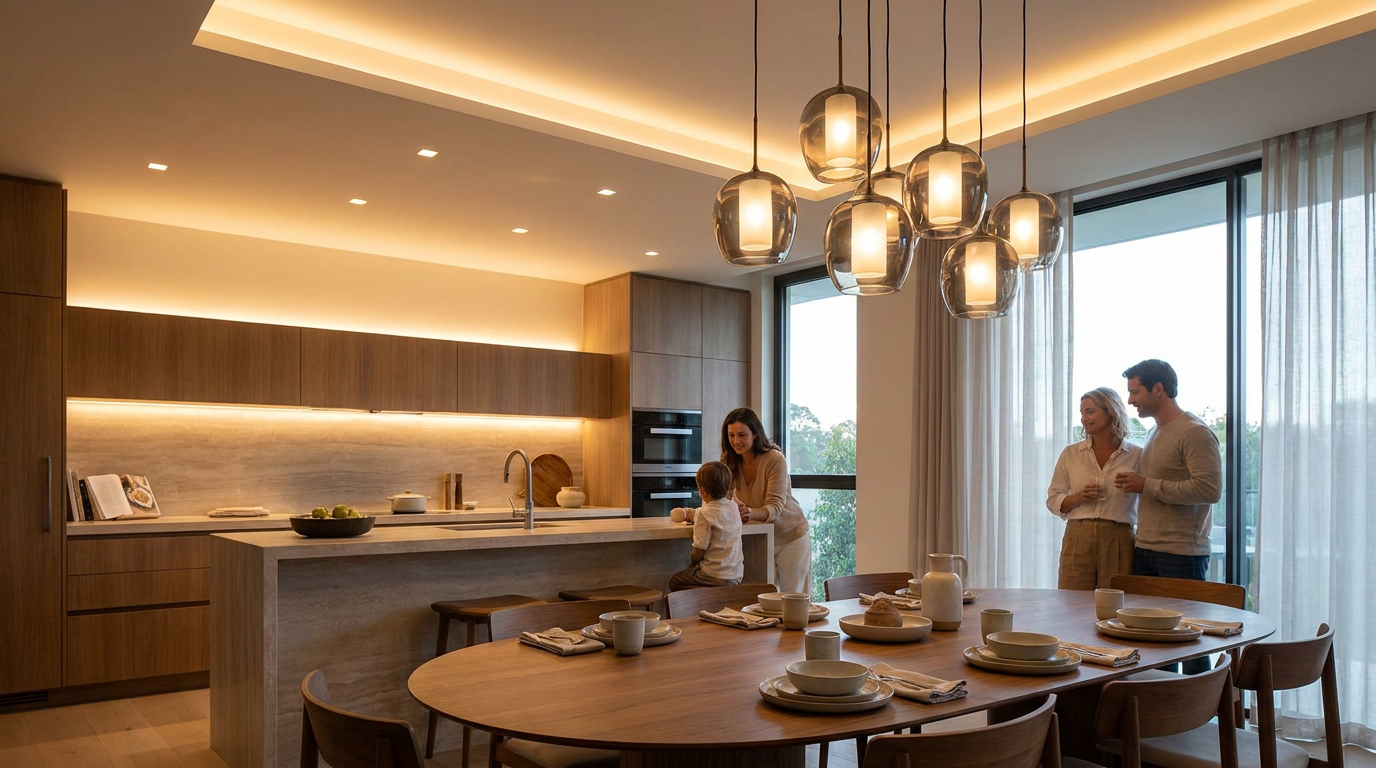
The kitchen needs clear, functional illumination, yet it also deserves visual warmth. This is where many homes become too harsh, especially when bright recessed lighting is the only source. A healthier strategy combines daylight, controlled ambient lighting, under cabinet task lighting, and pendants with proper glare control above islands or dining tables. The result is both efficient and refined.
During the day, the kitchen can support activity with brighter and more neutral light, particularly for food preparation. By dinner, however, the atmosphere should soften. Dimmers are invaluable here. If the kitchen opens into a dining area, consider allowing the dining zone to glow more warmly and intimately than the prep area, reinforcing a gentle shift from work to gathering.
Home Office
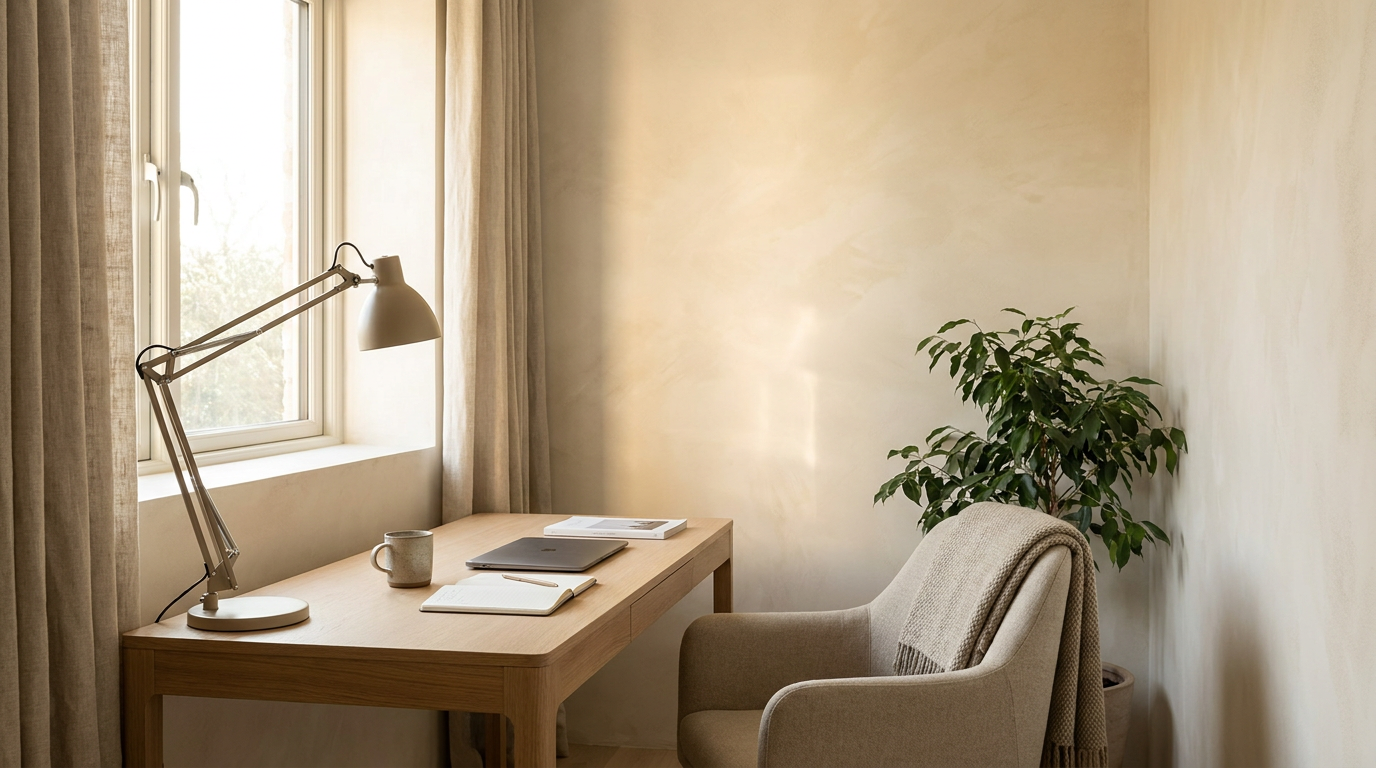
In homes where work now occupies a serious place, lighting deserves careful planning. Position the desk near a window when possible so daylight can support alertness and visual variety. Avoid placing screens directly in front of strong glare sources. A well designed task lamp with adjustable direction helps provide focused light for reading and paperwork without overlighting the room.
If you work into late afternoon, consider lighting scenes that remain crisp and clear through productive hours but soften as the day ends. This is where tunable white systems or a combination of daylight and warmer lamps can be particularly effective. The home office should support concentration without becoming a bright island that keeps the entire household in daytime mode after dusk.
Bedroom
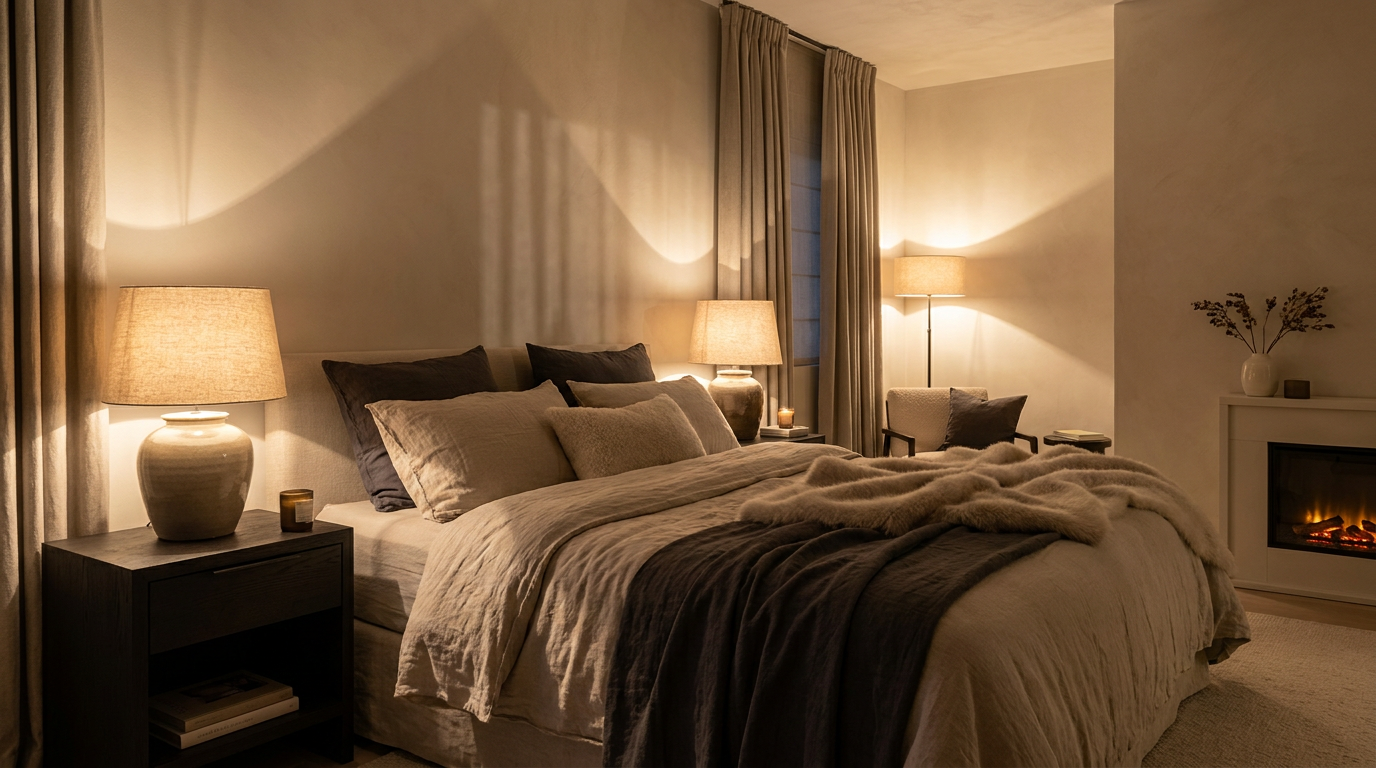
The bedroom is where wellness lighting becomes most intimate. This room should send a clear message of evening restoration. Avoid relying on bright overhead light near bedtime, especially cool white sources. Instead, use low level bedside lamps, wall sconces with warm lamps, and dimmable indirect lighting if needed for dressing or gentle navigation.
Blackout layers may be helpful for sleep, but they should ideally be paired with opportunities for strong daylight in the morning, whether through opening drapery promptly or allowing light into an adjacent dressing area. The bedroom should feel bright enough to wake gently and dark enough to sleep deeply. Those two conditions are not contradictory. They are the very essence of circadian design.
Bathroom
Bathrooms require a balance between accurate visibility and softness. Vanity lighting should ideally illuminate the face from the sides or with diffuse frontal light, reducing shadows and improving comfort for grooming. A harsh recessed downlight directly overhead can be both unflattering and visually tiring. Layering vertical vanity lighting with dimmable ambient light creates a more refined experience.
The primary ensuite at 216 Duncan Rd in Richmond Hill follows this principle, with an LED-backlit mirror flanked by glass pendants above the double vanity.
At night, the bathroom benefits from low level pathway or under vanity lighting that allows safe use without flooding the body with brightness. This is particularly important if the bathroom is used during the night. A subtle glow is enough. The goal is to protect sleep while preserving ease of movement.
Smart Controls, Dimmers, and Tunable Systems
Technology can serve wellness beautifully when it remains discreet and purposeful. Among the most useful tools are dimmers, which allow the same fixture to respond differently at different times of day. A room that requires bright support in the morning should not be locked into that same intensity at ten in the evening. Dimming is one of the simplest and most elegant investments in healthy lighting.
Smart controls add another layer of refinement by allowing scenes to be programmed around routines. A home might gradually brighten key spaces in the morning, maintain balanced daytime settings in work areas, and then shift automatically toward warmer and dimmer evening scenes. When done well, automation disappears into daily life. The home simply feels more aligned and less effortful.
Tunable white systems can be especially helpful in multipurpose spaces. They are not essential in every house, but they can bring impressive flexibility to kitchens, offices, media rooms, and open plan living areas. The key is to use them with restraint. Wellness lighting should feel natural and nearly imperceptible in its transitions. It is less about theatrical color changes and more about subtle temporal intelligence.
For homeowners who prefer a simpler approach, there is no need to feel excluded. A thoughtful combination of daylight, warm evening lamps, dimmers, and reduced nighttime screen glare can achieve a great deal. Wellness design is not dependent on complexity. It depends on sensitivity.
Common Misconceptions About Healthy Home Lighting
Because wellness has become such a desirable concept, lighting advice is often clouded by oversimplifications. One of the most common myths is that blue light is always harmful. In reality, blue enriched light is helpful during the day, when it supports alertness and circadian alignment. Its disruptive potential appears primarily at night, especially when exposure is bright, prolonged, and close to bedtime.
Another misconception is that higher brightness is always healthier. This is not true. Brightness without timing, context, and comfort can undermine wellness just as easily as insufficient light can. A brilliantly illuminated room at midnight is not evidence of healthy design. It may be evidence of a space that ignores the body’s need for darkness and gradual transition.
Many people also assume that color temperature alone determines whether a light is sleep friendly. While warmer light is generally better in the evening, intensity and placement still matter. A warm lamp aimed directly at the eyes can be intrusive, and a very bright warm overhead fixture can still feel stimulating. Wellness is not a single specification. It is an ecosystem of choices.
Finally, there is the belief that only sunlight affects circadian rhythm. Daylight is indeed the strongest natural cue, but electric light also matters, especially in homes where people rise before dawn, work indoors, or spend evenings in brightly lit rooms. This is precisely why residential lighting design has become such an important part of the wellness conversation.
A Practical Checklist for Creating a Wellness Lighting Scheme
If you want to begin improving your home lighting with wellness in mind, the process can be both manageable and rewarding. Start by observing how each room functions from morning to night. Notice where daylight enters, where glare occurs, and where you tend to turn on lights out of habit rather than necessity. The most useful design decisions often begin with attention.
-
Maximize daylight in spaces where you spend mornings and work hours, especially breakfast areas, desks, and living zones.
-
Use layered lighting instead of relying on a single overhead fixture, combining ambient, task, and accent sources.
-
Install dimmers in major rooms so light levels can shift naturally through the day and evening.
-
Choose warmer, lower intensity lighting for nighttime spaces such as bedrooms, living rooms, and hallways.
-
Prioritize glare control with shaded lamps, diffused fixtures, and careful aiming of recessed lights.
-
Position task lighting close to the activity so the whole room does not need to be excessively bright.
-
Reduce bright overhead light close to bedtime and consider gentle night lighting for navigation instead.
-
If possible, explore tunable white or smart scenes in multipurpose rooms that serve different functions across the day.
These steps are effective because they work with the body’s natural expectations rather than against them. They create stronger days, softer evenings, and a more graceful visual experience overall. In design terms, they also make the home feel more curated, more dimensional, and more quietly luxurious.
The Emotional Beauty of Light That Supports Life
There is a special kind of elegance in a room that feels right before you can explain why. The proportions may be lovely, the materials tactile, the palette composed, yet often it is the light that completes the experience. When illumination is calibrated with care, the room seems to breathe with the hour. Morning light stirs it awake. Afternoon light keeps it lucid. Evening light allows it to exhale.
Wellness lighting design offers more than a checklist of healthy practices. It offers a more humane vision of the home. One in which beauty and biology are not separate ambitions, but partners. This is perhaps why the idea has gained such resonance in contemporary interiors. We are no longer satisfied with rooms that look impressive only in photographs. We want spaces that sustain us in real time, through work, rest, family life, solitude, and sleep.
The most compelling interiors have always understood atmosphere as a form of care. Today, science gives that intuition new vocabulary, from circadian rhythm to melanopic EDI to vertical eye level exposure. Yet the essence remains timeless. Light should honor human life. It should help us wake with clarity, live with comfort, and retreat with peace.
If there is an art to wellness lighting, it lies in restraint, sensitivity, and rhythm. It asks us to notice not only how bright a room is, but how it guides our senses and our hours. In that attention, design becomes something more than decoration. It becomes a daily act of well-being, shaped in glow, shadow, and grace.



No Comment! Be the first one.