



Designing Public Infrastructure for Sustainable Urban Growth
Public infrastructure design is one of the most powerful and underestimated forces shaping urban growth. It influences where homes can be built, how people move across a city, how businesses access labour and markets, and how communities respond to climate risk. In practical terms, infrastructure is the framework that determines whether growth becomes productive, inclusive, and resilient or fragmented, costly, and difficult to maintain. When cities grow quickly without a coherent infrastructure strategy, they often inherit congestion, servicing shortfalls, housing constraints, and rising long term fiscal burdens.
Table Of Content
- Infrastructure Is a Network, Not a Collection of Assets
- Why Housing-Enabling Infrastructure Matters More Than Ever
- Land Value, Public Investment, and the Politics of Growth
- Compact Growth and the High Cost of Sprawl
- Climate Resilience Is Now Core Infrastructure Design
- Designing for Accessibility, Equity, and Community Development
- The Role of Public Realm in Long Term Value
- Using Underutilized Land to Unlock Infrastructure-Led Growth
- Common Misconceptions About Sustainable Infrastructure
- What Effective Public Infrastructure Design Looks Like in Practice
- Priority Actions for Growing Cities
- The Strategic Case for Infrastructure-Led Urban Growth
- Conclusion
For Canadian and North American cities, the stakes are especially high. Population growth, housing shortages, climate pressure, and infrastructure aging are all converging at once. That means infrastructure can no longer be treated as a reactive exercise in extending roads, pipes, and transit after growth has already arrived. It has to be designed strategically, in alignment with land use, housing delivery, economic development, and resilience goals from the outset.
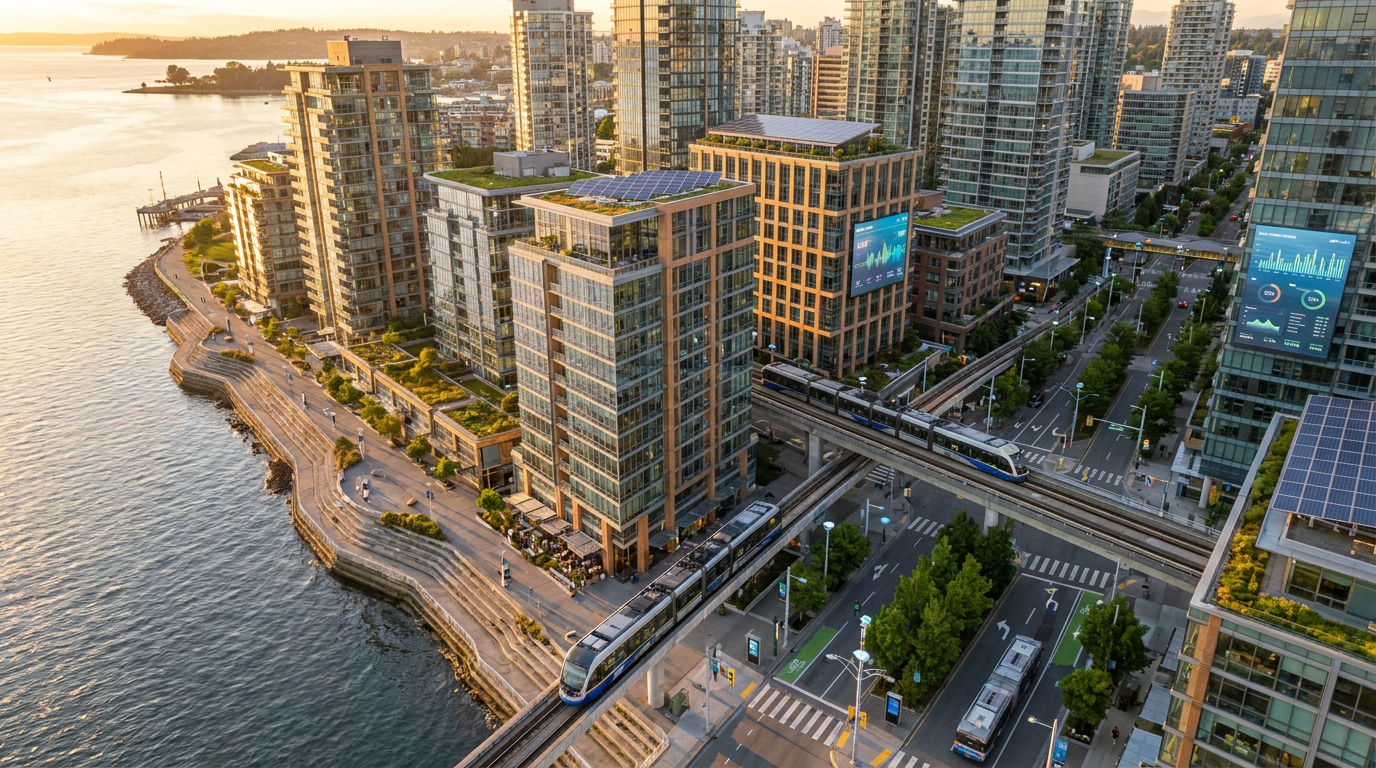
Public infrastructure design is the practice of planning and building the physical and public systems that support urban life: transit networks, water and wastewater service, roads and active transportation routes, parks, utility corridors, and public spaces. It is a city-building discipline rather than a purely technical or engineering exercise, because every one of those systems shapes where housing can be built, how feasible it is to deliver, and how a community actually functions day to day. The design of transit networks, water systems, parks, complete streets, utility corridors, and public spaces directly affects land value, project feasibility, community quality, and environmental performance. In the strongest growth markets, infrastructure is not simply a public service — it is the platform on which sustainable urban development becomes possible, marking the difference between growth that is productive, inclusive, and resilient, and growth that is fragmented, costly, and difficult to maintain.
The future of city growth will be determined less by how much land is available and more by how intelligently infrastructure is planned, financed, and integrated with community needs.
Infrastructure Is a Network, Not a Collection of Assets
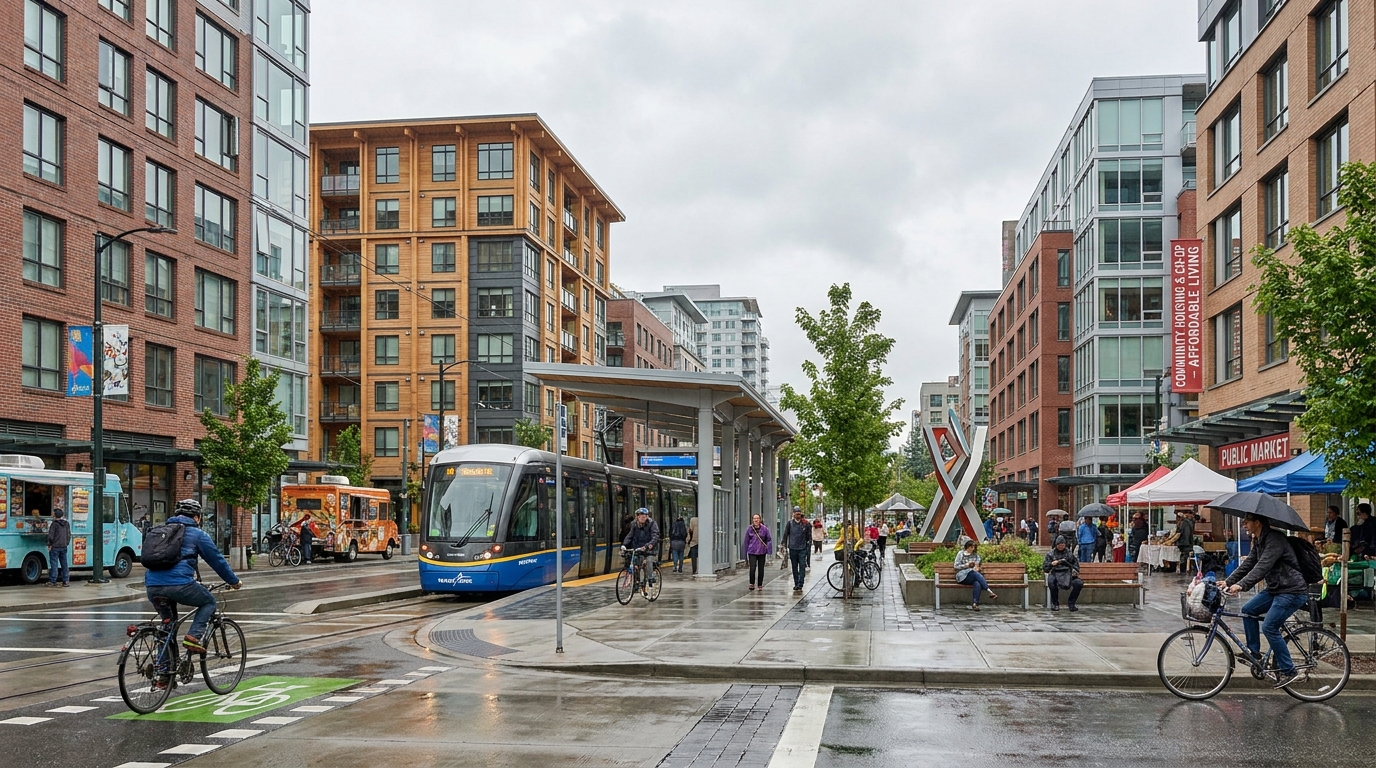
One of the most important principles in sustainable urban growth is that infrastructure must be planned as a network rather than as isolated assets. A transit line does not succeed because rails are installed. It succeeds when land use around stations supports ridership, when sidewalks and cycling networks make access easy, when water and wastewater capacity can support new housing, and when the public realm encourages daily activity and safety. The same principle applies to roads, parks, stormwater systems, community facilities, and utility upgrades.
Too often, infrastructure decisions are still made in silos. Transportation planning can proceed without enough coordination with zoning. Servicing plans can move forward without a realistic understanding of future housing demand. Parks and public realm investments can be treated as amenities rather than as core contributors to health, climate adaptation, and land value. This fragmented approach produces underperformance. It also makes it harder to capture the full public and private return on infrastructure spending.
Integrated planning produces stronger outcomes because it recognizes that urban systems interact continuously. An area served by quality transit can absorb more housing if servicing capacity and policy permissions align. A complete street with safe active transportation infrastructure can support local retail, improve accessibility, and reduce vehicle dependence at the same time. A well-designed park or green corridor can provide recreation, support biodiversity, manage stormwater, and increase the desirability of surrounding development. The value comes not from any single element but from the coordination among them.
OECD and ITF research has increasingly shifted the focus away from simple congestion relief and toward accessibility and well-being. That is a meaningful shift for North American cities that remain heavily car oriented even where density levels could support better transit and active transportation outcomes. Measuring success only by traffic speed misses the larger purpose of infrastructure. The real goal is to connect people to jobs, education, health services, public space, and opportunity in a reliable and equitable way.
Why Housing-Enabling Infrastructure Matters More Than Ever
In much of Canada, infrastructure capacity has become a decisive factor in the housing crisis. It is now common to hear about land that is designated for growth but not fully serviceable, transit corridors that are expected to carry higher density but lack surrounding utility upgrades, and suburban expansion areas where the long term public cost of servicing may exceed their near term benefit. This is why the idea of housing-enabling infrastructure has moved to the centre of public policy.
Housing does not happen simply because there is demand or zoning permission. It happens where infrastructure can support people at the intensity a city wants to achieve. Water, wastewater, transit access, roads, active mobility, parks, schools, and waste systems all play a role. If one major component is missing or under-capacity, projects slow down, density is reduced, or costs rise to the point that feasibility becomes difficult. In a constrained market, these failures affect not just individual projects but the broader urban supply pipeline.
The National Infrastructure Assessment in Canada has highlighted exactly this point. As cities and regions absorb more growth, infrastructure systems that once seemed peripheral are now central to housing delivery. A transit station without connected community amenities, safe access, and servicing capacity cannot unlock its full potential. A growth area dependent on long distance road expansion and expensive utility extensions may produce housing, but often at a higher per-unit infrastructure cost and with weaker long term sustainability performance.
That is why sustainable infrastructure design should be understood as a housing strategy as much as an engineering strategy. It shapes where additional supply can realistically be delivered, what kind of housing forms are viable, and whether complete communities can emerge instead of isolated subdivisions. Infill growth, missing middle housing, transit-oriented development, and mixed-use intensification all depend on infrastructure that has been sized and sequenced for those outcomes.
Land Value, Public Investment, and the Politics of Growth
One of the most practical realities of infrastructure design is that public investment changes land value. A new transit line, upgraded sewer trunk, complete street, or major public realm improvement can make nearby land significantly more desirable and more developable. This uplift is economically logical. Better access, better services, and stronger place quality expand what a site can support. But the policy implications are more complicated.
CMHC research has noted that transit investments can raise nearby land values and that land cost is often one of the biggest obstacles to delivering affordable housing in transit-oriented development areas. This is a critical point. Infrastructure can unlock value, but if that value is not matched by housing policy, land assembly strategy, zoning reform, or affordability tools, the same public investment that improves accessibility can also intensify exclusion. In growth markets, this tension is already visible around major stations and redevelopment corridors.
That makes infrastructure design inseparable from land economics. Municipal leaders cannot assume that transit investment alone will produce inclusive outcomes. They need a framework that addresses permissions, tenure mix, public land strategy, and affordability requirements early in the process. Otherwise, rising land value can narrow the range of feasible housing products and undermine broader public goals.
At the same time, municipalities rely heavily on financial tools such as development charges to fund roads, transit, water, sewage, parks, and school land acquisition. CMHC has also highlighted that these charges can add substantial cost to new housing and materially affect project viability. This creates a core policy tension for rapidly growing cities. Infrastructure must be funded, yet if too much cost recovery is pushed directly onto new development without careful calibration, housing supply can slow and affordability can worsen.
The answer is not to ignore infrastructure costs or to underprice growth. The answer is to use a more strategic funding model. That can include phased servicing, value capture in high-uplift areas, smarter use of public land, coordination across governments, and a stronger emphasis on lifecycle value rather than only upfront capital recovery. When public investment generates measurable private benefit, there should be mechanisms to reinvest part of that value into community infrastructure and housing outcomes. But those mechanisms need to be designed carefully so they support feasibility rather than undermine it.
Compact Growth and the High Cost of Sprawl
The form of urban growth has a direct relationship to infrastructure efficiency. Low density expansion often appears straightforward in the short term because land at the edge of a city may seem abundant and development can proceed on large parcels. But over time, sprawling growth patterns impose higher servicing distances, larger road networks, greater maintenance obligations, and weaker transit performance. They also tend to increase car dependence, travel time, and per-capita emissions.
OECD analysis on urban sprawl and land consumption shows that these patterns have long run consequences for sustainability and productivity. The farther growth extends without sufficient intensity, the more expensive it becomes to serve with transit, utilities, and public facilities. Municipalities inherit a larger network to maintain, often with lower tax productivity per kilometre of infrastructure. Residents inherit longer trips and fewer transportation choices. The result is a structural mismatch between growth and public value.
Compact growth does not mean crowding for its own sake. It means aligning land use and infrastructure so that urban services can operate more efficiently and communities can function more completely. Mid-rise corridors, mixed-use station areas, gentle density in established neighbourhoods, and redevelopment of underused land can all support a more efficient urban form. These patterns make it easier to deliver transit, parks, schools, and utilities at a lower per-capita cost while also supporting local commerce and better access to amenities.
This is one of the strongest strategic arguments for infrastructure-led intensification. When public investment is directed toward places that can absorb growth efficiently, cities can improve both sustainability and fiscal resilience. They can accommodate more people without endlessly expanding the urban footprint. They can support better transport performance without relying solely on road widening. Most importantly, they can build communities that are more accessible, more affordable to service, and better positioned for long term economic health.
Climate Resilience Is Now Core Infrastructure Design
There was a time when climate resilience could be discussed as an added layer of environmental sensitivity. That period is over. In current practice, resilience is a core design requirement for sustainable public infrastructure. Flooding, wildfire risk, extreme heat, wind stress, freeze-thaw pressure, and storm intensity are already affecting Canadian communities and capital programs. Infrastructure that is not designed for these realities will cost more to maintain, perform less reliably, and expose people and assets to greater risk.
Canada’s NRC and Housing, Infrastructure and Communities Canada have been advancing guidance, standards, and decision support tools for climate-resilient buildings and core public infrastructure. This work reflects a broader shift in how infrastructure must be evaluated. It is not enough to ask whether a system can meet current demand under normal conditions. The relevant question is whether it can continue to function under climate stress, disruption, and changing environmental baselines.
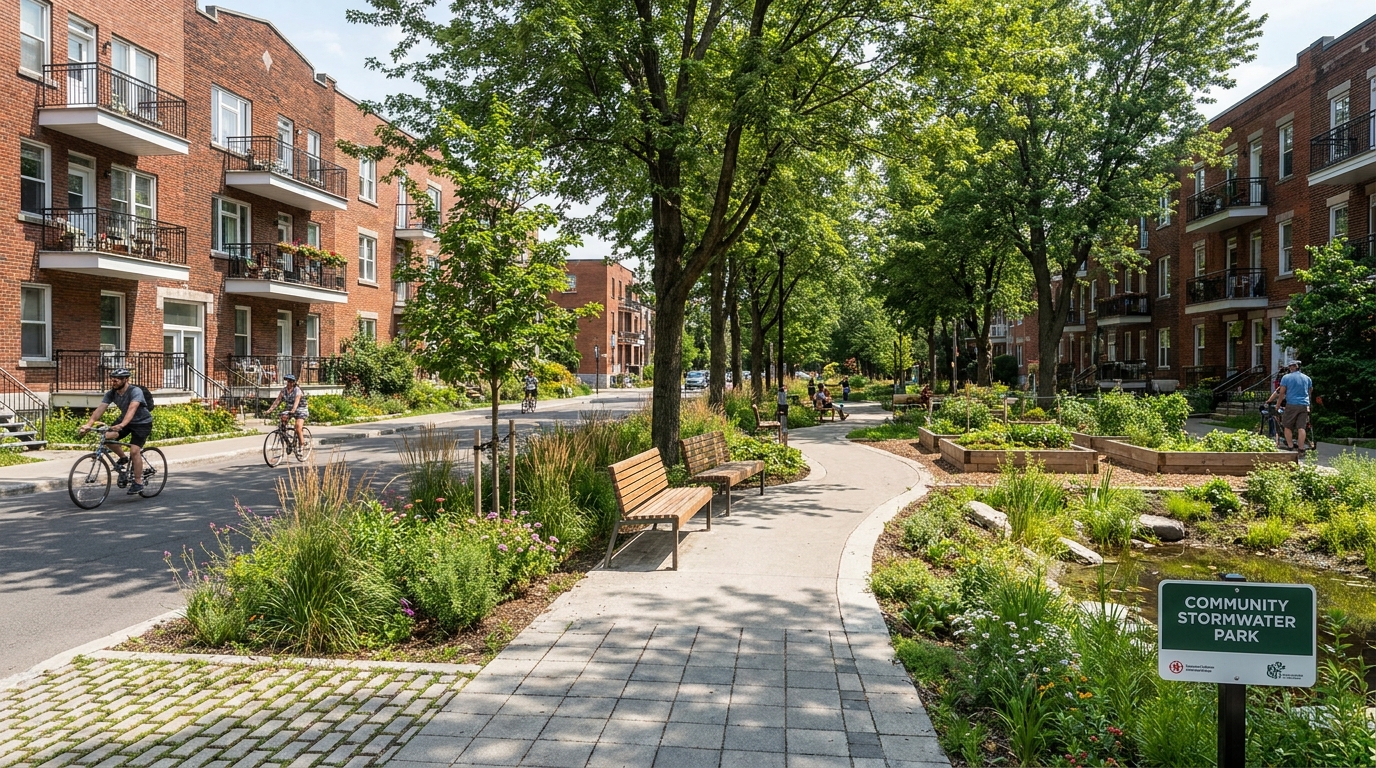
That changes design priorities. Stormwater systems now need to account for larger and more volatile rainfall events. Streetscapes need more shade, permeable surfaces, and drainage capacity. Public buildings and utilities need stronger thermal performance and backup capability. Transport corridors need materials and configurations that can withstand extreme temperature variation. In fire prone regions, infrastructure layout and landscape design also have a direct role in risk reduction.
Resilience also has a financial dimension. High upfront cost does not always equal high long term value. In many cases, the more intelligent investment is the one that reduces maintenance, lowers failure risk, protects service continuity, and extends useful life. That is why lifecycle costing has become so important. Sustainable infrastructure is not simply the cheapest to build. It is the most reliable and cost effective to own, operate, and adapt over decades.
Designing for Accessibility, Equity, and Community Development
Good infrastructure design is not defined only by throughput. It is defined by what it allows people to reach and participate in. This is why accessibility is such an important lens. A city can have significant transport investment and still fail to connect people to opportunity if routes, schedules, costs, and urban form are poorly aligned. Similarly, a neighbourhood can have new development but remain underserved if parks, childcare, public space, schools, or safe walking routes are missing.
OECD and ITF research is especially relevant here because it reframes infrastructure around access to jobs, education, health services, and well-being. That perspective is valuable for cities trying to move beyond narrow traffic engineering metrics. Public infrastructure should be evaluated by how effectively it supports daily life. A resident should be able to move through the city safely, reliably, and affordably without excessive time loss or dependence on a single travel mode.
Equity enters this discussion in two ways. First, underserved communities often carry a disproportionate burden of poor infrastructure, weak transit access, environmental risk, and limited public amenities. Second, new public investment can improve these areas or displace them, depending on how policy is structured. If a corridor receives major investment but no protection for housing access or community-serving uses, the benefits may not remain with the people who most need them.
That is why successful infrastructure design increasingly combines physical improvements with broader community development strategy. Recent Canadian projects have shown a more integrated model that brings together housing, transit access, parks, childcare, and public realm improvements. This is a better expression of complete community thinking. It recognizes that sustainable urban growth is not just about accommodating more residents. It is about creating places where those residents can thrive.
The Role of Public Realm in Long Term Value
Public realm investments are sometimes treated as secondary to core infrastructure, but that view is too narrow. Streets, plazas, parks, civic spaces, and landscape systems are part of the infrastructure of urban life. They shape social interaction, health, safety, identity, and local economic vitality. In many redevelopment districts, the public realm is also one of the strongest contributors to land value and market confidence.
A well-designed public realm helps convert growth from a numbers exercise into a place-making strategy. It supports walkability, creates everyday convenience, improves retail conditions, and increases the perceived quality of a neighbourhood. It can also support climate goals through urban tree canopy, cooling, habitat, and stormwater function. The lesson for city builders is straightforward. Public realm design is not decorative. It is foundational.
Using Underutilized Land to Unlock Infrastructure-Led Growth
One of the most promising opportunities in Canadian urban development is the reuse of underutilized or surplus land near existing infrastructure. This includes station-area parcels, aging commercial sites, surface parking lots, former industrial land, and underperforming public holdings. In many cases, these sites are better candidates for sustainable growth than greenfield expansion because they already sit within or near established service networks.
When these lands are planned strategically, cities can unlock multiple objectives at once. They can add housing supply in accessible locations, improve the tax base, reduce pressure for outward expansion, and create room for new amenities. They can also use public ownership or partnership structures to shape affordability outcomes more directly. This is especially important in strong markets where land assembly costs around transit can otherwise become prohibitive.
Infrastructure design is central to making these opportunities viable. Existing services may need upgrading, reconfiguration, or coordination with phased development. Streets may need to be redesigned from auto-oriented layouts into complete urban blocks. Parks and community facilities may need to be inserted into sites that were never intended to support residential density. But when this work is done well, underused land becomes a powerful lever for community development rather than a missed opportunity.
In strategic terms, this is one of the clearest examples of infrastructure as a city-building platform. Instead of simply adding capacity at the edge, cities can intensify where services and accessibility already exist, making each public dollar work harder. That approach tends to produce stronger long term land value, better mobility outcomes, and more resilient urban form.
Common Misconceptions About Sustainable Infrastructure
Public discussion around sustainable infrastructure often gets distorted by a few persistent misconceptions. One is the idea that sustainability is mostly about green technology. Technology matters, but design, land use, operations, maintenance, and governance often matter just as much. A highly efficient system in the wrong place, serving inefficient growth patterns, can still produce weak outcomes. Sustainable infrastructure begins with strategic alignment, not equipment selection alone.
Another misconception is that transit investment automatically creates affordability. It does not. Transit can improve access and increase development potential, but without land policy, zoning flexibility, and housing supply measures, value uplift can drive costs upward. This is why transit-oriented development has to be paired with a housing strategy, especially in high demand urban regions.
A third misconception is that more capital spending necessarily means better infrastructure. In reality, larger budgets do not guarantee stronger performance. What matters is whether the investment improves lifecycle value, resilience, accessibility, and service outcomes. Some of the most expensive systems can still underperform if they are poorly integrated or difficult to maintain.
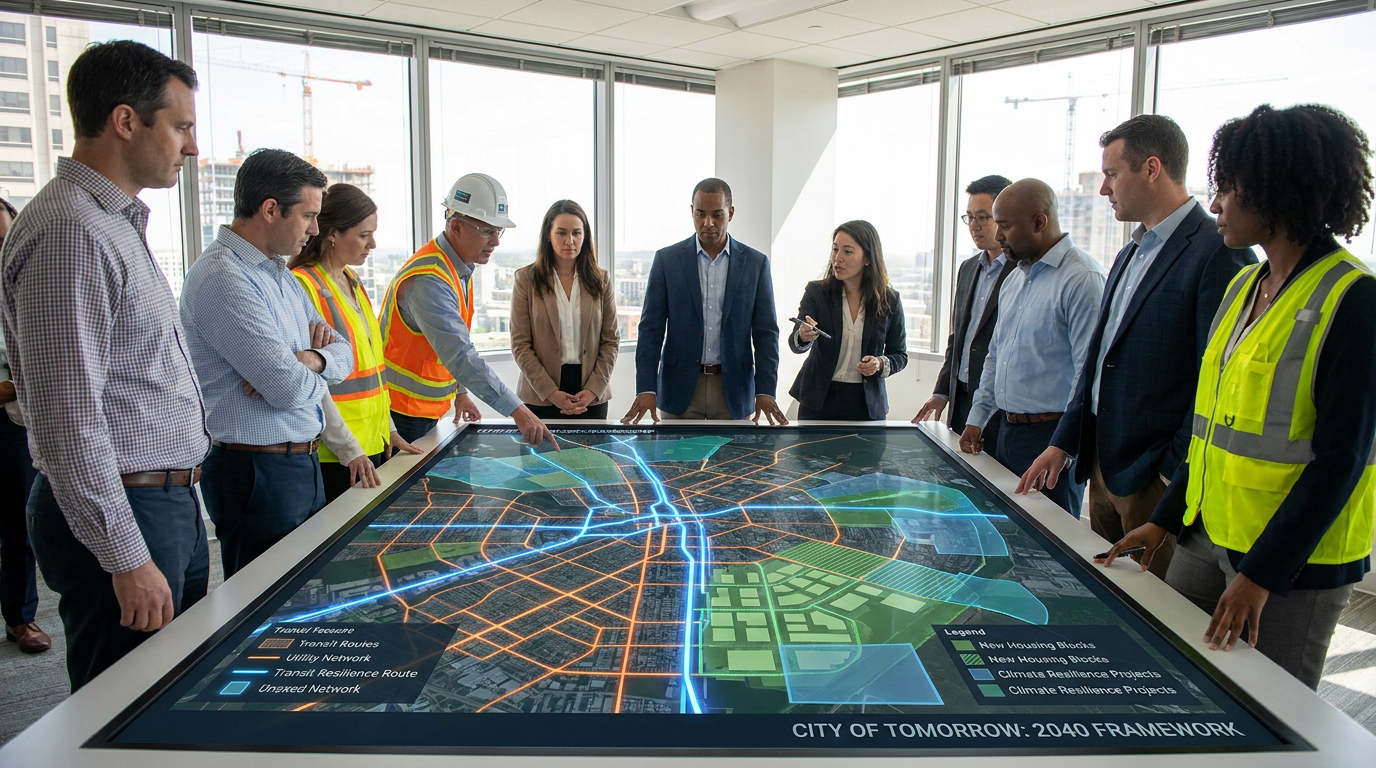
Finally, many still think of public infrastructure design as primarily an engineering problem. Engineering is essential, but infrastructure is equally a planning, finance, equity, and land market issue. The most successful projects are rarely the product of one discipline acting alone. They emerge when urban planners, engineers, finance teams, housing experts, and public leaders work from a shared growth framework.
What Effective Public Infrastructure Design Looks Like in Practice
If cities want infrastructure to support sustainable urban growth, several principles should guide practice. First, infrastructure planning should begin with a clear growth vision rather than with isolated asset replacement. That means identifying where the city wants density, housing diversity, employment, and community services to concentrate over time. Infrastructure should then be sequenced to support that pattern.
Second, municipalities need to evaluate projects based on accessibility, resilience, and lifecycle outcomes rather than only short term capital cost. This leads to different decisions. It favours complete streets over road widening in many contexts. It supports utility upgrades where housing can actually be delivered. It elevates park systems and green infrastructure because they produce multiple benefits across public health, stormwater, and land value.
Third, funding models have to reflect the real relationship between public investment and private gain. Development charges remain important, but they cannot be the only tool in markets where housing affordability and feasibility are already under pressure. Value capture, intergovernmental funding partnerships, phased infrastructure agreements, and strategic public land deployment can help create a more balanced system.
Fourth, cities should strengthen integration across departments and across governments. Water planning, transit planning, land use planning, and housing strategy are often managed through separate processes, yet their outcomes are deeply interdependent. Better coordination can shorten delays, improve forecasting, and reduce the mismatch between planning documents and implementation capacity.
Fifth, infrastructure design should include adaptation from the start. Climate resilience should not be treated as a final checklist. It should shape site layout, materials, drainage, thermal performance, emergency access, and asset management from the earliest stages. This is increasingly essential in protecting both communities and public budgets.
Priority Actions for Growing Cities
-
Map housing potential against actual infrastructure capacity so growth targets are tied to service reality rather than policy aspiration alone.
-
Focus major investment in transit-supportive and serviceable growth areas where complete communities can be delivered efficiently.
-
Use public land and station-area planning to preserve room for affordable housing, childcare, parks, and community-serving uses before value escalation limits options.
-
Adopt lifecycle costing and resilience criteria for capital decisions so long term performance is prioritized over narrow upfront savings.
-
Measure outcomes through accessibility, equity, environmental performance, and fiscal sustainability alongside conventional engineering metrics.
The Strategic Case for Infrastructure-Led Urban Growth
From a development and city-building perspective, public infrastructure is one of the few policy levers capable of improving multiple outcomes at once. Done well, it can support housing supply, raise land productivity, strengthen climate resilience, reduce long term service costs, and improve everyday quality of life. Few other interventions operate at that scale of influence.
This is especially important in an era when urban growth pressures are colliding with affordability concerns and fiscal constraints. Cities cannot afford to treat infrastructure as an afterthought to development, nor can they afford to build it in patterns that create ongoing inefficiency. Strategic infrastructure design provides a path toward more orderly, more sustainable, and more inclusive growth.
It also improves market clarity. When municipalities identify priority growth areas, align servicing and transit plans, and create a credible long term infrastructure framework, the private sector can respond with greater confidence. That reduces uncertainty, improves project sequencing, and can support a healthier pipeline of housing and mixed-use development. In that sense, infrastructure is not just a public expenditure. It is a signal to the market about how a city intends to grow.
For residents, the benefits are equally tangible. Better-designed infrastructure means shorter and more reliable trips, safer streets, stronger parks, more climate-ready neighbourhoods, and better access to daily needs. It means communities that function as places, not just as collections of buildings. And it means growth that adds capacity without eroding quality of life.
Conclusion
Designing public infrastructure for sustainable urban growth is ultimately about shaping the long term performance of cities. It requires leaders to think beyond asset delivery and toward integrated systems that connect land use, housing, mobility, climate adaptation, and community well-being. In the Canadian context, where housing demand, infrastructure pressure, and climate risk are all rising, this integrated approach is no longer optional. It is the foundation of effective urban strategy.
The strongest cities of the next generation will be the ones that understand infrastructure as both a physical network and a policy framework. They will align transit with housing, utilities with land use, resilience with finance, and public realm with growth management. They will recognize that every major infrastructure decision reshapes land value, development potential, and social opportunity. And they will act early enough to ensure those benefits are broadly shared.
That is the real promise of strategic public infrastructure design. It gives cities a practical way to grow without simply expanding costs, risks, and inequality. It allows public investment to do more than keep up with change. It allows it to direct change toward stronger, more sustainable, and more resilient urban futures.

No Comment! Be the first one.