



Smart city investing has moved well beyond futuristic marketing language. It now sits at the center of how cities plan growth, modernize infrastructure, improve services, and respond to climate pressure. For investors, this matters because the urban economy is increasingly shaped by connected systems that make transportation, buildings, utilities, and public operations more efficient. The result is a development investment theme that combines long-duration infrastructure demand with rising expectations around sustainability, resilience, and measurable service outcomes.
Table Of Content
- What a smart city investment actually is
- Why the macro case is so strong
- How smart city investing creates returns
- The sectors with the clearest opportunity
- Mobility and transportation systems
- Building efficiency and district-scale development
- Smart grids and urban energy management
- Water, flood resilience, and climate adaptation
- Digital public services and secure urban data systems
- How sustainability strengthens the investment thesis
- How to evaluate a viable smart city investment
- Common mistakes investors should avoid
- Where Canada and North America stand now
- A practical framework for investing in smart cities
- Final thoughts
- Frequently asked questions about smart city investments
- Are smart city investments only for large institutional investors?
- What makes a smart city project financially viable?
- Is sustainability always part of the return story?
- What is the biggest risk in smart city investing?
In Canada and across North America, the opportunity is especially compelling because municipalities are under pressure to do more with aging infrastructure, constrained budgets, and growing populations. Smart city projects address that gap by integrating physical assets with software, sensors, analytics, connectivity, and more responsive operating platforms. This is not a niche category limited to venture-backed gadgets. It is a broad investable ecosystem that touches real assets, digital infrastructure, public-private partnerships, utility modernization, climate adaptation, and urban redevelopment.
The scale of the market supports that thesis. The OECD estimates the global smart city market will grow from USD 511.6 billion in 2022 to over USD 1.024 trillion by 2027, a signal of strong long-term demand for urban technology and services. North America remains a central adoption market, with one recent estimate placing the region at 21.5% of the global smart city market in 2025. For investors looking for durable themes rather than short-lived trends, that combination of structural demand and public necessity deserves attention.
At the same time, smart city investing should be approached with discipline. Strong opportunities are not created by technology alone. They depend on governance, procurement structure, resident trust, interoperability, and clear financial logic. The best investments are usually those that improve how a city operates, lower lifecycle costs, support sustainability goals, and create a pathway to scale across multiple communities.
What a smart city investment actually is
One of the biggest misconceptions in this space is that a smart city is a single category of asset. It is not. Smart cities are an operating model for urban development, where physical infrastructure and digital systems work together to improve outcomes. That means investment exposure can sit across transportation assets, communications networks, software platforms, utility upgrades, digital public services, building automation systems, data infrastructure, and cybersecurity solutions.
This matters because it changes how capital should be allocated. A smart traffic management platform may look like a technology investment, but its value may depend on municipal procurement and long-term service contracts. A district energy system may look like a utility play, but its upside may be linked to new building development and local decarbonization policy. A flood-monitoring network may appear to be a resilience product, but its economics may be strongest when bundled into infrastructure modernization or insurance risk reduction.
Canada’s Smart Cities Challenge helped define this practical view by framing smart cities around outcomes rather than gadgets. The program highlighted goals such as safer neighborhoods, improved mobility, healthier environments, and more inclusive economic participation. That is a useful framework for investors because it points toward projects where demand is driven by public need and measurable operating benefit, not by novelty.
From an investment perspective, the most attractive opportunities usually have three qualities. First, they solve a real and recurring urban problem. Second, they fit into a procurement, concession, or service model that can generate predictable cash flow. Third, they can be replicated across multiple municipalities or scaled within a growing metro area. When those elements align, smart city investing starts to look less speculative and more like disciplined development investing with a technology layer.
Why the macro case is so strong
The long-term case for smart city investments begins with urbanization. Cities continue to absorb population growth, employment concentration, and economic activity, which puts constant pressure on transportation, housing, utilities, safety, and environmental performance. That pressure creates sustained demand for systems that improve capacity without requiring cities to rebuild everything from scratch. Technology becomes valuable when it helps cities optimize existing assets, plan future ones more efficiently, and reduce service friction.
There is also a fiscal case. Municipal governments face rising expectations but often limited capital flexibility. Smart systems can help lower operating costs, improve maintenance efficiency, reduce energy use, and allocate resources more precisely. For investors, that creates a practical opening. If a project can demonstrate a clear operating benefit to a city or utility, it becomes easier to justify procurement and easier to structure revenue around contracts, subscriptions, service agreements, or performance-based models.
Sustainability adds another layer of urgency. OECD analysis notes that cities account for more than 70% of global energy-related CO2 emissions and roughly half of global waste. That means urban systems are one of the most powerful levers for emissions reduction and resource efficiency. Smart grids, building controls, transit optimization, water monitoring, and climate response systems are not optional upgrades in that context. They are increasingly central to how cities meet environmental targets while protecting quality of life.
Public policy also supports the theme. In Canada, the federal Smart Cities Challenge committed CAD 300 million over 11 years to the broader initiative, including prize funding and a Community Support Program. Evaluation documents show the intent went beyond rewarding pilots. It also aimed to build capability, share learning, and create pathways for broader adoption. For investors, that is important because it suggests a maturing market where tested approaches can move from demonstration to implementation at greater scale.
Investment takeaway: Smart city returns are strongest when technology is embedded in essential urban systems such as mobility, utilities, buildings, resilience, and public service delivery rather than treated as a standalone innovation theme.
How smart city investing creates returns
Investors often ask a simple question: where does the money actually come from? In smart city investing, returns generally come from one of four sources. The first is contracted revenue, where a city, utility, or agency pays for software, equipment, or managed services over time. The second is asset value enhancement, where connected infrastructure improves the performance or attractiveness of real estate and district-scale development. The third is operating cost reduction, where technology lowers energy consumption, maintenance costs, or service inefficiencies. The fourth is strategic optionality, where a platform that succeeds in one city can be replicated across many others.
Consider transportation. A city that improves signal timing, traffic analytics, curb management, and transit coordination may reduce congestion, lower fuel waste, increase transit reliability, and improve development attractiveness along major corridors. Investors can participate through mobility technology providers, fiber and communications infrastructure, transit-oriented development, parking systems, and concession-based operating contracts. The return is not just software revenue. It can also show up in higher land values, greater foot traffic, stronger tenant demand, and more efficient public asset utilization.
Energy and utilities offer another strong pathway. Smart meters, distributed energy management, district energy systems, demand response platforms, and building automation can all produce measurable cost savings. When energy prices are volatile and carbon requirements are tightening, technologies that improve efficiency and visibility become financially attractive. This is particularly relevant in mixed-use developments, logistics assets, campuses, and municipal building portfolios, where recurring savings can support financing assumptions.
Water and resilience projects are increasingly investable as climate risk becomes more visible. Sensors, predictive maintenance systems, flood modeling, leak detection, and digitally managed stormwater infrastructure can reduce both direct costs and catastrophic downside. These are not always glamorous investments, but they fit a premium investment framework because they address essential needs, support public resilience, and can be backed by long-term budgets or regulated utility models.
The sectors with the clearest opportunity
Mobility and transportation systems
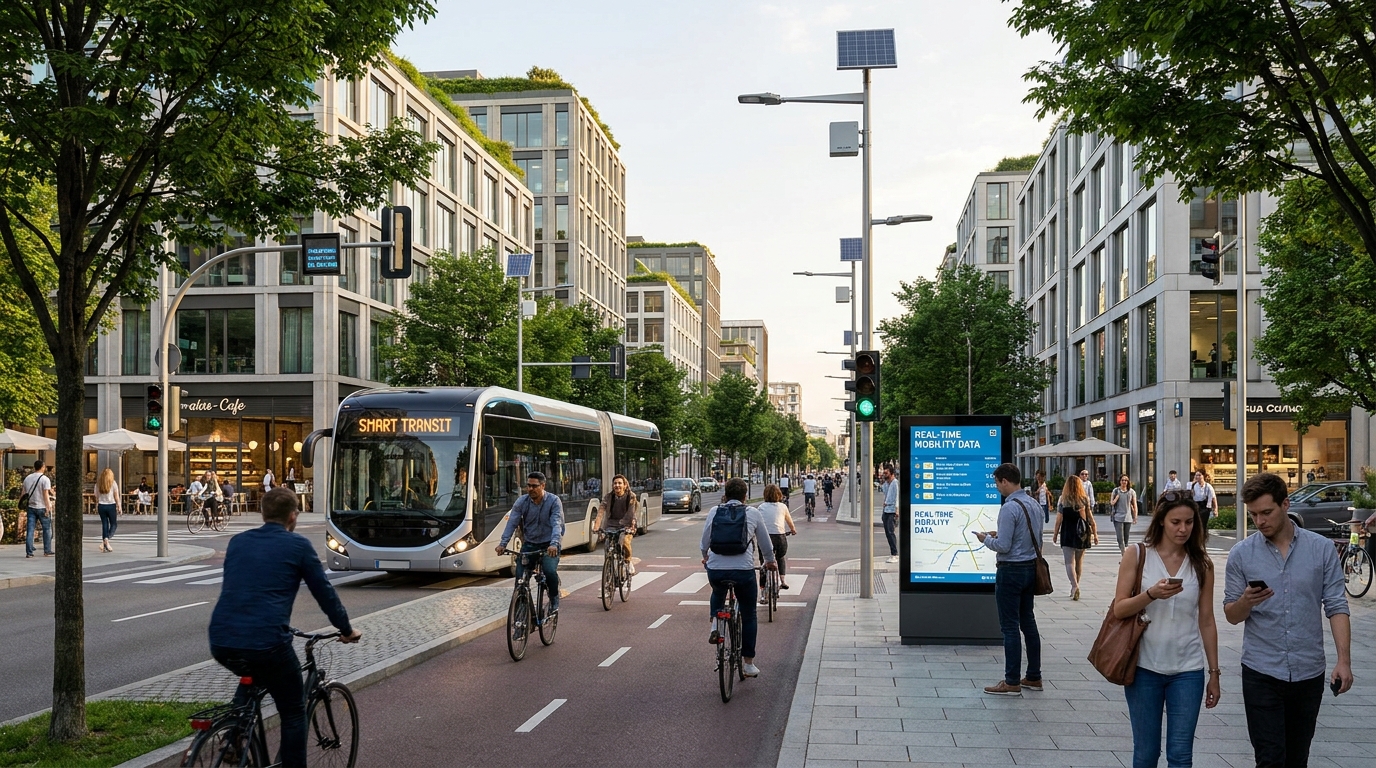
Mobility remains one of the most visible and investable smart city segments. Cities need better transit coordination, safer streets, more efficient traffic flow, and stronger integration between public transit, active transportation, freight movement, and electric vehicle infrastructure. Technologies that support these functions can improve the economics of entire neighborhoods by reducing travel friction and making districts more livable.
Investors should pay close attention to corridors where transportation modernization intersects with real estate development. A new transit spine with data-enabled operations can influence office demand, multifamily absorption, retail performance, and land pricing. In that setting, smart mobility is not an isolated infrastructure layer. It is a driver of district competitiveness and long-term asset appreciation.
Building efficiency and district-scale development
Buildings are another core category because they consume large amounts of energy and represent a major source of operating expense. Smart systems that manage HVAC, lighting, occupancy, maintenance, and energy procurement can increase net operating income while improving tenant comfort and sustainability performance. In institutional and commercial portfolios, these gains can be meaningful over the life of an asset.
District-scale developments are especially attractive because they allow integrated planning from the start. Rather than retrofitting one building at a time, developers can design connected infrastructure across residential, office, retail, public realm, and utility networks. That creates more opportunities to capture value through lower operating costs, stronger ESG positioning, and better long-term leasing outcomes.
Smart grids and urban energy management
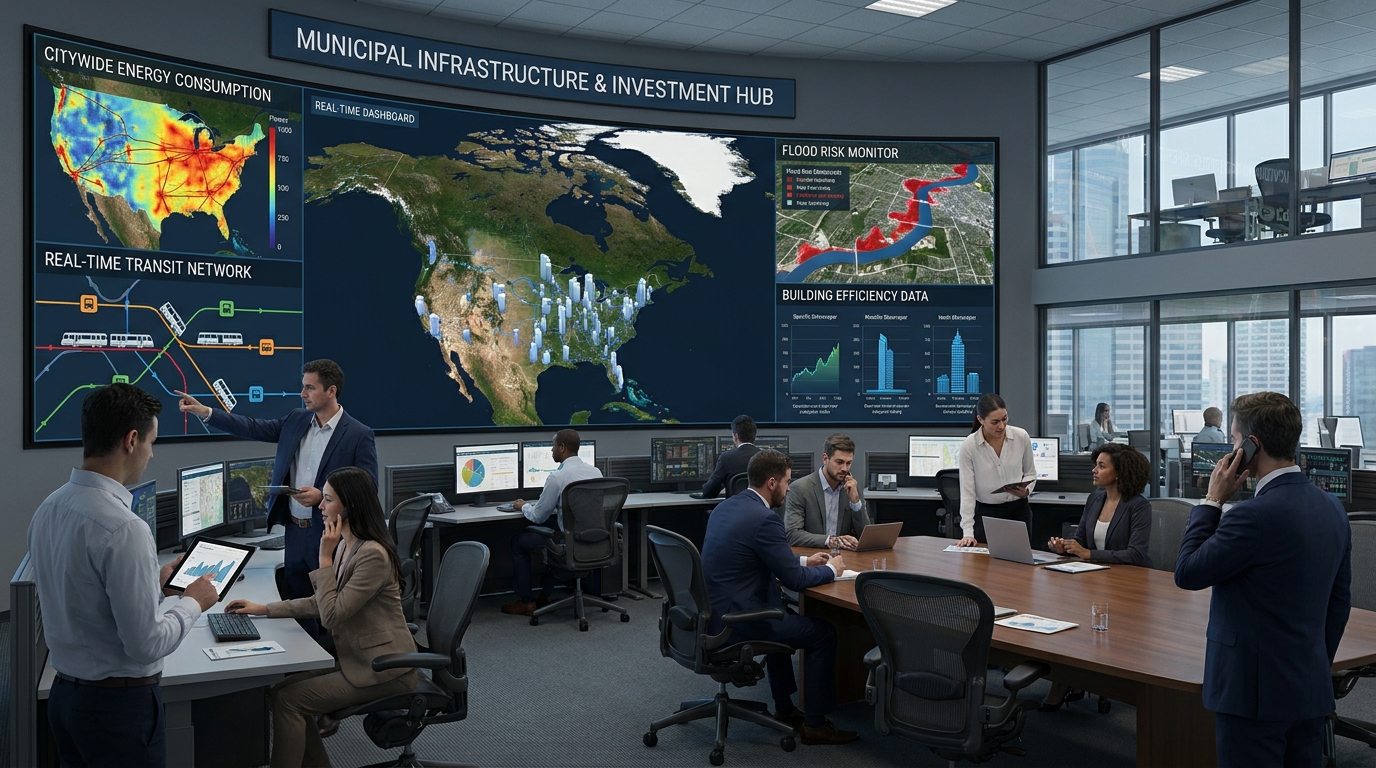
Grid modernization is moving from technical necessity to investment priority. Electrification, distributed energy resources, battery systems, and volatile demand patterns all require smarter management. The opportunity sits in software, communications, edge infrastructure, and coordinated energy systems that help balance loads and improve resilience.
For investors, this segment is attractive because the demand is long term and often tied to regulated utilities, municipal infrastructure plans, or large institutional asset owners. Projects with clear integration into utility strategy or district energy planning tend to carry a stronger risk-adjusted profile than standalone products searching for adoption.
Water, flood resilience, and climate adaptation
Climate resilience is becoming one of the most important smart city use cases in North America. Flood management, heat mitigation, emergency response systems, and infrastructure monitoring are all receiving more attention as weather risk grows. From an investment standpoint, resilience has matured from a defensive category into a performance category because the cost of failure is rising.
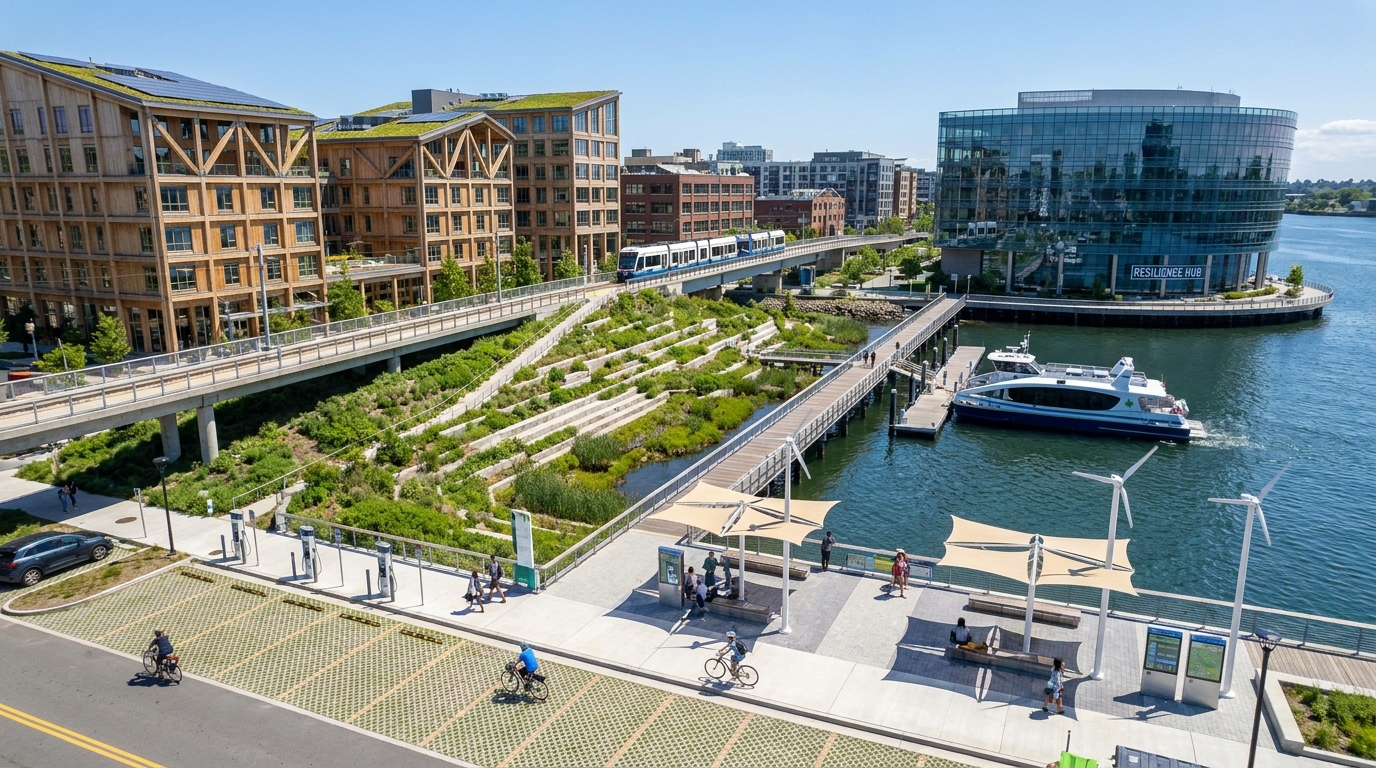
Projects that help cities anticipate, measure, and manage physical risk can create value in several ways. They may protect infrastructure, lower insurance exposure, prevent service interruption, or support planning for future development. In flood-prone regions and waterfront districts, resilience technology may become a prerequisite for long-term real estate value rather than an optional add-on.
Digital public services and secure urban data systems
Smart cities also depend on digital public infrastructure that improves how residents access services and how governments make decisions. This includes digital identity layers, service portals, operational dashboards, open data tools, permit systems, and analytics platforms. Although these may seem less tangible than roads or utility upgrades, they can materially improve service speed, public trust, and municipal productivity.
Security is inseparable from this category. Data governance, privacy-by-design, cybersecurity, and legal compliance are now competitive differentiators in procurement. OECD research has repeatedly noted that smart-city data initiatives face challenges such as insufficient financial resources, weak business models, limited expertise, and privacy and security risks. Investors should interpret that not simply as a warning, but as a filter. Teams that can combine technical capability with governance excellence are more likely to win contracts and sustain margins.
How sustainability strengthens the investment thesis
A smart city is not inherently sustainable just because it uses technology. Sustainability appears when connected systems improve how energy, land, water, mobility, and public assets are managed over time. This distinction is important because investors should avoid equating digital activity with environmental progress. The stronger opportunities are those where technology supports lower emissions, resource efficiency, resilience, and more equitable access to services.
In practical terms, that means looking for measurable outcomes. Does a building platform reduce energy intensity in a verifiable way? Does a transit system move more people with fewer delays and lower emissions? Does a flood management solution reduce risk for vulnerable neighborhoods and protect future development potential? If the answer is yes, sustainability becomes part of the return profile rather than a branding exercise.
This is where smart city investing aligns closely with modern development strategy. More investors now recognize that urban quality, climate resilience, and infrastructure performance influence long-term valuation. Markets that can move people efficiently, adapt to weather stress, and offer reliable services tend to attract stronger business activity, population retention, and capital formation. In other words, community sustainability is not separate from investment performance. Over the long run, it is often one of its foundations.
That principle is especially relevant in Canada, where infrastructure modernization, housing pressure, climate adaptation, and digital public service reform are increasingly connected. Investors who understand this linkage are better positioned to identify projects that are politically supported, socially useful, and financially durable.
How to evaluate a viable smart city investment
The first step is to understand the problem being solved. Good smart city investments are anchored in a pressing urban need such as congestion, energy waste, flood risk, permit delays, or unreliable service delivery. If the problem is not urgent or clearly funded, the project may struggle to move beyond pilot stage. Investors should favor opportunities where the buyer has an operational reason to act now rather than a general interest in innovation.
The second step is to map the revenue model. Some projects generate recurring software or service fees. Others rely on installation revenue followed by maintenance contracts. Some are embedded in concession agreements, utility structures, or broader infrastructure financing. The key is to understand contract duration, renewal risk, budget source, and whether the value delivered is visible enough to survive political or budget cycles.
The third step is to test scalability. Many urban technologies look promising in one district but fail to scale because they depend on custom integration, one-off political support, or unclear data ownership. Strong opportunities tend to be standards-based, interoperable, and adaptable across multiple municipalities. A project that can move from one city to ten has a very different return profile from one that remains trapped in local customization.
The fourth step is to assess governance. This includes privacy controls, cybersecurity protocols, procurement alignment, stakeholder coordination, and resident trust. Investors sometimes treat governance as a secondary issue, but in smart cities it often determines whether a project can move from concept to revenue. Municipal buyers are increasingly outcome-driven and risk-aware. Solutions that demonstrate privacy-by-design and transparent operating logic have a better chance of long-term adoption.
The fifth step is to examine whether the project improves community outcomes in a measurable way. Cities are more likely to support and renew technologies that produce visible service gains. That may include fewer traffic delays, lower energy use, faster service access, improved safety, or stronger resilience. The investor advantage is that measurable civic value often reinforces commercial durability.
Common mistakes investors should avoid
The first mistake is confusing innovation with investability. A product may be technically impressive but commercially weak if procurement is slow, integration is difficult, or the buyer cannot justify the cost. Smart city investing rewards practicality. Solutions that fit within municipal operations, infrastructure planning, and existing capital programs usually outperform highly visible but poorly integrated concepts.
The second mistake is underestimating implementation complexity. Urban systems involve multiple stakeholders, legacy infrastructure, public scrutiny, and legal obligations. Delays are common when ownership is unclear or when a project depends on too many disconnected agencies. Investors should price this complexity into timelines and avoid assumptions that resemble consumer technology adoption curves.
The third mistake is ignoring public trust. Data collection in public spaces raises legitimate concerns around surveillance, consent, security, and misuse. OECD guidance makes clear that privacy and legal compliance risks are real and can undermine smart city initiatives. If a project lacks a credible data governance model, it should be approached with caution no matter how attractive the technical pitch may appear.
The fourth mistake is expecting every project to behave like a venture-scale software company. Some of the best smart city investments are lower growth but more durable, supported by infrastructure budgets, utility economics, or long-term contracts. Investors who understand that distinction can build stronger portfolios across risk profiles rather than chasing only the fastest headline growth.
Key misconception: Investing in smart cities does not mean betting on futuristic hardware. More often, it means backing integrated systems that make urban assets cheaper to operate, easier to manage, and more resilient over time.
Where Canada and North America stand now
Canada and North America remain important smart city markets because they combine urgent infrastructure needs with relatively advanced procurement capacity, strong institutional capital, and growing climate pressure. Aging transit systems, utility modernization requirements, housing intensification, and digital service expectations all create demand. The region is also seeing a shift away from isolated pilots toward more scalable infrastructure modernization and broader public service reform.
That shift is healthy for investors. Pilot programs can validate ideas, but they do not always produce investable scale. A market that moves toward standardized procurement, measurable outcomes, and long-term operating integration is easier to underwrite. It also supports repeatability, which is one of the most valuable features in any investment theme linked to public systems.
Canadian policy signals support this direction. The Smart Cities Challenge and its broader support framework were designed not just to fund showcase projects, but to build local capability and share knowledge across communities. That means investors should not only look at the largest cities. Mid-sized municipalities, growth corridors, regional utilities, and emerging development districts may also produce compelling opportunities where adoption is faster and local alignment is stronger.
A practical framework for investing in smart cities
For most investors, the most effective approach is to treat smart cities as a disciplined theme within development investment rather than a standalone hype cycle. Start with sectors where public or quasi-public demand is clear. Then focus on models with recurring revenue, contracted cash flow, or visible operating savings. Finally, prioritize solutions that deliver measurable outcomes and can scale across geographies.
That framework naturally points toward mobility systems, building efficiency, energy management, water and flood resilience, digital government platforms, and secure urban data infrastructure. It also encourages a balanced view of risk. Public sector alignment, procurement capability, and stakeholder trust are not peripheral concerns. They are central to value creation.
Investors should also recognize that the highest-conviction opportunities often sit at the intersection of physical infrastructure and digital intelligence. A road on its own is a traditional asset. A road with integrated traffic management, curb data, EV charging coordination, and transit priority begins to function as a more productive urban platform. The same logic applies to buildings, utility networks, public spaces, and waterfront development.
There is also room for different styles of capital. Infrastructure funds may target contracted systems and utility-linked assets. Real estate investors may focus on district developments that gain value from smart mobility and energy efficiency. Venture and growth investors may back platforms that can scale across municipalities. Private credit and project finance may support implementation once procurement is secured. Smart city investing is broad enough to accommodate these different entry points, but success depends on matching the right capital to the right risk profile.
Final thoughts
Smart cities represent one of the more credible long-term themes in development investing because they respond to problems that are not going away. Cities need to move people more efficiently, operate infrastructure more intelligently, reduce emissions, adapt to climate risk, and deliver services with tighter budgets. Technology is becoming the enabling layer that helps them do that, but the investment case only works when technology is paired with governance, financing discipline, and practical implementation.
The strongest opportunities are rarely the noisiest ones. They are usually found in systems that improve everyday urban performance: smarter grids, more efficient buildings, better transit coordination, secure digital services, and resilient water infrastructure. These assets may not always look glamorous, but they are where public need, operating economics, and sustainability goals increasingly converge.
For investors in Canada and North America, the signal is clear. Smart city investing is not about buying into a distant urban future. It is about participating in the modernization of essential systems that support growth, livability, and long-term value creation today. Those who approach the space with patience, analytical rigor, and a focus on measurable outcomes will be better positioned to unlock both returns and lasting community benefit.
Frequently asked questions about smart city investments
Are smart city investments only for large institutional investors?
No. While many opportunities involve infrastructure-scale capital, investors can access the theme through public companies, private funds, real estate strategies, utility modernization exposure, venture opportunities, and development projects that integrate smart systems. The key is understanding where in the capital stack the investment sits and how value is created.
What makes a smart city project financially viable?
Financial viability usually comes from a clear urban problem, a buyer with budget authority, measurable outcomes, and a revenue model tied to contracts, service fees, savings, or asset enhancement. Projects with weak governance or unclear procurement pathways often struggle regardless of the technology involved.
Is sustainability always part of the return story?
Not automatically, but in many of the best opportunities it is. When smart systems reduce energy use, strengthen resilience, improve transit efficiency, or support better land use, sustainability can reinforce financial performance. In modern urban markets, those advantages increasingly support occupancy, valuation, policy alignment, and long-term asset durability.
What is the biggest risk in smart city investing?
The biggest risk is assuming the technology is the whole story. In practice, many projects underperform because of procurement delays, poor stakeholder alignment, weak governance, privacy concerns, or limited scalability. Investors who underwrite these issues carefully tend to make better decisions than those who focus only on technical promise.



No Comment! Be the first one.