



In land development, the earliest decisions are often the most consequential. Before a project becomes a construction site, a sales launch, or a new housing address, it begins as a question: can this actually work? That question sits at the heart of every feasibility study. For developers, municipalities, non-profits, lenders, and landowners, feasibility is the structured process of determining whether a site can support a proposed use in legal, physical, financial, and market terms. It is not a formality. It is the discipline that separates ambition from execution.
Table Of Content
- What a Feasibility Study Really Is
- Why Feasibility Studies Matter More in Today’s Housing Environment
- The Core Components of a Land Development Feasibility Study
- Planning and Zoning Analysis
- Site and Physical Conditions
- Servicing and Infrastructure Capacity
- Environmental Due Diligence
- Market Analysis and Absorption
- Construction Costs, Financing, and Revenue
- Feasibility as a Strategic Tool for City Building
- Real-World Development Lessons: Where Feasibility Creates Success
- The Growing Importance of Development Charges, Policy Risk, and Timing
- Feasibility Is Iterative, Not a One-Time Yes or No
- Common Misconceptions About Feasibility Studies
- What Strong Feasibility Work Looks Like
- The Long-Term Impact on Housing Availability and Urban Form
- Final Thoughts
- Key Elements Typically Reviewed in a Feasibility Study
- Questions a Good Feasibility Study Should Answer
This matters more today than it has in years. Canada’s housing challenge is no longer abstract. According to CMHC, restoring affordability to 2019 levels could require roughly 430,000 to 480,000 new housing units per year over the next decade. That scale of delivery will not happen through good intentions alone. It depends on projects moving efficiently from concept to approval and from approval to construction. Every stalled site, failed rezoning, servicing bottleneck, or mispriced acquisition has consequences for housing supply, city growth, and affordability.
A strong feasibility study helps reduce those failures before major capital is committed. It screens land for risk, reveals what is realistically possible, and tests whether the intended project aligns with policy, infrastructure, demand, and economics. In practical terms, it can prevent a buyer from overpaying for land, stop a team from pursuing density that cannot be approved, or identify a servicing issue that would make a project unbuildable without major reinvestment. In strategic terms, it helps cities and project sponsors direct time and capital toward places where growth can actually happen.
Feasibility studies are often misunderstood. Many people assume they are simply financial spreadsheets designed to answer whether a project makes money. In reality, they are broader and more important than that. They sit at the intersection of planning, engineering, environmental due diligence, market research, finance, and public policy. They test not only whether a project is profitable, but whether it is permissible, supportable, financeable, and durable under changing conditions.
That is why feasibility studies deserve more attention in any serious conversation about housing and urban development. They are not just private-sector tools used behind closed doors. They are an early-stage planning instrument that influences urban form, infrastructure demand, land value, redevelopment patterns, and long-term housing availability. If we want more complete communities, more transit-supportive growth, and more homes delivered with fewer false starts, we need to understand how feasibility works and why it matters.
What a Feasibility Study Really Is
At its core, a feasibility study is an evidence-based assessment of whether a land development project should proceed, and if so, in what form. It asks a series of disciplined questions. Is the proposed use allowed under current zoning or would it require amendments? Can the site physically support the intended building type and density? Are there environmental constraints, access limitations, or servicing deficiencies? Is there real market demand for the product being considered? And once all costs, fees, financing, and timing are accounted for, does the project remain viable?
These questions may sound straightforward, but together they form a complex picture. A site can appear attractive on paper and still fail under scrutiny. A parcel may be well located but constrained by height limits, shadow policies, unstable soils, contamination, traffic concerns, or insufficient water and wastewater capacity. Another site may support strong density but face a weak rental market, high development charges, or a lengthy approvals path that erodes the economics. Feasibility exists to uncover these issues before they become expensive surprises.
In land development, this early clarity is invaluable. Once a site is purchased, consultants are retained, and plans are advanced, the cost of being wrong rises quickly. Feasibility provides a way to make better decisions when optionality still exists. It can validate a concept, redirect a strategy, support negotiation on land value, or tell a project sponsor to walk away entirely. In many cases, the most valuable feasibility study is the one that prevents the wrong project from moving forward.
Feasibility is not just about proving a project can work. It is just as much about identifying why it may not work, and what must change to improve the odds.
That point is especially important in urban development, where each parcel sits inside a larger system of policy, infrastructure, and community expectations. Land is not developed in isolation. A proposed building depends on transportation networks, utility systems, approval frameworks, market cycles, and neighborhood context. Feasibility studies translate those external realities into decision-ready insight.
Why Feasibility Studies Matter More in Today’s Housing Environment
Across Canada, the pressure to accelerate housing supply is intensifying. Yet the obstacles to delivering homes remain substantial. Land values are high in major urban markets. Servicing upgrades can be costly. Approval timelines can stretch beyond expectations. Municipal fees and development charges materially affect economics. Interest rates and financing conditions shift quickly. Construction costs remain volatile. Under these conditions, a project that looks promising at first glance may become unviable once all moving parts are considered together.
CMHC’s research consistently points to the consequences of supply failing to keep pace with demand. Affordability deteriorates when not enough homes are built, when housing costs rise faster than incomes, and when the available housing stock does not match household needs. That means feasibility studies are not only about developer risk management. They are part of the broader machinery of housing delivery. Projects that cannot withstand realistic feasibility analysis often consume scarce time and land without producing homes. Projects that are rigorously tested and intelligently structured are more likely to move toward completion.
This is why feasibility should be understood as a strategic bridge between land economics and public outcomes. In practical terms, it helps determine whether a site can support the unit mix, density, parking approach, servicing plan, and phasing structure needed to add housing in a way that is both buildable and aligned with urban objectives. In policy terms, it reveals where bottlenecks exist, whether in zoning, fees, infrastructure, or process. In market terms, it improves the likelihood that a project matches real demand rather than theoretical demand.
Today’s best feasibility studies also reflect growing uncertainty. They are increasingly expected to model policy risk, fee volatility, approval delays, and financing sensitivity alongside traditional assumptions about rents, sales values, and hard costs. That is a meaningful shift. Development is no longer a static exercise where one set of assumptions is enough. Feasibility has become a dynamic framework for testing resilience under changing conditions.

The Core Components of a Land Development Feasibility Study
Although every project differs, most thorough feasibility studies include several core components. These are not separate silos. They interact continuously, and the strength of the study comes from understanding how one variable affects another. A promising market can be undermined by weak servicing. Strong zoning potential can be neutralized by environmental remediation costs. Attractive land pricing can disappear under extended approval timelines. The purpose of feasibility is to see the whole picture.
Planning and Zoning Analysis
The first question in most feasibility reviews is whether the intended use is legally supportable. This means examining the official plan, zoning by-law, secondary plans, urban design guidelines, parking standards, density permissions, height limits, setbacks, heritage considerations, and any site-specific policies. In some cases, the path is as-of-right, which significantly reduces uncertainty. In other cases, the project depends on rezoning, variances, or plan amendments, each of which introduces time, cost, and approval risk.
Planning analysis is not simply a checklist against current rules. It also requires judgment about policy direction and municipal priorities. A city may be supportive of intensification near transit, but cautious about tower forms on a particular corridor. A municipality may want more housing but have unresolved infrastructure capacity issues. A project may align with broad growth goals while conflicting with detailed built-form expectations. Feasibility work must interpret not only what policy says, but how policy is likely to be applied.
Site and Physical Conditions
Every site carries physical realities that shape what can be built. Lot size, dimensions, grade changes, geotechnical conditions, access points, neighboring buildings, easements, and topography all matter. Even a well-located parcel can become difficult if the site configuration makes efficient building design impossible or if underground conditions create major structural costs. For urban infill, physical feasibility is often one of the most underrated constraints because available land tends to be smaller, more irregular, and more complex than greenfield parcels.
This physical review often includes massing exercises or concept plans to test realistic development envelopes. These early design studies are critical because they translate policy permissions into an actual building form. It is one thing to assume a site can support a certain density. It is another to prove that the required units, circulation, amenity space, loading, parking, and setbacks can all fit in a coherent design. Feasibility improves when assumptions are grounded in practical layout logic.
Servicing and Infrastructure Capacity
One of the most decisive elements in feasibility is whether the surrounding infrastructure can support the project. Water, wastewater, stormwater, road access, transit capacity, hydro connections, and other municipal services all influence project readiness. In many Canadian markets, servicing constraints are among the biggest barriers to faster housing delivery. A site may be appropriately zoned and financially compelling, yet still delayed or downsized because upstream infrastructure is inadequate.
For this reason, feasibility studies frequently include preliminary servicing analysis and conversations with municipal staff or utility providers. These reviews help determine whether off-site improvements may be required, whether capacity exists in the near term, and whether timing risks are significant. Servicing is a classic example of why land development cannot be understood only through market demand or land price. Housing delivery depends on systems, and those systems have limits.
Environmental Due Diligence
Environmental review is another essential part of feasibility. A project sponsor needs to understand whether the site contains contamination, hazardous materials, groundwater issues, or other environmental liabilities that could affect cost, timing, or even basic viability. Environmental site assessments, commonly Phase I and Phase II ESAs, are often part of this process, but they do not by themselves constitute a full feasibility study. They are one component of a wider decision framework.
This distinction matters particularly in redevelopment and brownfield contexts. Underused industrial or commercial lands may be well positioned for housing or mixed-use redevelopment, but the path to reuse depends on whether remediation is technically, financially, and regulatorily manageable. Brownfield projects often require separate feasibility work precisely because reuse can be promising in urban planning terms while still being highly complex in environmental and financial terms.
Market Analysis and Absorption
Feasibility must also answer a basic market question: who is the project for, and how quickly can it be absorbed? This includes understanding local demographics, competing supply, tenure demand, price points, rental rates, unit preferences, and neighborhood evolution. A project can be physically buildable and legally supportable yet poorly matched to market demand. That mismatch can undermine financing, delay lease-up or sell-out, and weaken long-term performance.
Market analysis is especially important when evaluating housing diversity. Not all demand is interchangeable. A city may need more housing overall, but a specific site may be better suited to rental apartments than ownership condominiums, or family-sized units rather than micro suites, or mixed-income housing rather than a narrow premium segment. Feasibility brings precision to these decisions by linking site characteristics to actual household demand and competitive positioning.
Construction Costs, Financing, and Revenue
Financial feasibility remains a central pillar of development analysis. This includes estimating hard costs, soft costs, municipal fees, development charges, financing costs, carrying costs, contingencies, and projected revenue through sales or rental income. The resulting pro forma provides a snapshot of whether the project can generate acceptable returns or support the target capital structure. But the best financial analysis goes beyond a single base case.
Modern feasibility work increasingly relies on sensitivity testing. What happens if development charges rise, if construction costs escalate, if absorption slows, or if interest rates remain elevated longer than expected? What if a rezoning extends by twelve months? What if the parking ratio must increase or the affordable housing requirement changes? These scenario tests are now indispensable because project viability can shift meaningfully with policy, fee, or market movement.
Feasibility as a Strategic Tool for City Building
It is easy to think about feasibility as something done for a single site by a single project team. But in practice, good feasibility work has broader implications for how cities grow. It influences whether development occurs near transit, whether underused land is recycled into productive use, whether infrastructure is leveraged efficiently, and whether housing supply expands in places that support complete communities. In this sense, feasibility is not just a project filter. It is a city-building tool.
Consider transit-oriented development. Many municipalities want to concentrate growth around stations and major corridors because this supports ridership, reduces car dependency, and makes better use of public investment in infrastructure. Yet not every transit-adjacent parcel can support the same development form. Feasibility studies help determine the right density, unit mix, access strategy, parking approach, and phasing model for each site. They allow planners and developers to move from broad policy aspiration to implementable projects.
The same logic applies to intensification generally. Cities often designate growth areas or corridors with the expectation that housing delivery will follow. But policy permission alone does not guarantee viability. If fees are too high, servicing is inadequate, or built-form rules create unworkable outcomes, projects may stall. Feasibility studies expose those gaps. They show where the planning vision is well aligned with economics and where structural adjustments may be needed to unlock delivery.
When feasibility is done well, it does more than protect capital. It helps align land use policy, infrastructure capacity, and housing outcomes in a way that makes growth more durable.
This is one reason public agencies, municipalities, and non-profits use feasibility studies alongside private developers. Whether the goal is affordable housing, public land redevelopment, mixed-use intensification, or brownfield reuse, the underlying challenge is the same. Decision-makers need to know what is possible, what is risky, and what conditions must be in place for a project to succeed. Feasibility provides that discipline.
Real-World Development Lessons: Where Feasibility Creates Success
Many successful land projects share a common pattern. Their eventual success was not simply the result of bold vision or favorable markets. It was the result of early analytical discipline. Feasibility work helped identify the right land use, the right scale, the right financing strategy, or the right phasing plan before too much momentum formed around the wrong idea. This is true in affordable housing, mixed-use redevelopment, infill intensification, and brownfield conversion.
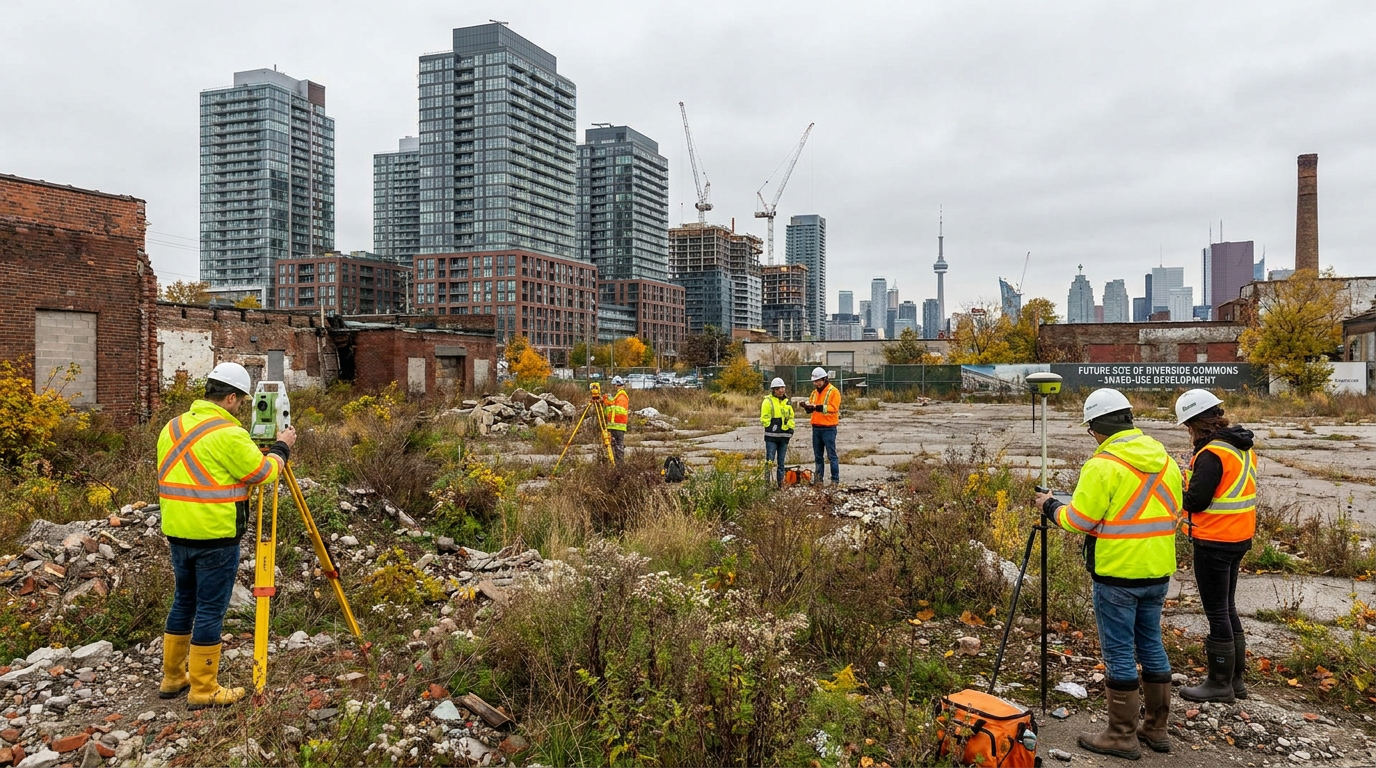
Take brownfield redevelopment as an example. Former industrial or commercial sites often sit in strategic urban locations near jobs, transit, and existing infrastructure. On paper, they can appear to be ideal candidates for new housing. But their value depends on a series of hard questions: what is the contamination profile, what level of remediation is required, what approvals are needed, how long will cleanup take, and can the future land value justify the cost and risk? Separate feasibility work is frequently required because the answer is rarely obvious at acquisition.
When that work is done properly, dormant land can be transformed into productive urban fabric. Sites that would otherwise remain vacant or underused can become new neighborhoods, employment districts, or mixed-use communities. The impact is significant because these are often locations where infrastructure already exists, which reduces the long-term burden of peripheral expansion. In this way, feasibility contributes directly to smarter land recycling and stronger urban efficiency.
Affordable housing projects offer another important lesson. In this segment, feasibility is often more complex because the financial structure may involve layered funding sources, public incentives, inclusion requirements, and lower revenue assumptions than conventional market projects. Here, feasibility is essential not just to determine if the project works, but to identify what support mechanisms are required. It may reveal the need for public land contribution, reduced parking, tax relief, faster approvals, or alternative construction forms to close the viability gap.
Mixed-use and corridor redevelopment also illustrate the iterative power of feasibility. A site initially envisioned as a pure residential scheme may perform better as a mixed-use project with retail or community-serving space at grade. A concept that starts too tall and expensive may become viable when redesigned as mid-rise wood frame. A large site may need phased delivery rather than a single all-at-once approach. These are not signs of failure. They are examples of feasibility doing exactly what it should do: improving the match between site conditions, market demand, and implementation reality.
The Growing Importance of Development Charges, Policy Risk, and Timing
One of the defining realities of current development feasibility is the growing weight of municipal fees and policy-related costs. CMHC has published research showing that development charges and other municipal fees can materially affect housing project viability and influence whether projects move forward. This is a critical point because many public conversations about housing focus on supply in broad terms while underestimating the importance of project-level economics. Homes are delivered one site at a time, and the viability of each site matters.
Development charges are only one piece of the equation, but they are a major one. Combined with parkland requirements, application fees, studies, carrying costs, design revisions, and approval delays, they can significantly alter the residual land value of a project. In some cases, they compress margins to the point that a landowner’s price expectations no longer align with what the site can support. In other cases, they force redesigns, reduce density, delay launch timing, or eliminate affordability components that were initially intended.
The key lesson here is not that every project fails because fees are high, or that lowering charges alone solves the housing challenge. The deeper lesson is that feasibility must account for cost structures realistically and early. Too often, stakeholders discuss desired outcomes without grounding them in executable economics. If policy requirements, municipal costs, and construction realities are not aligned with achievable development returns, projects stall. Feasibility makes that tension visible.
Timing risk is equally important. A project that is viable with a twelve-month approval path may become unviable at twenty-four months once interest carry, consultant costs, and market shifts are considered. This is why modern feasibility studies increasingly include schedule risk and scenario-based analysis. Approval uncertainty is no longer a secondary issue. It is a core economic variable.
Feasibility Is Iterative, Not a One-Time Yes or No
One of the most common misconceptions about feasibility studies is that they produce a definitive answer that remains fixed. In reality, feasibility is iterative. A project that appears strong at acquisition may weaken as rates rise, municipal fees change, or servicing information becomes clearer. A site that initially seems marginal may improve if zoning evolves, transit investment increases, or a revised building form lowers costs. Feasibility is therefore best understood as a process of refinement rather than a one-time stamp of approval.
This iterative nature is one reason sophisticated development teams revisit feasibility repeatedly. They test assumptions at acquisition, at concept design, before submission, during approvals, and before construction financing. Each stage introduces new information. Geotechnical data may refine structural costs. municipal feedback may change density expectations. Market absorption may strengthen or soften. Financing terms may become more restrictive. The project evolves, and the feasibility analysis must evolve with it.
For this reason, good feasibility studies are transparent about assumptions and explicit about uncertainty. They do not present a single polished conclusion as if future conditions are guaranteed. Instead, they define a range of scenarios, identify key drivers, and show where the project is most sensitive. This is what makes the study useful not only as a gatekeeping exercise, but as an active management tool.
In the current Canadian environment, scenario analysis and sensitivity testing should be considered standard practice. Projects need to be tested against changing interest rates, shifts in development charges, slower approvals, different unit mixes, and varying construction inflation. That may sound technical, but the principle is simple: if a project only works under perfect assumptions, it is probably not truly feasible.

Common Misconceptions About Feasibility Studies
Because feasibility is often discussed behind the scenes, several misconceptions persist. The first is that feasibility studies are only for large private developers. In fact, municipalities, housing agencies, institutional landowners, and non-profit organizations rely on feasibility work as well. Any entity making land decisions under uncertainty benefits from understanding legal constraints, site conditions, costs, and delivery risk.
The second misconception is that a feasibility study guarantees approval. It does not. A study can estimate approval likelihood, identify required entitlements, and assess policy alignment, but no consultant can guarantee municipal decisions or community response. Feasibility improves preparation and decision quality. It does not remove uncertainty altogether.
A third misconception is that environmental site assessments and feasibility studies are the same thing. They are not. Environmental due diligence may be part of a broader feasibility process, especially on redevelopment sites, but feasibility also includes planning analysis, servicing review, market assessment, financial testing, and strategy. Thinking of an ESA as a complete feasibility study leaves major blind spots unaddressed.
Another common misunderstanding is that if a project is financially viable on paper, it will proceed unchanged. In practice, land development is iterative and adaptive. Design changes, policy updates, public feedback, financing shifts, and cost escalation all affect outcomes. A feasibility study should therefore be read as a structured decision framework, not a permanent promise.
What Strong Feasibility Work Looks Like
The best feasibility studies share a few qualities. They are multidisciplinary, realistic, and strategic. They bring together planning, engineering, environmental, market, and financial perspectives rather than treating each issue separately. They use current assumptions and local knowledge rather than generic benchmarks. And they are honest about risk. A useful feasibility study does not try to force a positive conclusion. It clarifies what is possible, what is uncertain, and what conditions are required for success.
Strong feasibility also means comparing alternatives. Sometimes the right answer is not whether to build on a site, but what to build and when. Should the project be rental or condominium? Mid-rise or high-rise? Single phase or multiple phases? Market rate, mixed income, or affordable with subsidy? Can a lower parking ratio improve viability? Would a different tenure or building type better align with demand and policy support? These are strategic questions, and feasibility provides the framework for answering them.
For landowners, this can mean understanding the highest and best use of a site before selling or partnering. For municipalities, it can mean identifying which parcels are capable of supporting growth under current servicing and policy conditions. For non-profits, it can mean designing a housing project around a realistic capital stack rather than an aspirational one. In each case, the value lies in turning uncertainty into informed action.
The Long-Term Impact on Housing Availability and Urban Form
When we talk about feasibility studies, it is easy to focus on near-term outcomes such as cost savings, risk reduction, or improved acquisition decisions. Those are real benefits, but the long-term impact is larger. Feasibility influences which projects proceed, which sites remain idle, where housing gets built, what types of homes are delivered, and how cities use their infrastructure over time. In that sense, it shapes both housing availability and urban form.
If a city wants more homes near transit, more redevelopment of underused land, and more efficient use of existing infrastructure, it needs projects that are not only desirable in principle but viable in practice. Feasibility studies help bridge that gap. They identify the practical barriers standing between policy aspiration and housing delivery. They also help reveal where reforms may be needed, whether through faster approvals, smarter zoning, infrastructure investment, or cost recalibration.
Over time, that matters enormously. Strong feasibility work can unlock sites that would otherwise remain dormant. It can support redevelopment in areas where public investment has already been made. It can reduce expensive project failures that consume years without producing homes. And it can improve the alignment between land use planning and real market conditions, which is essential if cities want growth to be both ambitious and implementable.
In a country facing sustained housing pressure, this is not a niche technical issue. It is part of the larger conversation about how to deliver more homes responsibly and efficiently. Feasibility studies may happen early in the process, often before the public sees architectural renderings or construction cranes, but their influence extends far beyond that early stage. They help determine whether land becomes housing, whether policy becomes built form, and whether growth strategies become real neighborhoods.
Final Thoughts
Feasibility studies are one of the quiet foundations of successful land development. They rarely attract public attention, but they shape decisions that affect housing supply, capital allocation, infrastructure use, and urban growth for years to come. In a market where affordability is strained and delivery conditions are increasingly complex, the importance of rigorous feasibility work only grows.
The most effective development strategies are not built on optimism alone. They are built on disciplined analysis that tests what is legal, physical, financial, and market-ready before resources are overcommitted. That is what feasibility provides. It helps project teams avoid preventable mistakes, redesign weak concepts, and move forward with a clearer understanding of risk and opportunity.
For anyone involved in land development, whether as a developer, planner, investor, policymaker, or community stakeholder, feasibility should be seen for what it really is. It is not just a spreadsheet exercise. It is a strategic planning tool that connects site-level decisions to city-wide outcomes. And in a period when Canada needs more housing, faster and smarter, that connection has never been more important.
Key Elements Typically Reviewed in a Feasibility Study
- Planning and zoning compliance, including official plan alignment, permitted uses, density, height, setbacks, and approval pathway.
- Physical site conditions, including dimensions, topography, access, massing potential, and constructability constraints.
- Servicing and infrastructure capacity, including water, wastewater, stormwater, hydro, roads, and transit context.
- Environmental conditions, including contamination risk, Phase I and Phase II ESA findings, and remediation implications.
- Market demand and absorption, including buyer or renter profile, competitive supply, pricing, and unit mix strategy.
- Financial viability, including construction costs, soft costs, development charges, financing, revenues, and return thresholds.
- Scenario and sensitivity testing, including changes to fees, timing, rates, policy conditions, and phasing assumptions.
Questions a Good Feasibility Study Should Answer
- Is the proposed project permitted as-of-right, or does it require planning approvals that introduce risk and delay?
- Can the intended density and building form actually fit on the site in a practical, buildable way?
- Does existing infrastructure support the project, or will upgrades or timing constraints affect delivery?
- Are there environmental or physical issues that materially change project cost or complexity?
- Is there real market demand for the proposed housing type, tenure, and price point?
- After accounting for all costs, fees, and financing assumptions, does the project remain economically viable?
- How does viability change if rates, approvals, charges, or market conditions move against the base case?



No Comment! Be the first one.