



As cities grow denser and summers become hotter, urban cooling systems are moving from a niche sustainability topic into a basic resilience need. Heat is no longer just an occasional seasonal discomfort. It is an infrastructure challenge, a housing challenge, a public-health challenge, and increasingly an affordability issue for households trying to stay safe without pushing energy bills even higher. In practical terms, urban cooling is about helping buildings, streets, and public spaces absorb less heat and release it more effectively, while giving people more access to shade, airflow, and cooler surfaces throughout the day and night.
Table Of Content
- Why Cities Stay Hotter Than They Should
- Urban Cooling Works Best as a Layered System
- Trees and Urban Forestry: The Most Familiar Cooling System Still Matters Most
- Cool Roofs: A Straightforward Upgrade With Measurable Results
- Green Roofs: Cooling With Added Ecological Value
- Cool Pavements and Better Ground Surfaces
- Planning and Urban Design: Cooling Begins Before Materials Are Chosen
- Urban Cooling as a Public-Health Strategy
- What Communities Can Actually Do
- A practical cooling portfolio for many cities might include
- Common Misconceptions About Urban Cooling
- What a Sustainable Cooling Future Looks Like
- Final Thoughts
In Canada and across North America, the urgency is clear. Health Canada reports that the 2021 British Columbia extreme heat event caused at least 619 deaths, a sobering reminder that heat can become deadly when intense temperatures collide with vulnerable housing, limited shade, and the urban heat island effect. Federal guidance also notes that extreme heat events are expected to become more frequent and intense as climate change continues. That means cities need solutions that work at multiple scales, from individual buildings and blocks to parks, streets, and entire neighbourhoods.
The good news is that effective urban cooling does not depend on one expensive technology or a dramatic reinvention of city life. In many cases, the most useful solutions are familiar, visible, and achievable. Trees, reflective roofs, vegetated rooftops, lighter pavements, shaded streets, and better planning choices can all make a meaningful difference. When these measures are combined thoughtfully, they can lower heat exposure, improve comfort, reduce strain on the electrical grid, and make communities more resilient without sacrificing practicality.
This is also why the conversation around urban cooling has evolved. It is no longer only about energy performance or beautification. Today, cities are increasingly treating heat mitigation as a public-health intervention and an equity strategy. The neighborhoods with the least tree cover, the hottest surfaces, and the oldest buildings often carry the highest risks. Residents who are older, very young, living with chronic illness, or facing financial pressure are often the least able to adapt when temperatures rise. Good urban cooling policy recognizes that reality and responds with solutions that are layered, durable, and accessible.
Why Cities Stay Hotter Than They Should
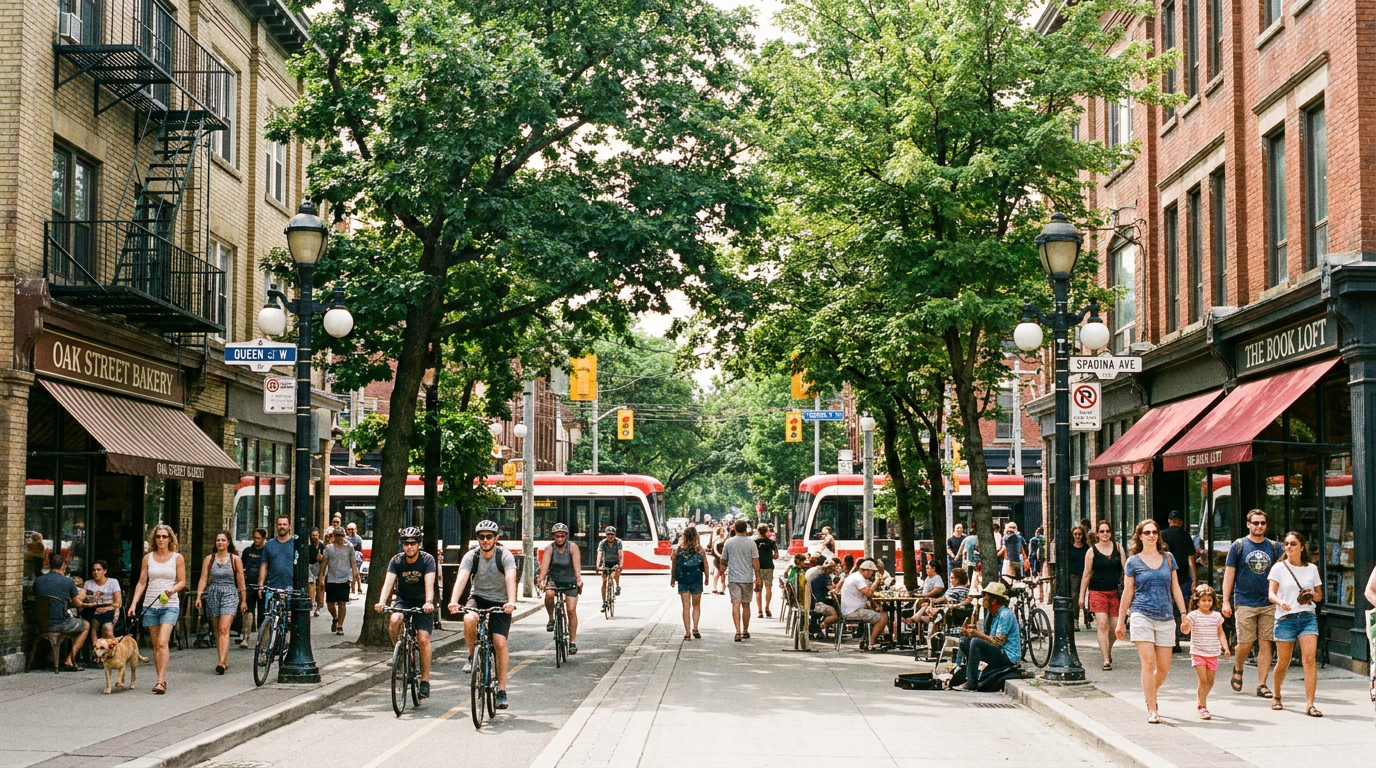
To understand urban cooling systems, it helps to start with the urban heat island effect. Cities often run hotter than nearby rural or less developed areas because they contain so many dark, hard, heat-absorbing surfaces. Asphalt roads, conventional rooftops, parking lots, and concrete sidewalks collect solar energy through the day and slowly release that heat later on. Dense development can also trap warmth, especially where airflow is limited by building form and street design.
One of the most difficult aspects of urban heat is that it often lingers into the evening. That matters because nighttime cooling is essential for human recovery. If apartments, houses, sidewalks, and streets remain warm after sunset, people have fewer opportunities to cool down physically. This is especially dangerous in buildings without reliable air conditioning or in homes where residents avoid using cooling equipment because of cost concerns.
Heat also interacts with other urban pressures. Federal guidance notes that high heat can worsen air quality, increase health risks, and strain infrastructure. Roads and rails can buckle under extreme conditions, energy systems can face peak demand, and water systems may be stressed as people use more for irrigation and cooling. In that sense, urban cooling is not just about comfort. It is part of the broader work of making cities function better in a changing climate.
There is also a strong social dimension. Heat risk is not evenly distributed. Neighborhood tree cover, housing quality, building age, access to shaded public space, and even the amount of nearby pavement can shape how hot a place feels and how safely people can live there. A well-designed cooling strategy pays attention to these local realities rather than assuming the same solution will perform equally well in every district.
Urban Cooling Works Best as a Layered System
A common misconception is that urban cooling simply means adding more air conditioning. Mechanical cooling has an important role, especially during dangerous heat events, but it is not the whole story. If cities rely only on air conditioning, they can increase electricity demand, intensify grid stress during peak periods, and leave many lower-income households exposed if they cannot afford installation or operating costs. Passive and nature-based measures, by contrast, often reduce heat exposure more sustainably and can lower overall cooling demand.
The most successful approach is to think in layers. Shade trees can cool sidewalks, playgrounds, and streetscapes. Cool roofs can reduce solar heat gain at the top of buildings. Green roofs can moderate roof temperatures while adding stormwater and biodiversity benefits. Cool pavements can reduce surface temperatures in highly paved areas. Planning and urban design can preserve airflow, improve shade, and reduce the number of heat-trapping surfaces concentrated in one place.
The United States Environmental Protection Agency identifies five main urban heat reduction strategies: trees and vegetation, green roofs, cool roofs, cool pavements, and smart-growth practices. That framework is useful because it avoids the false choice between natural systems and built technologies. In reality, cities benefit when they combine both, matching each solution to local building stock, climate conditions, budgets, maintenance capacity, and equity goals.
Urban cooling is most effective when it is treated as a network of complementary measures rather than a single fix. The question is rarely which one strategy should replace all others. The better question is which mix of strategies fits a community best.
Trees and Urban Forestry: The Most Familiar Cooling System Still Matters Most
Trees remain one of the most practical and widely beneficial forms of urban cooling. They cool through two simple mechanisms: they provide shade, and they release moisture through evapotranspiration, which helps lower surrounding air temperatures. EPA cites a review of 308 studies finding that urban forests were, on average, 1.6°C cooler than urban non-green areas. That is a meaningful change, especially during long heat events when every degree can affect public comfort and health.
What makes trees especially valuable is that they work at the level people actually experience city life. A shaded sidewalk feels different from an exposed one. A bus stop under a canopy is more usable than one surrounded by pavement. A street lined with mature trees can become a viable walking route even on hot afternoons, while a bare corridor can quickly become hostile. In this way, trees are not only a climate adaptation tool. They are also a mobility and public-space investment.
Urban forestry can support buildings as well. Properly placed trees reduce solar exposure on walls and windows, lowering indoor heat gain in homes and commercial buildings. That can reduce the need for air conditioning, particularly in older housing stock where insulation and envelope performance may be limited. It can also make naturally ventilated buildings more livable during shoulder seasons and moderate heat events.
Still, planting trees is not as simple as dropping saplings into any available patch of soil. Communities need species selection suited to local conditions, adequate root space, long-term irrigation during establishment, and maintenance plans for pruning and health monitoring. In hotter and drier future climates, resilience matters. A successful urban forestry program chooses trees that can survive local stresses while delivering shade where people need it most.
There is also an important timing consideration. Trees provide profound long-term value, but they do not create full canopy overnight. That is one reason cities should avoid treating them as a stand-alone answer. New planting should begin now, yet communities should also use quicker measures, such as cool roofs or shade structures, while that canopy matures.
Cool Roofs: A Straightforward Upgrade With Measurable Results
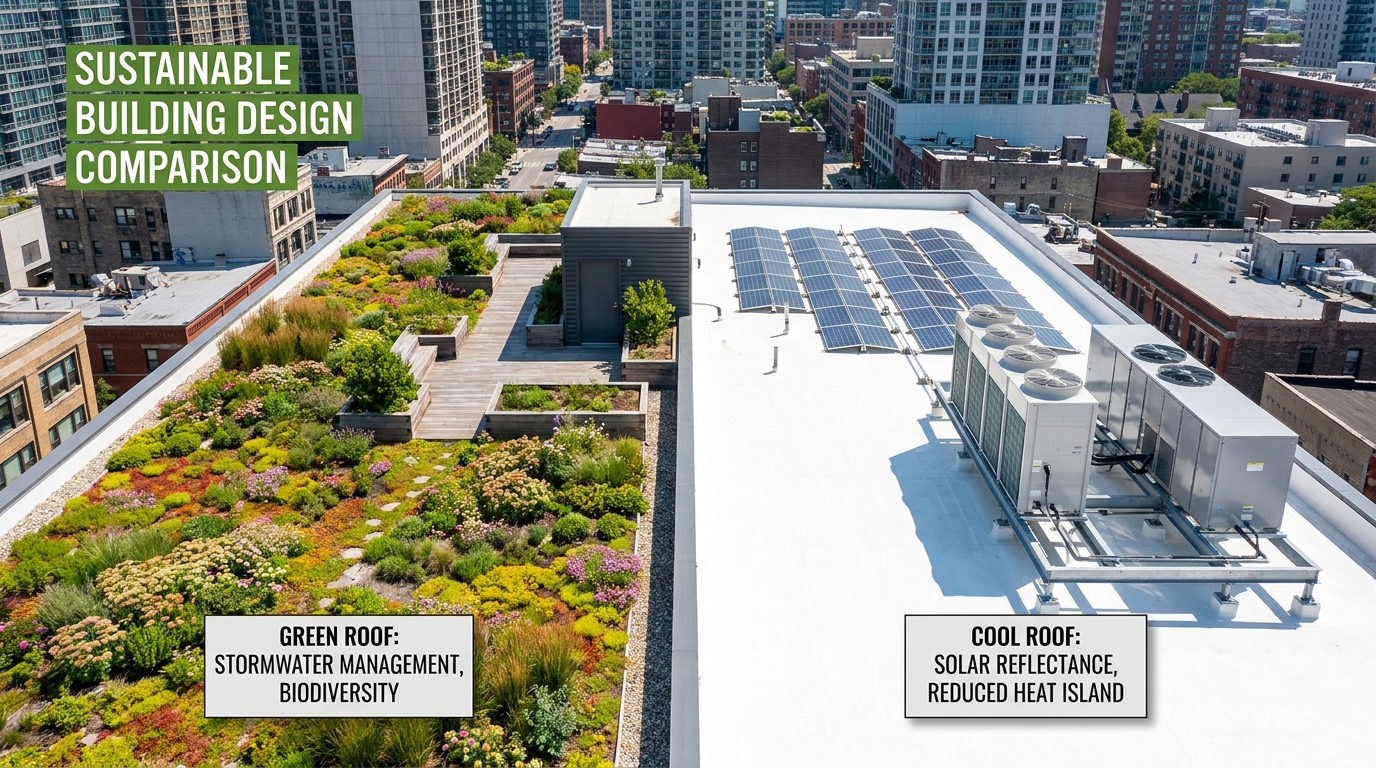
Among building-scale interventions, cool roofs are often one of the simplest and most cost-effective ways to reduce heat gain. A cool roof reflects more solar radiation and emits absorbed heat more effectively than a conventional dark roof. Instead of allowing the roof surface to heat up dramatically through the day, it helps keep that surface and the spaces below it cooler.
EPA reports that cool roofs can lower maximum indoor temperatures in non-air-conditioned residential buildings by 1.2–3.3°C. It also notes that they can reduce peak cooling demand in air-conditioned homes by 11–27%. Those numbers matter because they translate into both resilience and affordability. For households without central cooling, a few degrees can significantly improve livability. For households with air conditioning, lower peak demand can mean lower bills and reduced pressure on the grid during heat waves.
Cool roofs are especially appealing because they can often be integrated into normal roof replacement cycles. When a building already needs a new roof, selecting a reflective membrane or coating may be a practical step rather than a major separate project. This is one reason cool roofs have gained traction in policy and standards programs. They are performance-driven, visible, and relatively easy to explain to both building owners and the public.
That said, cool roofs are not identical to green roofs, and the distinction matters. Cool roofs are generally simpler and less expensive to install. They primarily address solar reflectance and thermal performance. Green roofs, by contrast, can add broader co-benefits but usually require more structural consideration, waterproofing detail, and maintenance planning. A city does not need to choose one universally. It can encourage each where it makes the most sense.
Green Roofs: Cooling With Added Ecological Value
Green roofs have become a symbol of climate-conscious urban design, but their value goes beyond appearances. These systems place vegetation and growing medium over a protected roof assembly, helping reduce roof surface temperatures and, in some cases, lowering nearby air temperatures. EPA notes that green roofs can lower roof surface temperatures substantially while also improving stormwater management. In dense cities where land is limited, rooftops can become an important layer of environmental performance.
One of the most compelling advantages of green roofs is that they offer multiple functions at once. They can support heat mitigation, absorb rainfall, contribute to biodiversity, and extend roof membrane life by shielding it from direct ultraviolet exposure and extreme thermal cycling. For municipalities managing flood risk as well as heat, this multifunctionality is highly attractive. It turns a previously inactive roof surface into a working piece of urban infrastructure.
Toronto offers a strong North American example of what policy support can achieve. The city reports that its Green Roof Bylaw helped develop and install more than 1,200 green roofs and supported a $50-million green roof industry from 2010 to 2025. This is significant because it shows how regulation and incentives can create a local market, build technical expertise, and normalize a resilience measure that may once have been seen as specialized.
For building owners, however, green roofs are best approached realistically. Not every structure is a good candidate. Roof load capacity, access, waterproofing condition, maintenance expectations, irrigation, and plant selection all matter. Extensive green roofs, which are shallower and lighter, tend to be more widely applicable than intensive roof gardens, but both require informed design. The practical lesson is not that every roof should become green. It is that where conditions are right, green roofs can deliver a combination of cooling and ecological value that few other building measures can match.
Cool Pavements and Better Ground Surfaces
Roads, parking lots, plazas, schoolyards, and sidewalks make up a large share of exposed urban surface area. Because these spaces often receive full sun, they can become major contributors to local heat build-up. This is why cool pavements are receiving more attention in resilience planning. These materials or coatings are designed to reflect more sunlight or store less heat than conventional dark surfaces, helping lower surface temperatures in highly paved settings.
Cool pavements are still a somewhat less mature field than trees, cool roofs, and green roofs, but the basic logic is straightforward. If a city can reduce the amount of heat absorbed by the surfaces people walk and gather on, it can improve thermal comfort and reduce the intensity of the heat island effect. This matters particularly in neighborhoods where open land is limited and pavement dominates the public realm.
Surface choice also intersects with stormwater planning. In some cases, permeable pavements can help manage runoff while supporting localized cooling benefits, particularly when paired with trees, planting strips, and bioswales. The exact performance depends on climate, maintenance, traffic loads, and site design, so these materials should be specified carefully rather than treated as a universal drop-in solution.
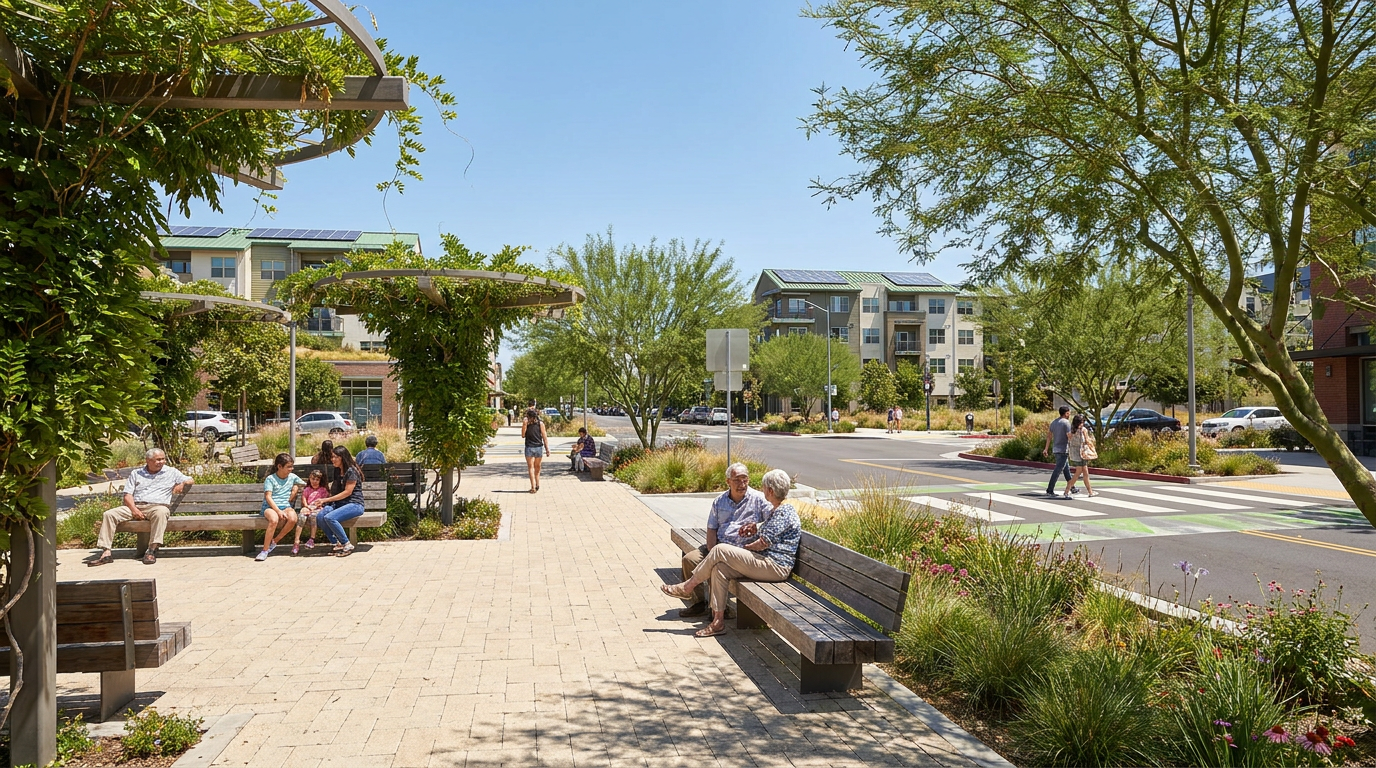
For communities, the most useful applications may be targeted rather than citywide. Schoolyards, transit waiting areas, public plazas, recreation spaces, and large parking areas are often good candidates because they are intensely used and can become dangerously hot. When paired with shade and seating, improved surfaces can help turn these spaces from heat traps into more comfortable public assets.
Planning and Urban Design: Cooling Begins Before Materials Are Chosen
Some of the most durable cooling gains come from planning decisions made long before a roof membrane or tree species is selected. Street orientation, block design, building spacing, open-space distribution, and the placement of parks or civic facilities all influence how heat moves and accumulates in a city. Smart-growth practices, as highlighted by EPA, are part of urban heat reduction because urban form can either support or undermine every other cooling intervention.
For example, preserving airflow corridors can help neighborhoods cool more effectively in the evening. Locating shade trees along pedestrian routes can improve access to transit and public services during hot weather. Reducing oversized paved areas lowers heat storage and creates room for green infrastructure. Encouraging infill that includes canopy, high-performance roofs, and thoughtful setbacks can improve density without accepting avoidable heat burdens.
Planning also shapes access. Cooling centers and shaded public spaces are important during extreme heat, but they are most useful when residents can reach them safely and easily. A neighborhood where sidewalks are exposed, crossings are long, and public space is sparse may leave vulnerable residents isolated during heat events. In that sense, urban cooling is closely tied to inclusion and daily usability.
The most thoughtful cities are beginning to integrate heat considerations into zoning, public works, capital planning, and community development rather than leaving the issue to environmental departments alone. This is a healthy shift. Heat touches housing, transit, parks, health systems, emergency response, and utility planning. The built environment responds best when those conversations are connected.
Urban Cooling as a Public-Health Strategy
One of the strongest reasons to invest in urban cooling systems is that they protect health. Heat affects the body directly, but it also interacts with pre-existing vulnerabilities. Older adults, infants, young children, outdoor workers, low-income residents, and people with chronic illnesses often face the highest risks. Housing quality matters too. Apartments with poor ventilation, dark roofs, limited insulation, or west-facing glazing can become dangerously warm, especially if nights remain hot.
The public-health framing changes how cooling should be prioritized. It suggests that the first question is not which project looks most innovative, but which intervention protects the people and places at greatest risk. That may mean targeting tree planting in low-canopy neighborhoods, improving reflective roofs on affordable housing, retrofitting schoolyards with shade, or creating cooler routes to transit and essential services. In many cases, the right answer is modest, local, and highly specific.
This is also where affordability enters the picture. Cooling strategies that lower indoor temperatures passively can reduce dependence on expensive mechanical cooling. Even households with air conditioning benefit when buildings and neighborhoods absorb less heat. Reduced peak demand can lower system stress, and better envelope or roof performance can help contain utility costs during the hottest months. These are practical advantages, not abstract environmental benefits.
Importantly, urban cooling should not be framed as a luxury layer for already comfortable districts. It is core climate resilience infrastructure. Heat kills quietly, often in private spaces and among people who are less visible in public debate. A calm, evidence-based response means designing cities that reduce that risk as a matter of ordinary planning and maintenance.
What Communities Can Actually Do
The most useful urban cooling plans usually begin with a heat map and a vulnerability lens. Communities need to know where temperatures are highest, where tree canopy is lowest, where hard surfaces dominate, and which populations are most exposed. Once that picture is clear, action becomes more practical. Instead of trying to cool everywhere equally at once, municipalities can focus first on the blocks, corridors, and facilities where heat risk is most acute.
Implementation often works best through a mix of regulation, incentives, and public investment. Municipal standards can require or encourage cool roofs on new construction and major reroofing. Incentive programs can support green roofs, tree planting, and schoolyard retrofits. Public works departments can pilot cool pavements in selected sites. Park agencies can expand canopy in heat-stressed districts. Housing agencies can prioritize passive cooling measures in older rental stock.
Community partnership matters as well. Residents often know which bus stops are unbearable in July, which apartment buildings stay hot overnight, and which schoolyards have no meaningful shade. Local organizations, health agencies, schools, and neighborhood groups can help shape projects that are both responsive and well used. Cooling is more effective when it is designed with users rather than simply delivered to them.
Maintenance should be part of the conversation from the start. Trees need watering and care during establishment. Green roofs need inspection and plant management. Reflective surfaces need product selection appropriate to climate and wear. Permeable materials need upkeep to perform well. A resilience investment only stays resilient if someone is prepared to maintain it over time.
A practical cooling portfolio for many cities might include:
- Expanding tree canopy on priority streets, school grounds, and low-shade neighborhoods
- Adding cool roofs during standard replacement cycles on public, commercial, and residential buildings
- Installing green roofs where structures, budgets, and maintenance plans make them feasible
- Using cool or permeable pavements in plazas, schoolyards, parking lots, and transit areas
- Revising planning and design standards to preserve shade, reduce excessive paving, and support airflow
- Targeting investments first where heat vulnerability and social risk overlap
Common Misconceptions About Urban Cooling
It is easy to assume that all cooling strategies are interchangeable, but they are not. Trees, cool roofs, green roofs, pavements, and planning measures each operate differently and bring different co-benefits. A cool roof may be faster and cheaper to implement than a green roof. A tree canopy may improve walking comfort more directly than a reflective coating applied to a rooftop. A green roof may offer stormwater and habitat value that a cool roof does not. Context matters.
Another common misunderstanding is that planting trees alone solves urban heat. Trees are immensely valuable, but they cannot fully offset the heat generated and stored by every roof, road, and parking area in a dense city. They also take time to mature. The best outcomes usually come from combining canopy with reflective surfaces, building design improvements, and smarter site planning.
There is also a tendency to think of urban cooling as a purely environmental gesture. In practice, it is strongly tied to economics and daily quality of life. Better cooling can lower energy demand, support grid resilience, make public spaces more usable, and reduce health costs associated with heat exposure. These outcomes matter even to people who would not normally consider themselves focused on sustainability.
Perhaps the most important misconception is that every city should copy the same template. Performance depends on local climate, roof type, building stock, maintenance capacity, and neighborhood conditions. A successful strategy respects these differences. It is careful rather than fashionable, and that is often what makes it durable.
What a Sustainable Cooling Future Looks Like
The cities that handle future heat best are unlikely to be the ones that rely on any single intervention. They will be the places that quietly, consistently build cooling into ordinary decisions about roofs, streets, parks, schools, housing retrofits, and redevelopment. They will treat trees as infrastructure, roofs as climate assets, and public space as part of a health system. They will also recognize that the coolest neighborhood is not necessarily the most technologically advanced one. Often, it is the one that planned with balance and care.
This is encouraging because it means progress is possible in increments. A city does not need to solve urban heat all at once. It can start with the next reroofing project, the next schoolyard redesign, the next road reconstruction, the next tree-planting budget, or the next update to design standards. Over time, these decisions can accumulate into a noticeably cooler, safer, and more livable urban environment.
For residents, developers, municipal staff, and local leaders, the real opportunity is to move beyond the idea of cooling as emergency response alone. Emergency preparedness remains essential, but resilience is stronger when heat is addressed upstream through the built environment itself. A well-shaded street, a reflective roof, a vegetated building, and a cooler public plaza all reduce risk before a crisis peaks.
Urban cooling systems are, at their best, practical acts of stewardship. They respond to a changing climate without demanding perfection. They improve daily comfort while supporting longer-term sustainability. And they remind us that the most effective urban innovations are often the ones that feel calm, visible, and well integrated into everyday life.
Final Thoughts
As extreme heat becomes more frequent and intense, urban cooling deserves a central place in climate resilience planning. The evidence is clear that layered solutions work. Trees and vegetation cool neighborhoods. Cool roofs lower indoor temperatures and reduce demand. Green roofs add ecological performance to the top of buildings. Cool pavements improve conditions in hardscaped areas. Better planning helps all of these measures work together rather than in isolation.
For communities looking for a practical path forward, the lesson is reassuring. Urban cooling does not require choosing between innovation and environmental responsibility. The most successful systems usually balance both. They combine proven materials, nature-based infrastructure, and thoughtful design in ways that suit local budgets, local climates, and local needs. In a hotter future, that kind of balanced thinking may be one of the most valuable urban tools we have.

No Comment! Be the first one.