



AI design systems are becoming one of the most important shifts in modern creative work. The phrase can sound abstract at first, but the idea is practical. An AI design system is not just a single image generator or a clever prompt tool. It is a broader workflow made up of software, rules, data, automation, and human review that helps teams generate ideas, test options, refine outputs, and move from concept to production more efficiently.
Table Of Content
- What Are AI Design Systems?
- Why AI Design Systems Matter Now
- The Bridge Between Human Creativity and Machine Efficiency
- AI Design Systems in Architecture
- Where Architecture Gains the Most Value
- AI Design Systems in Fashion
- Personalization Without Losing Brand Identity
- AI Design Systems in Graphic Design and Branding
- Why Human Taste Still Matters Most in Branding
- The Main Benefits of AI Design Systems
- The Risks, Limitations, and Misconceptions
- Governance, Transparency, and Responsible Adoption
- What the Future Looks Like
- How Creative Teams Should Approach AI Design Systems
- Conclusion
What makes this moment different is that AI is no longer sitting at the edge of the design process as an experiment. It is increasingly being embedded into the everyday tools that architects, fashion teams, and graphic designers already use. Adobe reported in 2026 that 87% of creators using creative AI said it accelerated the growth of their business or follower base, and 75% described creative AI as integrated or essential to how they work. That data matters because it shows a shift from novelty to infrastructure. AI is moving from a curiosity to an operating layer in design.
The core value of AI design systems is not that they replace human creativity. In fact, the strongest case for them is the opposite. They help bridge the gap between human imagination and technological efficiency. AI can produce variation, handle repetition, identify patterns, and process scale much faster than people can. Humans still provide taste, context, strategy, ethics, and final judgment. When the relationship works well, the result is not less creative work. It is more ambitious creative work with better use of time.
This article explores what AI design systems are, why they matter, and how they are reshaping architecture, fashion, and graphic design. It also looks at the legal, ethical, and operational questions that come with them. The future of design will not be defined by software alone. It will be shaped by how intelligently creative teams build systems around these tools and how carefully they protect the human decisions that give design its meaning.

What Are AI Design Systems?
AI design systems are structured creative environments where artificial intelligence supports repeatable design tasks across ideation, development, testing, and adaptation. That can include generating concepts, creating variants, predicting trends, optimizing layouts, personalizing outputs, automating resizing, simulating performance, or assisting with production. The important point is that the AI sits inside a process. It is not only creating outputs. It is contributing to a workflow that people can scale, monitor, and improve over time.
In practical terms, an AI design system often combines several layers. There may be generative models for visual ideation, rule-based design libraries for consistency, analytics dashboards for performance tracking, and approval workflows for human review. In enterprise settings, these systems are often linked to brand guidelines, asset management libraries, project management tools, and customer data. That makes them more powerful than standalone tools because they can connect creativity with business operations.
There is also an important distinction between using AI occasionally and building an AI design system. Occasional use might mean asking a tool to generate an image or suggest a layout. A system means defining where AI fits into a creative process, what kinds of tasks it can support, what quality standards apply, who approves outputs, and what governance rules exist around data, copyright, and provenance. In other words, a system turns AI from a feature into a reliable working method.
This is why the concept matters for both individual creators and large organizations. Smaller firms can use AI design systems to expand their capacity without dramatically increasing headcount. Larger teams can use them to create consistency across many channels, products, or project types. In both cases, the opportunity is not simply speed. It is the ability to work through more possibilities and make better informed design decisions with less friction.
Why AI Design Systems Matter Now
The timing of this shift is not accidental. Creative industries are under pressure to produce more content, more variations, and more personalized experiences than ever before. Brands need assets for many platforms. Retailers want tailored product experiences. Developers and architecture firms are expected to compare more options earlier in the planning process. Design teams are increasingly asked to deliver both originality and operational efficiency at the same time.
AI design systems respond directly to that tension. Adobe’s 2024 U.S. survey of 2,002 creative professionals found strong interest in generative AI for time savings, brainstorming, transparency, and content-control features. That combination tells an important story. Designers are not only looking for speed. They want support that still leaves room for review, authorship, and intent. In mature workflows, AI becomes most useful when it reduces low value repetition and expands the range of options available for human evaluation.
Another reason these systems matter now is the broader normalization of AI inside software environments. Instead of forcing creatives to jump between separate experimental tools, AI features are being embedded directly into creative suites, enterprise platforms, and workflow software. This reduces friction and increases adoption. It also changes expectations. Once AI becomes part of the standard interface, teams begin thinking less about whether to use it and more about where it can create meaningful leverage.
There is also a workforce dimension. The OECD reported in 2024 that generative AI can help creative workers generate ideas and audiovisual content, but can also increase work intensity and reduce worker agency if implemented poorly. That is a crucial insight. Efficiency gains do not automatically create better work lives. In some environments, they can lead to higher output demands and compressed timelines. That means successful AI design systems require not only good tools but also thoughtful management and participation from the people who use them.
The strongest AI design systems do not remove human creativity from the process. They create more room for it by automating repetition, surfacing alternatives, and making complex tradeoffs easier to evaluate.
The Bridge Between Human Creativity and Machine Efficiency
To understand the real value of AI design systems, it helps to think in terms of complementary strengths. Machines excel at scale, speed, pattern recognition, variation, and consistency. Humans excel at meaning, taste, cultural sensitivity, strategic direction, narrative judgment, and accountability. Creative work needs both. AI can help produce ten, one hundred, or one thousand viable options quickly, but it cannot reliably decide which option aligns with a community’s identity, a brand’s emotional tone, or a client’s unspoken priorities.
This balance is especially important because there is still a persistent misconception that AI makes design objective. It does not. AI can generate faster, test more broadly, and optimize toward measurable goals, but quality still depends on what the team is trying to achieve and how critically it reviews the result. A system that produces hundreds of options can still produce mediocre work if the creative direction is weak. More output does not equal better output.
That is why human-centered AI is such an important concept in creative industries. A good AI design system gives people more control over the process, not less. It helps them compare scenarios, spot patterns, and reduce repetitive effort while preserving the role of the designer as editor, curator, and decision-maker. In this model, creativity is not outsourced. It is amplified through better tools and more efficient workflows.
The most successful teams treat AI as a force multiplier. They let it handle the repetitive labor of resizing, sorting, variant generation, simulation, or initial concept exploration. Then they concentrate human energy on framing the brief, judging subtle differences, integrating stakeholder feedback, and ensuring the work is ethically, culturally, and commercially sound. That is the bridge. AI handles the heavy lifting of scale. Humans keep the work meaningful.
AI Design Systems in Architecture
Architecture offers one of the clearest examples of how AI design systems can enhance creative exploration without replacing professional judgment. In this field, AI is often used for concept generation, massing studies, parametric exploration, rapid option comparison, and performance analysis. Architects can input site conditions, zoning constraints, environmental goals, and spatial requirements, then use AI-assisted tools to generate multiple scenarios quickly. Instead of spending days building early options manually, teams can evaluate a much wider design space in a shorter period.
This does not mean AI designs buildings independently. The more accurate story is that it helps architects test possibilities earlier and evaluate tradeoffs faster. For example, a team might compare different building forms based on daylight access, energy performance, material efficiency, and floor area potential. AI can support this analysis by surfacing patterns and narrowing options, but the architect still interprets what matters most in context. A building is not only a geometry problem. It is a social, environmental, and cultural intervention.
In early stage design, AI can also strengthen collaboration. Clients often struggle to react to abstract plans or technical drawings. AI-assisted visualizations can help generate understandable concept directions much earlier in the process, making feedback more specific and useful. This can reduce wasted iterations later. It can also improve stakeholder engagement by allowing decision-makers to compare alternatives more confidently before large commitments are made.
Another strong application is performance simulation. Architecture has long used computational tools to evaluate energy use, lighting, thermal comfort, and circulation. AI design systems can accelerate this by linking generative exploration with performance feedback loops. A designer can move more fluidly between form making and measurable outcomes. That matters in a market where sustainability, efficiency, and resilience are increasingly central to project success.
Still, architecture also reveals the limits of AI clearly. Building design is deeply tied to local culture, regulation, material reality, and lived experience. AI can help propose arrangements and compare metrics, but it cannot reliably understand the politics of a neighborhood, the emotional symbolism of public space, or the long term maintenance implications of a design choice without human interpretation. The best architectural use cases are therefore collaborative. AI expands the set of options. Architects determine what is worth building.
Where Architecture Gains the Most Value
Architecture benefits most from AI design systems in the phases where possibility is wide and evaluation is expensive. Concept generation, test fitting, form studies, and simulation all fit that pattern. These are tasks where producing and comparing many alternatives creates real value. AI also helps reduce the cost of iteration, which is critical because early design decisions can influence budget, sustainability, and user experience later in the project lifecycle.
There is also a growing connection between AI design systems and digital twins, urban analytics, and planning intelligence. As design teams work with more environmental data and real world performance information, AI can help surface patterns that would be difficult to interpret manually. This supports smarter conversations around density, mobility, climate performance, and space use. For firms operating in data-rich environments, AI becomes part of the intelligence layer behind design decisions rather than just a tool for imagery.
AI Design Systems in Fashion
Fashion is another sector where AI design systems are reshaping both creative development and customer experience. Here, AI is commonly used for trend forecasting, textile and print generation, styling recommendations, virtual sampling, merchandising, and product customization. Fashion already operates on fast cycles with high demand for novelty and variation, so the fit is intuitive. AI can help teams spot emerging patterns, generate more options quickly, and connect design choices with commercial signals.
One of the most compelling advantages in fashion is the reduction of physical sampling. Traditional design cycles can involve multiple rounds of prototypes, which cost time, money, and materials. AI-assisted virtual sampling allows teams to test colors, patterns, silhouettes, and fabric appearances digitally before producing physical versions. This can shorten iteration cycles and reduce waste. It also allows for more experimentation because the cost of trying new directions falls significantly.
AI design systems are also important on the consumer side of fashion. Adobe’s 2024 consumer research found that many Americans were open to AI-enabled retail experiences such as custom product design and automated product filtering. That supports a larger shift toward personalization and mass customization. Instead of producing one static collection for a broad market, brands can use AI-supported systems to offer more relevant product suggestions, personalized styling flows, and even tailored design variations based on user preferences.
This creates a powerful link between creative concepting and commercial performance. In a mature fashion AI system, trend analysis might inform concept development, generative tools might assist with pattern or print ideation, virtual try-on tools might support evaluation, and personalization engines might help convert interest into sales. The process becomes more connected from inspiration to transaction. For brands, this can improve responsiveness. For consumers, it can make design feel more participatory.
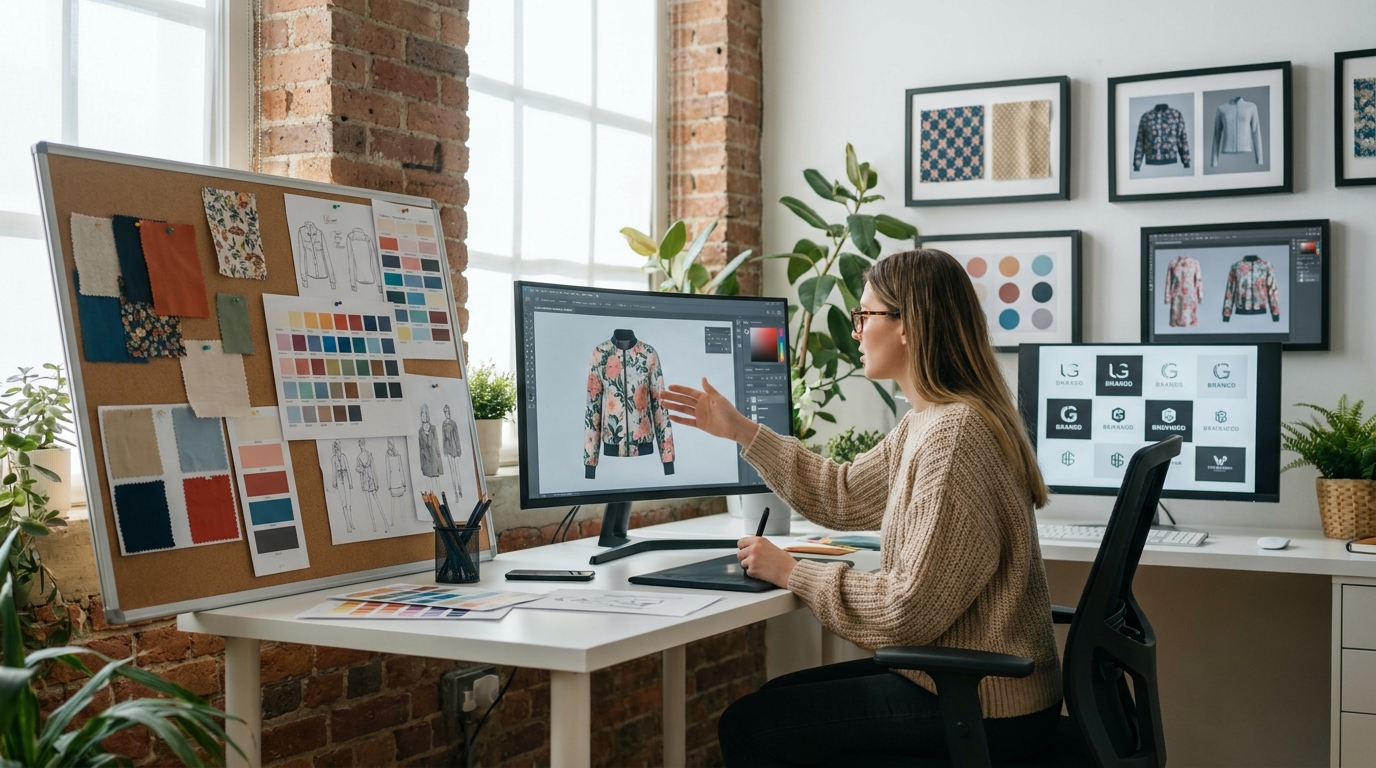
At the same time, fashion exposes some of the thorniest questions around originality and authorship. If an AI system is trained on existing visual cultures, patterns, garments, or branded aesthetics, what counts as a genuinely original output? Who owns an AI-assisted textile design or print variation? What happens when generated work resembles protected designs too closely? These are not fringe concerns. They sit at the center of responsible adoption.
Fashion also depends heavily on cultural context. A trend may be visible in data, but understanding why it matters and whether it should be translated into a product requires human sensitivity. The same is true for luxury positioning, subcultural references, and emotional resonance. AI can speed up option generation, but the brand still needs people who can identify what feels timely, respectful, and commercially coherent. In this sense, AI expands possibility while making human editing even more important.
Personalization Without Losing Brand Identity
One of the biggest opportunities in fashion is using AI design systems to personalize offerings without fragmenting the brand. This is not easy. Too much automated variation can make a collection feel inconsistent or generic. Strong systems solve this by embedding guardrails such as color rules, silhouette parameters, fabric constraints, and brand language into the workflow. AI can then generate or recommend within a defined identity rather than outside it.
This same logic applies to retail interfaces and e-commerce design. AI can help sort large product catalogs, recommend combinations, and create dynamic presentations, but it should do so in ways that reinforce a coherent brand story. The most effective systems are not only technically smart. They are strategically bounded. They use AI to increase relevance while maintaining a recognizable creative signature.
AI Design Systems in Graphic Design and Branding
Graphic design may be the field where AI design systems have become most visible to the public. Many people now encounter AI in layout suggestions, image generation, copy variations, background removal, auto-resizing, and content adaptation across channels. For design teams, however, the bigger story is not a single flashy feature. It is the integration of these capabilities into broader design systems where assets, templates, rules, and approvals work together.
Brand design in particular benefits from AI when consistency and scale are essential. A modern campaign may require assets for social media, web, email, video thumbnails, paid advertising, retail signage, and internal presentations. Producing all of these manually is time intensive, especially when versions need to be localized or personalized. AI design systems can generate multiple layout options, adapt dimensions automatically, and help maintain visual consistency across formats. This lets designers focus more on concept, hierarchy, tone, and refinement.
Adobe’s research from 2024 to 2026 points in the same direction. Creators consistently say they want AI to handle repetitive or lower value tasks so they can spend more time on higher level creative work. That is a strong argument for understanding AI design systems as force multipliers rather than substitutes. A designer still decides what the message is, what visual logic supports it, and what assets should be approved. AI simply reduces the friction around execution at scale.
There is also a growing role for AI in asset management and content operations. In large organizations, design bottlenecks often come from locating the right files, updating legacy assets, adapting work for new campaigns, or maintaining consistency across distributed teams. AI-supported tagging, search, classification, and recommendation tools can make these systems more usable. This may sound less glamorous than image generation, but in practice it can create major productivity gains.
Graphic design also illustrates one of the hidden tensions of AI adoption. When teams become faster, stakeholders often expect more. More versions, more formats, more testing, more turnaround speed. Efficiency gains can therefore be partly offset by higher output demand. This does not mean AI is not valuable. It means organizations need realistic governance around workload and quality. Otherwise, the technology can increase pressure rather than creating space for better thinking.
Why Human Taste Still Matters Most in Branding
Brand systems depend on nuance. They reflect positioning, audience psychology, cultural cues, and long term strategic choices. AI can suggest combinations and automate production tasks, but it does not reliably understand whether a visual direction subtly weakens trust, confuses a message, or erodes distinctiveness over time. Those judgments come from experience and editorial discipline. Taste remains a competitive advantage.
This is especially true in saturated markets where differentiation matters. If many teams use similar AI capabilities without strong creative direction, outputs may begin to converge. The role of the human designer then becomes even more valuable. Distinctive work does not emerge from speed alone. It emerges from clear thinking, selective restraint, and the confidence to reject easy options that feel technically acceptable but strategically empty.
The Main Benefits of AI Design Systems
The benefits of AI design systems are real, but they are best understood in a balanced way. The strongest gains usually come from increasing option generation, accelerating repetitive processes, and linking creative work more closely to measurable data. When these capabilities are integrated thoughtfully, teams can spend more time on decision quality and less time on mechanical production.
- Faster ideation: AI can generate many concepts or variations quickly, helping teams move beyond the first obvious idea.
- Reduced repetitive work: Tasks such as resizing, tagging, filtering, sampling, and adaptation can often be automated or semi-automated.
- Better comparison of options: In fields like architecture and fashion, AI can help teams evaluate tradeoffs across more scenarios.
- Personalization at scale: Brands can tailor products, messages, or layouts to different audiences more efficiently.
- Stronger workflow integration: Embedded AI features reduce friction when connected to existing software and design systems.
- Expanded access: Smaller firms and solo creators may gain capabilities that once required larger teams or specialized resources.
These benefits help explain why adoption is accelerating. The OECD’s 2024 SME workforce research included Canada in a seven-country survey of more than 5,000 SMEs examining how generative AI helps address labor and skill needs. For smaller organizations especially, AI design systems can function as capacity multipliers. They do not eliminate the need for expertise, but they can make high quality output more achievable with leaner teams.
The Risks, Limitations, and Misconceptions
Despite the enthusiasm, AI design systems come with real risks. One of the biggest misconceptions is that AI-generated work is automatically original or safe to use. It is not. Questions about training data, resemblance to existing works, licensing, provenance, and authorship remain active concerns. Teams still need human review, legal awareness, and clear documentation of how outputs were created and approved.
Canada’s 2025 consultation on copyright and generative AI focused on three major issues: use of copyrighted works in AI training, authorship or ownership of AI-generated content, and liability for infringement. Canada’s Department of Canadian Heritage also reported in 2024 to 2025 that it advanced work on copyright modernization and generative AI consultations, showing active policy attention to creative-sector impacts. For agencies, fashion brands, publishers, architects, and in-house design teams operating in Canada and North America, this is not theoretical. Governance matters now, even while laws and platform policies continue to evolve.
Another limitation is that AI is not equally strong in every design context. It is often excellent at exploration, variation, classification, and iteration. It is weaker at cultural reading, strategic originality, emotional depth, and values-based judgment. This matters because some of the most important design decisions are not formal or technical. They are interpretive. They require understanding people, institutions, and symbols beyond what current AI systems can reliably infer.
There is also the risk of overproduction. As AI makes content generation easier, organizations may flood channels with more assets, more variants, and more experiments. Without strong standards, this can dilute brand quality and exhaust teams. Efficiency is only useful if it improves outcomes rather than just increasing volume. Creative leadership becomes more important, not less, when production constraints fall.
AI can expand the number of options in front of a designer, but it cannot decide what is culturally appropriate, strategically wise, or emotionally resonant.
Governance, Transparency, and Responsible Adoption
If AI design systems are becoming part of normal creative infrastructure, then they need governance just like any other operational system. That includes rules around acceptable use, approval chains, copyright review, attribution, security, data sourcing, and quality assurance. Responsible adoption is not about saying yes or no to AI in general. It is about defining where it adds value, where it should be limited, and who remains accountable for the final work.
Transparency features are becoming increasingly important in this context. Designers want provenance information, content-control tools, and better visibility into how AI-assisted outputs are produced. This aligns with a broader trend toward attribution and traceability in creative software. As AI-generated and AI-assisted content becomes more common, the ability to track source material, edits, and usage rights will become a standard operational need rather than a niche concern.
Participation also matters. The OECD’s warning about reduced worker agency if AI is implemented poorly should be taken seriously. Teams are more likely to adopt AI effectively when the people doing the creative work help shape how it enters the workflow. That means asking practical questions. Which tasks are genuinely repetitive? Where does AI save meaningful time? Where does it create confusion or quality risk? Which approvals should stay fully human? A useful system is one that reflects real working conditions, not just vendor promises.
For many organizations, responsible adoption will also involve training. Designers need to understand not only how to use AI features but how to evaluate outputs critically, document decisions, and recognize legal or ethical risk. Managers need to understand that faster tools can change workload expectations and team morale. Governance is therefore both technical and cultural. It is about setting boundaries that support creative quality and worker trust.
What the Future Looks Like
The next phase of AI design systems will likely be defined by deeper integration, stronger personalization, and more autonomous assistance within bounded workflows. We are already seeing movement from standalone generative tools to embedded AI features inside creative suites and enterprise design systems. That trend will continue because embedded tools are easier to govern, easier to scale, and more useful in day to day production environments.
There is also growing interest in agentic AI, where systems can perform more multi-step creative support tasks with less direct prompting. In design contexts, that might include assembling campaign variants, preparing presentation boards, organizing assets, proposing layout hierarchies, or coordinating early research steps. Even here, the most likely near term model is supervised autonomy. Creators may allow AI to do more, but they will still want final human control over what gets published, presented, or built.
Another major trend is the growing importance of provenance, transparency, and attribution. As legal scrutiny increases and clients become more aware of AI-related risks, teams will need systems that can show how outputs were generated, what sources were involved, and what rights considerations apply. This is especially important in industries where brand reputation and intellectual property are core assets.
For North American readers, there is a dual narrative worth paying attention to. On one side, AI design systems can expand access to sophisticated design capability for smaller firms and individual creators. On the other side, they may concentrate advantages among teams that have better data, stronger governance, and more training maturity. That means the future will not be shaped by technology alone. It will also be shaped by who learns to operationalize it responsibly.
How Creative Teams Should Approach AI Design Systems
For teams considering AI design systems, the smartest approach is usually incremental rather than dramatic. Start by identifying high friction tasks that are repetitive, rules-based, or variant-heavy. In architecture, that may be early concept comparison or performance simulation support. In fashion, it may be virtual sampling or pattern exploration. In graphic design, it may be adaptation across formats or asset organization. The right entry point is often the task where speed matters but human review can still remain straightforward.
It is also wise to define success clearly. Faster output is not enough on its own. Teams should ask whether AI improves option quality, reduces waste, supports consistency, increases responsiveness, or frees time for more strategic thinking. They should also track unintended consequences such as rising revision volume, unclear ownership, or workload inflation. Good systems are measured not only by what they automate but by what they actually improve.
Just as important, creative teams should build standards early. That includes prompt practices, review criteria, brand guardrails, source documentation, and rules for acceptable use. If AI outputs are entering client work, public campaigns, product development, or architectural presentations, teams need consistency in how those outputs are validated. Governance should not be an afterthought once risk appears. It should be part of the design system from the beginning.
Finally, teams should protect the parts of design that matter most. Strategy, empathy, originality, editorial judgment, and accountability are not inefficiencies. They are the value. AI design systems work best when they create more room for those strengths rather than compressing them. The goal is not to automate creativity into sameness. It is to remove enough friction that people can think better, explore further, and make stronger decisions.
Conclusion
AI design systems are transforming creative industries because they solve a real tension. They help teams move faster without requiring them to abandon the human judgment that gives design its depth and relevance. In architecture, they support broader exploration and faster evaluation of complex tradeoffs. In fashion, they connect concept generation with personalization and more efficient sampling. In graphic design, they reduce repetitive production work and strengthen consistency across channels.
The most important insight is that these systems are not fundamentally about replacing designers. They are about restructuring workflows so that machine efficiency and human creativity reinforce each other. AI can generate scale, speed, and variation. People still provide direction, taste, context, and accountability. That division of strengths is what makes AI design systems valuable when they are implemented well.
At the same time, success is not guaranteed. Legal questions around copyright, ownership, and liability remain unresolved in many contexts. Operational pressures can turn efficiency gains into higher output demands. Poor implementation can reduce worker agency instead of improving it. For that reason, the future of AI in design will belong to teams that build not only with ambition but with governance, transparency, and care.
As AI becomes normalized inside creative software and enterprise workflows, the question is no longer whether design will be influenced by these systems. It already is. The more useful question is how to shape that influence intelligently. The best answer is both simple and demanding: let AI do what it does best, and protect the human decisions that make design worth trusting.



No Comment! Be the first one.