



In large-scale land development, branding is often misunderstood as the final layer applied after planning, approvals, and construction strategy are already in motion. That view is outdated. In today’s market, especially across Canada and North America, branding has become part of the project’s strategic foundation because it influences how a development is understood, trusted, financed, supported, and ultimately absorbed over time. When a project will unfold across many years, involve multiple phases, and depend on coordination among municipalities, lenders, community groups, future residents, and commercial users, a coherent brand does more than attract attention. It gives the project continuity and meaning.
Table Of Content
- Why Branding Matters in Land Development
- Branding Is Not Decoration. It Is Strategic Infrastructure
- How Strong Branding Influences Urban Growth
- Community Engagement as a Branding Engine
- From Consultation to Coherence
- Place Identity and the Value of Narrative
- Branding and Land Value: What It Can and Cannot Do
- Case Patterns That Show Branding at Work
- Core Branding Strategies for Large-Scale Projects
- Start with a Place Thesis
- Build the Brand Around Verifiable Commitments
- Integrate Brand Strategy with Master Planning
- Use Public Realm as a Brand Expression
- Design for Stakeholder Alignment, Not Just Market Appeal
- Common Branding Mistakes in Development
- The Future of Development Branding: Inclusive Growth and Long-Term Legitimacy
- Conclusion
Branding for a large-scale land development project is the strategic framework that defines what kind of place is being created, for whom, and why stakeholders should believe in it — not a logo, sales centre, or slogan applied at the end. The most effective development brands begin with that question rather than with visual identity, because it sits at the intersection of economics, urban planning, placemaking, public narrative, and governance. A strong brand helps a project move from being seen as a parcel of land under development to being understood as a future district, neighbourhood, or community with identity, public value, and long-term relevance. In practice, it functions as a bridge between development economics and community outcomes: it articulates the project’s promise while remaining accountable to delivery, transparency, and authentic local benefit. This is what separates branding as strategic infrastructure from branding as decoration.
This matters because perception shapes outcomes. Buyer confidence, investor interest, municipal support, media coverage, and community acceptance are all affected by how a project is framed. Research from organizations such as CMHC and the Urban Institute reinforces that community-centric development processes, place identity, and civic narrative can meaningfully influence neighbourhood perception and market response. Branding does not create value on its own, but it can amplify strong fundamentals such as transit access, zoning certainty, public realm investment, housing diversity, and credible project execution.
In practical terms, branding for a major development project should be treated as a bridge between development economics and community outcomes. It helps articulate the project’s promise, but it must be supported by delivery, transparency, and authentic local benefit. Projects that understand this are more likely to secure social license, sustain momentum across market cycles, and build durable land value over time. Projects that do not often discover that no marketing campaign can compensate for weak planning, poor engagement, or a lack of credibility.
This article explores effective branding strategies for large-scale land development projects through a strategic lens. It explains why branding matters, how it influences urban growth and community engagement, what misconceptions continue to undermine it, and which practical approaches can improve project outcomes. It also looks at the growing relevance of equity-centered placemaking, transit-oriented development, and community-led development models in shaping the next generation of place branding.
Why Branding Matters in Land Development
Branding in land development is fundamentally about reducing uncertainty. A major project can take a decade or more to complete, and during that time many things can change: interest rates, political leadership, construction costs, housing demand, infrastructure priorities, and public sentiment. A strong brand helps create a stable narrative through that volatility. It tells stakeholders what the project stands for, what kind of place it is trying to become, and how decisions made over time connect back to a consistent long-term vision.
For developers, that consistency is commercially valuable. It supports absorption by making the project easier to understand in the market. It supports investment by communicating discipline, quality, and long-range intent. It supports public-sector relationships by showing that the project is not merely a speculative exercise, but a place-making effort with civic logic. And it supports internal alignment by helping planners, architects, consultants, and marketing teams work from the same core identity rather than producing disconnected outputs at each phase.
For municipalities and communities, branding matters for a different reason. It helps translate technical planning objectives into a human story. Density, mixed use, complete communities, public realm investment, mobility integration, affordability, and sustainability are all important, but they can feel abstract if they are presented only through planning jargon. A credible development brand turns those ideas into a visible promise about quality of life, access, inclusion, and identity. It creates a shared frame through which residents and civic stakeholders can evaluate whether a project is truly delivering what it claimed.
That is why branding should not be separated from placemaking. A development that wants to command trust must build a brand around real decisions: transit access, parks, local retail, public space programming, family housing, affordability, cultural expression, and walkability. When branding is connected to those elements, it can influence how a project contributes to urban growth in a positive way. When it is disconnected from them, it becomes a liability because the public quickly sees the gap between the message and the place.
Branding Is Not Decoration. It Is Strategic Infrastructure
One of the most persistent misconceptions in the industry is that branding is interchangeable with advertising. It is not. Advertising communicates a project to the market, but branding defines what is being communicated and why it matters. Naming, visual identity, renderings, and campaigns all have a role, but they sit downstream from the strategic work. If the underlying project identity is weak or inauthentic, the marketing assets may be attractive while the brand itself remains fragile.
In large-scale development, branding functions much more like strategic infrastructure. It shapes stakeholder alignment, guides amenity choices, influences public engagement, and affects how each phase reinforces the larger whole. It can support approvals by making the project’s civic rationale more legible. It can support leasing and sales by clarifying the lifestyle or value proposition of the emerging district. It can even support governance by establishing clear standards for public realm, design quality, programming, and communication across phases and partners.
There is also a misconception that branding only matters for luxury projects. In reality, branding is equally important in affordable housing, mixed-income communities, transit-oriented developments, regeneration districts, and community land trust initiatives. In these contexts, the brand may not be centered on exclusivity or prestige. Instead, it may be centered on stewardship, accessibility, belonging, resilience, cultural identity, or inclusive growth. The purpose is still the same: to build clarity and trust around the project’s long-term role in the city.
A third misconception is that branding can compensate for weak fundamentals. Research and market experience suggest the opposite. Land value uplift is primarily driven by hard fundamentals such as transit, zoning, infrastructure, amenity delivery, and execution quality. Branding influences value more indirectly by shaping expectations, trust, and market attention. In that sense, branding acts as a multiplier rather than a substitute. If the fundamentals are strong, branding can help the market recognize that strength sooner and more fully. If the fundamentals are weak, branding merely amplifies disappointment.
The most valuable development brands are not invented in a boardroom alone. They are earned through planning discipline, public credibility, and visible delivery over time.
How Strong Branding Influences Urban Growth
Urban growth is not just a quantitative process of adding units, jobs, and infrastructure. It is also a qualitative process of shaping how growth is experienced and accepted. In many cities, especially those facing acute housing pressure, the challenge is not only to build more but to build in a way that communities can understand and support. Branding plays a role here because it helps frame growth as place creation rather than disruption.
Consider the difference between a project presented as a dense redevelopment site and the same project presented as a future transit-connected neighbourhood with housing choice, parks, local commerce, and community amenities. The land use may be similar, but the public narrative is very different. One communicates extraction or imposition. The other communicates transformation and collective value. That distinction matters because large-scale projects often need social license to proceed smoothly. Without it, approvals become harder, opposition intensifies, and even a technically sound scheme can struggle to gain momentum.
Branding can also influence the pattern of growth by establishing what kind of district identity the project will cultivate. A transit-oriented community can brand itself around connectivity and convenience. A waterfront regeneration district can brand itself around public access, recreation, and cultural programming. A mixed-income community can brand itself around belonging and everyday livability. In each case, the brand helps prioritize the investments and experiences that will define the place. It becomes a strategic filter, not just a communications tool.
Over time, this affects urban performance. Districts with a coherent identity are often better able to attract retail tenants, cultural activity, institutional partnerships, and residential demand because people can grasp what the place is about. Investors and occupants prefer environments that feel legible and intentional. That does not mean every project needs a dramatic concept. In fact, many of the best brands are grounded, restrained, and deeply local. What matters is that they help the development become a recognizable urban place rather than a collection of isolated buildings.
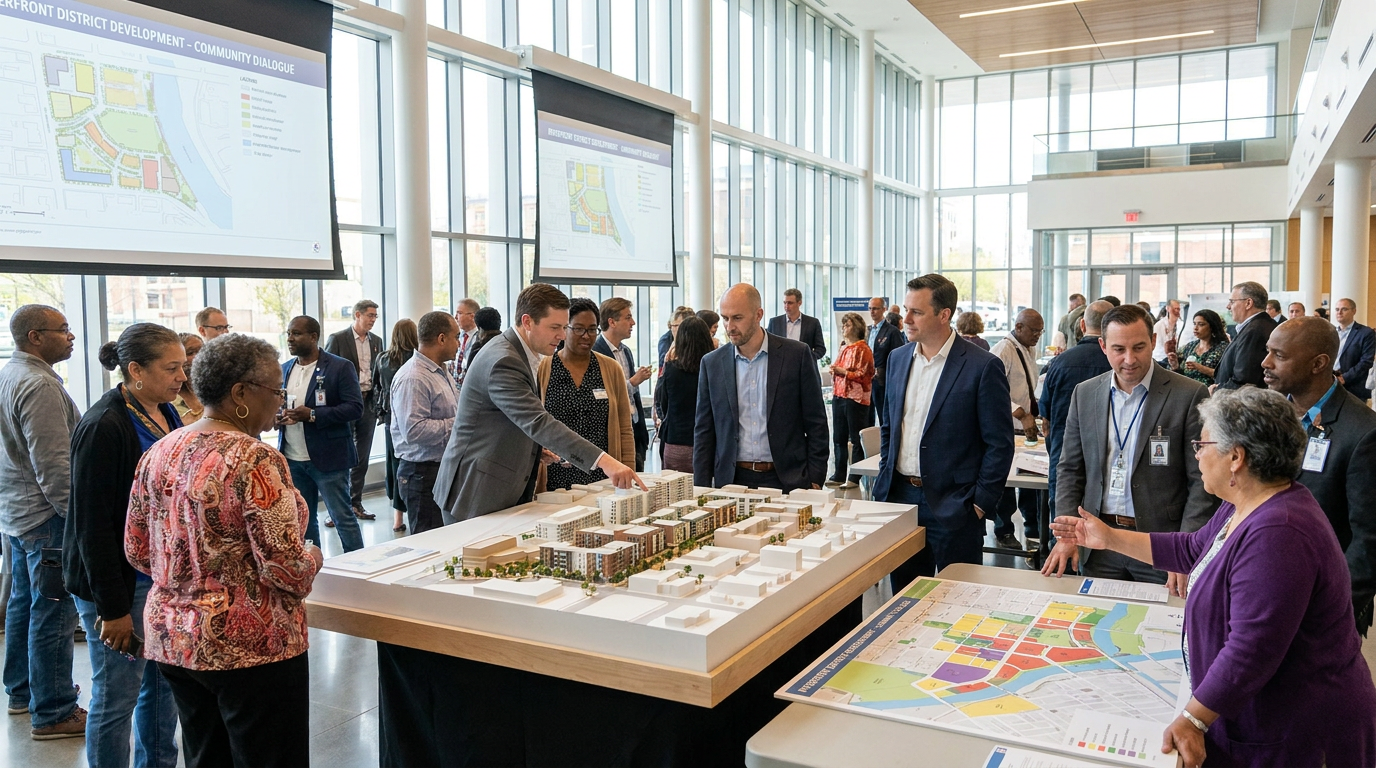
Community Engagement as a Branding Engine
If branding is about trust, then community engagement is one of its most important sources of legitimacy. This is especially true in Canadian development contexts where affordability, infrastructure financing, displacement concerns, and growth management are under intense public scrutiny. CMHC research and project profiles consistently emphasize that community-centric development processes and public engagement are central to successful outcomes. That is not just a governance lesson. It is also a branding lesson.
When engagement is authentic, the brand becomes more than a message delivered to the community. It becomes a story shaped with the community. Residents may help define local priorities, identify cultural references worth preserving, challenge assumptions about amenity needs, or strengthen the project’s response to mobility and public space concerns. The resulting brand is typically more credible because it reflects actual listening and adaptation rather than one-way persuasion. This process can be slower at the beginning, but it often creates stronger long-term support.
Developers sometimes treat engagement and branding as parallel workstreams when they should be integrated. If the engagement process reveals that residents care deeply about family housing, local business retention, Indigenous visibility, public art, flood resilience, or access to community services, those priorities should show up not only in the planning documents but also in the brand narrative and identity. The public can usually tell when a development is speaking in generic language borrowed from another project. Distinctive branding grows from local specificity.
Community engagement also helps prevent one of the biggest brand risks in development: overpromising. A brand built in isolation often defaults to abstract language about vibrancy, connection, and lifestyle. Those terms may sound polished, but they are weak if they are not tied to concrete outcomes. Engagement forces more precision. It clarifies what value actually matters to stakeholders and therefore what the project can credibly claim. This creates a stronger foundation for communications, phasing, and accountability.
From Consultation to Coherence
Effective engagement should not produce a scattered set of promises meant to satisfy every audience in the moment. The goal is to translate diverse input into a coherent place identity. That requires strategic discipline. Developers need to listen broadly, then synthesize what they hear into a compelling framework that can guide design, governance, and market positioning. In this sense, branding is the structure that turns consultation into direction.
For example, if a project is located near transit and adjacent to established neighbourhoods with strong local culture, the emerging brand might center on connected urban living rooted in existing community character. That can then guide everything from streetscape design to retail curation to event programming. The brand becomes a practical decision-making tool. It helps answer which amenities belong, what kinds of partnerships make sense, and how future phases should evolve without losing continuity.
Place Identity and the Value of Narrative
Urban Institute research has shown that place identity and civic narrative can have measurable effects on property markets and neighbourhood perception. This is an important insight for large development projects because it confirms something experienced developers have long observed: places are not valued only for their physical attributes. They are also valued for what they represent, how they are discussed, and who feels invited into them. Narrative can shape confidence, curiosity, and legitimacy.
That does not mean a clever name can create value from nothing. It means symbolic identity interacts with material change. When a project introduces new parks, improved streets, quality housing, mobility upgrades, and active public spaces, a strong narrative helps the market and the broader public interpret those improvements as part of a meaningful destination. The narrative tells people how to read the place. It connects the built environment to a larger idea.
Neighbourhood naming, district identity, and storytelling therefore deserve more attention in land development strategy. However, they must be handled carefully. The best naming and narrative strategies emerge from local history, geography, culture, or future function. The worst feel imposed, generic, or disconnected from the city around them. In a time when communities are increasingly skeptical of manufactured real estate language, authenticity is not optional. It is the basis of brand durability.
Developers should think of narrative as layered. There is the economic narrative, which explains why the project makes sense in terms of housing supply, infrastructure, and long-term growth. There is the civic narrative, which explains how it benefits the broader city. There is the community narrative, which explains how local identity and needs are being respected. And there is the user narrative, which explains what daily life will feel like for residents, workers, and visitors. A mature brand aligns all four.
Branding and Land Value: What It Can and Cannot Do
It is tempting to speak about branding as if it directly increases land value in the same way a zoning uplift or transit investment might. That is too simplistic. Land value is shaped primarily by fundamentals: entitlement potential, infrastructure, location, access, market demand, public realm quality, and the project’s ability to deliver. Branding operates differently. It shapes perception, lowers friction, attracts attention, and builds confidence around those fundamentals.
In practical terms, branding can contribute to stronger outcomes in several ways. It can improve absorption by helping buyers and tenants understand the project more quickly. It can support investor confidence by presenting the development as a coherent long-term district rather than a fragmented sequence of buildings. It can increase public and municipal support by demonstrating that growth is being managed with intention. And it can help attract commercial and institutional partners that want to associate with a place that has clarity and momentum.
There is a sequencing lesson here. Developers should first ensure the core value drivers are real and visible. Transit connectivity, walkable urban design, public realm investment, phasing logic, amenity delivery, and policy alignment need to be in place. Branding can then elevate those strengths, making them easier for the market and the public to perceive. Where those drivers are absent, even sophisticated branding will have limited staying power because the experience of the place will not validate the promise.
This is why some of the strongest development brands are relatively understated. They do not rely on exaggerated luxury cues or detached lifestyle fantasies. Instead, they build confidence through consistency. The brand says what the place will be, and then each phase delivers another proof point. Over time, that alignment can support stronger pricing power, faster trust formation, and more resilient value. The mechanism is credibility.
Case Patterns That Show Branding at Work
Across North America, the most persuasive case patterns are not always found in flashy master-planned communities. They are often found in projects where branding helped organize partnerships, public support, and long-term stewardship. Community land trusts offer one important example. These models frequently use branding and public communication not as a sales exercise, but as a trust-building mechanism. The brand explains the mission of long-term affordability, land stewardship, and community benefit in a way that funders, residents, governments, and partners can understand.
Indigenous-led and community-led housing initiatives provide another strong pattern. In these projects, identity is not cosmetic. It is central to governance, legitimacy, and cultural meaning. The brand may express values of self-determination, continuity, care, and belonging, while the development itself embodies those values through design choices, programming, service partnerships, and long-term management. This is a powerful reminder that branding can support inclusive growth when it reflects who holds authority and how the place is intended to serve people over time.
Urban regeneration districts also reveal the power of branding when paired with real public realm transformation. Former industrial sites, rail lands, aging shopping centres, and underused corridors often face a perception gap. The physical location may have strategic advantages, but the public still associates it with its previous identity. A disciplined branding strategy helps close that gap by presenting a clear future narrative supported by visible upgrades, connectivity improvements, and amenity investments. The brand in this context is a tool for reframing possibility.
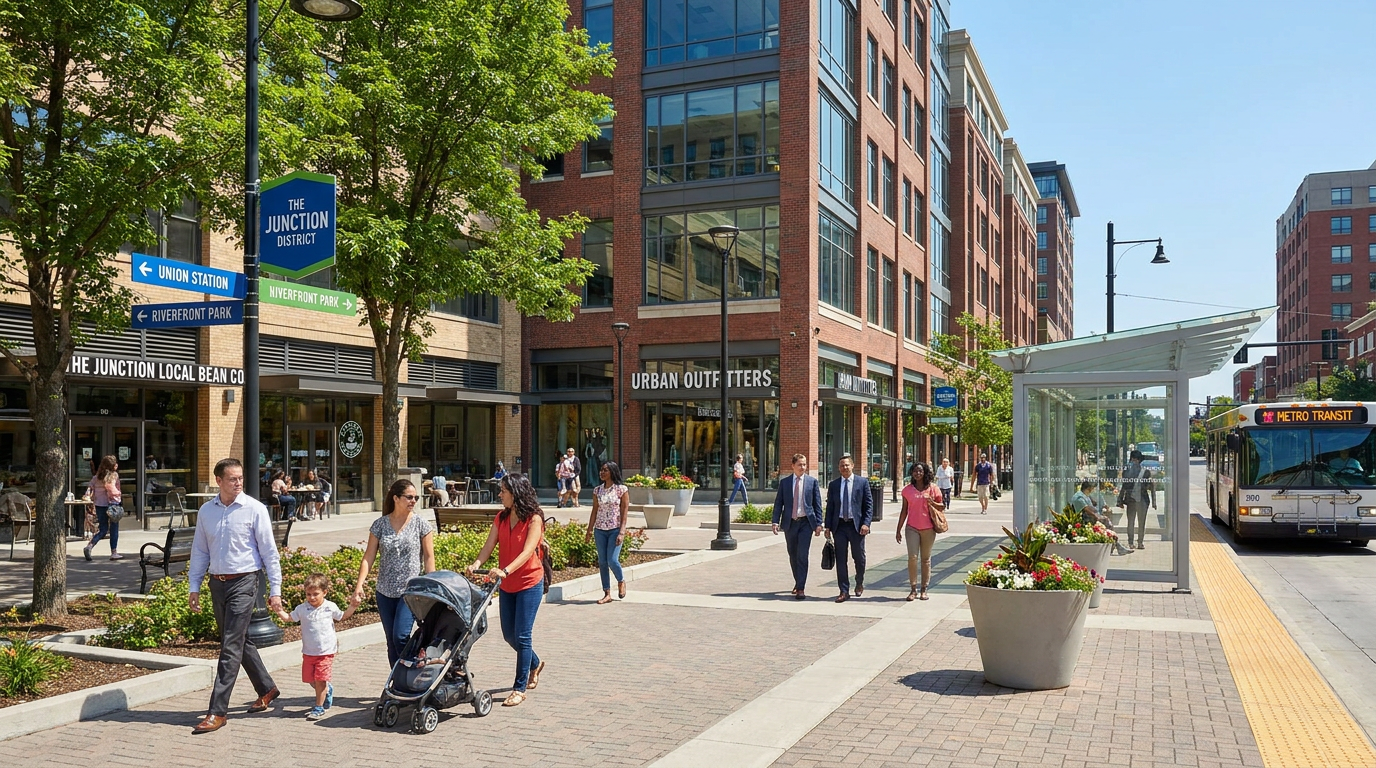
Transit-oriented developments offer perhaps the clearest example of branding aligned with fundamentals. Transit access is a major value driver, but its benefits are not fully realized unless the surrounding district is branded and designed as a complete place. When the identity of the area emphasizes convenience, walkability, mixed-use intensity, and public life, the transit advantage becomes more legible in the market. This can help accelerate absorption and support a stronger long-term urban role for the site.
Core Branding Strategies for Large-Scale Projects
To be effective, a branding strategy for a large-scale development must be built into the project early and then carried through governance, design, engagement, and implementation. The following strategic approaches consistently produce stronger outcomes when they are grounded in the realities of land development and urban growth.
Start with a Place Thesis
Every major project needs a clear place thesis. This is not a slogan. It is a strategic statement of what the development will become in the urban fabric, why that matters, and what distinctive value it will deliver. A strong place thesis might define the project as a transit-connected mixed-income district, a complete family-oriented community, an innovation-focused employment node, or a waterfront neighbourhood centered on public access and civic life. This thesis becomes the foundation for all branding decisions.
Without a place thesis, branding tends to drift toward generic real estate language. With one, the brand can remain focused through entitlement changes, market fluctuations, and phase transitions. It gives decision-makers a framework for what belongs in the project and what dilutes it. It also helps external stakeholders assess the project on terms that are larger than individual buildings or sales launches.
Build the Brand Around Verifiable Commitments
The strongest brands are supported by commitments that can be seen, measured, or experienced. These may include public parks, affordable housing components, transit integration, local retail strategy, sustainability benchmarks, public art, community facilities, or mobility infrastructure. Branding should elevate these commitments, not distract from them. The question should always be whether the message reflects a delivery path that the project can sustain.
This is especially important in multi-phase developments where the early years shape public opinion for the entire project. If the first phase delivers quality public realm, thoughtful activation, and visible signs of the promised identity, the brand gains credibility. If the first phase feels purely transactional, the development may spend years trying to recover trust. Early proof points matter because they set the narrative trajectory.
Integrate Brand Strategy with Master Planning
Brand strategy should be developed alongside master planning, not after it. Land use, block structure, open space networks, street hierarchy, mobility connections, and community amenities all influence place identity. A branding team that arrives too late can only describe decisions already made. A branding team involved early can help ensure the emerging identity is reflected in the physical structure of the district.
This integration often improves strategic clarity. For example, if the brand promise emphasizes everyday convenience and walkability, the plan should prioritize fine-grain pedestrian routes, active frontages, and a visible main street environment. If the brand emphasizes inclusivity and family life, the plan should incorporate schools, parks, community services, and housing diversity in meaningful ways. The built form and the narrative should support each other.
Use Public Realm as a Brand Expression
Public realm is one of the most powerful carriers of brand because it is where the project becomes tangible to everyone, not only to buyers. Streets, plazas, parks, lighting, signage, materials, trees, seating, and programming all communicate identity. They signal whether a project is genuinely urban, family-friendly, culturally rooted, resilient, or community-oriented. In many cases, the public realm does more to establish the brand than any campaign can.
Creative placemaking and equity-focused placemaking are increasingly important here. Culture, art, and local storytelling can shape a development’s identity in ways that are both economically productive and socially meaningful. However, they should be curated with care. Public art or cultural branding should not be used to mask displacement risk or shallow engagement. It should emerge from partnership and respect for the people and histories tied to the place.
Design for Stakeholder Alignment, Not Just Market Appeal
Large projects have many audiences: municipalities, lenders, residents, community organizations, commercial tenants, advocacy groups, transit agencies, and future occupants. Effective branding aligns these audiences around a core vision while tailoring the language to what each group needs to know. The brand should help all parties understand how the project creates value, how it will be delivered, and why it deserves support.
This is where governance and communication discipline become critical. If planning documents, media statements, public consultations, investor materials, and sales messaging all describe the project differently, the brand weakens. Alignment requires internal coordination and clear narrative ownership. One of the most overlooked parts of development branding is simply ensuring that everyone involved is telling the same strategic story.
Common Branding Mistakes in Development
Even experienced teams can undermine a good project through weak branding decisions. One common mistake is overreliance on generic aspirational language. Terms such as vibrant, connected, elevated, or curated may sound contemporary, but they communicate very little unless they are tied to specific urban qualities and commitments. A project should be able to explain exactly how it creates connection, what makes it vibrant, and who benefits from that outcome.
Another mistake is treating branding as a late-stage sales function. By the time a project enters active marketing, many of the most important identity decisions have already been made through planning, design, and engagement. If branding begins only at that point, it often becomes cosmetic. The result is a polished campaign attached to a place that has not been strategically differentiated.
A third mistake is ignoring local context. Development brands that could belong anywhere usually fail to inspire confidence anywhere. People want to know how a project fits into the city they know, what history it respects, what future it enables, and how it relates to the surrounding neighbourhoods. Context is not a limitation. It is often the source of the most compelling identity.
Finally, many projects underestimate the reputational cost of inconsistency. If public commitments around affordability, amenities, phasing, or accessibility are later scaled back without clear explanation, the brand suffers. In large-scale development, credibility compounds either positively or negatively. Trust built in year one can accelerate support in year five. Distrust built in year one can linger for a decade.
The Future of Development Branding: Inclusive Growth and Long-Term Legitimacy
The future of branding in land development is moving toward greater seriousness. It is becoming less about polished imagery alone and more about legitimacy, evidence, and place-based accountability. Equity-centered placemaking, Indigenous-led development, community land trusts, missing-middle housing initiatives, and transit-connected growth are all pushing the industry to think differently about what a development brand should represent. The market still cares about design and aspiration, but it increasingly also cares about governance, inclusion, and long-term stewardship.
This shift is healthy. Cities need growth, but they need growth that can earn trust. In an environment of housing shortages, infrastructure constraints, and rising public scrutiny, branding must do more than sell. It must explain why a project deserves to exist in the form proposed and how it contributes to a broader urban future. That means a stronger relationship between branding and evidence. Developers should be prepared to show how transit access, public space, affordability, sustainability, and community benefits are integrated into the project and not merely referenced in messaging.
It also means branding should be understood as an enduring management tool. A project’s identity should guide decisions well after the first launch campaign. It should inform operations, programming, tenant curation, partnerships, and future phases. In that sense, the brand becomes part of the long-term stewardship of the place. The district continues to evolve, but the underlying promise remains legible and credible.
For developers, this creates both a challenge and an opportunity. The challenge is that shallow branding will be exposed more quickly in a more informed and skeptical environment. The opportunity is that projects willing to invest in authentic place-making, clear stakeholder alignment, and community legitimacy can create lasting competitive advantage. In a crowded market, trust is one of the few differentiators that compounds over time.
Conclusion
Large-scale land development projects are not simply physical undertakings. They are public propositions about how a city should grow, who it should serve, and what kind of places it should create. Branding has become essential because it helps translate that proposition into a coherent and credible identity. When done well, it supports stakeholder alignment, strengthens community engagement, clarifies market positioning, and helps the development realize the full value of its underlying fundamentals.
The most effective branding strategies are rooted in authenticity. They emerge from real planning choices, real public benefits, and real understanding of local context. They treat community engagement as a source of legitimacy, public realm as a carrier of identity, and governance as part of the brand itself. They do not promise what cannot be delivered, and they do not assume image can replace substance.
For the next generation of master-planned communities, regeneration districts, transit-oriented developments, and community-led housing initiatives, branding should be treated as strategic infrastructure. It is the connective tissue between vision and execution, economics and trust, growth and belonging. In a development landscape defined by complexity and long time horizons, that is not a soft advantage. It is a hard one.
Ultimately, the question is not whether a large project will have a brand. Every major development creates a reputation, a narrative, and a public identity whether the team manages it intentionally or not. The real question is whether that brand will be coherent, credible, and aligned with the place being built. The projects that answer that question well are the ones most likely to shape cities positively and endure in value long after construction is complete.


No Comment! Be the first one.