



Hempcrete has become one of the most talked about materials in sustainable construction, but the real story is more grounded and more useful than the headlines often suggest. For homeowners, designers, and builders trying to create healthier and lower impact homes, hempcrete offers a compelling mix of comfort, moisture management, and reduced embodied carbon. It is not a miracle material, and it does not replace good design. What it does offer is a practical way to rethink parts of the building envelope through a bio-based material that fits well within modern residential construction.
Table Of Content
- What Hempcrete Actually Is
- Why Hempcrete Is Attracting Attention Now
- How Hempcrete Is Made and Installed
- Where Hempcrete Fits Best in Residential Building
- Environmental Benefits, With the Right Expectations
- Hempcrete and Energy Efficiency
- The Importance of Moisture Management and Wall Design
- Common Misconceptions About Hempcrete
- Costs, Labor, and Market Realities
- How Hempcrete Compares With Other Sustainable Building Materials
- What Homeowners Should Ask Before Choosing Hempcrete
- The Future of Hempcrete in North American Housing
- Conclusion: A Practical Material for a More Thoughtful Home
- Quick Reference: Key Takeaways About Hempcrete
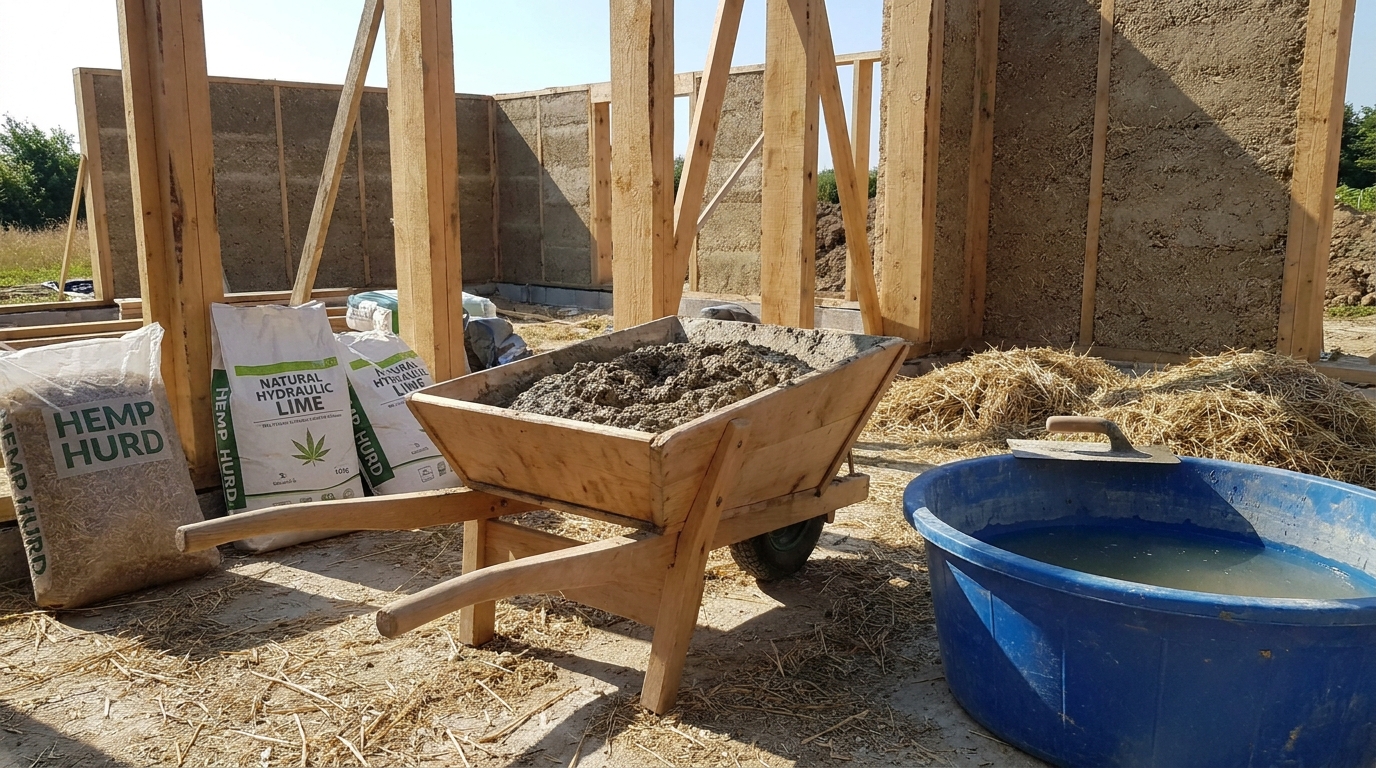
Part of hempcrete’s appeal comes from how approachable it feels. It is made from relatively simple ingredients, and its role in a building is easy to understand once the basics are clear. Hempcrete is a non-structural bio-composite made from hemp hurd, which is the woody inner core of industrial hemp, combined with a lime-based binder and water. That mixture is then placed around or within a structural frame to create an insulating, breathable wall system that can support better thermal comfort and moisture regulation.
In North America, the most relevant application is residential. Hempcrete is most often used in single-family homes, additions, deep energy retrofits, and smaller low-rise buildings where a timber frame or other structural system carries the loads and the hempcrete acts as infill. This distinction matters because many first-time readers assume hempcrete is a direct substitute for concrete or masonry. It is not. Its real value lies in the way it works as part of a wall assembly that is designed for performance, durability, and lower environmental impact.
This article looks at hempcrete from a practical perspective. We will explore what it is, how it is made, where it fits in modern home building, how it performs in real climates, what the recent code developments mean, and where its limitations still matter. The goal is not to oversell it, but to help you understand where hempcrete makes sense and why it is becoming a more serious option for eco-friendly building.
What Hempcrete Actually Is
The name can be slightly misleading, especially for people encountering it for the first time. Hempcrete sounds like a version of concrete, but the comparison only goes so far. While both materials are mixed and placed in a form of wall construction, hempcrete is not designed to carry structural loads in the same way concrete does. A more accurate term is hemp-lime, which reflects its composition and performance more clearly.
The hemp portion comes from industrial hemp hurd, not from hemp fiber insulation and certainly not from any part of the plant associated with intoxication. The hurd is lightweight, porous, and plant-based, which gives hempcrete some of its insulating and moisture buffering properties. The lime-based binder helps hold the material together and contributes durability, vapor openness, and fire resistance within tested assemblies. Water activates the mix and allows it to be cast, sprayed, or formed depending on the construction method.
When combined, these ingredients create a material with a texture and density very different from conventional concrete. Hempcrete is lighter, softer, and more insulating. It is generally used as nonstructural wall infill, roof insulation in some applications, or insulation within floor and envelope systems. In most residential projects, it is cast around timber framing or installed as part of a prefabricated panel or block system.
The easiest way to understand hempcrete is to think of it as a performance layer within a home’s shell. It does not replace the frame, foundation, or structural engineering. Instead, it helps shape the indoor environment by supporting a wall assembly that can store and release moisture, moderate temperature swings, and reduce reliance on more carbon-intensive materials. That role may sound modest, but in building science terms it can be quite meaningful.
Why Hempcrete Is Attracting Attention Now
Interest in hempcrete has been building for years, but recent developments have made it more relevant for mainstream residential construction. One of the most important milestones is the inclusion of hemp-lime construction in the 2024 International Residential Code through Appendix BL. For U.S. builders and homeowners, this is a major step because code recognition can simplify permitting conversations, improve consistency, and give local officials a clearer pathway for approvals.
Code acceptance does not mean hempcrete will suddenly appear in every subdivision, but it does reduce one of the biggest barriers to adoption. In the past, many bio-based materials were slowed by the uncertainty surrounding approvals, testing, and insurance. A recognized code appendix helps move hempcrete from the category of niche experiment into the category of legitimate option. That is especially important for residential construction, where predictability often matters as much as performance.
In Canada, the picture is a bit more varied. Hempcrete is still typically addressed through product approvals, alternative compliance pathways, and project-specific engineering. Adoption can differ significantly by municipality, province, and even the experience level of the local building official. That can make planning more complex, but it does not mean hempcrete is off the table. It simply means early coordination with consultants, suppliers, and permitting authorities is especially important.
Another reason hempcrete is getting more attention is the broader shift toward embodied carbon awareness. More homeowners now understand that a home’s environmental footprint is not only about operating energy. The materials used to construct walls, insulation, finishes, and structural systems also carry carbon impacts. Because hempcrete is bio-based and can offer lower embodied carbon than many conventional wall assemblies, it fits naturally into the conversation about smarter long-term building choices.
Hempcrete is most valuable when it is treated as a well-designed part of a wall system, not as a one-size-fits-all sustainability claim.
How Hempcrete Is Made and Installed
The basic recipe for hempcrete is straightforward, though the performance of the final product depends heavily on proportions, material quality, and installation method. Hemp hurd is mixed with a lime-based binder and water to create a damp, workable composite. The exact binder chemistry can vary by manufacturer or region, and this is important because binder choice has a major influence on both performance and environmental impact. Not all mixes behave the same way, and not all hempcrete products carry the same carbon profile.
In residential construction, hempcrete is often installed around a structural timber frame using temporary formwork. The mix is placed in lifts and lightly tamped to create consistent density without overcompacting it. Once the wall is built up, the forms are removed and the hempcrete is left to dry and cure. Some systems are sprayed rather than hand placed, while others rely on prefabricated blocks or panels to improve speed and consistency.
Drying time is one of the practical considerations that often surprises people. Hempcrete needs time to release moisture after installation, and that can affect project sequencing. The pace depends on climate, thickness, ventilation, and the specifics of the assembly. Builders who are experienced with hempcrete tend to plan around this rather than treating it as a problem, but it does mean the material rewards careful scheduling and realistic expectations.
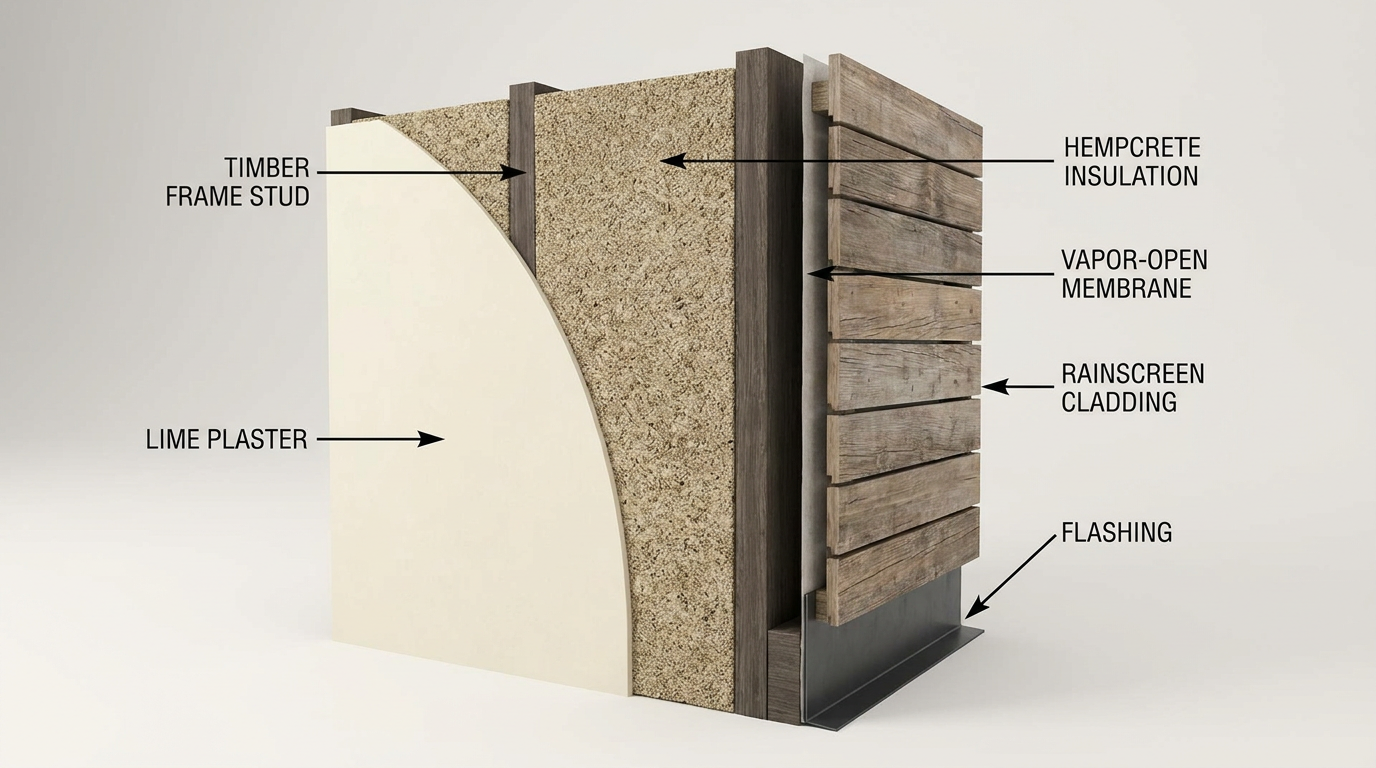
The finish layers matter as much as the core material. Because hempcrete is vapor open and intended to help manage moisture, it is usually paired with compatible plasters, cladding, and air-sealing strategies. Lime plaster is a common interior or exterior finish because it supports the material’s breathability. Exterior assemblies may also include rainscreen cladding and carefully detailed flashing to ensure that rain is managed properly while the wall remains able to dry.
Where Hempcrete Fits Best in Residential Building
Hempcrete is not trying to do every job in a house. It performs best in very specific roles, and that focus is part of what makes it practical. In most homes, it is used as nonstructural wall infill within timber-framed construction. This makes it well suited to custom homes, cottage projects, additions, laneway homes, and other small to medium residential builds where builders have more control over detailing and sequencing.
It can also be a strong fit for homeowners pursuing high-performance envelope strategies inspired by Passive House principles, even if they are not seeking formal certification. Hempcrete can contribute to a comfortable, well-insulated, vapor-open wall assembly that supports indoor air quality and moisture balance. In a retrofit or renovation, it may be used selectively where the assembly can be redesigned appropriately, though this often requires careful planning to integrate structural, moisture, and space constraints.
For people interested in acoustic performance, hempcrete may offer an additional benefit. Its density and fibrous composition can help dampen sound transmission in certain wall assemblies. Fire performance can also be a positive attribute when the specific system has been tested and approved. However, these advantages should always be verified through product data and local code pathways rather than assumed based on the material category alone.
The homes that benefit most from hempcrete are often those where comfort and durability matter just as much as headline efficiency numbers. If a project values low-toxicity materials, moisture resilience, lower embodied carbon, and a calm, stable indoor environment, hempcrete can be a sensible part of the solution. It tends to appeal to people who want sustainability built into the shell of the house rather than added as a superficial feature.
Environmental Benefits, With the Right Expectations
The environmental case for hempcrete is real, but it is strongest when discussed with precision. Hemp is a fast-growing crop, and the hurd used in hempcrete stores biogenic carbon captured during the plant’s growth. That makes hempcrete attractive in life-cycle terms, especially when compared with more carbon-intensive insulation and wall materials. At the same time, the lime-based binder has its own manufacturing impact, and this can be significant.
Recent life-cycle assessment research has shown that hempcrete’s climate impact depends heavily on mix design. The ratio of hemp hurd to binder matters a great deal. So do transport distances and binder chemistry. A 2024 U.S. cradle-to-gate life-cycle assessment reported carbon-negative outcomes for hempcrete compositions that included at least 20 percent hemp by weight. That finding is encouraging, but it does not justify blanket claims that all hempcrete is carbon negative in all situations.
Older and broader LCA work has consistently shown that the binder stage is often the largest source of environmental burden in hempcrete walls. This is an important reminder that sustainability is rarely automatic. A hempcrete wall made with a high-impact binder shipped long distances may still offer benefits, but those benefits can be reduced. Local sourcing, thoughtful chemistry, and efficient wall design help maximize the environmental upside.
For homeowners, the practical takeaway is simple. Hempcrete can be part of a lower embodied carbon home, but only if the design team treats carbon as a measurable objective. That means asking where the hemp was grown, where the binder comes from, how the assembly is detailed, and how much material is truly needed. Good environmental performance is not just about choosing a green-sounding product. It is about understanding the whole system.
Hempcrete and Energy Efficiency
One of the reasons hempcrete continues to attract serious interest is its contribution to indoor comfort and energy-conscious design. Hempcrete offers moderate insulation, but its performance is not limited to a single R-value number. It also provides thermal mass in a lightweight form and, perhaps more importantly, hygrothermal buffering. That means it can absorb, store, and release moisture in ways that help stabilize indoor conditions over time.
Research in Canadian climates, including Ontario and British Columbia, has found hempcrete useful for thermal performance and moisture buffering in residential wall assemblies. These are meaningful findings because Canadian and northern U.S. climates place real demands on building envelopes. A wall that can handle seasonal moisture shifts while supporting thermal comfort is valuable, especially in homes designed to be airtight and efficient.
It is important to avoid oversimplifying what this means for energy bills. Hempcrete is not a shortcut to ultra-low energy use on its own. The full wall assembly, the window package, air sealing, mechanical systems, and orientation all shape how a home performs. Still, hempcrete can support an energy-efficient design by helping create a well-balanced envelope that reduces drafts, moderates humidity, and contributes to more stable indoor temperatures.
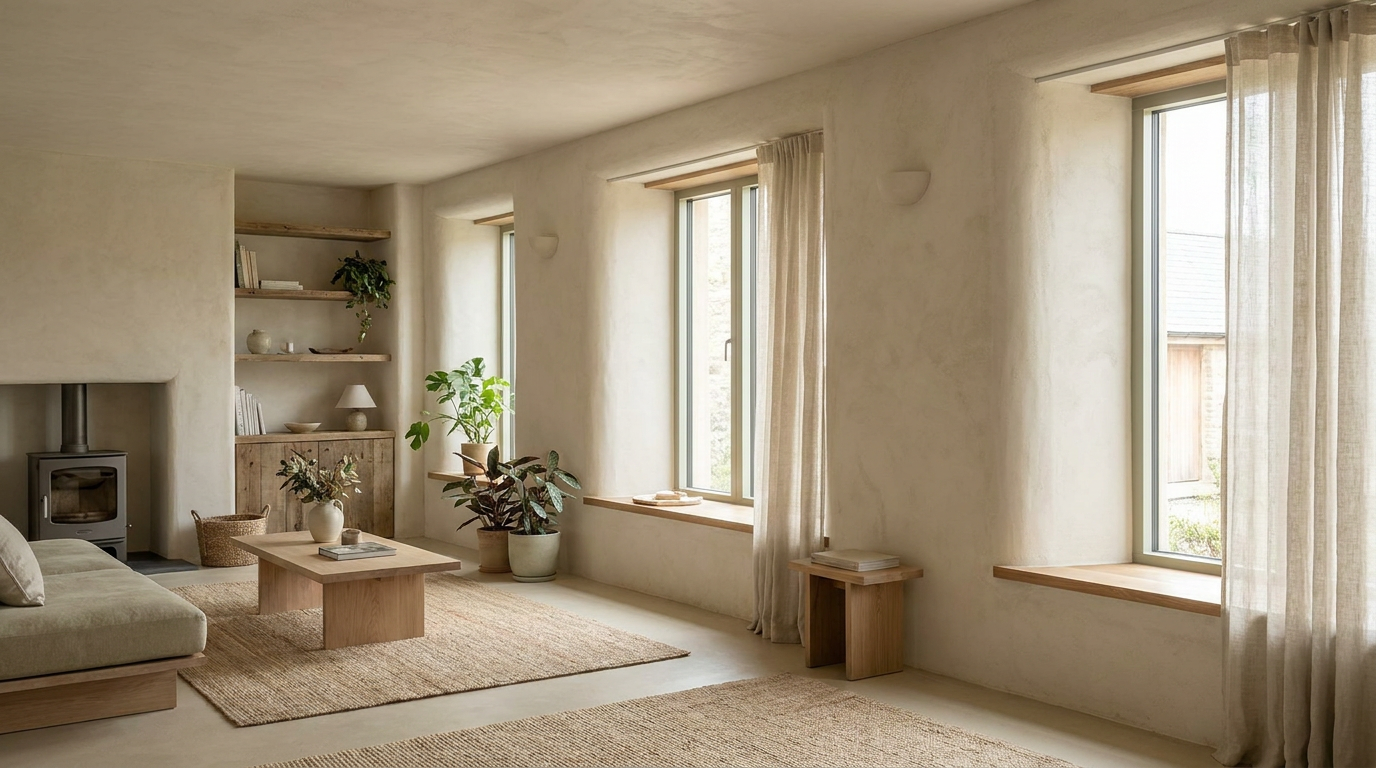
In practice, many people notice the comfort side before they notice the technical numbers. Thick hempcrete wall assemblies often create deep window reveals, a sense of solidity, and a softer thermal feel near surfaces. Rooms can feel less dry or less damp depending on the season because the wall participates in moisture regulation. These qualities do not replace good HVAC design, but they do influence how a home feels day to day, which is one reason the material has such loyal advocates.
The Importance of Moisture Management and Wall Design
Hempcrete is often described as breathable, and that description is useful as long as it is not mistaken for immunity from moisture problems. Breathability in this context means the material is vapor open and can support drying. That can be a real advantage, especially in wall assemblies designed to avoid trapped moisture. However, vapor openness does not eliminate the need for flashing, drainage, air control, and careful detailing.
Good hempcrete design starts with the assembly, not the material alone. The wall should include compatible interior and exterior finishes, a clear weather barrier strategy where required, and proper interfaces around windows, doors, and rooflines. Cladding systems often rely on a rainscreen approach to keep bulk water out while allowing drying. Interior finishes need to work with the wall rather than sealing it inappropriately.
Air sealing deserves particular attention because a wall can be vapor open without being leaky. High-performance homes need well-defined air control layers, and those layers must be integrated into the overall system. This is where experienced designers and builders make a big difference. Hempcrete performs best when it is part of a coherent envelope strategy, not when it is added casually as a substitute for standard insulation without redesigning the assembly.
For homeowners, this is one of the most reassuring truths about sustainable building. Natural materials still benefit from disciplined construction science. Choosing hempcrete does not mean abandoning modern best practices. In many ways, it encourages better ones. When moisture, air, and finish details are handled thoughtfully, hempcrete can become part of a durable and resilient wall rather than a risky experiment.
Common Misconceptions About Hempcrete
Because hempcrete attracts a lot of curiosity, it also attracts a fair amount of misunderstanding. The first and most common misconception is that hempcrete is structural. It is not. It should not be treated as a load-bearing substitute for reinforced concrete, concrete block, or properly engineered masonry. Structural framing still carries the building loads in most residential hempcrete systems.
The second misconception is that hempcrete is automatically carbon negative. As current research makes clear, the answer depends on the mix design, the binder, and transportation. Some formulations can achieve carbon-negative cradle-to-gate results, while others may simply be lower carbon than conventional alternatives. That is still valuable, but it is not the same as an unconditional claim.
A third misconception is that hempcrete is a direct replacement for batt insulation or spray foam in any wall. In reality, hempcrete changes the nature of the assembly. It requires different detailing, thickness, drying considerations, and finish compatibility. This is not a drawback, but it does mean the material should be chosen intentionally rather than inserted into a standard wall without adaptation.
There is also occasional confusion about the hemp itself. Hempcrete does not present an intoxication risk and is not made from the flowering parts associated with recreational or medical cannabis. It uses industrial hemp hurd as a building component. Once mixed with mineral binder, it functions as a construction material, not as a consumer hemp product in the lifestyle sense many people imagine.
Costs, Labor, and Market Realities
Any balanced discussion of hempcrete has to address cost and labor. In many North American markets, hempcrete still costs more than conventional insulation systems, especially where local supply chains are limited. Material costs can be higher, shipping may be more complex, and experienced installers may be harder to find. For custom residential projects, this does not necessarily make hempcrete unaffordable, but it does place it more comfortably in the category of intentional investment rather than default choice.
Labor can also be more intensive than standard insulation installation. Cast-in-place hempcrete requires formwork, mixing, placement, and drying time. Builders who are new to the material may face a learning curve, which can affect scheduling and labor efficiency. That said, growing standardization, increasing supplier support, and emerging prefabricated systems may gradually improve the economics over time.
For homeowners comparing options, it helps to evaluate hempcrete against the broader goals of the project. If the priority is lowest first cost, it may not be the obvious winner in every market. If the goal includes lower embodied carbon, distinctive comfort, vapor-open wall design, and material health, the value proposition becomes more compelling. Like many sustainable choices in housing, it performs best when judged over the long term and in context.
Insurance, financing, and permitting may also require additional conversations, particularly in areas where hempcrete is still unfamiliar. The recent U.S. code recognition helps, but local implementation takes time. Working with a design team and supplier who can provide tested data, product documentation, and clear assembly details will make the process much smoother. Practical adoption is often less about ideology and more about preparation.
How Hempcrete Compares With Other Sustainable Building Materials
Hempcrete sits within a wider family of low-impact and bio-based building materials, and understanding its role means seeing where it differs from the alternatives. Compared with conventional fiberglass batt insulation, hempcrete offers a more monolithic and moisture-responsive wall approach, though batt systems are often simpler and cheaper. Compared with spray foam, hempcrete is typically much more vapor open and can carry a lower embodied carbon profile, but it does not provide the same air sealing on its own and requires a more integrated assembly strategy.
Compared with cellulose insulation, hempcrete is denser and more structurally integrated into the wall cavity, while cellulose often excels in retrofit flexibility and affordability. Compared with wood fiber insulation boards, hempcrete may offer more mass and a distinct moisture behavior, though both belong to the growing category of natural and vapor-open envelope materials. Each material has strengths, and none should be treated as universally superior.
This is a useful lens for sustainable decision-making in general. The best material is rarely the one with the most enthusiastic marketing language. It is the one that fits the climate, budget, skill base, and design intent of the project. Hempcrete has an important place in that conversation because it bridges environmental ambition and real residential application. It is not the answer to everything, but it can be a very good answer to a specific set of needs.
What Homeowners Should Ask Before Choosing Hempcrete
If you are considering hempcrete for a future home or renovation, the quality of your questions will shape the quality of the outcome. It helps to begin with the role of the material in the building. Ask whether the design team sees hempcrete as wall infill, insulation, or part of a hybrid assembly. Clarify where the structural loads are carried and how the air, water, and vapor control layers are being handled. These early questions set the tone for a realistic and successful project.
You should also ask about sourcing and carbon assumptions. Where is the hemp hurd coming from. What binder is being used. Has the supplier provided environmental product data or life-cycle information. If carbon reduction is one of your goals, it is worth asking how the wall assembly compares with a conventional alternative in measurable terms rather than general impressions.
Permitting and construction experience matter just as much. Has the builder worked with hempcrete before. If not, who is supporting installation training or quality control. Has the design team discussed the project with local code officials. The more familiar the team is with the material, the more likely the process will feel calm and predictable rather than experimental.
Finally, ask how the wall will be finished and maintained over time. What cladding or plaster system is being used. How are penetrations detailed. What drying considerations affect the construction schedule. These are not glamorous questions, but they are the ones that turn an interesting material into a durable home.
The Future of Hempcrete in North American Housing
Hempcrete’s future in North America will likely be shaped less by novelty and more by infrastructure. The trends are promising. Model code recognition in the United States is accelerating interest in residential projects. ASTM standards development is helping create more consistent pathways for testing and permitting. At the same time, Canadian discussions around low-carbon construction and circular bioeconomy strategies are increasingly making room for hemp-based materials.
Localized supply chains will be especially important. The environmental and economic case for hempcrete improves when hemp hurd and binders can be sourced more regionally and when trained installers become easier to find. Prefabricated panels and hybrid wall systems may also help the material scale by reducing labor intensity and improving quality control. These kinds of practical improvements tend to matter far more than marketing excitement.
What is encouraging is that hempcrete no longer needs to be framed as futuristic to be interesting. Its appeal is more mature now. Builders are examining it through the lens of code pathways, measured performance, embodied carbon accounting, and climate-appropriate detailing. That is exactly how sustainable materials should enter the mainstream, through evidence, adaptation, and steady refinement.
For homeowners, this means the choice may become less niche over time. As standards improve and examples accumulate, hempcrete may feel less like a custom experiment and more like one option within a broader menu of high-performance building strategies. That kind of normalization is healthy. It allows people to choose the material for the right reasons, not just because it sounds innovative.
Conclusion: A Practical Material for a More Thoughtful Home
Hempcrete offers something increasingly valuable in residential construction: a way to connect environmental responsibility with lived comfort. It is made from hemp hurd, lime-based binder, and water. It is non-structural, vapor open, and best used as an infill or envelope material within a well-designed framed system. When handled thoughtfully, it can contribute to moisture buffering, thermal comfort, acoustic performance, and lower embodied carbon compared with many conventional wall assemblies.
Its strengths are real, but they work best within clear boundaries. Hempcrete is not a load-bearing substitute for concrete. It is not automatically carbon negative in every formulation. It is not a universal replacement for all insulation systems. What it is, however, is a serious and increasingly practical material for homeowners and builders who care about healthier envelopes, climate-conscious choices, and long-term resilience.
The most useful way to think about hempcrete is not as a trend, but as a tool. In the right project, with the right design team and the right expectations, it can help create a home that feels quieter, steadier, and more aligned with a lower impact future. That future does not require perfection. It simply asks for better decisions, made carefully, one wall assembly at a time.
Quick Reference: Key Takeaways About Hempcrete
- Hempcrete is non-structural. It is typically used as infill insulation within a timber frame or other structural system.
- It is made from hemp hurd, a lime-based binder, and water. The exact mix design affects both performance and environmental impact.
- Its main benefits are comfort and moisture management. Hempcrete can support thermal stability, humidity buffering, and vapor-open wall assemblies.
- Code progress is improving adoption. The 2024 International Residential Code includes Appendix BL for hemp-lime construction in the U.S.
- Its carbon story is strong but nuanced. Environmental performance depends on binder choice, transport distances, and hemp-to-binder ratio.
- It requires good detailing. Proper flashing, cladding, plaster compatibility, and air sealing remain essential.
- It may cost more in some markets. Limited supply chains and specialized labor can increase project costs today.
- It works best when chosen intentionally. Hempcrete is most compelling in projects that value low embodied carbon, indoor comfort, and durable envelope design.


No Comment! Be the first one.