



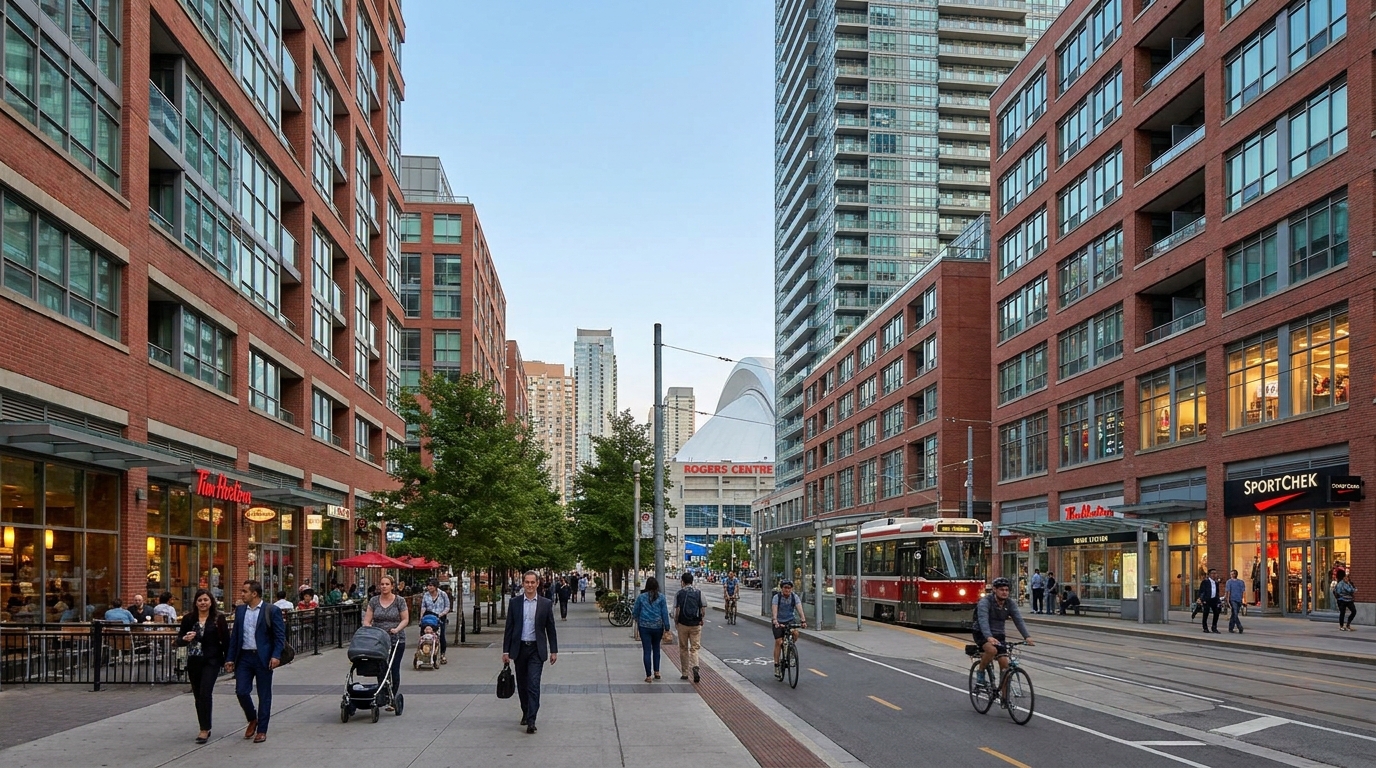
Across North America, sports and entertainment districts have evolved from simple event destinations into powerful urban development tools. A sports and entertainment district is a mixed-use urban precinct built around a stadium or arena that also includes housing, offices, hotels, retail, restaurants, public plazas, transit improvements, and year round programming, rather than a facility that sits dormant outside event nights. The old model was familiar: a stadium or arena placed on a large site, wrapped in parking, active on game nights and largely dormant the rest of the week. The new model is fundamentally different. Today, the most ambitious projects are conceived as mixed-use districts that combine sports venues with housing, offices, hotels, retail, restaurants, public plazas, transit improvements, and year round programming so the area functions as a neighborhood rather than an occasional destination.
Table Of Content
- Why Cities Are Turning to District Scale Development
- The Economics: What Sports Districts Actually Deliver
- From Event Venue to Complete Neighborhood
- Housing Supply and the Urban Growth Agenda
- Transit, Infrastructure, and the Logic of Location
- Case Studies That Illustrate the Shift
- Lansdowne Park, Ottawa
- ICE District, Edmonton
- Arena District, Columbus
- The Risks: Displacement, Subsidy, and Uneven Benefits
- What Good Governance Looks Like
- Strategic Principles for Future Projects
- The Real Opportunity in Mega Developments
This shift matters because cities are under pressure from several directions at once. Housing supply is constrained in many major urban regions, infrastructure dollars are limited, downtowns are competing to remain relevant in a post industrial and increasingly hybrid work economy, and municipal leaders are trying to reduce outward sprawl while directing growth toward serviced land. In that environment, large urban districts anchored by sports and entertainment can become more than branding exercises. They can become strategic mechanisms for land reuse, placemaking, tax base expansion, and denser city building.
At the same time, it is important to be precise about what these projects can and cannot do. A significant body of academic and policy research has found that stadiums and arenas alone rarely generate major metropolitan economic gains. The strongest case for these developments is not that a new arena will transform an entire regional economy by itself. The stronger case is that, when embedded in a disciplined redevelopment strategy, the district surrounding the venue can produce localized economic uplift, unlock infill housing, improve public space, and attract sustained private investment.
That distinction is critical. A sports venue is often the anchor, but the district is the value engine. The real long term question is not whether people will attend games or concerts. It is whether the land around the venue is planned and governed as a complete neighborhood that contributes to the broader city.
In the best examples, sports and entertainment districts act as catalysts for urban transformation. In the weaker examples, they remain isolated entertainment islands or become expensive public commitments without sufficient community return. The future of these projects therefore depends on planning quality, land use strategy, transportation integration, housing outcomes, and the fairness of the public deal.
Why Cities Are Turning to District Scale Development
Municipal governments and private developers increasingly recognize that large parcels of underused urban land are among the most valuable opportunities in city building. Former industrial sites, obsolete commercial lands, aging event facilities, and parking dominated blocks near downtowns represent rare chances to reshape urban form at scale. Sports and entertainment districts fit into this opportunity because they can create a destination anchor while also supporting a broader redevelopment vision.
The appeal is strategic. A major venue can provide identity, foot traffic, and investor attention. Around that anchor, a city can pursue a much larger set of objectives that include residential intensification, commercial activity, tourism, public realm upgrades, and transit support. In effect, the venue becomes part of a wider framework for land value creation. What matters is not just the building itself, but the way it helps organize and accelerate surrounding development.
This is especially relevant in markets where greenfield expansion is increasingly costly and politically contentious. Statistics Canada has documented the environmental and socioeconomic implications of sprawl, reinforcing the need to think seriously about densification and infill. Sports and entertainment districts align with that direction when they are placed on central or inner urban land that can absorb new housing and employment while making use of existing or planned infrastructure.
There is also a timing advantage. District scale projects can concentrate investment, create a visible sense of momentum, and help justify infrastructure that may otherwise be difficult to finance. Streetscape upgrades, transit enhancements, utilities, parks, and public plazas become easier to advance when they support not just a single facility, but a whole new urban quarter with multiple revenue streams and long term tax generation potential.
In other words, cities are not simply building venues. They are assembling redevelopment platforms. The most successful projects treat the district as a city building instrument, not a stand alone entertainment asset.
The Economics: What Sports Districts Actually Deliver
One of the most persistent misconceptions in this field is that a stadium or arena automatically creates broad based economic growth. Decades of research suggest otherwise. Many studies have found limited evidence that sports facilities alone produce strong net metropolitan gains in income, employment, or tax revenue. Spending at games and events is often displaced from other entertainment spending in the city, which means the venue does not necessarily create entirely new economic activity at the regional scale.
That does not mean these projects have no value. It means the value must be understood correctly. The most defensible benefits are usually localized and linked to real estate, urban design, and adjacent investment. A district can increase foot traffic, improve visibility for an area, raise land values, attract private development, expand the tax base, and support new retail and hospitality demand. Those outcomes are real, but they arise from the surrounding mixed-use ecosystem much more than from the venue in isolation.
This is where disciplined analysis matters. Public officials should be skeptical of inflated claims about citywide GDP growth or massive job creation generated by the venue itself. They should focus instead on measurable district impacts: how much housing is added, what underused land is brought into productive use, how infrastructure is financed, whether surrounding streets become safer and more active, and how much private capital is actually mobilized.
The most strategic framing is to see sports and entertainment districts as place based economic development. Their power lies in clustering uses that reinforce each other. A game or concert creates demand for restaurants and hotels. Office workers support daytime retail. Residents create a base of constant activity. Public plazas host festivals and civic events. Over time, the district becomes an environment with its own economic rhythm, rather than a one purpose facility that peaks only on event nights.
The lesson from modern sports districts is simple: the venue may draw attention, but the surrounding neighborhood creates long term value.
For developers, investors, and municipalities, that insight changes the business case. Success depends less on ticket sales and more on the quality of the land plan, the development phasing, the public realm, and the governance structure. In practical terms, the district works when it functions as a genuine urban neighborhood.
From Event Venue to Complete Neighborhood
The defining trend in the sector is the move away from the old sports complex model. Surface parking lots, inward facing superblocks, and isolated facilities are increasingly recognized as inefficient land use in central city locations. They generate low intensity activity, poor walkability, and weak integration with surrounding neighborhoods. In contrast, the modern district model prioritizes continuity with the city.
A complete sports and entertainment district is planned to be active across the day, across the week, and across the year. Residential towers and mid rise buildings bring population. Retail frontages animate the street. Hotels support tourism and convention activity. Offices add weekday demand. Public plazas and cultural programming draw people even when no major sporting event is scheduled. This creates what many planners describe as an 18 hour or 24 hour neighborhood.
The land efficiency of this approach is significant. In high demand urban areas, a large site anchored by a venue can no longer be justified purely as episodic entertainment space. The opportunity cost is too high. Cities need housing, jobs, tax revenue, and public amenities. A mixed-use district can provide all of these, while still retaining the symbolic and civic energy that a sports venue can bring.
This trend also reflects a broader change in urban expectations. Residents increasingly want walkable districts with access to transit, local services, public space, and varied experiences. The most successful entertainment districts now resemble ordinary city neighborhoods at ground level, even if they are organized around an extraordinary anchor. They do not shut down when the game ends. They continue to function as places to live, work, meet, and move through.
Housing Supply and the Urban Growth Agenda
Housing is one of the most important reasons these districts deserve attention today. In many Canadian and North American cities, the central policy challenge is not simply how to grow, but how to grow within existing urban boundaries in a way that is more efficient, more inclusive, and less dependent on long distance commuting. Sports and entertainment districts can contribute to that goal if they are planned as infill communities rather than entertainment compounds.
Ottawa’s Lansdowne redevelopment offers a useful example of this logic. The project was structured as a mixed-use urban village that included 360,000 square feet of retail, 100,000 square feet of office space, and 280 residential units. That matters because it shows how a sports anchored site can support added housing and commercial density in a central city location, rather than preserving low intensity land use around a venue. The redevelopment value came from integrating multiple uses into the site, not from the sports component alone.
There is a broader policy relevance here. CMHC case studies have shown that mixed-use redevelopment can expand housing options, including affordable and accessible units, while reusing underutilized land. This is exactly the kind of framework that can be paired with district led projects. Where land assembly is complex and infrastructure costs are high, a major anchor can help organize financing and market attention around a larger housing outcome.
From a strategic perspective, this is one of the strongest arguments for sports and entertainment districts. They can unlock housing in locations that are already connected to jobs, services, and transit. That is far more valuable in the long run than pushing growth outward to greenfield sites that require expensive new infrastructure and deepen regional sprawl.
Of course, housing benefits do not happen automatically. If a project delivers only luxury residential units, speculative price escalation, and limited local access, then the public value is far weaker. To support city building goals, district plans should address unit mix, affordability targets where feasible, family suitable housing, accessibility, and integration with the surrounding community. Housing cannot be treated as an afterthought in these schemes. It must be one of the central outcomes.
Transit, Infrastructure, and the Logic of Location
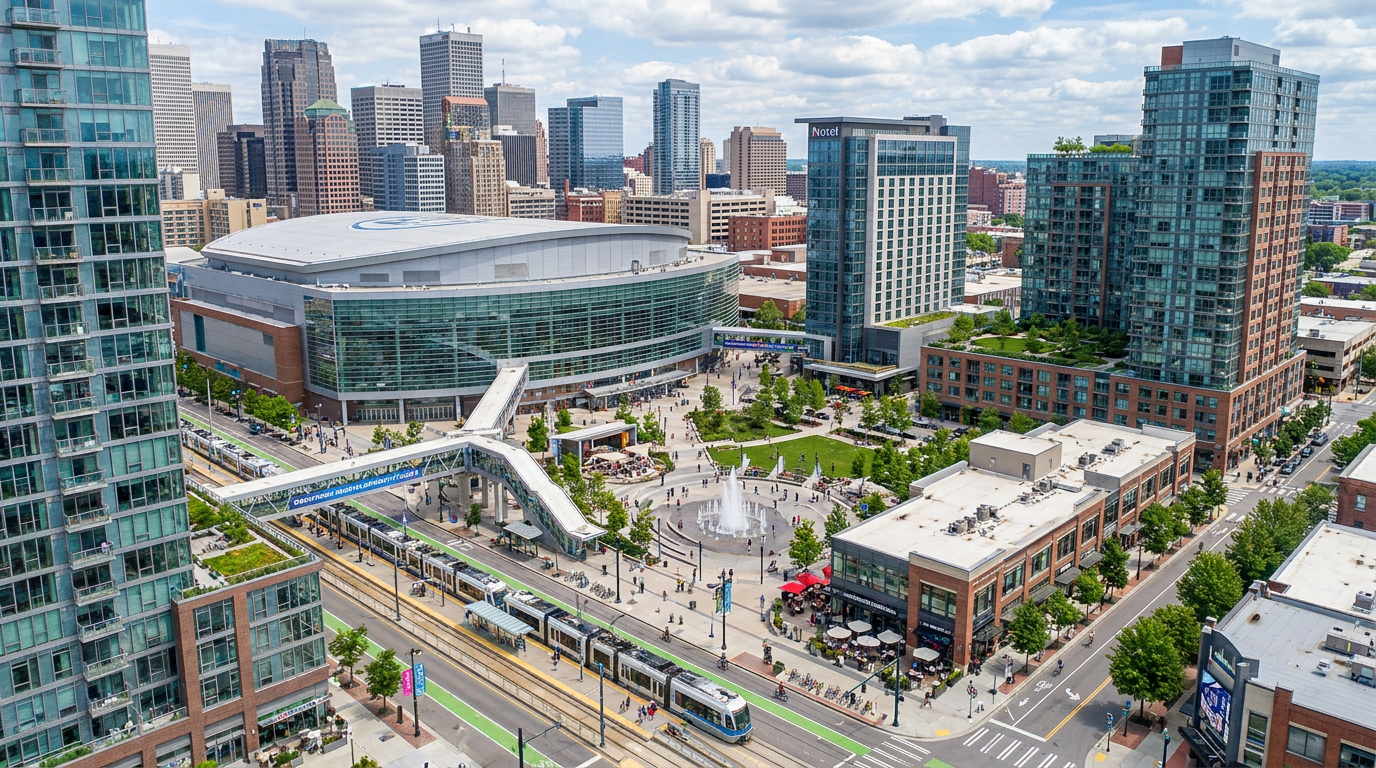
Location is everything in district scale development. A sports and entertainment district performs best when it sits within or adjacent to an established urban area with strong transit access and the capacity to support density. This is not just a design preference. It is an infrastructure strategy. Central locations allow cities to leverage existing networks while concentrating activity where walking, transit, and cycling are realistic choices.
That is why these projects are increasingly tied to transit-oriented development and downtown revitalization. The logic is straightforward. Large event venues already generate concentrated travel demand. Pairing them with rapid transit, regional rail, bus integration, and complete streets can reduce congestion pressure while making surrounding residential and commercial uses more viable. The district then becomes part of a larger mobility ecosystem rather than a traffic problem waiting to happen.
From a development feasibility standpoint, infrastructure alignment is often what separates a strong district from a weak one. Utilities, roads, public spaces, flood protection where needed, and transit access all shape the cost structure and long term performance of the site. Cities that treat the venue as the end point of investment often underperform. Cities that use the venue as a trigger for coordinated infrastructure renewal are more likely to create lasting urban value.
There is also a fiscal dimension. When a district adds density and intensifies land use near serviced areas, it can improve the efficiency of public investment over time. More residents and businesses can share existing networks, and the municipal tax base can expand without the same level of outward infrastructure extension required by suburban sprawl. That does not make these projects cheap, but it can make them more rational in the context of long range growth management.
Case Studies That Illustrate the Shift
Lansdowne Park, Ottawa
Lansdowne Park is one of the clearest Canadian examples of sports led redevelopment being framed as a broader urban village. Located in the heart of Ottawa, the project moved beyond the narrow idea of stadium renewal and instead repositioned the site as a mixed-use destination. With 360,000 square feet of retail, 100,000 square feet of office space, and 280 residential units, Lansdowne demonstrates how a major civic and sports asset can be integrated with commercial density and housing.
What is especially important about Lansdowne is its urban context. This is not a peripheral greenfield entertainment zone. It is a central city redevelopment effort embedded within an existing fabric. That creates both opportunity and complexity. The opportunity is that the site can reinforce surrounding neighborhoods, public life, and economic activity. The complexity is that central city projects must respond to traffic concerns, public expectations, heritage context, and a more intensive level of community scrutiny.
Its significance lies in the planning lesson it offers: redevelopment success comes from the mix of uses, the public realm, and the integration with the city, not just from the sports venue itself. That is the broader takeaway for municipalities considering similar projects.
ICE District, Edmonton
Edmonton’s ICE District is frequently cited as one of the most ambitious modern district models in Canada. Described as a 25 acre mixed-use development, it combines sports, entertainment, residential, hotel, office, retail, and public plaza components. This reflects the full expression of the new district logic. Rather than treating the arena as an isolated object, the project organizes a dense urban environment around it.
From a city building perspective, ICE District illustrates how sports anchored redevelopment can be linked to downtown renewal. It creates a concentration of uses that support activity well beyond event schedules. Workers, visitors, residents, and patrons all contribute to a more continuous urban economy. This kind of intensity is exactly what many downtowns need as they adapt to changing employment patterns and seek to maintain relevance as mixed use centers.
It also shows why public realm design matters. Plazas, streets, and pedestrian circulation are not decorative add ons in a district like this. They are part of the operating system. If the spaces between buildings are attractive and functional, the district can perform as a neighborhood. If they are weak, then even major capital investment can still feel fragmented.
Arena District, Columbus
Columbus offers a compelling U.S. example of how a sports led district can mature into a permanent employment and business center. The Arena District is marketed as home to more than 75 businesses and 17,000 workers. That fact alone helps explain the broader economic logic. The district is not simply a place to watch sports. It has become a working part of the city economy.
This matters because it reflects a successful transition from event based identity to diversified urban function. Employment density, business presence, and sustained activity are strong indicators that a district has moved beyond novelty and into structural relevance. It becomes a neighborhood with an economic base, not just a destination with occasional surges of visitors.
For cities evaluating new projects, Columbus reinforces the importance of long term land use planning. If the surrounding parcels are developed intentionally, a sports anchor can help seed a larger commercial and residential ecosystem. If they are not, the opportunity can be lost for decades.
The Risks: Displacement, Subsidy, and Uneven Benefits
For all their potential, sports and entertainment districts can also create serious problems when poorly governed. The most common risk is that public excitement around a high profile venue can obscure the actual distribution of costs and benefits. If public subsidies are large, private gains are concentrated, and community protections are weak, the district may deliver a polished image while generating limited public value.
Displacement is one of the most pressing concerns. Major redevelopment can drive up land values, rents, and speculative activity in surrounding areas. Without anti displacement measures, small businesses, tenants, and long standing communities may face rising pressure precisely because the district becomes more successful. Recent U.S. arena debates have brought this issue into sharper focus, showing how redevelopment proposals can trigger strong resistance when residents believe they will bear the social cost of an externally driven vision.
There is also the question of fiscal accountability. Public subsidies are often justified using optimistic projections about jobs, tourism, and tax generation. Yet many studies show these claims can be overstated. Some jobs are temporary, some spending is shifted from other parts of the city, and some revenues take longer to materialize than expected. This does not mean public investment is never warranted. It means the rationale must be grounded in credible district wide outcomes rather than promotional arithmetic.
Another risk is poor urban design. Even projects branded as mixed use districts can underperform if they remain inward looking, car dominated, or disconnected from their surroundings. A cluster of towers around an arena is not automatically a neighborhood. The district must work at the level of streets, blocks, uses, and public access. It must feel permeable, safe, and welcoming on ordinary days, not only during major events.
Finally, there is the governance question. Large projects often involve public-private partnerships, layered land ownership, and long development timelines. Without clear accountability, transparent approvals, and measurable obligations, the public sector can lose leverage over outcomes that matter most, including housing delivery, affordability, infrastructure quality, and community access.
What Good Governance Looks Like
If sports and entertainment districts are to serve as credible redevelopment tools, they need strong governance frameworks from the start. That begins with a clear public interest test. City leaders should ask what specific outcomes justify public participation in the project. Those outcomes might include housing supply, transit integration, remediation of underused land, public space creation, tax base expansion, heritage reuse, or downtown revitalization. The key is that they must be explicit and measurable.
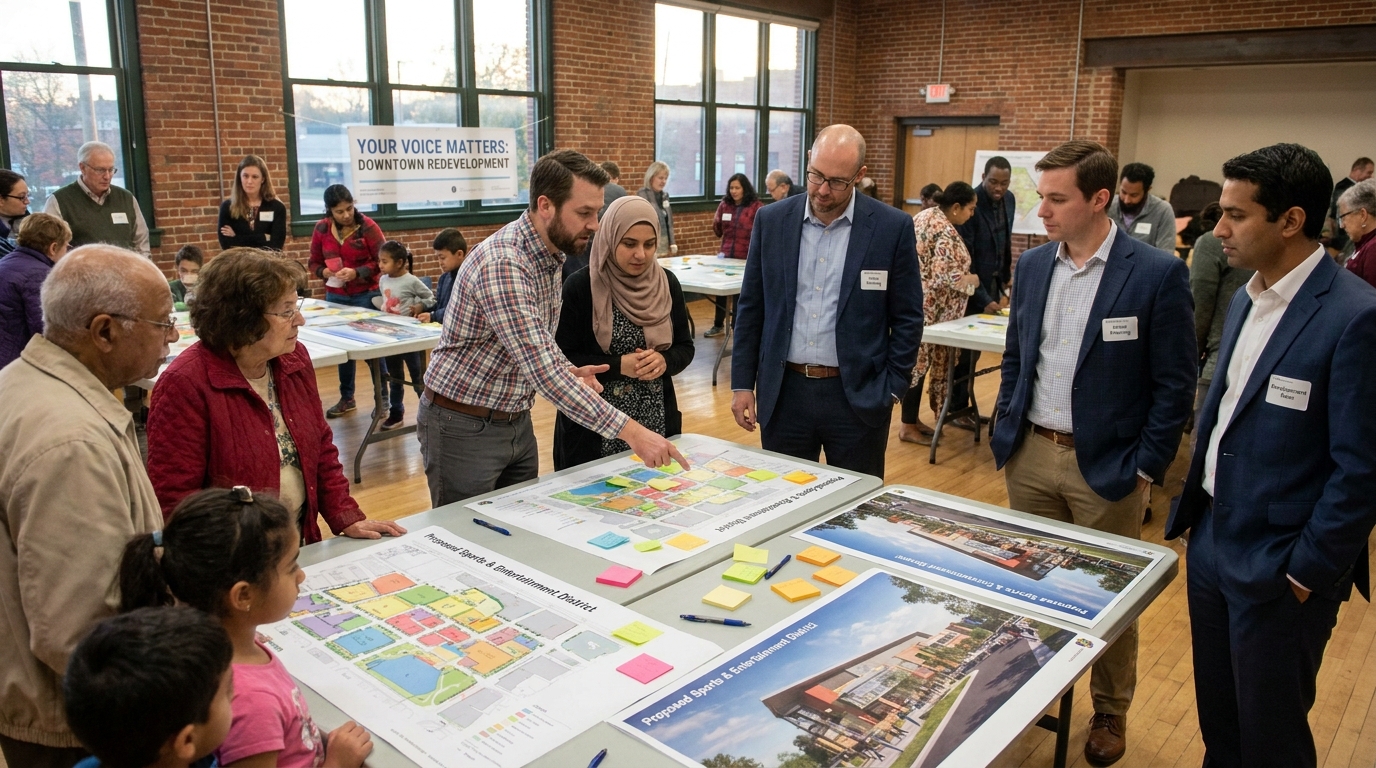
Community participation is equally important. Large districts reshape neighborhoods for generations, so local residents and businesses should not be treated as an afterthought. Meaningful consultation can improve design, identify pressure points, and build legitimacy. In some cases, community benefits agreements may help ensure that local hiring, affordable commercial space, public amenities, or other commitments are formalized rather than left to goodwill.
Housing strategy should also be embedded into approvals and phasing. If residential development is central to the value proposition, then municipalities should examine not just the total unit count but the tenure mix, affordability components, accessibility standards, and timing of delivery. A district that promises housing in concept but prioritizes only entertainment and premium commercial uses in practice may fail its broader city building mandate.
Transportation planning must be integrated at the district scale. This includes transit access, curb management, pedestrian circulation, cycling infrastructure, and event day operations. The objective is not merely to move crowds efficiently a few nights a year. It is to create a location that supports daily urban life without overwhelming surrounding streets and communities.
Finally, public agreements should address value capture and long term accountability. If land values rise significantly because of public action, there should be mechanisms to ensure some of that uplift supports public goals. Those tools can vary, but the principle is sound: when a district benefits from collective investment, the public should share in the return.
Strategic Principles for Future Projects
Looking ahead, the strongest sports and entertainment districts will be those that understand themselves as part of a larger urban growth strategy. The venue can be iconic, but the district must be practical. It must provide land use intensity, social value, transportation logic, and financial resilience. In my view, the most effective future projects will share several strategic characteristics.
-
They will prioritize mixed use from day one. Residential, office, hospitality, retail, and civic uses must be planned together so that the district works on both event days and ordinary weekdays.
-
They will be built on well located urban land. Central sites, transit accessible areas, and underused parcels with redevelopment potential offer the greatest long term public return.
-
They will support housing supply. In a housing constrained environment, large district projects should be expected to contribute meaningful new units and, where possible, a broader range of affordability and accessibility outcomes.
-
They will invest in the public realm. Streets, parks, plazas, and walkability are not cosmetic features. They are what make a district function as a place people choose to spend time in beyond scheduled events.
-
They will address equity directly. Anti displacement measures, local economic inclusion, and transparent public benefits are necessary to ensure redevelopment does not simply transfer value upward while externalizing social costs.
-
They will be judged on district outcomes, not arena headlines. The enduring measure of success is what the project adds to the city over time: homes, jobs, tax base, quality public space, better connectivity, and neighborhood vitality.
The Real Opportunity in Mega Developments
In the world of mega developments, sports and entertainment districts occupy a unique position. They are visible, politically charged, emotionally resonant, and often expensive. That combination can produce either remarkable city building or disappointing underperformance. The difference lies in whether decision makers are disciplined enough to treat the project as a long term urban strategy rather than a short term spectacle.
The opportunity is substantial. These districts can reclaim underused land, bring residents and businesses into central locations, strengthen downtown ecosystems, and create public spaces that become part of the civic identity of a city. They can link infrastructure upgrades with private investment and make denser growth more marketable and more coherent. In an era when municipalities need to do more with serviced land, that is a powerful proposition.
But the opportunity must be earned. Sports venues are not magic economic engines, and district branding does not guarantee public benefit. The best projects are those that align entertainment with housing, mobility, commercial intensity, and community value. They succeed because they are fundamentally about city building.
That is why the conversation around these developments needs to mature. We should stop asking whether a stadium alone will transform the economy and start asking whether a district can deliver a better urban future. Can it add housing where infrastructure already exists? Can it create a more complete neighborhood instead of a parking dominated enclave? Can it improve public space, support transit, and attract investment without displacing the people and businesses that gave the area its identity? Those are the right questions.
When the answers are yes, sports and entertainment districts can become some of the most effective redevelopment tools available to growing cities. Not because of the scoreboard, but because of the land plan. Not because of one building, but because of the district it makes possible.
For planners, developers, and municipal leaders, that is the strategic lesson. The future of these projects will not be defined by architecture alone. It will be defined by governance, integration, and the courage to use high profile investments to solve real urban problems. If we approach them with that level of seriousness, sports and entertainment districts can help build not just better venues, but better cities.


No Comment! Be the first one.