



There was a time when the phrase smart home brought to mind blinking devices, complicated remotes, and a certain visible obsession with technology. Today, the conversation has matured. The most compelling smart interiors are not built around gadgetry for its own sake. They are composed with the same care as any beautiful room, where proportion, texture, light, and rhythm remain central, and technology quietly supports the experience of living. In modern design, intelligence has become less about spectacle and more about elegance.
Table Of Content
- What Smart Interiors Really Mean
- The Aesthetic Principle: Technology as Invisible Infrastructure
- Why Interoperability Matters More Than Ever
- How to Choose a Future-Friendly Ecosystem
- The Practical Benefits: Comfort, Efficiency, and Everyday Ease
- Room-by-Room Ideas for Elegant Smart Integration
- The Living Room
- The Kitchen
- The Bedroom
- The Entry and Hallway
- Practical Tips for Homeowners Starting Out
- Security, Privacy, and the New Etiquette of Smart Living
- Designing for North American Homes and Retrofit Realities
- How to Maintain Sophistication While Adding Technology
- The Future of Smart Interiors
- Conclusion: A More Graceful Way to Live
This shift matters because homeowners no longer want a house that feels like a showroom of devices. They want rooms that are calm, intuitive, and visually resolved. They want lighting that adapts to the hour, shades that lower with the afternoon sun, heating that responds to real patterns of use, and sound systems that disappear into the architecture. They want all of this without sacrificing the softness of a linen curtain, the sculptural simplicity of a plaster wall, or the serenity of uncluttered surfaces.
Smart interiors sit at the intersection of interior design, home automation, and energy management. Their success depends not on how many products are installed, but on how gracefully those systems work together. In practice, the best smart homes treat technology as infrastructure. Wiring is concealed, interfaces are restrained, and devices are chosen for compatibility and long-term usefulness rather than novelty. This is especially relevant in North America, where adoption continues to grow. Statistics Canada reported that internet-connected smart home device use rose from 42 percent in 2020 to 47 percent in 2022, with smart speakers at 30 percent as the most common device. Kingsgate Luxury Homes has embraced this same philosophy in its own custom builds, weaving smart home automation seamlessly into refined interiors rather than layering it on top — you can see that approach in action at 3B Stuart Ave, North York.
For homeowners, this is an encouraging evolution. A smart interior does not require a total renovation or an all-or-nothing approach. It can begin with one room, one concern, or one repeated inconvenience. The most sophisticated homes are often those that use relatively few technologies, but use them exceptionally well. A well-programmed lighting scene, a thoughtful thermostat, and discreet motorized shades can do more for comfort and atmosphere than a dozen visible devices scattered across a room.
This article explores how smart technology is reshaping interior design with a focus on practical, beautiful implementation. From interoperability and invisible tech to energy savings and digital privacy, the goal is to help homeowners build spaces that feel both current and timeless. Smart interiors are not about making a home look more technological. They are about making a home feel more considered.
What Smart Interiors Really Mean
At its heart, a smart interior is a thoughtfully designed environment in which technology supports comfort, function, and beauty. That may include connected lighting, climate control, security, audio systems, air quality monitors, motorized window treatments, hidden charging stations, and occupancy sensors. Yet the defining principle is not simply connectivity. It is coordination. Each element should contribute to an atmosphere that feels seamless rather than mechanical.
One of the most common misconceptions is that smart interiors require visible devices in every corner. In reality, the strongest projects aim for visual discretion. Speakers are recessed into ceilings or concealed behind finishes. Charging ports are integrated into millwork. Thermostats are selected for their minimal profile or positioned with intention rather than treated as afterthoughts. Control is distributed through a combination of wall switches, scenes, voice, apps, and automation, so no single interface dominates the room.
Another misconception is that smart design means fully automated living. It does not. A home does not need to react to every movement or command to be intelligent. Sometimes the most elegant solution is modest and precise. A hallway that glows softly at night through motion sensing, a bedroom that cools before sleep, or a living room that shifts from bright daytime clarity to evening warmth with one touch can transform daily routines without becoming intrusive.
This subtlety is what makes smart interiors so compelling within modern design. They align with a broader preference for calm spaces, reduced clutter, and tailored functionality. In smaller urban homes, this is particularly valuable. When rooms perform multiple roles, technology that simplifies transitions without adding visual bulk becomes an asset. Smart interiors support this flexibility by helping one room become many things across the day while still looking composed.
The Aesthetic Principle: Technology as Invisible Infrastructure
The finest interiors have always relied on hidden systems. Plumbing, heating, ventilation, and structural supports do not announce themselves, yet they shape the comfort and function of a room. Smart technology works best when approached in the same way. Rather than asking which devices to display, it is more useful to ask what experiences the room should deliver and how technology can quietly make them possible.
Consider lighting. A beautiful room is rarely dependent on one overhead fixture alone. It is built through layers. There may be ambient light for general illumination, accent light for artwork or shelves, task lighting for cooking or reading, and low evening light to create intimacy. Smart controls elevate this layered approach by allowing scenes to be programmed around real moments. Morning preparation, daytime work, dinner, entertaining, and late-night circulation can each have their own atmosphere. The result is not simply convenience. It is a more nuanced and emotionally resonant space.
The same philosophy applies to window treatments. Motorized shades are one of the most transformative additions to a smart interior because they affect light, privacy, thermal comfort, and visual order all at once. In a refined room, dangling cords and unevenly adjusted blinds can undermine the architecture. Quiet, well-integrated shades preserve clean lines while responding to sunlight and schedule. In colder North American climates, they also contribute to energy management by reducing heat loss at night and controlling solar gain during the day.
Audio and charging can be handled with the same restraint. A room with portable speakers, visible wires, and chargers scattered across surfaces feels interrupted. Built-in or concealed systems restore visual calm. This is one reason the language of smart interiors increasingly overlaps with the language of luxury. Luxury today is often defined less by excess and more by ease. It is the feeling that everything has been considered and nothing is competing for attention.
Beautiful smart design does not put technology on display. It lets comfort, atmosphere, and function take center stage while the systems themselves recede into the architecture.
Why Interoperability Matters More Than Ever
Behind every graceful smart interior is a technical question that has become increasingly important for homeowners: will these systems work together well over time? This is where interoperability enters the conversation. A home may include lighting from one brand, a thermostat from another, a lock from a third, and voice or app control from a larger ecosystem. If these pieces cannot communicate reliably, the experience becomes fragmented. The room may look elegant, but daily life feels cumbersome.
The rise of Matter has significantly influenced this landscape. Matter is the leading interoperability standard for smart homes, designed to improve compatibility across brands, simplify setup, and increase reliability. Its development reflects a broader industry shift away from isolated devices and toward connected ecosystems that are easier for homeowners to manage. Recent releases have continued to expand what Matter can support. Matter 1.5 broadened capabilities around cameras, closures, soil sensors, and energy management, while Matter 1.6 focused on more intuitive setup, context-driven control, and multi-ecosystem experiences.
For the homeowner, this has direct design implications. Choosing products with strong interoperability can protect the interior from constant churn. It reduces the likelihood that a room will require additional hubs, redundant controls, or mismatched upgrades later on. It also supports a more flexible design strategy. A house can evolve room by room, with confidence that future additions will integrate more smoothly into the existing system.
This modular quality is essential in North American homes, where retrofitting is often more realistic than full-scale rebuilding. Whether working with a suburban family home, a downtown condominium, or a heritage property, most homeowners need solutions that can grow over time. Interoperability allows the smart interior to become an ongoing design framework rather than a one-time technical installation. That is a much more sustainable and aesthetically stable approach.
How to Choose a Future-Friendly Ecosystem
When selecting smart products, it helps to think like a designer and a planner at once. Start by identifying the systems that matter most to everyday comfort. For many households, that means lighting, climate, security, and shades before anything else. Then evaluate whether the products under consideration support major ecosystems and standards such as Matter. This does not guarantee perfection, but it improves the odds of reliable coordination.
It is also wise to favor brands that offer clear software support, regular updates, and a reputation for stability. A beautiful device that quickly becomes obsolete is poor design in any era. Homeowners should look for products that can function through more than one interface, such as physical controls, apps, voice, and automations. This layered approach creates resilience. If one method is inconvenient in a particular moment, another is readily available.
Finally, think beyond the immediate purchase. A smart interior should support the life of the home for years. Choosing interoperable, well-supported products is not just a technical decision. It is part of preserving visual coherence, reducing replacement waste, and ensuring that the design remains composed as technology evolves.
The Practical Benefits: Comfort, Efficiency, and Everyday Ease
One reason smart interiors have moved beyond trend status is that their benefits are both experiential and measurable. A well-designed system can make a home more comfortable while also reducing unnecessary energy use. This is especially relevant in regions with strong seasonal swings, where heating and cooling significantly shape household costs and daily comfort.
Smart thermostats are one of the clearest examples. According to ENERGY STAR, certified smart thermostats are independently tested using field data to deliver energy savings. The U.S. Department of Energy also identifies connected thermostats as useful tools for monitoring, optimization, and reduced power use. These devices allow homeowners to build more precise schedules, adjust temperatures remotely, and avoid conditioning empty spaces unnecessarily. In practical terms, that means a house can feel more tailored to real life instead of operating according to blunt, static settings.
Yet a thermostat is not only an energy device. It is also part of the sensory experience of a room. Interiors are felt as much as they are seen. A living room that remains too warm in the afternoon or a bedroom that never quite cools by night cannot be truly luxurious, no matter how beautiful the furnishings. Smart climate control helps correct this by aligning environmental conditions with the rhythms of use. Comfort becomes more intentional, and that intention is a design quality in itself.
Lighting offers similarly practical rewards. Motion-sensitive lighting in transitional spaces can reduce waste and increase safety. Scene-based controls can ensure lights are not left on at full intensity all evening when softer illumination would suffice. Motorized shades can be programmed to respond to sunlight, reducing glare and helping with thermal regulation. Together, these systems support a home that feels more alive to its environment and more considerate in its resource use.
Room-by-Room Ideas for Elegant Smart Integration
The Living Room
The living room is often the emotional center of the home, making it one of the best places to begin. Smart lighting scenes are particularly effective here because the room usually serves several purposes across the day. It may function as a reading area in the morning, a family gathering space in the afternoon, and an intimate entertaining room in the evening. Layered controls allow the mood to shift without constant manual adjustment.
Consider combining dimmable ambient lighting with accent lighting for artwork or built-ins, then adding a single scene control for evening use. Hidden speakers or integrated multi-room audio can preserve the visual quiet of the space while improving how the room is experienced. If the room receives strong sun, motorized shades can help protect textiles and finishes while reducing glare on screens. Each intervention is subtle, but together they create a living room that feels polished and responsive.
The Kitchen
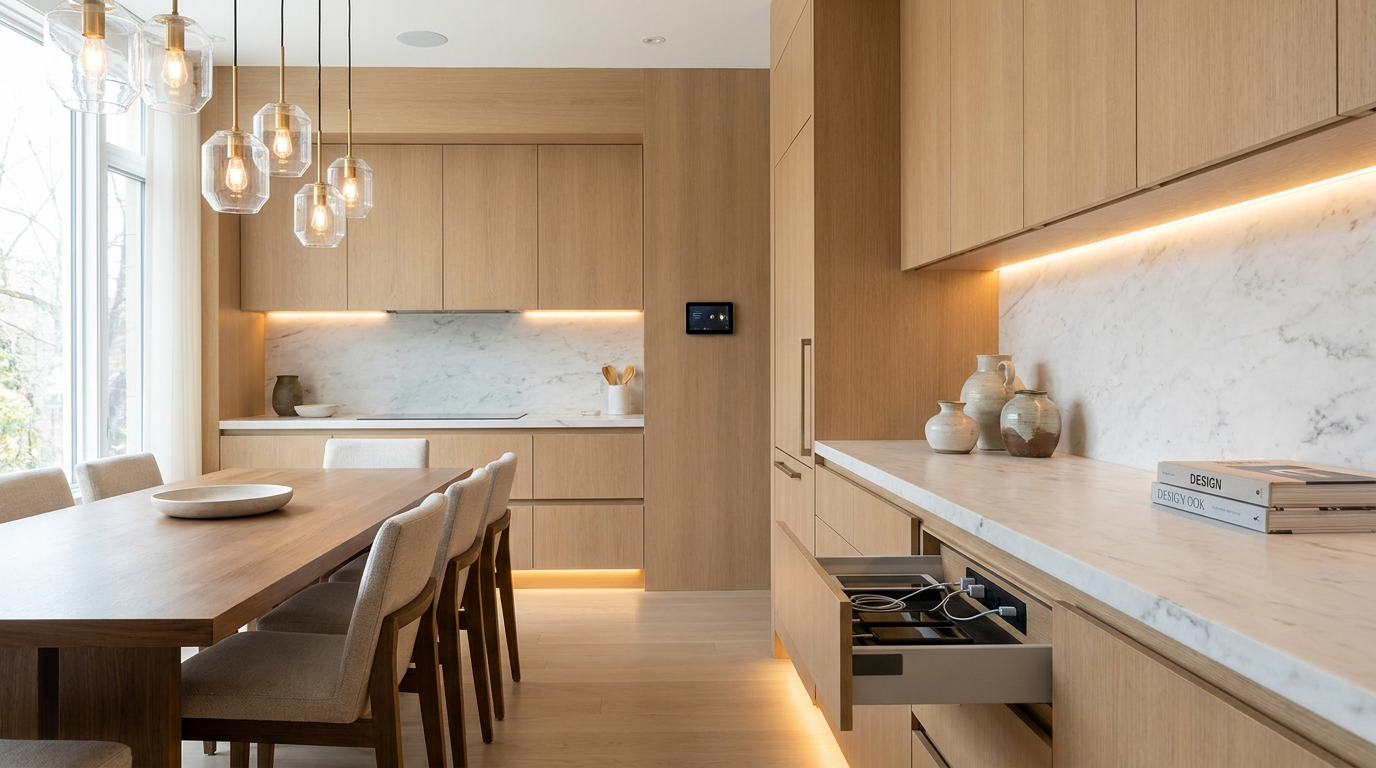
The kitchen benefits from smart design when practicality and restraint are balanced carefully. This is a room where clutter accumulates quickly, so hidden charging drawers, integrated under-cabinet lighting, and well-placed task scenes are particularly valuable. A kitchen should feel bright and precise when preparing meals, then soften gracefully when the day transitions into dining or conversation.
Smart controls can support this shift. Under-cabinet lights can activate gently in the early morning, while pendants over an island can dim to a warmer glow at dinner. Appliances may be connected, but the most design-friendly choices are often those that add convenience without crowding the visual field with screens and alerts. In smart kitchen design, less display and more orchestration usually lead to a more elegant result.
The Bedroom
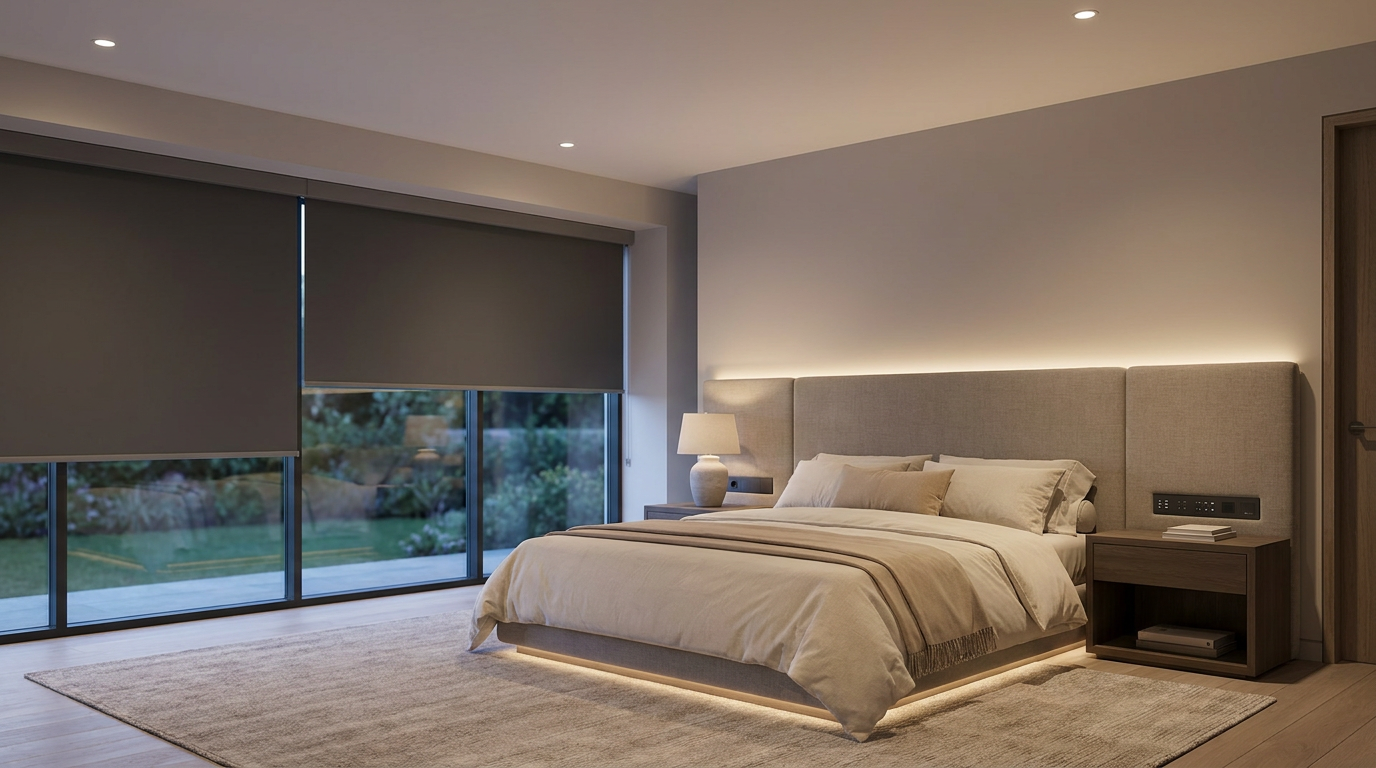
The bedroom may be the most intimate example of how smart interiors can improve quality of life. Here, technology should support restoration rather than stimulation. Motorized blackout shades, circadian-friendly lighting, discreet bedside controls, and a programmed temperature schedule can all contribute to better sleep conditions. The room remains serene, but it becomes more responsive.
Instead of relying only on voice control, bedrooms benefit from tactile simplicity. A quiet wall keypad, a bedside scene button, or a gently lit pathway to the bathroom can feel more intuitive in late hours. The aim is not to fill the room with functionality, but to reduce friction at vulnerable moments of the day. In the bedroom, smart design is successful when it feels almost invisible and deeply comforting.
The Entry and Hallway
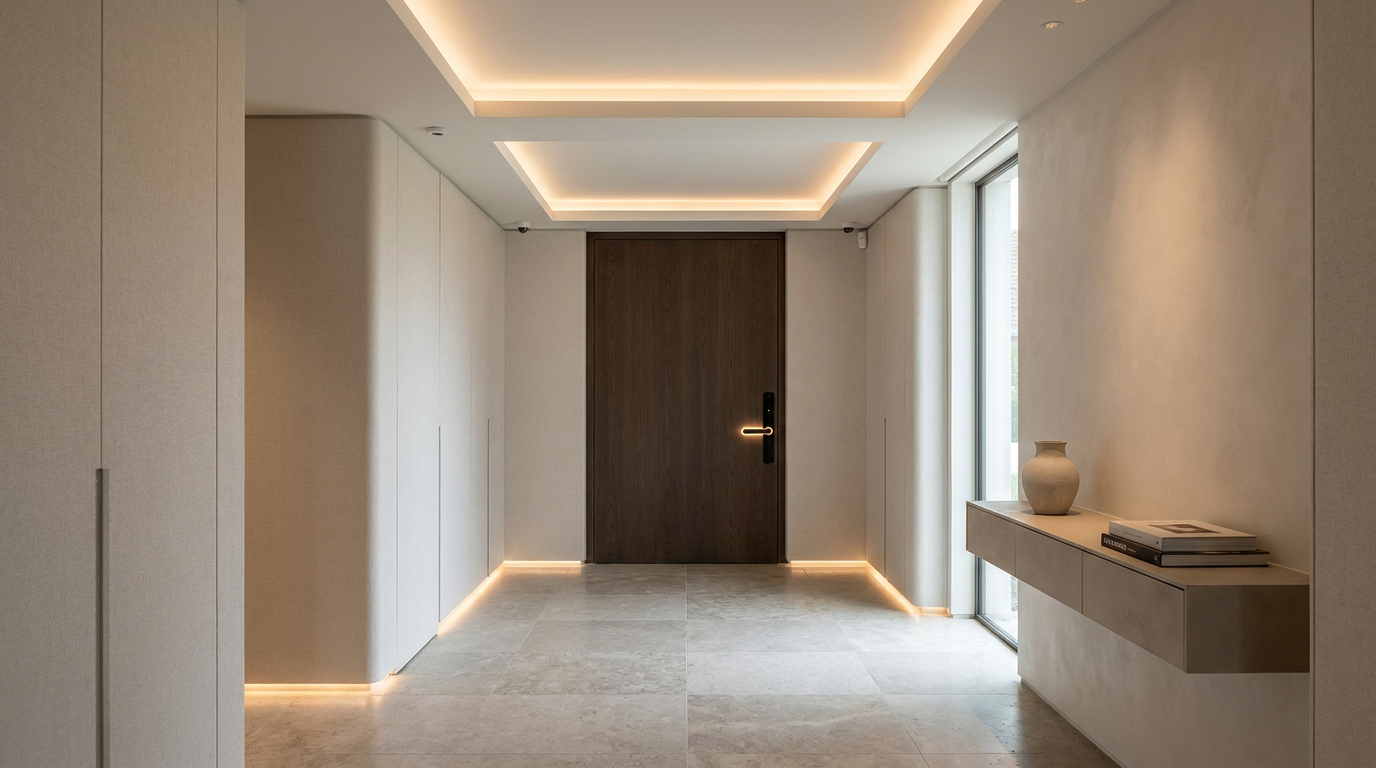
These circulation spaces are often overlooked, yet they offer some of the highest-impact opportunities. Smart locks, discreet security sensors, soft motion-activated lighting, and arrival scenes can make the home feel both welcoming and secure. Because entry areas are the threshold between public and private life, their atmosphere matters. A calm, well-lit arrival changes how the entire home is perceived.
From a design perspective, the goal is refinement rather than obvious surveillance. Choose hardware with a strong architectural presence and simple lines. Place sensors flush where possible. Use lighting to create guidance and warmth rather than harsh exposure. The smartest entryway is one that communicates confidence and serenity the moment the door opens.
Practical Tips for Homeowners Starting Out
For those new to smart interiors, the best approach is incremental and intentional. Begin with a lifestyle objective instead of a product category. Ask what would most improve the daily experience of the home. Is it gentler morning lighting, lower heating waste, better nighttime security, or reduced visual clutter from chargers and remotes? When the goal is clear, the technology selection becomes far more focused and aesthetically coherent.
It is also helpful to prioritize high-impact systems first. In many homes, the most transformative starting points are:
- Lighting for mood, flexibility, and visual sophistication
- Climate control for comfort and energy management
- Window treatments for privacy, glare control, and architectural calm
- Security and entry for reassurance and easier access
- Concealed charging and audio for reduced clutter
Once those foundations are in place, additional features can be added more naturally. This room-by-room progression also allows homeowners to observe how they actually use the systems. Smart interiors should be shaped by patterns of living, not by the pressure to install every available feature. A home feels more luxurious when it responds precisely to its inhabitants than when it performs technology in excess.
Whenever possible, plan concealment from the beginning. Even small upgrades benefit from forethought about cable management, hub storage, sensor placement, and wall-control design. A visible tangle of wires can undo the serenity of an otherwise lovely room. Thoughtful integration keeps the architecture legible and the technology discreet.
Security, Privacy, and the New Etiquette of Smart Living
As homes become more connected, elegance must be matched by digital responsibility. Smart interiors often rely on sensors, microphones, cameras, and cloud-connected systems. While these tools can enhance convenience and safety, they also introduce privacy and cybersecurity considerations that should never be treated as secondary. A truly well-designed home protects not only comfort, but also the integrity of personal space.
The Federal Trade Commission advises consumers to secure internet-connected devices through strong router settings, guest networks, and privacy management. NIST also publishes guidance on IoT cybersecurity and consumer-product security considerations that are directly relevant to smart-home choices. For homeowners, this means that selecting devices is no longer purely a style or convenience decision. It is also a question of trust, maintenance, and transparency.
There are several practical habits that support safer smart interiors:
- Choose trusted brands with a record of software support and security updates.
- Use strong, unique passwords for home networks and device accounts.
- Enable multi-factor authentication where available.
- Keep firmware and apps updated regularly.
- Place smart devices on secure networks, and consider a guest network for less critical devices.
- Review privacy settings carefully, especially for microphones, cameras, and cloud storage features.
- Prefer systems with clear local control options and transparent certification details.
There is also an interior dimension to privacy. Not every room should be equally instrumented. Bedrooms, dressing rooms, and other intimate spaces may call for a lighter technological touch than public-facing zones like entryways or media rooms. Good design respects emotional boundaries. Smart living should never come at the expense of discretion.
An elegant smart home is also a secure one. Digital hygiene is part of contemporary domestic design, just as much as lighting plans and material palettes.
Designing for North American Homes and Retrofit Realities
Much of the smart interior conversation is shaped by real conditions across Canada and the broader North American market. Housing stock varies widely, from compact condos and postwar houses to newer suburban builds and historic homes. Climate also plays a major role. In colder regions, heating demands are substantial, which makes smart climate control, scheduling, and shading especially relevant. In sunnier areas, glare management and cooling support may take precedence.
Because many homeowners are working within existing structures, retrofit design is often more useful than idealized new construction scenarios. This requires flexibility. Wireless devices, battery-powered sensors, and modular systems can make upgrades far more accessible without opening walls extensively. Yet retrofitting should still follow interior design principles. New additions must respect sightlines, finishes, and the visual logic of the room.
Older homes, in particular, benefit from a restrained smart strategy. It is often better to choose a few excellent interventions than to overburden historic architecture with visible devices. Thoughtful thermostat placement, concealed shades, subtle security upgrades, and carefully integrated lighting can preserve character while improving performance. The aim is not to make an older home look newly technological. It is to help it live more gracefully in the present.
This is where future-proofing becomes so important. North American consumers increasingly expect home technology to work across devices and platforms. Homeowners should therefore prioritize ecosystems that can grow with them instead of locking into a narrow brand path. The best smart interiors are modular, discreet, and adaptable enough to accommodate change without requiring a visual reset every few years.
How to Maintain Sophistication While Adding Technology
There is an art to keeping a smart home from feeling clinical. The answer lies in balance. Technology performs best in interiors that remain deeply tactile and human. Rich materials, layered textiles, natural wood, stone, plaster, linen, wool, and thoughtful color palettes all help soften the precision of digital systems. These sensory qualities ensure that the home still feels warm, grounded, and personal.
Control interfaces deserve special attention. Oversized glossy panels can disrupt an otherwise elegant wall. In many cases, a minimal keypad, a well-designed dimmer, or a discreet app-based scene system is more appropriate. The key is consistency. Switches, hardware finishes, and visible controls should feel related to the rest of the interior language. Smart design succeeds when the technology seems native to the architecture rather than imposed upon it.
Sound also influences sophistication. Mechanical hum, abrupt alerts, and harsh notification tones erode the sense of calm a room is trying to create. Whenever possible, select systems known for quiet operation and customize alerts to be subtle or minimal. The sensory environment of a home is holistic. Beautiful smart interiors are not only seen. They are heard, felt, and inhabited with ease.
Most importantly, avoid novelty for novelty’s sake. A room does not become more advanced because every possible action is automated. In fact, too much automation can make a home feel impersonal or frustrating. Keep asking whether a feature genuinely improves life, supports the architecture, or enhances atmosphere. If it does not, it is likely unnecessary.
The Future of Smart Interiors
Smart interiors are moving steadily toward greater subtlety, not greater visual complexity. As interoperability improves and standards mature, homeowners can expect connected environments to become easier to set up, more reliable across platforms, and less dependent on visible technical workarounds. This is promising for interior design because it allows the emphasis to return where it belongs, on space, light, material, and experience.
We are also seeing a conceptual shift in how smart homes are framed. They are no longer discussed only as convenience systems or luxury add-ons. Increasingly, they are part of larger conversations about sustainability, wellness, resilience, and adaptable living. Energy management, demand response, occupancy sensing, and healthier indoor environments are all becoming central to what a well-designed home can offer. Technology, in this context, is not competing with aesthetics. It is helping aesthetics function more intelligently in the real world.
For homeowners, this is liberating. It means that a smart interior does not need to announce itself with futuristic styling. It can be classic, contemporary, minimal, rustic, or richly layered. The intelligence lies beneath the surface and within the experience. A beautifully proportioned room with hidden capabilities may feel more modern than a visibly high-tech space because it reflects a deeper kind of design maturity.
Conclusion: A More Graceful Way to Live
The rise of smart interiors marks a turning point in modern design. We are moving away from the idea that technology must be seen to be valued. Instead, the most compelling homes are those where technology disappears into the architecture and strengthens the quality of everyday life. Light becomes more atmospheric, temperature more intuitive, security more discreet, and rooms more adaptable to the rhythms of their inhabitants.
For homeowners, the message is simple and reassuring. You do not need to automate everything. You do not need to chase every innovation. Begin with what will genuinely improve your comfort, efficiency, and visual calm. Choose interoperable products, conceal what can be concealed, protect privacy with care, and let your interior vision lead the technical decisions rather than the other way around.
In the end, smart interiors are not about living with more devices. They are about living with more ease, more beauty, and more intention. When handled thoughtfully, technology becomes almost invisible, yet its presence is felt everywhere in the quiet luxury of a home that simply knows how to live well.


No Comment! Be the first one.