



Light is one of the most intimate materials in a home. We live inside it, wake to it, soften it at dusk, and instinctively associate it with comfort, clarity, safety, and ritual. A room may be beautifully furnished and carefully planned, yet if the lighting is harsh, flat, or poorly placed, the experience of that space never fully settles into ease. Architectural lighting is what allows interiors to move beyond simple visibility and become environments with emotional depth, practical intelligence, and visual elegance.
Table Of Content
- What is architectural lighting?
- Why light feels emotional before it feels technical
- The foundation of good design: layered lighting
- Ambient lighting
- Task lighting
- Accent lighting
- More light is not always better
- Color rendering and color temperature: the nuances that change everything
- Lighting as architecture, not decoration alone
- Room by room strategies for residential lighting
- Living rooms
- Kitchens
- Dining rooms
- Bedrooms
- Bathrooms
- Hallways, stairs, and transitions
- The importance of controls, dimming, and smart systems
- LEDs, efficiency, and the difference between good and bad modern lighting
- Common mistakes to avoid in residential lighting design
- A simple framework for planning your home lighting
- The future of architectural lighting in the home
- Conclusion: designing with light means designing for life
In residential design, architectural lighting is both a technical system and a creative language. It helps us move safely through a corridor, prepare food with precision, read without strain, and feel grounded in our surroundings. At the same time, it shapes the way stone appears at night, how a ceiling seems to float, how timber gains warmth, and how a room can feel serene, dramatic, intimate, or expansive depending on the hour. Light is not only something we add to a room. It is something that reveals the room to us.
Today, homeowners are increasingly aware that good lighting is not achieved by installing brighter bulbs or adding more fixtures at random. The most successful residential schemes are layered, intentional, and responsive to real patterns of living. Guidance from the U.S. Department of Energy describes lighting in terms of distinct roles such as ambient, task, and accent, while professional standards from the Illuminating Engineering Society emphasize comfort, function, energy use, equipment selection, and code awareness. Together, these principles remind us that lighting design belongs to both art and performance.
This article explores how architectural lighting can transform domestic interiors while enhancing functionality and aesthetic appeal. We will look at the principles of layered lighting, the emotional effects of illumination, the importance of color rendering and color temperature, the role of controls and LEDs, and room by room design strategies that create homes which feel intuitive, comfortable, and quietly luxurious.
What is architectural lighting?
Architectural lighting is the practice of integrating light into a home’s structure and spatial design rather than treating it as a decorative afterthought. It combines three functional layers, ambient, task, and accent lighting, to support daily activities like cooking, reading, and moving safely through a space, while also shaping mood, revealing materials, and giving rooms a sense of depth and atmosphere. Guidance from the U.S. Department of Energy frames these three roles as the foundation of residential lighting design, while the Illuminating Engineering Society’s professional standards emphasize comfort, energy use, and code compliance alongside aesthetics. In practice, this means architectural lighting is judged not by how many fixtures a room contains, but by how well light supports both the function and the feeling of a space, from a kitchen countertop that needs shadow-free clarity to a bedroom that needs to settle into calm before sleep.
Why light feels emotional before it feels technical
Long before we speak of lumens, wattage, or fixture specifications, light reaches us emotionally. We know when a room feels restful, theatrical, energizing, or cold even if we cannot immediately explain why. Morning light spilling across a floor can make a kitchen feel alive. A softly lit bedroom can slow the pace of thought. A harsh ceiling light in a dining room can make an otherwise elegant setting feel exposed and uneasy. Architectural lighting works with these emotional instincts, shaping the atmosphere of the home in ways that are subtle yet profound.
Research on light exposure consistently shows that light affects circadian rhythms, sleep, alertness, and mood. This is one reason the conversation around residential lighting has become more nuanced in recent years. Designers are no longer speaking only about brightness and energy savings. They are also considering time of day, personal routines, visual comfort, and how interiors support well-being. Human-centric and circadian-aware lighting systems are gaining traction because people increasingly understand that the home should not be lit in the same way at noon, at dinner, and just before sleep.
Emotional lighting does not mean decorative lighting alone. It means understanding that every practical decision has a sensory consequence. A dimmer switch can make a room more accommodating to different moods. A concealed cove can reduce visual clutter and create calm. A wall washer can reveal the tactility of plaster or stone, making the envelope of the room feel richer and more dimensional. Even a simple bedside reading light, when carefully chosen, can turn a nightly routine into a more personal and comfortable moment.
Architectural lighting succeeds when it supports how a home works and how it feels at the same time.
The foundation of good design: layered lighting
One of the most useful frameworks in residential lighting is layered lighting. Rather than relying on a single central fixture to do everything, layered lighting distributes different roles across different sources. This creates flexibility, comfort, and visual depth. The three primary layers are ambient lighting, task lighting, and accent lighting. Each one serves a distinct purpose, and together they make a room feel complete.
Ambient lighting
Ambient lighting is the general illumination that allows a space to function safely and comfortably. It gives a room its base level of brightness and supports movement, orientation, and everyday use. In residential projects, ambient light may come from recessed downlights, concealed linear lighting, ceiling mounted fixtures, wall lights, or cove lighting. The most elegant ambient lighting is rarely overpowering. It creates an even visual field without flattening the room or causing glare.
Designers often prefer indirect or diffused ambient lighting because it softens contrast and reduces the sense of visual aggression that can come from exposed point sources. A cove that washes the ceiling with light can make a room feel taller and more serene. Kingsgate brought this exact concealed cove lighting technique to life on a recent build — see it here: 146 Northwood Dr, North York. Wall mounted fixtures that cast light upward and downward can provide general illumination while enhancing architectural surfaces. In larger rooms, thoughtful spacing is essential so the light feels balanced rather than spotty or over-concentrated.
Task lighting
Task lighting is more focused and practical. It supports activities that require clarity and precision such as reading, chopping vegetables, applying makeup, working at a desk, or getting dressed. This layer should always be designed around the body and around real behavior. A kitchen may have beautiful pendants over an island, but without under-cabinet lighting the countertop can still fall into shadow. A bedroom may feel atmospheric, yet if bedside lighting is poorly aimed, reading becomes uncomfortable.
Because task lighting must perform, its placement matters as much as its output. The fixture should illuminate the work surface without producing glare or awkward shadows. In a vanity area, light from the sides of the mirror often creates a more flattering and useful effect than a single bright source above. In a study nook, an adjustable lamp with proper beam control often works better than general overhead light alone. Task lighting should feel purposeful, not accidental.
Accent lighting
Accent lighting introduces emphasis, hierarchy, and drama. It highlights artwork, textured walls, shelving, niches, architectural details, and decorative objects. While often associated with luxury, accent lighting is not merely ornamental. It tells the eye where to look, helps establish depth, and prevents a room from feeling visually monotonous. In many of the most beautiful interiors, accent lighting is what gives the room its evening identity.
Wall washing is a common accent technique used to bathe a surface in a smooth field of light, making a room feel larger and more refined. Narrow beam spotlights can focus attention on a sculpture or painting. Concealed linear lighting can outline a joinery detail or softly illuminate shelving. When used with restraint, accent lighting brings intimacy and sophistication. When overused, it can make a home feel theatrical in a way that is tiring rather than elegant. As always, balance is the real discipline.
More light is not always better
One of the most persistent misconceptions in home lighting is the idea that brighter automatically means better. In truth, excessive illuminance can create glare, visual fatigue, and discomfort. It can erase shadow, flatten textures, and make even expensive materials appear lifeless. A room flooded with indiscriminate light often feels less welcoming than one that has been carefully composed with variation and restraint.
The quality of light matters just as much as the quantity. A comfortable residential environment depends on placement, shielding, beam spread, reflectance, and contrast. Poorly positioned downlights can create bright hot spots and dark gaps. Exposed lamps at eye level can be distracting. Highly reflective surfaces can amplify glare if fixtures are not selected with care. This is why lighting design is about more than choosing bulbs. It is about understanding where light lands, how it bounces, and what the eye experiences over time.
The goal is not to make every corner equally bright. The goal is to create a visual composition that supports the life of the room. Some areas may be brighter because they require focus. Others may be quieter because they are meant for rest. A beautiful home often relies on subtle transitions between levels of illumination, allowing the eye to move naturally from one focal point to another.
Color rendering and color temperature: the nuances that change everything
Two technical concepts have an enormous effect on the way a home feels: Color Rendering Index, often abbreviated as CRI, and Correlated Color Temperature, or CCT. These terms can sound overly specialist, yet they influence experiences that every homeowner immediately notices. They affect whether skin tones look natural, whether timber appears rich, whether white walls feel crisp or dull, and whether an interior feels invigorating or cocooning.
CRI describes how accurately a light source reveals colors compared with a natural reference. The U.S. Department of Energy notes that a CRI of 80 or higher is generally acceptable for most indoor residential applications. In practice, many designers look for high quality LEDs with good color rendering because poor color quality can make materials appear flat, greenish, or lifeless. This is particularly important in kitchens, bathrooms, dressing areas, and anywhere art, textiles, or natural finishes play a strong visual role.
CCT refers to whether light appears warmer or cooler. Lower color temperatures tend to feel warmer and more intimate, while higher color temperatures feel cooler and more alert. Warm light is often lovely in living rooms, bedrooms, and dining spaces, yet it is not automatically best everywhere and at every hour. A kitchen or task area may benefit from a cleaner, slightly cooler tone for clarity. This is why one of the more sophisticated current trends is tunable white lighting, which allows the color temperature to shift according to time of day or activity.
The deeper lesson is that there is no universally perfect light color. The right choice depends on function, mood, architecture, and personal preference. A stone clad hallway may glow beautifully under one temperature, while a minimalist bathroom may feel more refined under another. Good lighting design is responsive. It honors the materials and the rituals of the people who live there.
Lighting as architecture, not decoration alone
Architectural lighting differs from simply adding decorative fixtures because it is integrated into the spatial idea of the home. It works with ceilings, walls, millwork, niches, staircases, and circulation paths. It understands the architecture as a sequence of volumes and surfaces rather than as a set of isolated objects. This is why concealed lighting, recessed profiles, step lights, and wall grazing techniques have become so valued in contemporary interiors. They allow light to shape the room without overwhelming it visually.
That said, decorative fixtures still matter. Pendants, chandeliers, and sconces often provide identity and ornament, especially in rooms where a strong visual focal point is desired. The most graceful schemes combine decorative presence with architectural restraint. A dining pendant might anchor the table while concealed perimeter lighting softens the ceiling. A sculptural wall light may animate a corridor while recessed sources ensure safe passage. The result is a composition where every element has a role.
Homes today are also increasingly multiuse. A single space may need to function as lounge, workspace, entertaining zone, and family area. Architectural lighting responds to this complexity through layering and scene setting. Instead of one fixed condition, the room can adapt. A brighter daytime setting can support work and activity. A softer evening scene can draw attention to shelves, artwork, or a fireplace while reducing ambient levels. Flexibility is one of the hallmarks of contemporary lighting intelligence.
Room by room strategies for residential lighting
Living rooms
The living room is often the emotional center of the home, and its lighting should reflect that complexity. It must support conversation, relaxation, reading, television viewing, and entertaining without feeling generic. A single overhead fixture rarely provides enough nuance. Instead, the best approach is to combine ambient lighting with task sources near seating and accent lighting that gives the room depth after sunset.
Concealed cove lighting or well-spaced downlights can establish an even ambient base. Floor lamps and table lamps near sofas or armchairs can provide local pools of light that feel domestic and inviting. Accent lighting can highlight joinery, art, or textured walls to prevent the room from becoming visually flat in the evening. Dimming is essential here because the living room shifts constantly between functions. A bright afternoon setting and a late night cinema mood should both be possible within the same space.
Kitchens
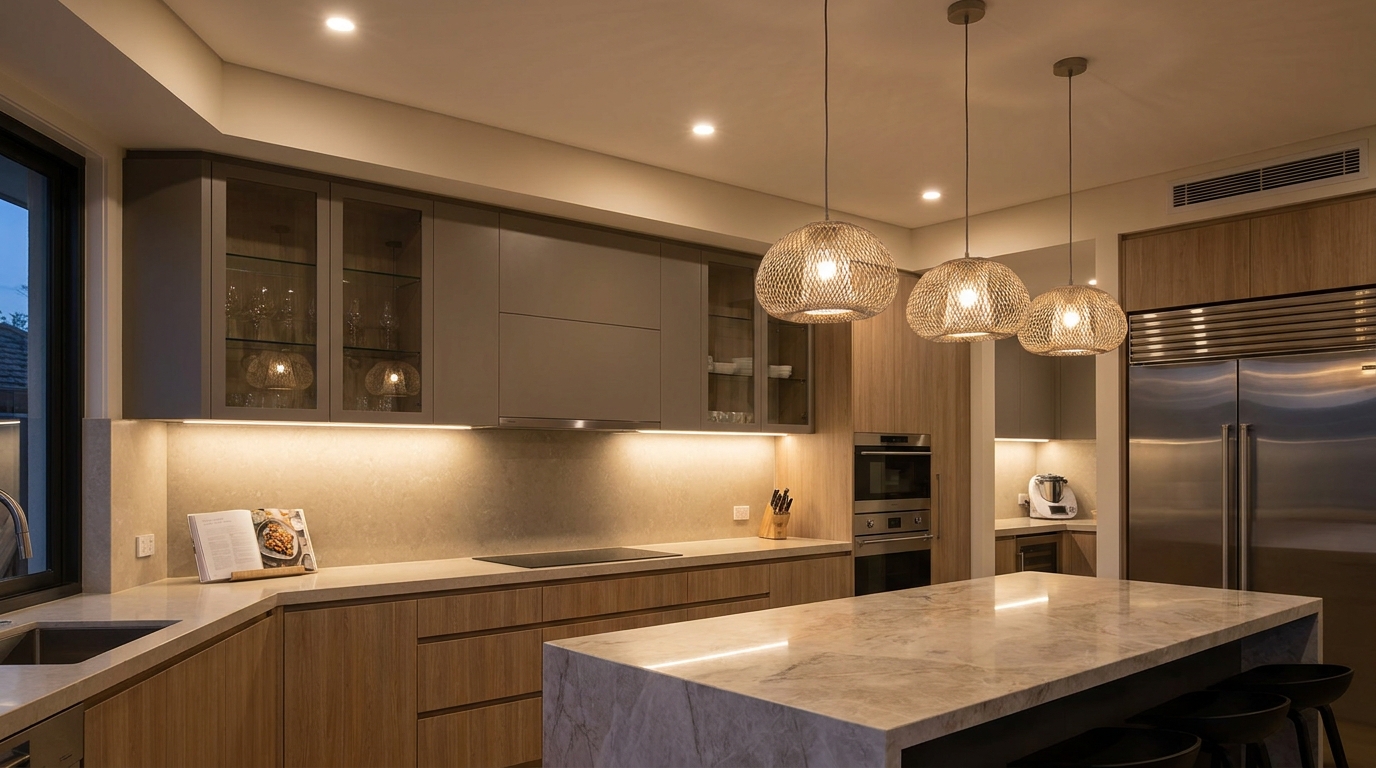
Kitchens demand some of the most disciplined lighting in the home because they involve movement, heat, sharp tools, and detailed work. General illumination is important, but task lighting is what truly determines whether the room functions well. Countertops, sinks, islands, and cooktops all need focused, shadow free light. Under-cabinet lighting is often indispensable because it brings light directly to the work surface where the body would otherwise block overhead illumination.
Pendants over an island can add identity and rhythm, but they should be selected and positioned carefully so they do not create glare or interrupt sight lines. Recessed downlights may support the broader room, though their spacing must be thoughtful. Materiality matters too. Polished stone, metal surfaces, and glossy cabinetry can reflect light intensely, so beam control and fixture finish become part of the visual equation. The ideal kitchen feels bright enough for precision yet warm enough to remain connected to the rest of the home.
Dining rooms
Dining rooms benefit from intimacy and hierarchy. A central pendant or chandelier often acts as the focal gesture, anchoring the table and defining the social heart of the room. Yet overhead light alone can feel severe if it is not balanced with surrounding layers. Wall lights, concealed perimeter lighting, or softly illuminated joinery can create a more flattering and atmospheric setting.
Dimming is especially important in dining areas because meals occur at different times and under different emotional conditions. Breakfast asks for freshness and clarity, while evening dining invites softness and glow. Good dining room lighting makes faces look natural, table settings appear rich, and the room feel gracious rather than stark. This is where quality of light becomes instantly visible, particularly in how it reveals food, textiles, wood, and skin tones.
Bedrooms
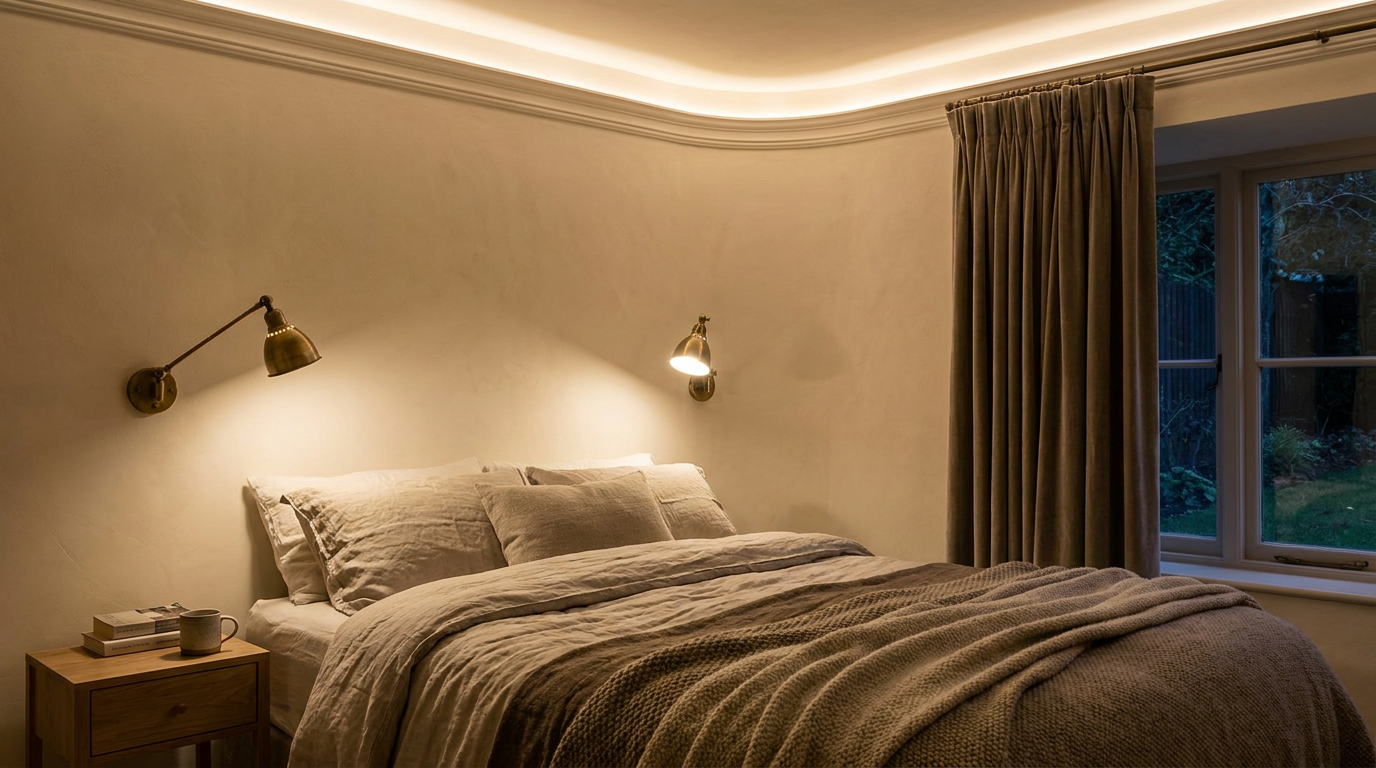
Bedrooms call for gentleness. They are spaces of retreat, privacy, and transition between day and night. Ambient lighting should feel calm and not overly bright. Indirect sources are especially effective because they reduce harsh contrast and support a restful atmosphere. Cove lighting, shaded lamps, and softly diffused ceiling fixtures often work better than aggressive recessed lighting as the primary source.
Task lighting remains essential, particularly at the bedside. Reading lights should be well aimed and individually controlled so one person can read without disturbing another. Wardrobes and dressing zones may require brighter, more accurate illumination, especially where color judgment is important. The best bedroom lighting allows the room to move easily from practical morning use to an evening mood that signals rest and calm.
Bathrooms
Bathrooms require a careful balance between clarity and comfort. Mirror lighting is often the defining issue because it directly affects grooming tasks. Side mounted fixtures or integrated mirror lighting can reduce facial shadows and provide a more even, flattering result than a lone downlight placed overhead. At the same time, the room should not feel clinical unless that is intentionally part of the design language.
Layering remains useful here as well. Ambient lighting establishes general brightness, task lighting serves the mirror and vanity, and accent lighting can elevate niches, stone textures, or a freestanding tub. Moisture ratings, safety, and code compliance are especially important in bathrooms, making fixture specification more technical than some homeowners realize. Beauty and performance must meet precisely in this room.
Hallways, stairs, and transitions
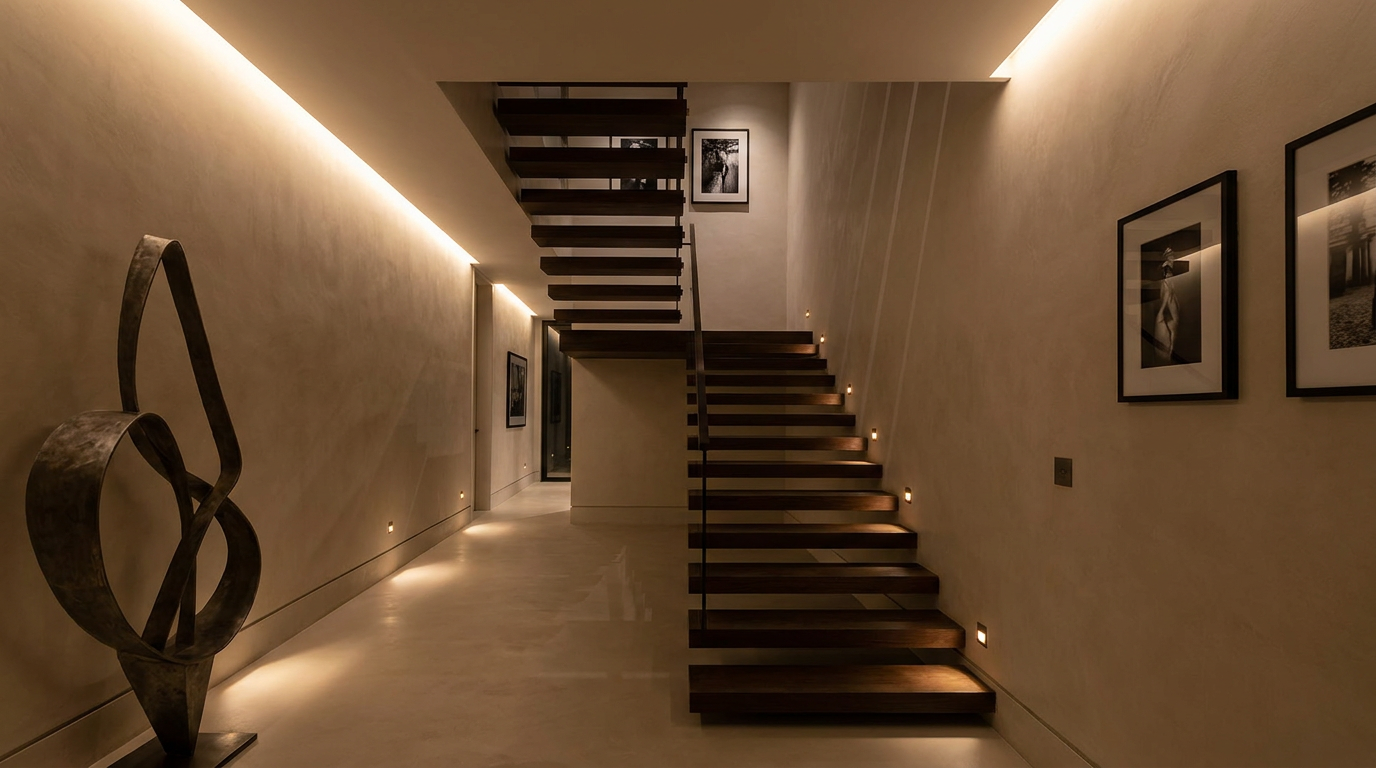
Circulation spaces are often underestimated, yet they strongly shape the character of a home. Hallways and staircases are not only routes from one room to another. They are moments of pause, framing, and anticipation. Architectural lighting can transform these areas with wall washing, recessed step lights, concealed linear strips, or discreet ceiling fixtures that provide safe navigation while reinforcing the geometry of the space.
At night, low level lighting in these areas is especially valuable because it allows movement without the shock of full brightness. In this sense, architectural lighting supports both safety and atmosphere. It turns ordinary circulation into something more composed and more intuitive. Even a narrow corridor can feel gracious when its walls are softly illuminated and its shadows are carefully controlled.
The importance of controls, dimming, and smart systems
One of the greatest shifts in residential lighting has been the rise of controls. LEDs and controls are now among the most important efficiency tools in the modern home, and they also dramatically improve the lived experience of space. Dimmers, motion sensors, photosensors, timers, and app based systems help ensure that light appears when and where it is needed, while reducing unnecessary operation. According to Natural Resources Canada, household lighting accounts for about 3.5 percent of the energy used in the average Canadian home, which makes it a smaller but still meaningful target in retrofits and upgrades.
From a design perspective, controls are not just about saving energy. They are about creating scenes. A kitchen can have a morning mode, a cooking mode, and an evening entertaining mode. A bedroom can shift from dressing brightness to a low, warm pre-sleep setting. Motion sensors in closets, pantries, and corridors can improve convenience, while schedules can support routine. Personalization is becoming increasingly important because modern households rarely use rooms in one fixed way.
Of course, technology must remain intuitive. A beautiful lighting plan can become frustrating if the control system is overly complicated. The best smart lighting feels almost invisible in its logic. It gives users flexibility without requiring constant management. In this sense, good control design is much like good interior design. It should make life feel easier, not more technical.
LEDs, efficiency, and the difference between good and bad modern lighting
LED technology has transformed residential lighting by offering long life, reduced energy use, compact fixture possibilities, and compatibility with advanced controls. Natural Resources Canada notes that LEDs can last at least 25,000 hours with proper design and use, which makes them highly attractive for both new homes and retrofits. Yet it is important to recognize another common misconception: LED does not automatically mean good lighting.
Quality depends on color rendering, fixture design, thermal management, dimming compatibility, and optical control. A poor quality LED may flicker, dim badly, distort colors, or produce unpleasant glare. By contrast, a well selected LED system can deliver extraordinary subtlety and consistency. The conversation today has evolved beyond watts and lumens alone. Homeowners and designers are paying closer attention to visual comfort, color quality, and overall user experience.
Energy efficiency remains central, but it should never come at the expense of atmosphere. The most successful sustainable lighting schemes are those that reduce energy use while enriching daily life. This may mean fewer fixtures, better placement, and smarter controls rather than more equipment. Efficiency and elegance are not opposing ideas. In the best projects, they reinforce one another beautifully.
Common mistakes to avoid in residential lighting design
Many lighting problems stem from oversimplification. Homeowners often rely too heavily on recessed downlights, assuming they are the neatest and most versatile solution. Used sparingly and placed well, recessed fixtures can be effective. Used excessively, they can create a ceiling full of visual clutter and a room full of glare. A home should not feel like a grid of bright spots overhead.
Another mistake is treating natural light as if it eliminates the need for a full artificial lighting plan. Daylight is invaluable, but homes still need layered lighting for evenings, darker seasons, and task specific needs. Likewise, choosing the same color temperature throughout the entire house can produce spaces that feel disconnected from their function. Uniformity is not always harmony. Sometimes refinement comes from calibrated variation.
Perhaps the most significant mistake is designing lighting too late in the process. Architectural lighting should be considered early, especially if it includes recessed channels, cove details, integrated joinery illumination, or control planning. When lighting is left until the final stages, opportunities for elegance and cohesion are often lost. Good lighting is not an accessory added at the end. It is part of the architecture from the beginning.
A simple framework for planning your home lighting
For homeowners beginning a renovation or new build, it can be helpful to approach lighting methodically. The following sequence keeps both beauty and practicality in view.
- Start with how each room is used. Consider movement, reading, cooking, grooming, socializing, relaxation, and nighttime routines.
- Define the ambient layer. Decide how general illumination will be provided without overlighting the room.
- Add task lighting where precision matters. Focus especially on kitchens, desks, mirrors, bedside areas, wardrobes, and stairs.
- Introduce accent lighting selectively. Highlight architecture, art, textures, or joinery to build depth and visual interest.
- Evaluate color quality and temperature. Aim for good CRI and choose CCT according to mood, materiality, and function.
- Plan controls early. Include dimming and scene setting wherever room use changes across the day.
- Review glare and fixture visibility. Ask what the eye will see from sitting, standing, and entering the room.
- Think about maintenance and longevity. Select quality fixtures and compatible components for reliable performance.
This framework is simple, but it reflects the same logic used by professional designers. It shifts the conversation away from isolated fixtures and toward the overall experience of the home.
The future of architectural lighting in the home
Residential lighting is becoming more personalized, more integrated, and more responsive to well-being. Trends such as circadian-aware systems, tunable white lighting, resilient lighting strategies, and smart home integration show that people want homes to adapt more elegantly to contemporary life. The newest guidance in residential lighting practice increasingly acknowledges psychological, physiological, and technical considerations together. This is a meaningful evolution because it reflects how people truly inhabit space.
We are also seeing a visual shift toward fewer visible sources and more seamless architectural integration. Concealed linear lighting, recessed profiles, soft wall grazing, and minimal apertures create interiors that feel calmer and more resolved. This does not mean decorative fixtures disappear. Rather, they become more intentional, acting as sculptural punctuation within a broader, quieter lighting composition.
Ultimately, the future of home lighting is not about spectacle. It is about refinement. It is about creating spaces that respond to routine and emotion with intelligence, sensitivity, and grace.
Conclusion: designing with light means designing for life
Architectural lighting is one of the most powerful ways to transform a home because it works simultaneously on function and feeling. It supports movement, safety, reading, cooking, and everyday rituals, while also shaping mood, revealing materials, and composing atmosphere. Through layered lighting, careful fixture placement, quality LEDs, strong color rendering, thoughtful color temperature choices, and intuitive controls, a house can become more comfortable, more expressive, and more deeply attuned to the people who live in it.
The emotional connection we have with light is not incidental. It is part of how we experience belonging. A well lit home does not simply allow us to see. It allows us to settle, focus, gather, rest, and appreciate the architecture around us in its most flattering and meaningful form. In this sense, lighting is not the finishing touch. It is one of the essential acts of design.
When approached with intention, architectural lighting brings together the measurable and the poetic. It respects energy use and visual performance, yet it also understands softness, rhythm, shadow, and warmth. And perhaps that is its greatest beauty. It reminds us that the most functional elements in a home can also be the most atmospheric, transforming ordinary rooms into places that feel not only illuminated, but truly alive.


No Comment! Be the first one.