Wembley Park’s Next Chapter: Why a Hotel and Student Tower Pairing Makes Sense on Constrained Land
Every so often a planning submission lands that tells you more about the future of a district than the buildings themselves ever will. The proposal now with Brent Council for Wembley Park Drive, designed by Sheppard Robson for developer Whitbread, is one of those cases. On paper it is a straightforward replacement of an aging 1990s Premier Inn and its car park. In practice, it is a case study in how constrained urban sites get squeezed for maximum value without losing coherence.
The numbers tell the strategic story. A 212 room hotel and a 605 bed purpose built student housing tower, sharing one site, separated by a shared amenity pavilion. That is not a design flourish. That is land economics. When a site sits opposite a major transit hub like Wembley Park station, within a masterplan already anchored by a stadium and a growing entertainment district, the question a developer asks is never “what one use fits here.” It is “what combination of uses extracts the most durable value from every square metre.”
Hotel and student accommodation is a pairing that deserves more attention from developers working tight urban parcels. The two uses have different but complementary demand cycles, different operating models, and crucially, different construction and cladding treatments that let a single site read as two distinct addresses rather than one oversized block. Sheppard Robson’s approach, giving the towers a shared architectural language but differentiating them through colour and proportion, is as much a leasing and identity decision as an aesthetic one. Distinct identity supports distinct rent rolls.
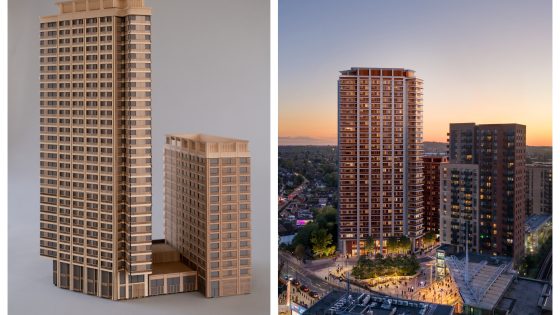
What should catch the eye of anyone tracking London’s housing supply pipeline is where this sits within the wider Wembley Park Masterplan. This is not a standalone speculative build. It is one more piece being fitted into a long term, phased vision for the arrival square leading to Wembley Way. That matters for feasibility. Sites that plug into an existing masterplan carry lower planning risk and benefit from infrastructure and public realm investment that has already been committed elsewhere in the district.
The project knits two uses on to a constrained site while exploiting the synergies between them.
That line from Sheppard Robson partner Dan Burr is worth sitting with. Synergy on a constrained site is the entire game in dense, high demand submarkets. Land is not getting cheaper near stations like Wembley Park, and single use towers increasingly look like an underuse of premium locations. Expect more developers to test mixed operator models like this one, pairing accommodation types that serve different populations, at different times of year, off the same core and podium.
For anyone tracking how London’s growth corridors are being built out plot by plot, Wembley Park Drive is a signal worth logging. Constrained sites are not dead ends for developers with the right vision. They are opportunities to layer uses, share infrastructure costs, and build long term value into a single, well planned parcel.
Source: Architects’ Journal