



There is something deeply comforting about settling into a room designed for shared stories. A cinema room is not simply a place to watch a film. It becomes the setting for Friday night traditions, rainy afternoon cartoons, championship games with friends, and those spontaneous evenings when everyone drifts in with blankets and snacks and decides to stay a little longer. When a room supports that kind of togetherness, it begins to feel less like a home upgrade and more like a meaningful part of everyday life.
Table Of Content
- Start With the Feeling You Want the Room to Create
- Choosing the Right Location in Your Home
- Designing Around Sightlines and Viewing Comfort
- Seating That Invites People to Stay
- Projector or Large TV? Choosing the Right Screen for Your Lifestyle
- The Sound Difference That Changes Everything
- Simple sound priorities to get right
- Lighting That Makes Movie Night Feel Special
- Smart Home Integration Without the Stress
- Planning for Streaming, Connectivity, and Everyday Use
- A Style Direction That Supports Atmosphere
- How Much Should You Spend?
- Common Misconceptions to Leave Behind
- Creating Rituals That Make the Room Meaningful
- Your Dream Cinema Room, Your Way
- Quick Planning Checklist for a Comfortable Cinema Room
That is why the best cinema rooms are designed around experience first. Of course, image quality matters, and beautiful sound can make a scene feel unforgettable, but the emotional magic happens when the room is easy to use, comfortable for every age, and welcoming enough that people want to gather there often. In many homes, the dream is not a formal, untouchable theater hidden away in the basement. It is a warm, inviting space that brings a touch of cinema into real family life.
Today, creating that experience is more realistic than many homeowners assume. A cinema room does not need to be enormous, outrageously expensive, or built around the most complex equipment available. Guidance from CEDIA increasingly frames home theater as part of a broader smart home or media room strategy, where lighting, seating, acoustics, and simple control come together to support how people actually use the room. Whether you have a spare den, a finished basement, a bonus room, or even a section of a large family room, it is possible to create a space that feels immersive and special.
The timing also makes sense. Streaming is now a natural part of household life, and the infrastructure behind it is stronger than ever. Statistics Canada reported that 96.4% of Canadian households had access to unlimited broadband coverage with at least 50 Mbps download and 10 Mbps upload speeds in 2024, while average monthly data use per high-speed residential subscription reached 585.5 GB. Those numbers matter because they support the kind of high-quality streaming, premium audio, and multi-device use that modern cinema rooms often depend on.
In this guide, we will look at how to create a cinema room that feels beautiful, functional, and emotionally rich. From choosing the right room to selecting seating, managing sound, layering light, and simplifying control, every choice should support comfort and connection. The dream is not just a better picture on the wall. It is a better way to spend time at home.
Start With the Feeling You Want the Room to Create
Before comparing projectors, researching speaker packages, or pinning velvet wall colors, pause and think about the emotional role this room will play in your home. Some families want a quiet retreat that makes movie nights feel ceremonial and calm. Others want an energetic social room where sports, gaming, and concerts feel just as important as films. A young family may prioritize washable fabrics, extra floor space, and easy snack access, while frequent hosts may imagine layered seating, soft lighting, and a polished atmosphere that impresses guests without feeling too formal.
It helps to imagine a few real scenarios. Picture a winter evening with children stretched out under throws, a shelf of favorite DVDs or a streaming queue ready to go, and lighting that dims with one tap. Then picture a group of friends arriving for a playoff game, with everyone able to see clearly, hear the commentary, and move around comfortably. A strong cinema room supports both the practical needs and the emotional rhythm of these moments.
This is also where the distinction between a dedicated cinema room and a media room becomes useful. CEDIA notes that many homeowners choose between the two based on room size and intended use. A dedicated cinema room is usually more immersive and controlled, often with darker finishes and fewer distractions. A media room is more flexible, blending movie watching with gaming, casual television, music, and entertaining. Neither option is better by default. The right choice depends on your lifestyle.
If your home needs every room to work hard, a media room may be the more realistic and satisfying path. If you have an underused basement or bonus room and long for a more transportive experience, a dedicated cinema room can be a joy. In both cases, the goal is the same: to create a room that feels intentional and easy to enjoy. KingsGate Luxury Homes brought a fully dedicated home theatre to life in a recent custom build — see how the room was designed and finished here: 71 Northwood Dr, North York.
Choosing the Right Location in Your Home
The best location for a cinema room is not always the largest room. It is the room that gives you the most control over sound, light, and comfort. Basements are a common choice because they tend to have fewer windows, natural sound isolation from the rest of the home, and enough separation to support louder viewing. But a basement is not the only answer. A spare bedroom, loft, den, or large bonus room can work beautifully when thoughtfully planned.
Start by looking at natural light. Bright rooms can absolutely become wonderful media rooms, especially when built around a large TV rather than a projector, but rooms with fewer windows are usually easier to shape into a cinema-like environment. Too much daylight can wash out darker scenes and limit the immersive quality that makes movie nights feel special. Blackout drapery, layered shades, and thoughtful screen placement can help, but choosing a room with manageable light from the start will save effort later.
Next, think about noise and privacy. A cinema room should not constantly compete with kitchen clatter, hallway traffic, or a nearby laundry area. Likewise, if the room is directly beside a nursery or home office, your ideal sound level may always feel compromised. The most comfortable setups are the ones that let you watch naturally without worrying that every exciting scene is disturbing someone else.
Then consider shape and layout. Long rectangular rooms often work well because they naturally support a screen wall at one end and seating facing forward. Square rooms can be more challenging acoustically, but they are still workable with good design. Ceiling height matters too, especially if you are considering a projector, ceiling speakers, or tiered seating. Dolby also suggests that in more advanced rooms, tiered seating can help multiple rows see well during viewing parties, but even in simpler spaces, a little extra height can give the room an airier and more comfortable feel.
Do not overlook convenience. A room that is too isolated from the rest of the home may sound ideal in theory, but if getting snacks, drinks, or extra blankets feels inconvenient, the room may not become part of daily life in the way you hoped. A dream cinema room should feel special, but it should also feel naturally connected to your routines.
Designing Around Sightlines and Viewing Comfort
One of the biggest differences between a room that merely contains a big screen and one that truly feels cinematic is the quality of the viewing layout. Great cinema design protects sightlines, reduces awkward neck angles, and gives each seat a strong relationship to the screen. Dolby advises placing viewers as close to the screen centerline as practical and facing the screen directly rather than at an angle. That guidance may sound simple, but it shapes nearly every layout decision.
When seating is skewed too far to one side, viewers can feel physically disconnected from the image, especially during longer films. The result is subtle but important. Instead of relaxing into the story, people shift, lean, and adjust. A room that keeps most seats aligned to the screen centerline simply feels more comfortable and more luxurious, even if the furniture itself is modest.
Screen size and viewing distance also matter. THX uses room-size categories and often points to roughly a 36-degree horizontal viewing angle for cinema-style screen placement. In practical terms, that means your screen should feel immersive without overwhelming the room or forcing eye fatigue. Bigger is not always better. The right size depends on how far away your main seating row will be, what kind of content you watch most often, and whether the room will serve children, adults, or a mix of ages with different comfort preferences.
As you plan, think in layers. Where is the primary viewing row? Will there be a second row, bar seating behind a sofa, beanbags for children, or occasional floor cushions for casual gatherings? Do people need side tables for drinks? Is there enough walkway clearance so no one has to climb awkwardly over someone else once the film begins? A room that respects movement and comfort feels easier to use, and that ease is part of the luxury.
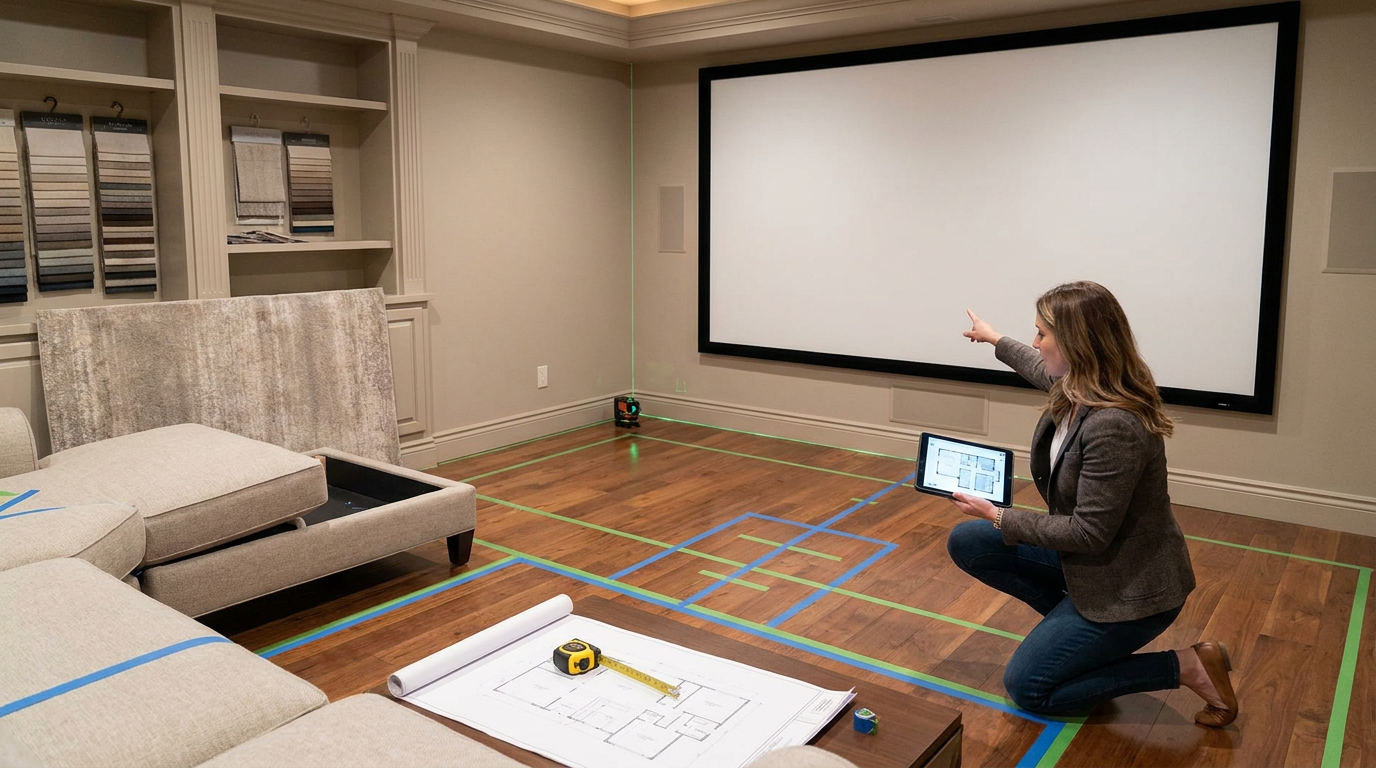
If you are unsure how to begin, it can help to map the room before buying anything. Painter’s tape on the floor can show where the screen wall, sofa depth, recliner footprint, and walking paths will go. Even this simple step often reveals whether a room can support one perfect row instead of two compromised ones. In cinema design, restraint is often what makes the room feel best.
Seating That Invites People to Stay
Comfort is at the heart of a successful cinema room. You can have excellent audio and a beautiful display, but if seating feels stiff, cramped, or overly formal, the room will not invite people to linger. The dream is to create a place where the first few minutes of settling in already feel restorative. That may mean classic recliners, a deep sectional, a modular sofa, chaise-style loungers, or a mix of seating types tailored to how your household gathers.
Dolby explicitly notes that seating should be comfortable for families and friends. That reminder is worth taking seriously because comfort in a cinema room is not only about softness. It is also about posture, spacing, support, and flexibility. A family with teenagers may love oversized loungers and snack-friendly armrests, while a couple who entertains often may prefer elegant theater-style seating with side tables and enough breathing room between guests.
Material selection matters more than many people expect. Dark leather can look sophisticated, but in some homes it may feel cold or overly formal. Performance fabric in a rich neutral can create a softer, more relaxed mood. Velvets, chenilles, and textured woven fabrics can add depth and absorb a bit of sound, helping the room feel both cozy and acoustically friendlier. The most beautiful seating choices often balance polish with everyday livability.
Layering is what turns seating into an experience. Add throw blankets within easy reach, lumbar pillows that support longer films, and small surfaces for drinks and popcorn. Consider hidden storage ottomans for remotes, gaming controllers, and extra chargers. If children will use the room often, washable covers or durable upholstery can preserve the room’s elegance without making you anxious every time someone reaches for candy.
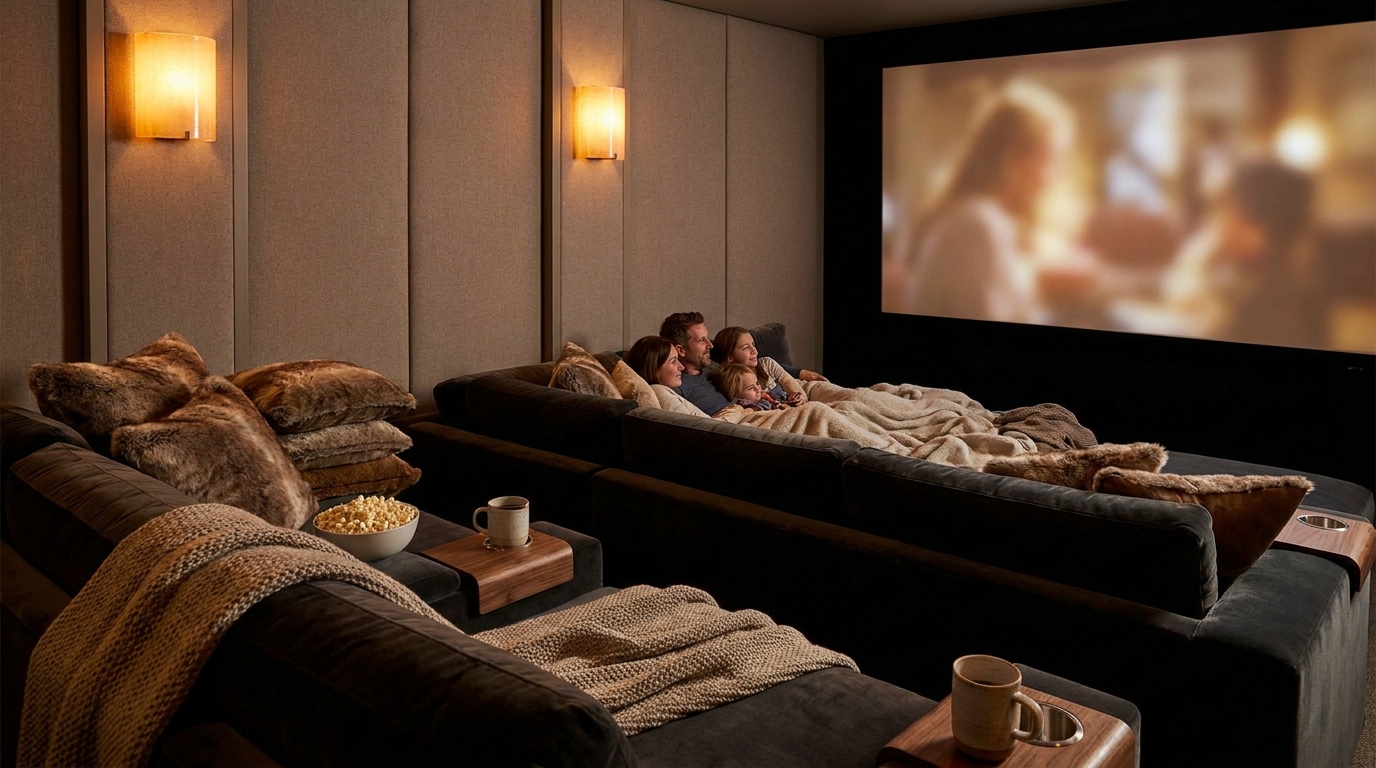
For larger homes or frequent hosts, tiered seating can be a wonderful upgrade. It helps preserve visibility for multiple rows and gives the room a true cinema rhythm. But it is not essential. Many of the most inviting media rooms use a single generous sofa as the main viewing zone, with movable poufs, accent chairs, or floor cushions brought in when needed. Comfort should feel easy, not rigid.
Projector or Large TV? Choosing the Right Screen for Your Lifestyle
One of the most common misconceptions in cinema room design is that a projector is automatically the superior choice. In reality, the better option depends on room brightness, desired screen size, budget, and how the room will be used day to day. A projector can create a beautifully theatrical experience, especially in darker rooms where a very large image becomes the star of the space. A large TV, however, can deliver exceptional brightness, convenience, and picture quality in rooms with ambient light or mixed use.
If your room will mostly be used at night for films, and you want the emotional impact of a truly expansive image, a projector may be worth serious consideration. It can make the room feel transportive in a way that many people associate with classic cinema. On the other hand, if the room will also host casual daytime viewing, sports, gaming, or family television with curtains open and people moving in and out, a large modern TV may feel easier and more satisfying.
There is also the visual impact of the screen itself. A dedicated projector room can feel beautifully understated when the screen disappears into the architecture or when cabinetry conceals supporting components. A large TV can be similarly elegant when integrated with millwork, a dark accent wall, or refined cable management. The best choice is not the one that sounds most dramatic. It is the one that works most naturally with your room and routines.
Whichever display type you choose, calibration matters. Color, brightness, and contrast should support comfortable viewing rather than harsh intensity. Families often watch a mix of animated films, dark dramas, sports, and streaming series, so tuning the image to feel balanced across content types can make the room much more enjoyable. A dream cinema room should not require endless settings adjustments every time someone changes platforms.
The Sound Difference That Changes Everything
If the screen draws people in, the sound is often what makes the room unforgettable. Good audio creates emotional depth, clarity, tension, and warmth. It helps dialogue feel understandable, music feel moving, and action scenes feel dimensional rather than noisy. This is where a true cinema room separates itself from an ordinary television setup.
Dolby Atmos for the home is designed to create a three-dimensional sound field with overhead and directional effects. That kind of immersion can make films, sports, and even certain streaming series feel dramatically more involving. But the key lesson is not simply that you need more speakers. It is that sound quality depends on placement, room acoustics, and calibration as much as the components themselves.
Another common misconception is that excellent sound comes mostly from buying expensive speakers. In reality, room acoustics, speaker positioning, and thoughtful setup are equally important. Hard surfaces can create reflections and echo that blur dialogue and make the room sound bright or tiring. Even a very beautiful room can underperform if every wall, floor, and tabletop bounces sound without any softness to absorb it.
That is why acoustic treatment should be seen as a comfort feature, not an audiophile indulgence. Rugs, upholstered seating, drapery, acoustic panels, and textured wall treatments can all help reduce harsh reflections. In a family room or media space, these elements can be integrated so gracefully that they simply read as good design. You do not need a room full of visible foam to improve the listening experience. You need balance.
Clear dialogue deserves special attention, especially in mixed-age households. When voices are easy to understand, everyone relaxes. Grandparents do not strain to follow the plot. Children stay engaged. Guests are not constantly reaching for subtitles unless they want them. A cinema room that sounds calm and intelligible often feels more luxurious than one that is simply loud.
Simple sound priorities to get right
- Center the listening experience by arranging main seats to face the screen and speaker array as directly as possible.
- Reduce echo with rugs, drapery, upholstered furniture, and acoustic panels where appropriate.
- Place speakers thoughtfully rather than hiding them in positions that compromise performance.
- Calibrate the system so dialogue, bass, and surround effects feel balanced at normal listening levels.
- Consider the household and choose a sound profile that feels exciting without becoming overwhelming.
Lighting That Makes Movie Night Feel Special
Lighting is one of the most emotional tools in the room. It shapes anticipation before the film begins, comfort during long viewing sessions, and the sense of calm when the credits roll and everyone stays in their seats talking. Good cinema lighting is layered, dimmable, and warm. It supports visibility when needed while allowing darkness to do its immersive work once the screen takes over.
A successful room usually combines several forms of light rather than relying on a single ceiling fixture. Recessed lights on dimmers can provide general illumination before and after viewing. Wall sconces add softness and visual rhythm. Low-level step lighting or LED strip lighting can guide movement safely without disrupting the image. Table lamps in a media room can make the space feel more residential and less formal, especially when movies are only one part of how the room is used.
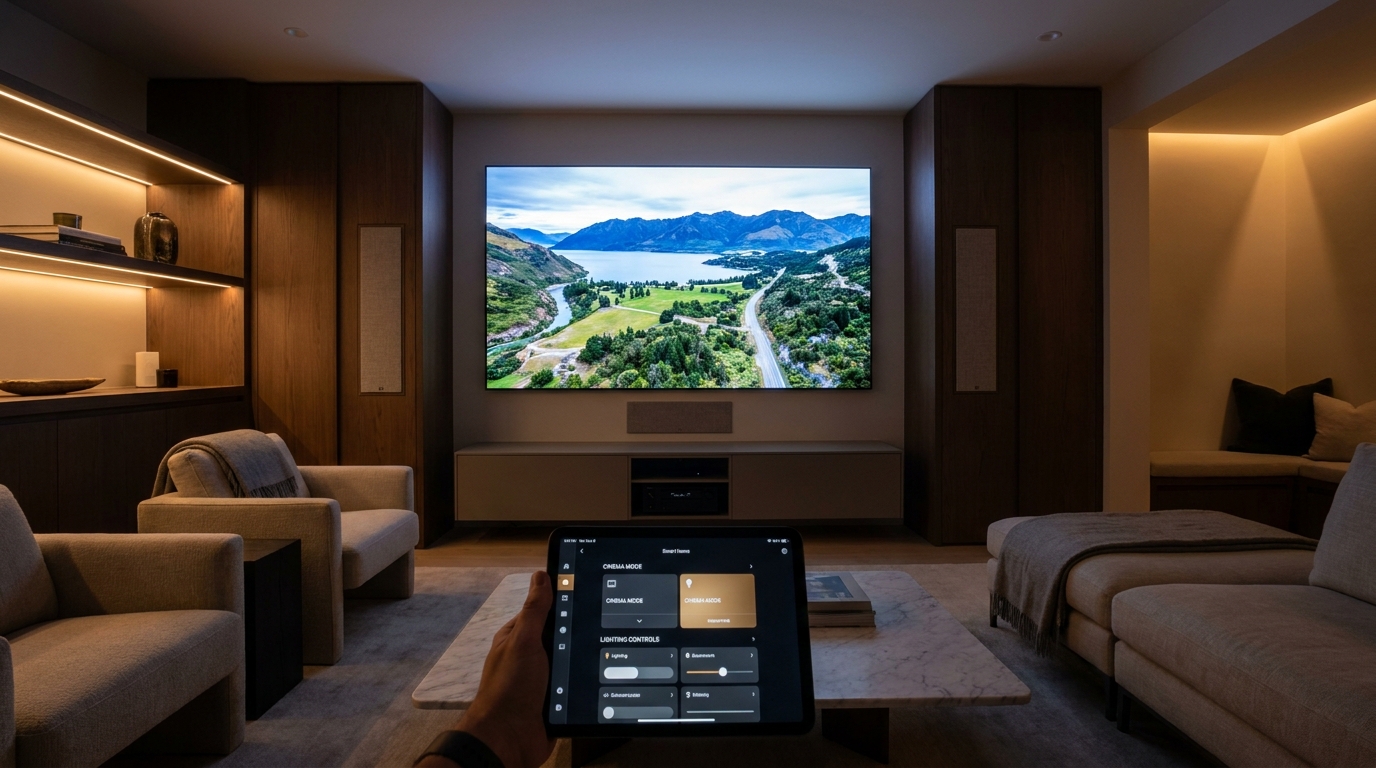
Smart control can make an enormous difference here. Human-centric smart home design is becoming more important, and cinema rooms are a perfect example of why. A well-designed system should simplify life, not complicate it. One-touch movie-night scenes can dim lights, lower shades, activate the display, and adjust sound settings in a way that feels seamless for the whole family. Smart does not need to mean technical. At its best, it simply means easy.
Dark finishes often help create a more cinematic mood because they reduce visual distractions and reflections. But dark does not have to mean gloomy. Rich charcoals, warm taupes, cocoa browns, deep olives, and inky blues can all create intimacy while still feeling elegant and inviting. Pair them with tactile fabrics, brass or blackened metal accents, and subtle lighting, and the room begins to glow in a very comforting way.
A cinema room feels luxurious not when it is packed with features, but when every feature quietly supports comfort, mood, and togetherness.
Smart Home Integration Without the Stress
For many homeowners, the phrase smart home cinema sounds more complicated than appealing. There is a fear that the room will become fussy, glitchy, or intimidating for guests and children. But one of the clearest modern trends is simpler user experiences. Properly designed systems are meant to reduce friction, not add it.
Imagine pressing one button labeled “Movie Night” and having the lights dim, blackout shades close, the system switch to your favorite streaming input, and the sound profile adjust automatically. That is the kind of integration that improves daily life. It removes the tiny frustrations that can make a room feel high-maintenance, especially when multiple family members use it and everyone has a different tolerance for technology.
CEDIA’s broader guidance on smart entertainment supports this lifestyle-focused approach. Home theaters are increasingly understood as part of whole-home living rather than isolated luxury projects. This shift is important because it means your cinema room can fit naturally into routines you already have. It can become as easy to enjoy as the kitchen coffee station or the patio fire table, which is exactly what makes it valuable.
Simple control options usually work best. A well-programmed remote, a wall keypad with a few clearly labeled scenes, or an app that only shows the functions people actually need can all make the room more intuitive. There is no prize for complexity. The dream is a room that anyone in the family can use confidently, including guests who just want to start a film without a tutorial.
Planning for Streaming, Connectivity, and Everyday Use
Because so much home entertainment now flows through streaming, internet quality has become part of cinema room comfort. This may not be the most glamorous part of the design process, but it has a real effect on the experience. Buffering in the middle of a dramatic scene or losing resolution during a big event can break the mood instantly. Strong connectivity supports the kind of premium, relaxed viewing that people want from a cinema room.
In Canada, this is especially relevant given the strength of residential broadband access and increasing household data use. Statistics Canada reported that average monthly data use per high-speed residential subscription reached 585.5 GB in 2024, up 9.7% from 2023. That trend reflects how deeply streaming is embedded in modern life. A cinema room designed today should assume regular high-bandwidth use, especially if the household streams 4K content, uses multiple platforms, and often has other devices running at the same time.
Whenever possible, plan for stable connectivity in the room itself rather than assuming a distant router will be enough. Wired connections can be helpful for some setups, while mesh systems or upgraded access points may improve reliability in larger homes. The point is not to over-engineer. It is to make sure the room performs as beautifully as it looks.
Daily usability also includes charging points, storage, cable management, and surfaces. Remote controls, headphones, game controllers, spare batteries, and streaming accessories all need a home. When these details are unresolved, clutter accumulates quickly and the room starts to lose its calm. Thoughtful cabinetry, baskets, drawers, and concealed wiring allow the room to feel polished even when it is used constantly.
A Style Direction That Supports Atmosphere
Many people imagine cinema rooms in one of two extremes: either a flashy commercial-style theater or a plain room with a giant screen dominating everything else. The most successful modern spaces tend to live somewhere in between. They feel intentionally atmospheric but still connected to the rest of the home. The design should support immersion while remaining warm, personal, and livable.
Texture is especially important. Because cinema rooms often use darker colors and lower light, texture keeps the room from feeling flat. Consider paneled walls, acoustic fabric treatments, heavy drapery, boucle or velvet pillows, ribbed wood details, soft carpeting, or a thick area rug. These layers create depth during the day and a cocooning feeling at night. They also soften sound, which gives them practical value as well as visual beauty.
Personal touches matter too. Framed vintage posters, shelves for favorite films, a discreet snack cabinet, or a drinks niche for hosting can make the room feel charming rather than generic. A cinema room should still reflect your household. If your home style is contemporary and minimal, the room can be sleek and serene. If your style is classic and inviting, richer materials and traditional sconces may feel right. The best spaces feel curated, not copied.
There is also room here for energy-conscious choices. ENERGY STAR displays, efficient lighting, and smart power settings can support more responsible use without sacrificing comfort. A room designed for pleasure can still align with practical values, and increasingly, homeowners want spaces that feel both indulgent and sensible.
How Much Should You Spend?
Budget can feel intimidating in the world of home entertainment, largely because images of ultra-luxury theaters tend to dominate the conversation. In reality, there is a wide range of possible investment levels. CEDIA’s cost guidance suggests that installations can start around roughly $1,000 to $7,000 for a basic setup and rise much higher for more advanced projector-and-surround-sound systems. That broad range is actually encouraging because it confirms that a meaningful cinema experience can begin at many different levels.
The smartest approach is to prioritize the choices that most directly affect daily enjoyment. In many rooms, that means spending well on seating comfort, display quality, and sound balance before chasing more dramatic but less essential features. A thoughtfully designed room with a large TV, excellent blackout shades, warm dimmable lighting, and good acoustic control may feel far more satisfying than a more expensive room with uneven priorities.
If you know this room will evolve over time, design for phases. You might begin with a strong screen and seating plan, then add acoustic panels, upgraded speakers, or custom millwork later. Wiring and infrastructure are often worth planning early, even if every piece of equipment does not arrive at once. A phased approach can protect your budget while still moving you toward the room you ultimately want.
Most of all, think in terms of value rather than spectacle. A cinema room that your family uses weekly, that makes hosting easier, and that gives everyone a place to unwind together has a lifestyle return that goes beyond the invoice. Comfort-rich spaces often become the rooms people remember most.
Common Misconceptions to Leave Behind
It helps to release a few common myths before making decisions. The first is that a cinema room must be large and fully dedicated to be worthwhile. In reality, smaller media rooms and hybrid spaces can be incredibly successful when planned around sightlines, lighting, and comfort. What matters is not the square footage alone, but how intentionally the room supports the experience.
The second myth is that a projector is always the premium option. Sometimes it is, especially in a dark room where a very large image is the goal. But many households are happier with a large TV that handles daytime viewing beautifully and asks less of the room. The better choice is the one that matches how you live.
A third misconception is that sound quality is mostly about expensive equipment. As discussed earlier, room acoustics, placement, and calibration are just as important. A thoughtfully treated room with balanced components can sound more refined than a much costlier system in an echo-prone space.
Finally, many people worry that smart systems will make the room harder to use. The opposite should be true. Smart integration, when properly designed, creates one-touch ease. It helps children, guests, and tired adults enjoy the room without thinking too much about the process. Good design always reduces stress.
Creating Rituals That Make the Room Meaningful
Once the technical and design choices are in place, the room’s real value begins to grow through use. This is the part that often matters most. A cinema room can become the setting for recurring rituals that strengthen family connection and make ordinary weeks feel softer around the edges. Sunday film nights, holiday movie marathons, birthday screenings, after-school cartoons, and impromptu concert streams all become more memorable when the environment supports them.
You can encourage that feeling with small, thoughtful habits. Keep a basket of favorite blankets nearby. Store popcorn bowls where children can help set up. Create a low shelf for board games or music listening when the screen is off. Add a mini fridge or drinks drawer if hosting is a priority. These gestures turn the room from a tech zone into a lived-in retreat.
The same applies to social gatherings. A good cinema room gives guests a reason to settle in and stay connected. Sporting events feel more communal, game nights become more immersive, and even casual catch-ups can unfold more comfortably when the room is layered with soft light and comfortable seating. Entertainment becomes less performative and more welcoming.
That emotional payoff is exactly why these rooms continue to resonate. They offer not only better viewing, but a better container for togetherness. In homes where schedules are busy and everyone is often scattered between devices and obligations, a room that gently draws people back into a shared experience can feel surprisingly meaningful.
Your Dream Cinema Room, Your Way
There is no single formula for the perfect cinema room because every home and every household uses comfort differently. For some, the dream is a dramatic projector room with plush recliners and layered surround sound. For others, it is a flexible media room with a beautiful large TV, a deep sectional, dimmable sconces, and storage for games and blankets. The common thread is not luxury for its own sake. It is intention.
When you design around how the room should feel, the choices become clearer. Sightlines matter because people deserve to relax without strain. Acoustics matter because hearing every word changes the emotional experience. Lighting matters because mood begins before the opening scene. Smart control matters because ease is part of comfort. And seating matters because the best rooms make people want to stay.
CEDIA’s homeowner guidance reflects the growing popularity and versatility of home entertainment, and its market outlook projects smart home theater volume at $4.1 billion by 2029. Yet the most compelling reason to create a cinema room is not the market momentum. It is the simple pleasure of having a space that welcomes your family and friends into shared moments, again and again.
If you are planning your own cinema room, start with the room you have, the rituals you want, and the level of comfort that will make the space impossible to resist. Build from there with warmth, clarity, and realism. A dream cinema room does not have to look like anyone else’s. It only has to make your home feel more connected, more restful, and a little more magical on movie night.
Quick Planning Checklist for a Comfortable Cinema Room
- Choose a room with manageable light, reasonable privacy, and enough wall space for a well-positioned screen.
- Decide whether you want a dedicated cinema room or a flexible media room based on real daily use.
- Plan seating around the screen centerline and comfortable viewing distance rather than trying to fit too many seats.
- Select a display type that suits brightness, lifestyle, and budget instead of assuming projector is always best.
- Improve sound with thoughtful placement, room calibration, and acoustic softening elements.
- Layer lighting with dimmers, sconces, and low-level guidance lighting for a cozy atmosphere.
- Use smart scenes to simplify movie night, not complicate it.
- Support streaming with reliable connectivity and tidy storage for accessories and cables.
- Style the room with texture, warmth, and personal touches that reflect the rest of your home.
- Focus your budget on the features that shape comfort and repeat use most directly.
When these pieces come together, the result is more than a viewing room. It is a place where home life feels fuller, softer, and more shared. That is the real dream.



No Comment! Be the first one.