



Understanding Robotics Intelligence: How Smarter Robots Work
Robotics intelligence is becoming one of the most important technology stories of the decade because it sits at the intersection of machines, software, data, and real-world action. Unlike traditional automation, which follows rigid instructions in predictable settings, robotics intelligence allows machines to sense their surroundings, interpret what they detect, make decisions, and adjust their behavior with some degree of autonomy. That shift matters because the environments where robots now operate are no longer limited to isolated factory cages. They increasingly include warehouses, hospitals, farms, retail spaces, roads, and other mixed environments where people and machines interact directly.
Table Of Content
- What Is Robotics Intelligence?
- The five layers behind intelligent robots
- 1. Hardware
- 2. Sensing and perception
- 3. Decision-making and planning
- 4. Control and actuation
- 5. Learning and adaptation
- Industrial robots versus service robots
- Where robotics intelligence is already making a difference
- Manufacturing
- Logistics and warehousing
- Healthcare
- Agriculture
- Public services and everyday environments
- Why safety and standards matter as much as capability
- The rise of shared autonomy
- North America, Canada, and the governance layer
- The biggest challenges still holding robotics intelligence back
- Common misconceptions about robot intelligence
- The next phase: embodied AI and physical AI
- What the future of automated systems will likely look like
- Final thoughts
For many readers, the phrase robotics intelligence can sound abstract or futuristic. In reality, it describes something practical: the growing ability of robots to do useful work in conditions that are imperfect, dynamic, and sometimes unpredictable. A robot that can identify a package, avoid a person crossing its path, adjust its grip on an object, or learn from repeated tasks is showing forms of robotics intelligence. It is not thinking like a human, but it is moving beyond fixed automation toward adaptable performance.
This matters now because the scale of adoption is no longer small. The International Federation of Robotics reported 4,281,585 industrial robots operating in factories worldwide in 2023, along with 541,302 new industrial robot installations that year. The Americas accounted for 10 percent of newly deployed industrial robots in 2023, and North America reached a robot density of 197 industrial robots per 10,000 manufacturing employees. Those figures tell a clear story: robots are no longer a niche capability. They are an operational layer in modern industry.
At the same time, robotics intelligence is expanding beyond manufacturing. The International Federation of Robotics also reported that professional service robot sales grew by 30 percent worldwide in 2023, with more than 205,000 units sold. More than half of those sales were tied to transportation and logistics, and the medical robotics market is also climbing, with about 6,100 medical robots sold worldwide in 2023 and about 16,700 in 2024. In other words, robotics intelligence is becoming visible in the places where goods move, care is delivered, and repetitive tasks consume time and labor.
This article offers an accessible overview of robotics intelligence by explaining how it works, what technologies sit underneath it, where it is already being used, and which challenges still limit its full potential. The goal is not to oversell robots as magic solutions. The goal is to show why this field is advancing, why safety and standards matter as much as raw capability, and why the future of automated systems depends on making robots not just more powerful, but more reliable, measurable, and useful around people.
What Is Robotics Intelligence?
At its core, robotics intelligence is the combination of capabilities that allows a robot to perform tasks with increasing autonomy. These capabilities usually include sensing, perception, planning, control, and learning. Sensing is how the robot gathers raw information from the environment. Perception is how it interprets that information. Planning is how it chooses a path or task sequence. Control is how it turns those decisions into movement. Learning is how it improves performance over time, whether through data, demonstration, simulation, or repeated interaction.
This layered view is useful because it separates robotics intelligence from the common misconception that a robot must possess human-like general intelligence to be considered smart. Most robots today are narrow systems designed for specific tasks under defined conditions. A warehouse robot does not understand the world the way a person does, and a surgical robot does not possess broad reasoning across unrelated domains. What these systems do have is specialized intelligence that helps them operate more effectively within their intended environment.
That distinction matters because it helps set realistic expectations. Robotics intelligence does not mean a machine can do anything. It means a machine can often do one class of work better than before because it can interpret more signals, respond to more variation, and require less rigid setup. In practical terms, this is the difference between a robot that repeats a fixed motion all day and a robot that can detect object position changes, avoid collisions, or collaborate with a human operator.
The future of robotics intelligence is not about building robots that think like people. It is about building systems that can handle uncertainty, support human work, and perform safely in the real conditions where automation actually happens.
The five layers behind intelligent robots
1. Hardware
Every robotics system begins with physical hardware. This can take many forms, including robotic arms, mobile robots, manipulators, collaborative robots, exoskeletons, drones, inspection machines, and autonomous delivery units. Hardware design determines what a robot can physically reach, lift, carry, sense, or tolerate in its environment. A robot designed for precision assembly in a factory will look very different from one built to move supplies through a hospital hallway or inspect crops in a field.
Hardware is often underappreciated in public discussions because software and AI attract more attention. Yet the intelligence of a robot is always constrained by what the body can do. A robot may have strong perception models, but if its gripper cannot handle irregular objects or its mobility platform cannot navigate rough surfaces, its practical utility is limited. In robotics, intelligence is embodied. The machine must be physically capable of acting on what it knows.
2. Sensing and perception
Robots understand their surroundings through sensors such as cameras, lidar, radar, force sensors, depth sensors, proximity sensors, and tactile sensors. These devices collect raw data about distance, texture, motion, pressure, light, and position. On their own, sensors do not create intelligence. They create signals. The challenge is turning those signals into useful understanding.
That is where perception comes in. Perception systems use computer vision, sensor fusion, and machine learning to detect people, objects, surfaces, obstacles, and task-relevant conditions. A robot in a warehouse might identify open pathways and shelf positions. A farm robot may distinguish crops from weeds. A hospital robot might detect doorways, carts, and moving staff members in crowded corridors. The better a robot can interpret noisy real-world data, the more flexible its behavior becomes.
Perception is also where many failures begin. Unusual lighting, reflective surfaces, clutter, dust, weather, and partial occlusion can confuse sensors. A robot that performs well in a polished demo environment may struggle in a busier, less predictable setting. That is why robust perception remains one of the central technical challenges in robotics intelligence.
3. Decision-making and planning
Once a robot has interpreted part of its environment, it must decide what to do next. Decision-making can involve path planning, object selection, task sequencing, grasp selection, obstacle avoidance, or choosing when to hand control back to a person. Some of these functions use classical robotics methods, while others now incorporate AI and machine learning. The trend is not a simple replacement of old methods with new ones. It is often a hybrid stack in which deterministic planning and learned models work together.
Planning becomes especially important in environments that contain uncertainty. A mobile robot in a logistics center may need to reroute around temporary congestion. A collaborative robot on an assembly line may need to pause when a worker enters its workspace. An assistive robot may need to interpret partial instructions and complete a task with human confirmation. In each case, intelligence depends on balancing autonomy with caution.
4. Control and actuation
Control is the bridge between decision and motion. It governs speed, force, trajectory, balance, grip pressure, and other aspects of movement. Actuation is the mechanical process that makes the robot move using motors, joints, drives, hydraulics, or other mechanisms. Even if perception and planning are strong, poor control can make a robot ineffective or unsafe. Precision matters, especially when robots operate near fragile materials, expensive goods, or human bodies.
One reason robotics is difficult is that the physical world is unforgiving. A tiny error in force control can crush an item. A slight navigation miscalculation can cause a collision. A delayed response can create risk around people. This is why robotics intelligence is not just about making better algorithms. It is about integrating software with mechanical and electrical systems that can execute decisions reliably.
5. Learning and adaptation
Learning allows robots to improve beyond initial programming. Some systems learn from labeled data. Others learn from simulation, demonstration, repeated trials, or supervised correction from human operators. Recent trends include robot learning from demonstration, in which a person shows a robot how to perform a task, and sim-to-real transfer, in which a robot is trained in simulation and then adapted for the physical world.
Learning is one of the most exciting parts of robotics intelligence because it promises more flexibility. But it is also one of the most sensitive areas because learned behavior can be brittle. A robot may perform well on the examples it has seen and still fail on rare or unusual cases. This is why researchers and industry teams are increasing their focus on stress testing, robustness evaluation, and red-teaming for robotic manipulation. Better learning matters, but better testing matters just as much.
Industrial robots versus service robots
A useful way to understand the robotics landscape is to distinguish between industrial robots and service robots. Industrial robots are typically used in manufacturing settings for tasks such as welding, assembly, painting, material handling, and packaging. These robots often operate in structured environments where workflows are repeatable, physical layouts are known, and performance can be optimized over long production cycles. Many are highly capable, but their intelligence is usually tuned for a narrower setting.
Service robots are built for work outside traditional factory production lines. They may operate in logistics, healthcare, retail, agriculture, hospitality, public infrastructure, or domestic settings. Their tasks can include moving inventory, assisting with surgeries, disinfecting rooms, inspecting assets, delivering items, or supporting rehabilitation. Because these environments are less predictable, service robots often require stronger perception, navigation, and human interaction capabilities.
This difference is important for safety, design, and public understanding. Industrial robots and service robots do not face the same constraints. A factory robot working behind protective barriers is operating under very different assumptions from a mobile robot navigating around patients in a hospital or workers in a warehouse. The intelligence stack may overlap, but the deployment realities are not the same.
The market data reinforces that shift. Factory automation remains a major engine of robotics adoption, but service robots are scaling quickly. More than half of professional service robot sales in 2023 were for transportation and logistics, which reflects the pressure to move goods faster and more efficiently. Healthcare is also becoming a major use case, especially where precision, repeatability, and support for clinical staff create clear value.
Where robotics intelligence is already making a difference
Manufacturing
Manufacturing remains the clearest example of robotics intelligence at scale. Robots in factories have moved well beyond simple repetitive motion in many facilities. Advanced systems can handle vision-guided picking, adaptive assembly, quality inspection, and collaboration with nearby human workers. The fact that North America has reached 197 industrial robots per 10,000 manufacturing employees shows just how central automation has become to productivity and capacity.
In this setting, robotics intelligence supports consistency, speed, and worker safety. It can reduce exposure to heat, heavy lifting, toxic materials, and repetitive strain tasks. It can also help manufacturers deal with labor shortages and production variability. However, success depends heavily on integration. A robot is valuable only when it fits into upstream and downstream workflows without creating new bottlenecks.
Logistics and warehousing
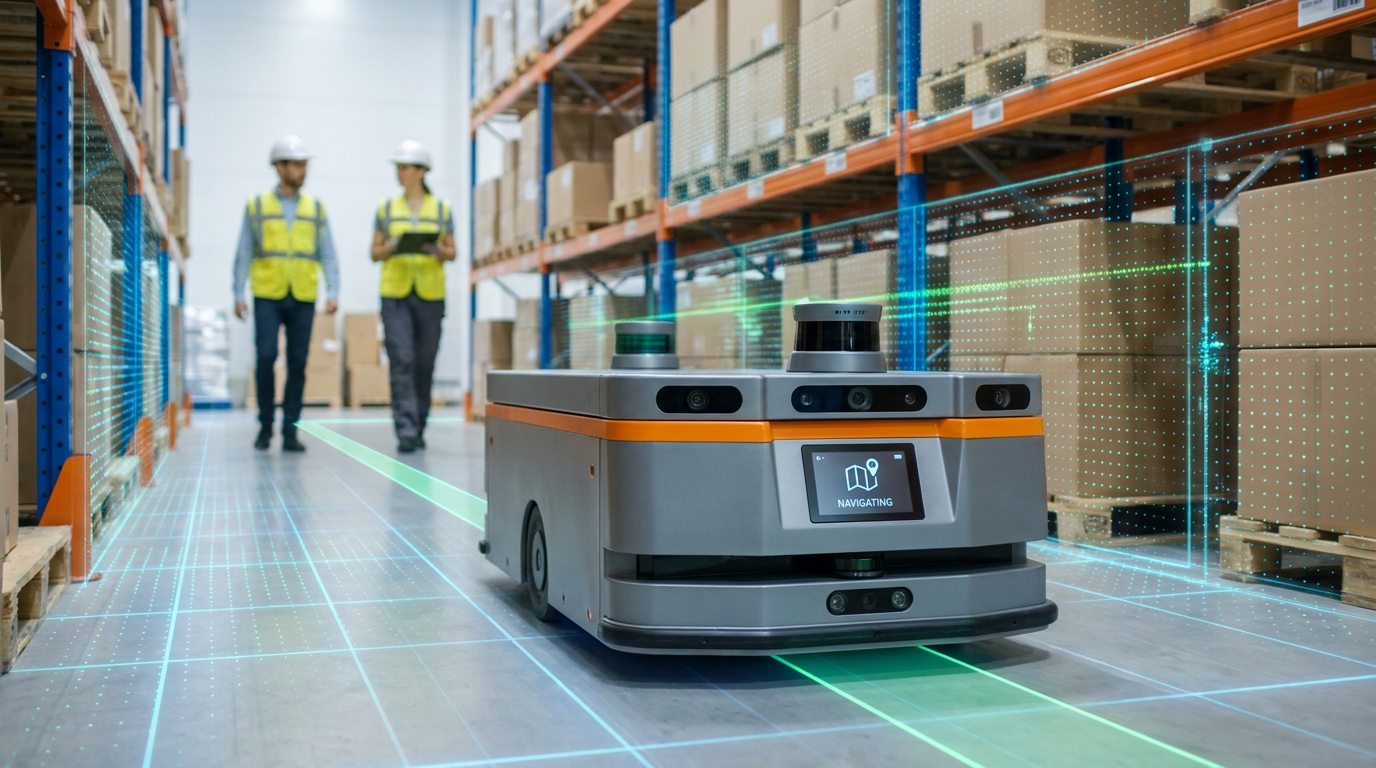
Logistics is one of the strongest growth areas for robotics intelligence because moving goods is a large, repetitive, and time-sensitive problem. Autonomous mobile robots, robotic arms for picking and sorting, and inventory-scanning systems are increasingly used in distribution centers and fulfillment operations. Here, intelligence is not just about motion. It is about route optimization, congestion management, object recognition, and coordination across many moving units.
The growth in service robots is especially visible in this sector. When transportation and logistics account for more than half of professional service robot sales, it signals that businesses see practical returns from robotic movement and handling. This does not mean warehouses are becoming fully autonomous. Many systems still rely on human supervision, exception handling, and staged task design. The real story is partial autonomy delivering operational value in controlled increments.
Healthcare
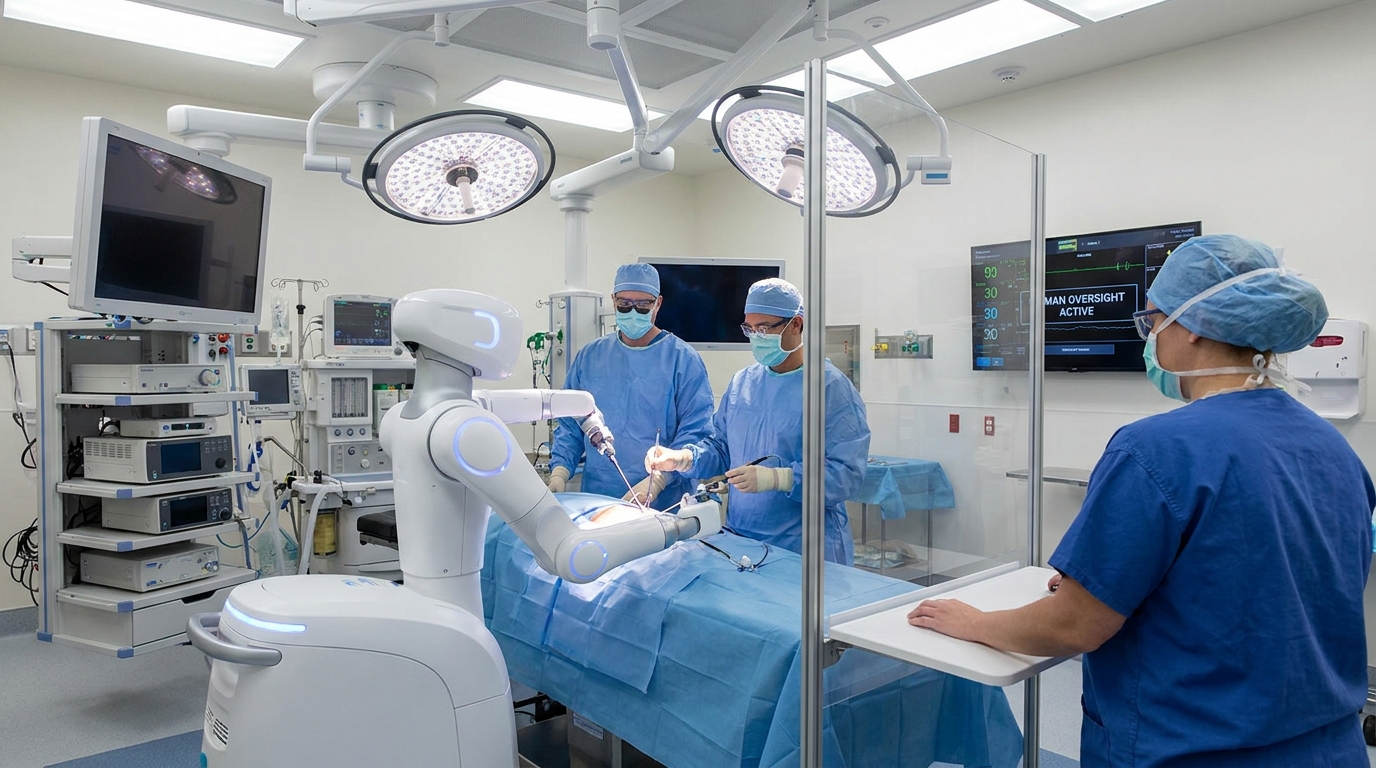
Healthcare offers a compelling example of where robotics intelligence can extend human capability rather than simply automate labor. Medical robots can support surgery, rehabilitation, imaging workflows, medication handling, and hospital logistics. In these use cases, the stakes are higher because robots operate close to patients and clinicians. Precision, traceability, safety, and oversight are therefore non-negotiable.
The increase in medical robot sales shows the market is moving. Still, healthcare robotics is not just about technical innovation. It is also about trust, clinical integration, regulation, and accessibility. A robot that saves clinician time but complicates workflow can become a burden rather than a benefit. The best systems are those that fit real care environments and support professional judgment rather than attempt to replace it.
Agriculture
Agriculture is another sector where robotics intelligence is becoming practical. Robots can help with harvesting, spraying, weeding, crop monitoring, and environmental sensing. Since farms are variable and outdoor conditions shift constantly, robotics intelligence in agriculture depends heavily on robust perception and adaptive control. Lighting changes, uneven terrain, weather, and biological variation all make the problem harder than many indoor automation tasks.
Yet the economic case is strong. Agriculture faces labor pressure, efficiency demands, and sustainability challenges. Robots that can target treatment more precisely or reduce manual repetitive work can improve both productivity and resource use. This is one of the clearest examples of why better robotics intelligence matters. It unlocks automation in environments that were previously too messy for rigid machines.
Public services and everyday environments
Robotics intelligence is also beginning to influence public services and daily life through cleaning robots, inspection systems, delivery robots, and assistive devices. These applications may appear modest compared with industrial automation, but they matter because they bring robots into shared human spaces. Once that happens, questions about accessibility, accountability, design transparency, and social acceptance become much more visible.
For the public, this may be the most meaningful shift. People are less likely to notice a robot in a distant factory than one that appears in a hospital corridor, airport terminal, campus sidewalk, or municipal service environment. As robotics intelligence becomes more visible, its success will depend not just on performance but on whether people feel safe, informed, and respected around it.
Why safety and standards matter as much as capability
One of the biggest misconceptions in robotics is that greater autonomy automatically means greater safety. In reality, more autonomy can introduce new risks if the system is not tested properly or if edge cases are ignored. A robot that adapts dynamically may be more efficient, but it can also behave in ways that are harder to anticipate than a simple fixed-function machine. This makes standards, evaluation methods, and risk reduction frameworks essential.
That is why standards such as ISO 10218-1:2025 matter. This industrial robot safety standard emphasizes safe design and risk reduction, helping organizations establish baseline expectations for deployment. Safety standards do not eliminate all risk, but they create a framework for identifying hazards, validating controls, and building accountability into system design. In mixed environments where humans and robots work close together, that structure is critical.
The U.S. National Institute of Standards and Technology has also highlighted key areas such as human-robot interaction, shared autonomy, digital twins, and test methods and metrics. That focus is important because robotics intelligence is not just about creating smart behavior. It is about measuring performance under realistic conditions and understanding how systems fail. A robot that works 99 percent of the time in a lab is not necessarily ready for a public-facing environment if the 1 percent failure mode is dangerous.
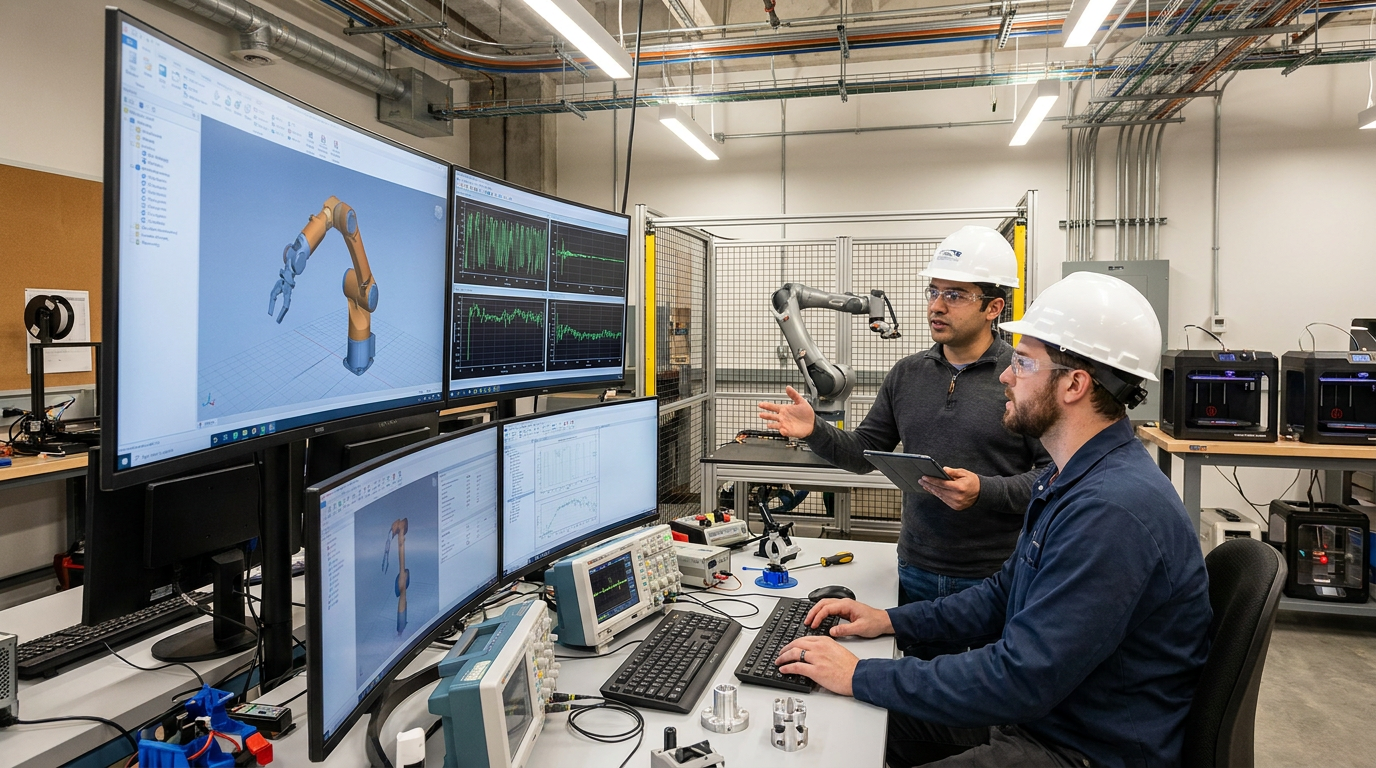
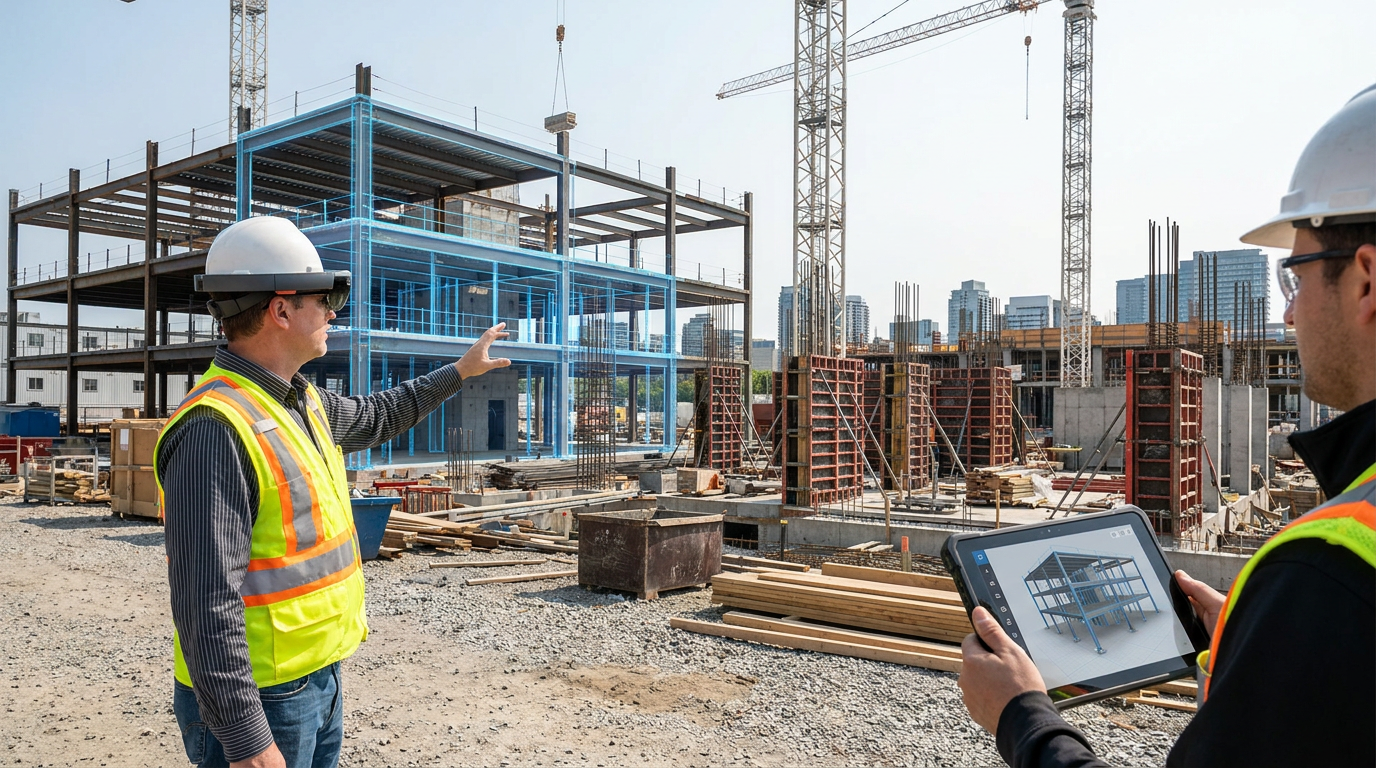
Digital twins are especially relevant here. A digital twin is a virtual representation of a physical system that can be used for testing, simulation, monitoring, and optimization. In robotics, digital twins help teams evaluate how a robot might behave under many scenarios before deploying it in the real world. This can reduce cost, accelerate iteration, and improve safety by revealing weaknesses earlier in the development cycle.
The rise of shared autonomy
One of the most realistic and useful concepts in robotics intelligence today is shared autonomy. Instead of framing the future as a binary choice between human control and full robotic independence, shared autonomy treats work as a collaboration. The robot handles parts of the task that it can do reliably, while the human provides guidance, supervision, correction, or final approval where judgment is needed.
This approach is gaining momentum because it reflects how many real deployments actually work. A robot may navigate on its own most of the time but request help when it encounters uncertainty. A manipulation system may execute a grasp after a human confirms the target object. An assistive robot may learn incrementally through user interaction rather than being expected to generalize perfectly from day one. This is often more practical than chasing full autonomy too early.
NIST research points to shared autonomy as a central area because it improves both usability and safety. It also supports a better public understanding of what robotic intelligence really is. Many systems are not replacing humans. They are redistributing tasks between human and machine in ways that aim to improve performance, reduce strain, and maintain oversight where it matters most.
North America, Canada, and the governance layer
North America is not only a region of robotics adoption. It is also becoming a region where governance, standards, and public-sector frameworks are shaping how intelligent systems are deployed. That matters because robots do not exist in a vacuum. Once AI-driven machines interact with workers, patients, consumers, and public environments, questions of accountability and accessibility become unavoidable.
Canada offers a useful example of this governance trend. The federal government launched its first AI Strategy for the public service in March 2025. It also launched the Canadian Artificial Intelligence Safety Institute in November 2024 and signed the Council of Europe framework convention on AI and human rights in February 2025. These developments matter for robotics intelligence because they reflect a broader policy effort to ensure AI-enabled systems are safe, rights-aware, and subject to public trust mechanisms.
Accessibility is another key dimension. Accessibility Standards Canada published CAN-ASC-6.2:2025, the first National Standard of Canada focused specifically on accessible and equitable AI systems. That is highly relevant to robotics intelligence. As robots move into workplaces, services, and public settings, accessibility cannot be treated as an afterthought. Systems should be designed so that they do not create new barriers for people with disabilities or exclude users whose needs differ from the assumptions built into the technology.
This governance layer may sound less exciting than breakthroughs in robot learning, but it is what separates scalable innovation from fragile experimentation. If organizations want robots in high-trust environments, they need more than performance claims. They need standards, documentation, evaluation, transparency, and processes for intervention when something goes wrong.
The biggest challenges still holding robotics intelligence back
For all the progress in robotics intelligence, the field still faces serious limitations. Reliability remains one of the largest. Robots can fail when confronted with novel obstacles, poor lighting, sensor noise, cluttered environments, or unpredictable human behavior. The gap between a successful demo and a dependable production system is still wide in many applications. This is why deployment often happens gradually rather than as a sudden full replacement of existing workflows.
Cost is another major barrier. Intelligent robotics systems are not just machines. They often require sensors, software, integration work, data infrastructure, safety controls, training, maintenance, and ongoing updates. The return on investment can be strong in the right setting, but it is rarely instant. Small and mid-sized organizations may find the technical and operational burden difficult unless solutions become easier to implement and support.
Data quality also matters more than many people realize. Machine learning systems are only as good as the data and scenarios used to train or validate them. If a robot has limited examples of unusual layouts, objects, or edge cases, its confidence may exceed its competence. In physical systems, that gap can be expensive or dangerous. Better datasets, stronger simulation environments, and more realistic test protocols are all part of the solution.
Integration into existing workflows is often the hidden challenge. A robot may perform its individual task well and still create friction if upstream supplies are inconsistent, downstream systems cannot accept its output, or workers are not trained to interact with it effectively. Robotics intelligence succeeds when it is embedded into operations thoughtfully, not when it is dropped in as a standalone showpiece.
Labor transition is perhaps the most publicly debated issue. It is simplistic to say that robots only replace jobs. In many sectors, robotics intelligence automates repetitive, hazardous, or physically exhausting work while creating demand for integration specialists, technicians, maintenance roles, operators, safety managers, and oversight functions. At the same time, disruption is real. Workers and organizations need training pathways and transition support if the benefits of automation are to be shared rather than concentrated.
Common misconceptions about robot intelligence
Several misconceptions continue to distort how the public sees robotics intelligence. One is the idea that most robots are already fully autonomous. In practice, many systems still depend on supervision, structured environments, human setup, or shared autonomy. Another is the belief that robotic intelligence equals human-level intelligence. Today’s systems are usually specialized and narrow, even when they appear impressive in a specific domain.
A third misconception is that more autonomy automatically improves safety. In reality, autonomy without robust testing and clear guardrails can increase risk. Another common myth is that robots only destroy jobs. A better framing is that they reconfigure work. Some tasks disappear, some tasks change, and some entirely new roles emerge around programming, monitoring, compliance, repair, and system optimization.
Finally, many people treat industrial and service robots as if they were the same category. They are not. Their environments, design constraints, user expectations, and safety requirements differ substantially. Understanding these distinctions helps readers evaluate claims more accurately and see why progress in robotics intelligence is uneven across different sectors.
The next phase: embodied AI and physical AI
Looking ahead, two terms appear more often in discussions about advanced robotics: embodied AI and physical AI. Both point to a similar idea. Intelligence becomes more meaningful when it is tied to a body acting in the world. A model that can classify images is useful, but a robot that can perceive, decide, and manipulate physical objects in changing conditions is operating at a more demanding level.
This is why current research and industry development are focusing so heavily on real-world robustness. Sim-to-real transfer, incremental learning, manipulation red-teaming, and edge AI all aim to improve performance where conditions are imperfect. The future is not simply smarter software. It is better software connected to sensors, motors, safety systems, test frameworks, and deployment practices that work outside controlled demos.
The momentum is real. The International Federation of Robotics has indicated that 2024 was the second-highest year on record for global industrial robot installations and that the Americas exceeded 50,000 installations in 2024. That suggests automation demand remains strong despite regional variation and economic complexity. Robotics intelligence is no longer a distant possibility. It is an active industrial transformation with expanding reach into service sectors and public environments.
What the future of automated systems will likely look like
The most likely future is not one in which robots suddenly take over every task. It is one in which automated systems become more capable in selected domains, more collaborative with people, and more embedded in the background of daily operations. In factories, this may mean more adaptive lines and smarter inspection. In logistics, it may mean coordinated fleets of mobile robots. In healthcare, it may mean more assistive systems that reduce burden on staff while preserving clinical control. In public services, it may mean targeted robotics where reliability and safety justify the deployment.
That future will depend on a balance of ambition and discipline. Organizations will need to invest not only in AI models and hardware, but in governance, accessibility, workforce training, and standardized evaluation. Policymakers will need to support innovation without ignoring risk. Developers will need to design for edge cases and human realities, not just benchmark performance. And the public will need clearer language about what robotics intelligence can and cannot do.
If there is one idea worth carrying forward, it is this: the real progress in robotics intelligence is not that robots are becoming magically human. It is that they are becoming incrementally more capable, more measurable, and more useful in the environments where automation matters. That may sound less dramatic than science fiction, but it is far more important. It is how automated systems move from novelty to infrastructure.
Final thoughts
Robotics intelligence is best understood as a practical evolution in automation. By combining sensing, perception, planning, control, and learning, robots can now handle a wider range of tasks with greater adaptability than previous generations of machines. The market data from manufacturing, logistics, and healthcare shows that this shift is already underway, especially in North America where adoption is rising alongside stronger attention to standards and governance.
The promise is substantial. Smarter robots can improve productivity, reduce exposure to dangerous work, support accessibility, and enable new services across many industries. The limits are equally real. Reliability, cost, data quality, safety, oversight, and labor transition all shape whether a robotics system delivers lasting value. The future will belong not to the flashiest demos, but to the systems that prove they can work safely and consistently in the real world.
For readers trying to make sense of this field, the clearest takeaway is simple. Robotics intelligence is not a speculative concept waiting for some distant breakthrough. It is a present-day technology layer that is steadily reshaping automated systems around us. The smarter question is no longer whether robots will matter. It is how we design, measure, govern, and live with them as they become part of modern life.


No Comment! Be the first one.