When Architecture Heals: Inside Toronto’s New Indigenous Women’s Shelter
There is a particular kind of design challenge that asks a building to do more than shelter. It must comfort. It must honour. It must help someone begin again. In Toronto, LGA Architectural Partners has taken on exactly this task with a new eighteen room facility for Anduhyaun, the city’s only Indigenous Violence Against Women shelter, and the result is a space I find myself returning to in my mind long after seeing the images.
What strikes me first is the restraint. So much of contemporary institutional architecture leans on hard edges and repeated grids, a language of efficiency rather than empathy. Here, the architects chose the opposite path. Water, earth, and sky, the elements most associated in Indigenous tradition with healing and nourishment, are not simply referenced in a mood board. They are translated into form, into the curve of a wall, the warmth of timber, the way light is allowed to move through a room rather than simply illuminate it.
The organic geometry is the boldest decision in the whole project. Conventional shelter design, and frankly conventional housing design in general, tends to rely on rectilinear efficiency because it is cheaper and faster to build. LGA instead created flowing spaces that resist that hierarchy entirely. For women arriving in crisis, often after violence and displacement, a building that does not feel institutional is not a luxury. It is part of the treatment. Atmosphere, in a place like this, is architecture’s most important material.
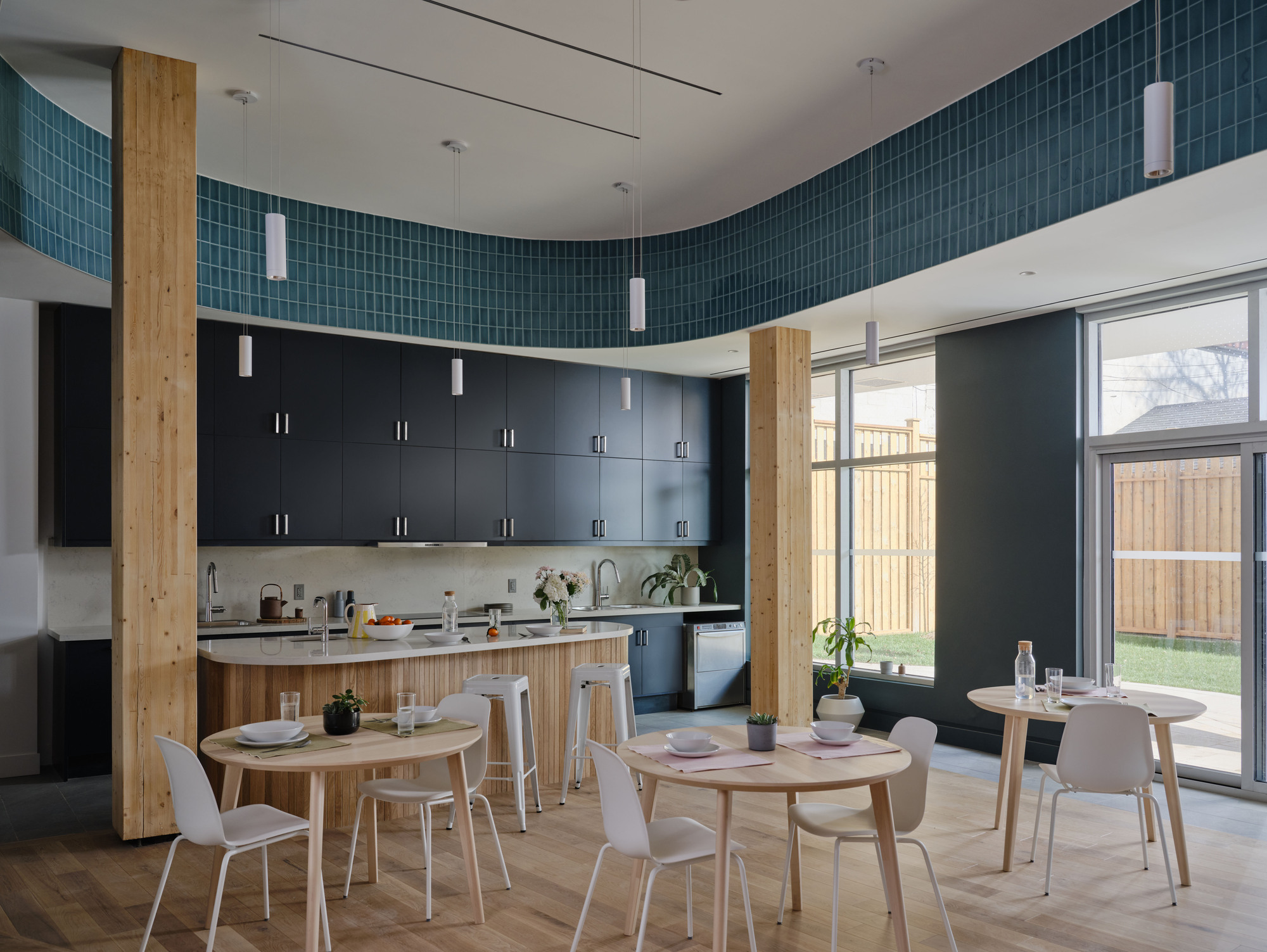
Material choice reinforces the same intent. Wood surfaces soften the light throughout the interior photography, and glass is used sparingly, to draw daylight inward rather than to expose. Every finish seems chosen for how it feels under a hand rather than how it photographs from a distance, though it photographs beautifully too. This is the quiet discipline I always look for in meaningful design: a building that performs emotionally before it performs visually.
The result is a set of flowing spaces that feel organic and stand in contrast to the rectilinear shapes and spatial hierarchies of conventional buildings.
What I find most compelling is how specific this design is to its purpose and its community. It does not borrow a generic language of wellness architecture. It draws directly from Indigenous tradition and applies that vocabulary with real seriousness, not as ornament but as structure. That is the difference between decoration and design with conviction, and it is the reason this project deserves attention well beyond the architecture press.
Shelters rarely receive this level of architectural ambition, and that in itself says something about what we choose to invest beauty and care into. Anduhyaun’s new home is proof that dignity can be built into every wall, and that the most transformative interiors are not always the ones designed for admiration, but the ones designed for healing.
Source: ArchDaily, “Anduhyaun Emergency Shelter / LGA Architectural Partners”