



Development timelines are often discussed as if they are simple countdowns from land purchase to ribbon cutting. In reality, urban growth projects move through a much more complex path shaped by land economics, planning frameworks, infrastructure constraints, public policy, and stakeholder expectations. For developers, municipalities, investors, and community partners, timing is not just a project management concern. It is a strategic variable that influences feasibility, carrying costs, risk exposure, and ultimately whether new housing or mixed use supply reaches the market at all.
Table Of Content
- Why Development Timelines Matter More Than Most Stakeholders Realize
- The Full Development Timeline: From Concept to Occupancy
- 1. Project Initiation and Land Strategy
- 2. Feasibility Analysis and Project Definition
- 3. Planning, Rezoning, and Entitlements
- 4. Regulatory Approvals Beyond Municipal Permitting
- 5. Community Engagement as a Timeline Input
- 6. Financing, Capital Structuring, and Market Readiness
- 7. Building Permits and Pre-Construction Mobilization
- 8. Construction and Delivery
- 9. Occupancy, Closeout, and Project Completion
- The Biggest Factors That Affect Development Timelines
- Common Misconceptions About Development Timelines
- How to Optimize Each Phase Strategically
- What Policy Trends Mean for Future Timelines
- A Practical Framework for Building Better Timelines
- Conclusion
In Canada and across North America, one of the most persistent misconceptions is that the clock really starts when excavation begins. The truth is that some of the most consequential schedule pressure is created long before construction crews arrive on site. Feasibility analysis, rezoning, official plan amendments, environmental review, utility servicing coordination, financing, permit issuance, and public consultation can consume months or years. By the time visible construction starts, the project has already passed through several decision gates that determine not only timing, but also design, density, capital structure, and viability.
This matters in a period when cities are under intense pressure to add housing, upgrade infrastructure, and support long term growth. The faster urban regions grow, the more important it becomes to understand how development timelines actually work. Projects that move efficiently are rarely the product of luck. They are the result of disciplined sequencing, informed entitlement strategy, proactive engagement, and strong coordination across agencies and consultants.
This guide breaks down the major phases of development timelines for urban growth projects and explains why each phase matters strategically. It also examines the main causes of delay, including regulatory approvals, community engagement, development charges, infrastructure servicing, and permit interpretation. The goal is not simply to describe a timeline, but to show how experienced development teams treat time itself as a core asset to be managed.
Strategic principle: In urban growth projects, the biggest timeline risks often come from governance, approvals, and coordination rather than physical construction alone.
Why Development Timelines Matter More Than Most Stakeholders Realize
A development timeline is more than a schedule on a Gantt chart. It is the framework that connects land acquisition, approvals, financing, delivery, and occupancy into a coherent business plan. Every month on that timeline carries implications for interest costs, consultant fees, tax exposure, inflation, contractor pricing, and market timing. If a project misses its targeted launch or occupancy window, the impact can be felt across the entire pro forma.
For private developers, delays increase carrying costs and can erode margin in ways that are difficult to recover later. For institutional investors and lenders, longer timelines mean greater uncertainty and more pressure on capital deployment. For municipalities, prolonged approvals can slow housing supply and intensify affordability challenges. For communities, delays may stall infrastructure improvements, public realm investments, and the delivery of services tied to growth.
Research consistently reinforces that approval timing has broader economic consequences. CMHC has reported that municipal review and approval for multi unit housing in Canada takes, on average, about a full year. That average alone should reframe how stakeholders think about development. If the approval process routinely consumes a year before construction even starts, then schedule discipline must begin at the entitlement and planning stage, not after permits are issued.
There is also a competitive dimension. In high demand urban markets, developers who can forecast timelines more accurately tend to make better land decisions, structure capital more effectively, and navigate approvals with fewer surprises. Time certainty is not just operationally useful. It can be a meaningful advantage in bidding, phasing, and delivery strategy.
The Full Development Timeline: From Concept to Occupancy
Although every urban growth project is unique, most follow a recognizable sequence. The phases often overlap, and in well managed projects they should overlap where possible. Parallel processing can reduce unnecessary idle time, especially when financing, design refinement, consultation, and technical studies continue while approvals are under review. Even so, each phase has its own risks, decision points, and dependencies.
1. Project Initiation and Land Strategy
The earliest phase starts before formal planning submissions are made. It usually includes site identification, acquisition strategy, market analysis, highest and best use evaluation, title review, and initial conversations with planning and legal advisors. This is where a project team tests whether the site can support the intended density, use mix, and built form within current policy or through a rezoning pathway.
At this stage, strategic discipline matters more than speed alone. Some projects look attractive based on location or land price, but become far less compelling when infrastructure limitations, servicing constraints, heritage issues, or political sensitivity are properly understood. A rushed acquisition without entitlement awareness often creates timeline risk later. In contrast, a carefully underwritten site can justify a more confident schedule and a stronger development strategy.
Early due diligence should also examine how the municipality handles approvals in practice. Two sites with similar policy designations may have very different timelines depending on local staffing, review culture, infrastructure priorities, or appeal history. Developers who understand both the written rules and the unwritten process realities are usually better positioned to set realistic expectations.

2. Feasibility Analysis and Project Definition
Once a site is under control, the project moves into feasibility. This phase typically includes planning analysis, massing studies, servicing review, transportation assessment, environmental studies, cost estimating, and preliminary financial modeling. A credible timeline starts here because assumptions made in feasibility often shape every subsequent milestone.
Feasibility is where the team determines whether the project can absorb development charges, permit fees, soft costs, financing costs, and construction inflation. CMHC has reported that development charges in some Canadian cities can add roughly $40,000 to more than $100,000 to a new home, with wide variation between municipalities. Those charges are not just accounting items. They can influence phasing, lender comfort, permit timing, and whether the project proceeds at all.
It is also important to distinguish market ambition from planning reality. A project may perform well financially at one density and poorly at another. If approvals are likely to reduce height, unit count, or commercial area, the timeline and the economics can deteriorate together. Strong feasibility work builds in sensitivity testing so the team understands which variables create the greatest pressure on timing and viability.
3. Planning, Rezoning, and Entitlements
For many urban growth projects, entitlements are the true center of the timeline. This phase can include rezoning applications, official plan or comprehensive plan amendments, site plan review, urban design review, and technical submissions related to transportation, servicing, stormwater, shadow impacts, and environmental conditions. Where land use permissions are not already aligned with the proposal, this phase can be lengthy and iterative.
Developers sometimes underestimate how much design and policy negotiation happens here. Municipal staff may request revisions to height transitions, built form, parking supply, loading access, affordable housing components, streetscape treatment, or community benefits. These are not cosmetic details. They can alter engineering requirements, unit mix, and total development yield, all of which affect both schedule and pro forma.
CMHC’s finding that municipal review and approval for multi unit housing averages a full year in Canada is especially relevant at this point. In many markets, a year may be a reasonable baseline rather than a worst case scenario. More complex projects, particularly those requiring multiple amendments or political support, may take considerably longer. Developers who assume rapid approvals without local evidence often create unrealistic investor expectations and fragile business plans.
Another critical issue is appeal risk. If a project attracts opposition or policy disagreement, tribunal or court processes can extend timelines significantly. Even when the eventual outcome is favorable, appeals introduce uncertainty that can complicate financing and procurement. The strategic response is not simply legal preparedness. It is better front end planning, cleaner policy alignment, and stronger stakeholder management before the dispute hardens.
4. Regulatory Approvals Beyond Municipal Permitting
One of the biggest mistakes in timeline planning is treating municipal permitting as the only regulatory hurdle. Many projects face broader approval requirements involving provincial, territorial, federal, Indigenous, conservation, transit, utility, or park related authorities. Depending on site conditions and project type, these reviews may run in parallel with municipal planning, or they may introduce sequential dependencies that extend the critical path.
In Canada, the federal impact assessment process is a useful example of how timelines can expand beyond city hall. The process includes a planning phase and legislated timelines, with an explicit focus on coordinated review across jurisdictions. For large or sensitive projects, this means the schedule must account for consultation, technical review, and cross agency coordination at levels well beyond local building permit review.
Recent policy direction has aimed to reduce some of this friction. The Building Canada Act framework, for projects of national interest, reflects a broader trend toward consolidating approvals rather than forcing each one to occur sequentially. That is strategically important because sequential reviews often create dead time in which teams are waiting for one authority before meaningfully engaging another. Consolidation does not remove due diligence or consultation requirements, but it can improve predictability and reduce administrative drag.
For developers, the lesson is straightforward. The approval map should be built early and with precision. It is not enough to know that approvals are needed. The team must understand which approvals are discretionary, which are technical, which can proceed in parallel, and which agencies have the power to impose design changes or additional conditions.
5. Community Engagement as a Timeline Input
Community engagement is often discussed as a communications task, but in urban growth projects it is a schedule input with real strategic weight. Projects that require rezoning, official plan amendments, environmental review, public hearings, or major design change usually involve residents, local businesses, Indigenous communities, elected officials, and advocacy groups. Their concerns can shape design revisions, conditions of approval, and political momentum.
Weak engagement rarely saves time in the long run. When consultation is rushed, defensive, or disconnected from real project choices, opposition can harden and delay the process through redesign requests, escalated political attention, or appeals. By contrast, early and credible engagement can surface solvable issues before positions become entrenched. That might include traffic circulation, shadow impacts, transitions to low rise neighbourhoods, public space design, construction management, or affordable housing expectations.
This is especially relevant in high growth corridors where residents may support more housing in principle but have concerns about pace, servicing, school capacity, or local identity. Developers who treat engagement as substantive rather than ceremonial are usually better equipped to build trust and preserve schedule certainty. The project may still change, but changes made early are generally less costly than changes imposed late.
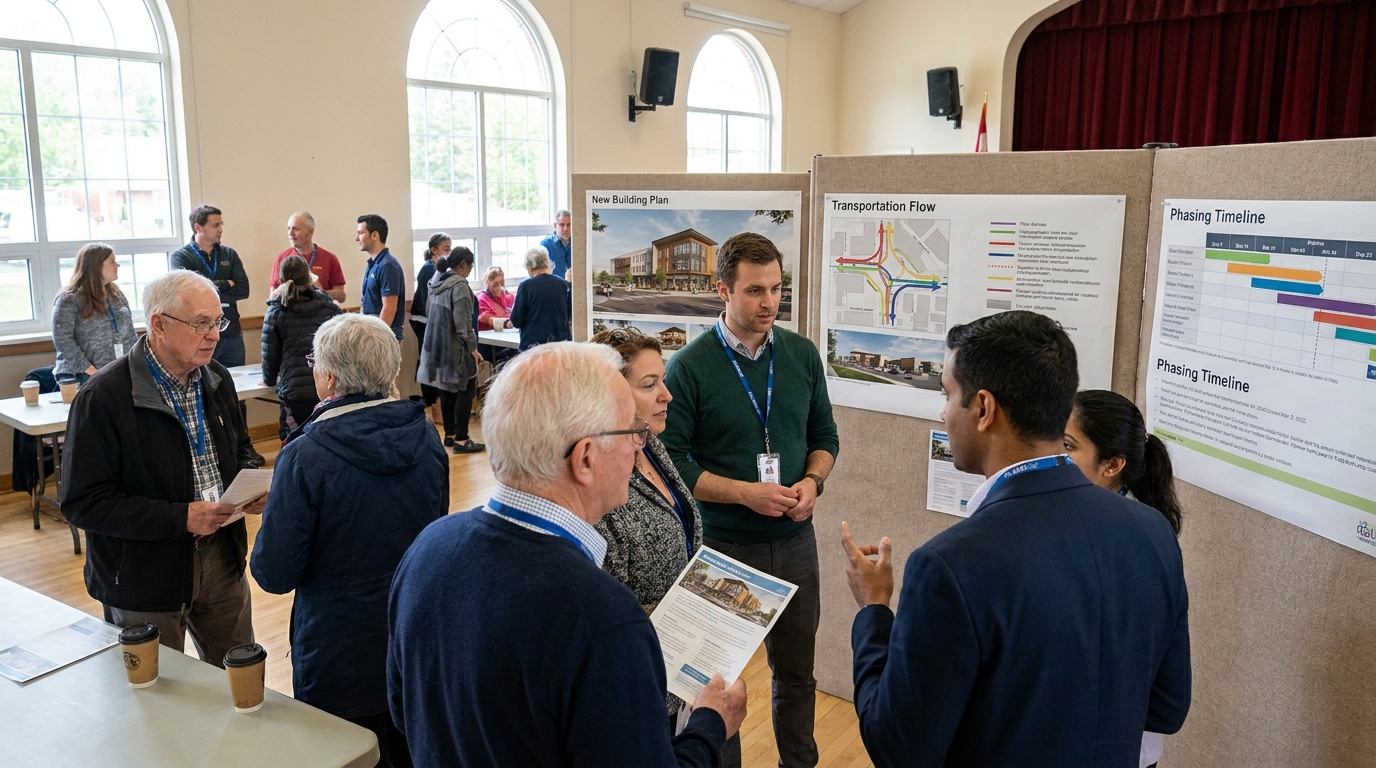
Key insight: Community engagement should be planned as part of the timeline, budget, and approvals strategy rather than treated as an optional step at the end of design.
6. Financing, Capital Structuring, and Market Readiness
While approvals are advancing, financing strategy often evolves in parallel. Construction lenders, equity partners, and institutional capital sources all evaluate timeline risk carefully because time affects interest carry, return thresholds, absorption assumptions, and exit timing. A project with uncertain approvals may still secure funding, but often on less favorable terms or with more conditions.
Financing is not merely a reaction to approvals. In many cases, the capital strategy influences how the project is phased and how quickly later steps can proceed. Some projects are structured so that specific permits, fee payments, or pre sales thresholds trigger financing draws. Others need certainty on development charges, servicing obligations, or occupancy timing before lenders will fully commit. This means that fee structures and municipal timing can directly influence both cash flow and schedule.
Interest rate conditions also matter. In periods of higher borrowing costs, every month of delay compounds pressure on feasibility. That can change decisions about unit mix, tenure, construction method, or launch timing. Strategic teams model multiple timing scenarios so they can see how schedule drift affects internal rate of return, debt service, and contingency needs.
7. Building Permits and Pre-Construction Mobilization
Once planning approvals are in place, the project moves toward permit issuance and mobilization. This includes detailed construction drawings, code review, consultant coordination, permit applications, contractor procurement, trade pricing, insurance, and site logistics planning. It is easy to assume the project is now on a simple march toward construction, but this phase often contains its own bottlenecks.
CMHC tracks the duration between building permit issuance and housing starts in months across census metropolitan areas, but it also warns that these comparisons are not always valid because municipalities use different permit definitions. Some cities issue excavation or shoring permits at earlier stages, which can make permit to start timelines appear longer even if substantial above grade work has not begun. This nuance matters because poorly interpreted data can lead developers or investors to draw the wrong conclusions about municipal performance or project pace.
Permit readiness is also highly dependent on document quality. Incomplete submissions, unresolved design coordination, code deficiencies, or late consultant revisions can create delay even in municipalities working to process applications quickly. Process modernization, including e permitting and digitized review workflows, is improving efficiency in some jurisdictions, but digital tools cannot compensate for weak project preparation. Good teams enter the permit phase with disciplined documentation and realistic review assumptions.
8. Construction and Delivery
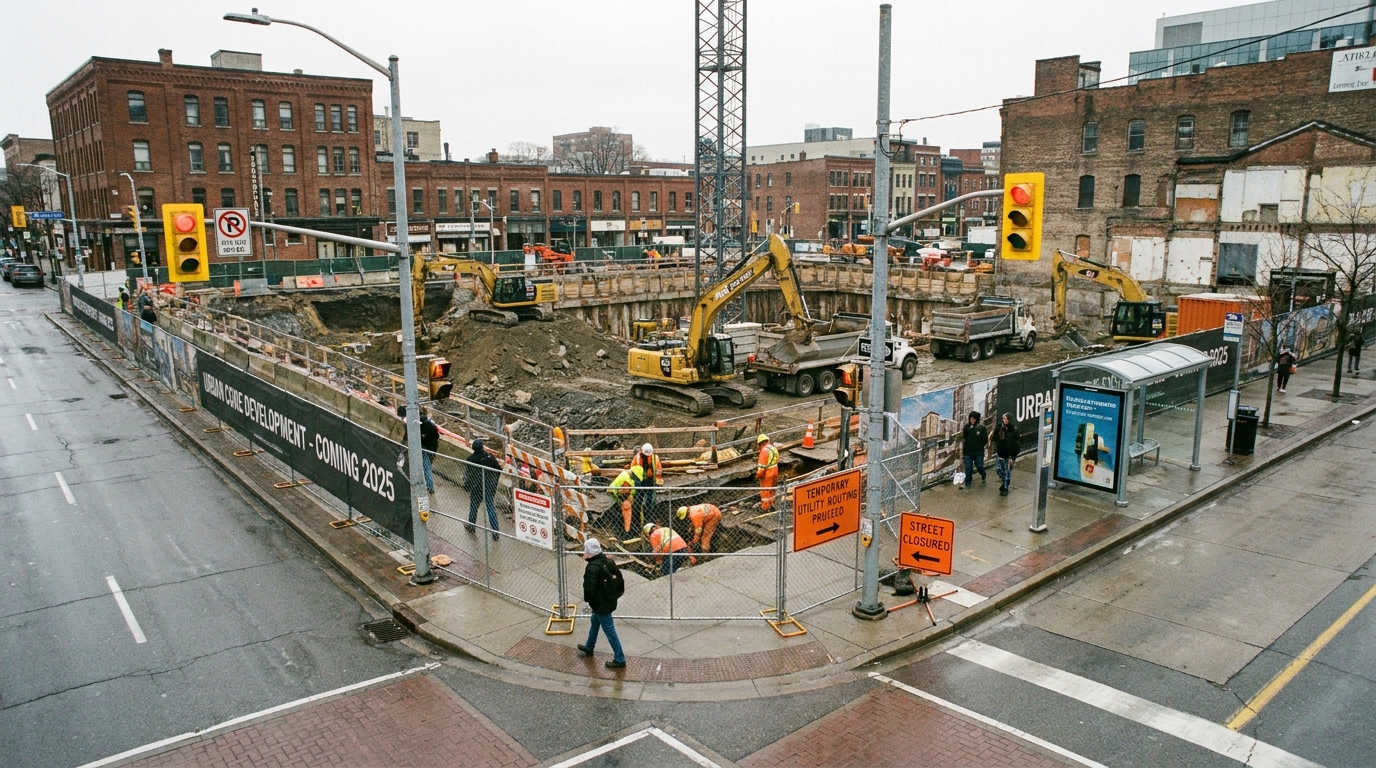
Construction is the most visible phase of development, but not always the longest or riskiest. Its timeline is shaped by project size, construction method, labour availability, supply chain conditions, weather, inspections, utility coordination, and site complexity. In dense urban environments, staging and logistics can become major schedule variables, especially where adjacent roads, transit lines, or neighboring properties constrain access.
Servicing and utility coordination deserve particular attention. Water, sewer, hydro, telecom, gas, and road work are not background items. They can determine when excavation starts, when foundations can proceed, and when occupancy can be achieved. If external servicing upgrades are required, or if agency coordination is weak, the downstream schedule can slip even when the building contractor is ready to move.
Phasing strategy is often what separates resilient projects from fragile ones. On large sites, developers may break delivery into stages that align with financing, market absorption, or infrastructure readiness. Done well, phasing can reduce risk and create flexibility. Done poorly, it can introduce rework, duplicated mobilization, or sequencing conflicts that add cost and time.
9. Occupancy, Closeout, and Project Completion
The final phase includes inspections, occupancy permits, deficiency work, commissioning, leasing or closings, and handover to operations or property management. Many timelines underestimate this period because the building appears visually complete before all regulatory and operational requirements are satisfied. In practice, occupancy can be delayed by outstanding life safety issues, utility sign offs, elevator certification, environmental conditions, or unresolved common area work.
For residential projects, occupancy timing affects revenue recognition, move in scheduling, purchaser expectations, and warranty obligations. For mixed use developments, tenant fit outs and phased openings can create another layer of complexity. Strategic project teams manage closeout with the same discipline they apply to approvals because the last mile is where both reputation and cash flow are exposed.
The Biggest Factors That Affect Development Timelines
Although every project is different, a handful of factors repeatedly influence urban development schedules. Understanding them early can dramatically improve forecast quality and decision making.
- Regulatory complexity. Projects involving rezoning, environmental review, special districts, heritage considerations, or multiple agencies usually face longer and less predictable timelines.
- Community engagement quality. Early, substantive consultation tends to reduce redesign and appeal risk, while weak engagement often extends the schedule.
- Development charges and fee structures. These can affect not only cost but also sequencing, permit issuance, financing draws, and phasing decisions.
- Infrastructure and servicing capacity. Utility upgrades, transportation improvements, and stormwater requirements can become critical path items.
- Municipal process variation. Staffing levels, review culture, digitization, and permit definitions differ significantly across jurisdictions.
- Capital market conditions. Interest rates, lender appetite, and pre sale or leasing requirements can change project timing even after approvals are secured.
- Construction market constraints. Labour shortages, trade availability, procurement delays, and material volatility affect duration and sequencing.
Common Misconceptions About Development Timelines
Misunderstanding the timeline is one of the most common reasons projects underperform against expectations. Several misconceptions continue to distort decision making in both public and private sector settings.
The first misconception is that construction defines the schedule. In reality, pre construction work often consumes as much time as physical building activity, especially in urban contexts with complex approvals. The second is that all municipalities process permits and approvals in comparable ways. CMHC’s warning about permit to start comparisons is important here because data can be misleading when permit definitions differ.
A third misconception is that development charges are simply a pricing issue. They are also a timing issue because they can affect when capital is needed, whether phases proceed, and how lenders assess risk. A fourth misconception is that public consultation is symbolic. On many projects, it is materially connected to design outcomes and political viability. A final misconception is that faster permitting automatically means faster delivery. Approval speed matters, but it does not eliminate construction, servicing, financing, or market related constraints.
How to Optimize Each Phase Strategically
There is no universal formula for making complex projects move quickly, but there are consistent ways to improve timeline performance. The first is to invest heavily in early due diligence. Clear understanding of policy fit, servicing conditions, environmental constraints, and stakeholder landscape can prevent months of downstream correction. The second is to map approvals comprehensively so the team knows which reviews can proceed in parallel and which sit on the critical path.
Third, developers should treat engagement as design intelligence rather than resistance management. Listening early often improves the project and reduces schedule friction later. Fourth, teams should build financial models that account for fee timing, approval delay scenarios, and interest rate sensitivity. A timeline that only works in a best case environment is not a strategy. It is a wish.
Fifth, documentation quality should be seen as a schedule tool. Strong submissions reduce review cycles and create more confidence with regulators and lenders. Sixth, major projects should align construction phasing with infrastructure readiness and market absorption. And finally, teams should continuously update their timeline assumptions as new information emerges rather than preserving outdated milestones for optics.
What Policy Trends Mean for Future Timelines
Across Canada, there is growing policy momentum toward faster housing approvals, digitized permitting, and reduced administrative friction. Municipalities are under pressure to modernize workflows, improve review speed, and support new supply. Federal and provincial policy discussions increasingly focus on how to accelerate approvals without removing legitimate safeguards tied to safety, environment, consultation, and infrastructure planning.
This direction is important, but it should be interpreted carefully. Process reform can shorten timelines, especially where redundant reviews and outdated manual systems create avoidable delay. However, faster administration does not eliminate the underlying complexity of urban growth. Cities still need to coordinate infrastructure, assess impacts, consult communities, and ensure projects fit broader planning objectives. The most realistic outcome is not instant approvals, but better predictability, improved transparency, and more parallel processing.
For developers, that means the strategic advantage may increasingly belong to teams that combine policy literacy with execution discipline. Those who understand how to navigate digitized systems, fee structures, political context, and multi agency approvals will be better positioned to deliver housing and mixed use projects on time. In a supply constrained market, that capability has real value.
A Practical Framework for Building Better Timelines
To create a more resilient development timeline, it helps to think in terms of gateways rather than simple dates. Each gateway should answer a strategic question. Is the site truly feasible under realistic planning assumptions. Are approvals mapped and sequenced correctly. Have community concerns been surfaced early enough to address them constructively. Is financing aligned with fee and permit timing. Are servicing and utility dependencies understood. Is the construction plan matched to market and infrastructure realities.
When teams answer those questions honestly, their schedules become more useful. They stop functioning as optimistic marketing documents and start operating as decision tools. That shift is essential in urban growth projects because complexity is not the exception. It is the norm. Good development strategy does not try to wish complexity away. It organizes around it.
Stakeholders should also remember that not all delays are equal. Some are signs of weak preparation or poor coordination. Others reflect legitimate public interest considerations that improve project quality or reduce long term risk. The goal is not merely speed for its own sake. The goal is a disciplined process that moves efficiently while still producing better urban outcomes, stronger communities, and sounder investments.
Conclusion
Understanding development timelines requires a broader lens than construction alone. Urban growth projects move through overlapping stages of concept, feasibility, planning, approvals, financing, construction, and occupancy, with meaningful schedule risk concentrated in the pre construction period. Municipal approvals, broader regulatory reviews, development charges, infrastructure servicing, and community engagement are all strategic factors that can materially alter both timing and feasibility.
That is why the best developers approach timelines as a form of governance and capital strategy, not just project scheduling. They map approvals early, build in realistic assumptions, engage communities credibly, coordinate infrastructure carefully, and align financing with regulatory milestones. In a market where housing supply and urban growth depend on execution as much as vision, understanding the full development timeline is one of the most practical advantages a project team can have.
For anyone involved in urban development, the central lesson is clear. If you want better project outcomes, start by treating time with the same seriousness as land, design, and capital. In city building, timelines are never just dates on a page. They are the structure through which growth either reaches the ground or gets stuck in the pipeline.



No Comment! Be the first one.