Why July’s Biggest GTA Stories Were Not About Toronto at All
Every so often a month of headlines tells you something bigger than any single project ever could. July was one of those months. Look past the individual cranes and rezoning notices and a clear pattern emerges: the centre of gravity for growth in the Greater Golden Horseshoe is shifting outward, and transit is the force doing the pulling.
A recap of the region’s most read development stories from July found that Markham, Mississauga, Whitby, and Niagara Falls, not the downtown Toronto core, generated the month’s biggest proposals and construction milestones. That is not a coincidence. It is a direct read on where infrastructure dollars are landing and where land is still available to build at scale.
The clearest signal came from Markham, where a six-tower transit-oriented community was proposed around the Mount Joy GO Station, and from Whitby, where a separate six-tower GO-connected community rising to 45 storeys was floated alongside a four-tower project already advancing through approvals. These are not speculative land bets. They are direct responses to transit infrastructure that is either under construction or already committed, most notably tunnelling preparation for the Yonge Line 1 North Extension into York Region, which topped the month’s most read list, and the major excavation now underway at Pape Station for the Ontario Line interchange.
For anyone assessing where the next decade of housing supply will actually come from, this is the pattern to watch. When a GO station gets a firm timeline, land around it gets rezoned for density soon after. Municipalities beyond Toronto’s borders are increasingly willing to approve six and seven figure unit counts near these stations, because the transit business case and the housing supply case reinforce each other. Whitby and Markham are behaving less like suburbs and more like secondary downtowns in waiting.
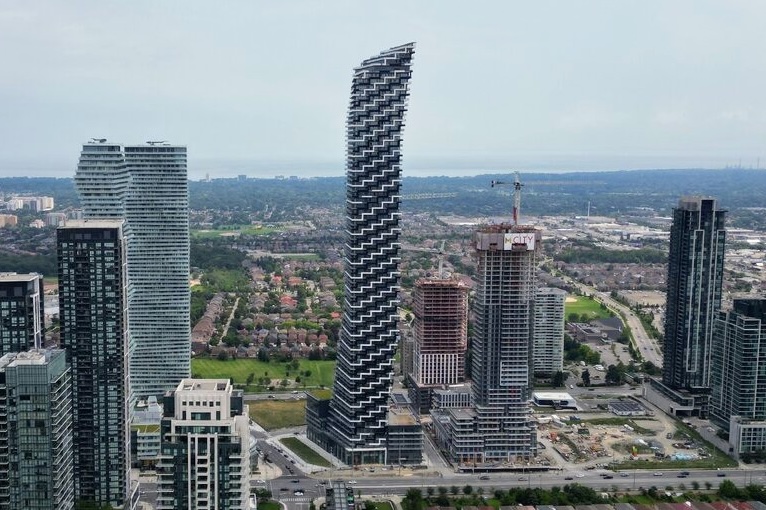
Mississauga offered a different but related story. M3 at M City, now Canada’s tallest building outside Toronto, reached its crown milestone in July, a reminder that City Centre planning decisions made years ago are still paying out in skyline terms today. Meanwhile Niagara Falls saw a 50-storey hotel proposal for Clifton Hill, and the Mimico waterfront application grew to five towers reaching 54 storeys, both signs that intensification appetite is not limited to transit nodes alone, but extends to any market with strong tourism or waterfront fundamentals.
Strong projects are built from a wider understanding of timing, access, infrastructure, and demand, and July’s roundup showed that understanding is now firmly regional, not just downtown.
None of this diminishes what is happening inside Toronto proper. The Line 2 signalling upgrade and the ongoing interest in towers like One Bloor West and Pinnacle One Yonge confirm the core still commands attention. But for developers and municipal planners thinking about where the next wave of approvals and land value appreciation will concentrate, July’s numbers point outward. Transit-oriented communities anchored to GO stations are becoming the defining housing story of this cycle, and the municipalities that move fastest to align zoning with transit delivery will capture the growth first.
Source: UrbanToronto, “Transit and Towers Beyond Toronto Made Headlines in July”