


The New Luxury Amenity Is Educational Advantage
For high-net-worth families, a home purchase is rarely just about bedrooms, water views, or architectural finish. It is a capital allocation decision around lifestyle, tax positioning, access, and increasingly, the future readiness of a child’s education.
That is the investment signal inside Haute Living’s Florida Private School AI Curriculum Index 2026. The report ranked 43 private schools across 11 Florida markets and found that the strongest AI education infrastructure is concentrated in South Florida’s most valuable residential corridor: Fort Lauderdale, Miami, and West Palm Beach.
For real estate investors, that matters. Schools have always influenced housing demand, but elite private schools with differentiated AI programs now add a new layer to luxury market pricing. Buyers relocating to Florida are not only comparing waterfront frontage, club access, and airport proximity. They are also asking whether the surrounding education ecosystem can prepare children for an economy being reshaped by artificial intelligence.
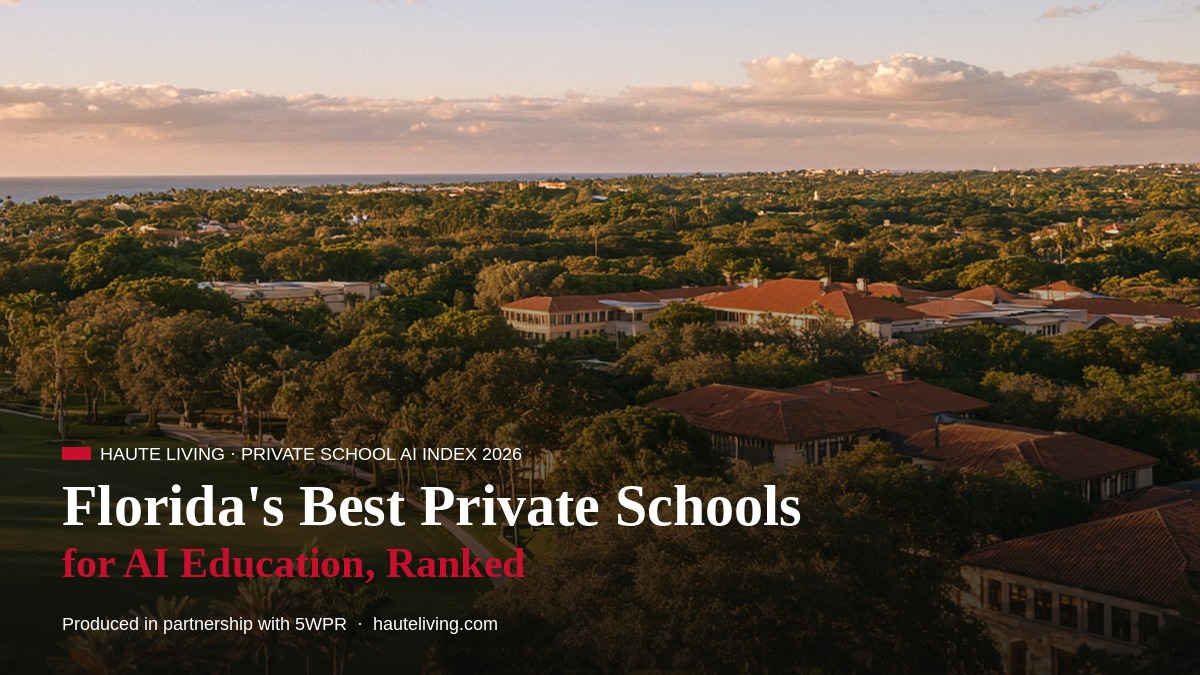
The top three schools in the index are Pine Crest School in Fort Lauderdale, Ransom Everglades School in Miami, and Oxbridge Academy in West Palm Beach. Their AI Index scores were 92.8, 90.2, and 86.0 respectively. The next-ranked school scored 74.8, creating an 11.2-point gap between third and fourth place. That is not a marginal difference. It suggests institutional separation.
Pine Crest’s position is notable because its AI offering appears embedded into the academic structure, including a Post-AP Computer Science course with artificial intelligence in the catalog and a named Educational Data, AI and CS Specialist. Ransom Everglades brings breadth, with a cross-departmental AI task force and advanced machine learning coursework. Oxbridge has gone further in branding AI as a formal Signature Program, making it part of the school’s identity rather than a narrow academic add-on.
The investment implication is straightforward: affluent family demand tends to cluster around scarce advantages. In South Florida, the combination of favorable tax treatment, lifestyle migration, private aviation access, waterfront inventory, and elite education has already supported pricing in premium submarkets. A differentiated AI education corridor adds another demand driver.
In luxury residential markets, the strongest amenities are often the ones that cannot be replicated quickly.
This does not mean investors should buy a property solely because it sits near a top-ranked school. School quality is one variable among many. But it does strengthen the case for long-term resilience in neighborhoods serving families with high disposable income, especially where inventory is constrained and private school access is part of the relocation calculus.
Fort Lauderdale’s average AI Index score of 62.2 led the 11 Florida markets in the report, helped by Pine Crest’s top ranking. Palm Beach followed at 61.7 and Miami at 60.9. Jacksonville, Orlando, and Tampa showed respectable STEM strength, but none produced a Tier A school. That geographic gap may become relevant for investors comparing future family demand across Florida’s major luxury and upper-income markets.
The risk is overpricing the signal. Private school performance can change, and access is not guaranteed by proximity alone. Admissions, tuition, commute patterns, and family preferences all matter. Still, when a market combines wealth migration with scarce educational differentiation, investors should pay attention. These are the soft factors that often harden into pricing support over time.
For buyers, landlords, and developers, the takeaway is practical: evaluate schools not only by reputation, but by curriculum depth, institutional commitment, and future relevance. In the next cycle of luxury real estate, educational infrastructure may become one of the quiet forces separating good locations from enduring ones.
Source: Haute Living