

Office-to-Rental Conversions Prove Their Worth: Lessons from a Toronto Award Winner
When the Ontario Home Builders’ Association handed its 2026 High-Rise Building of the Year prize to Amexon Development Corporation’s e lofts in Flemingdon Park, it was easy to read the headline as a design story. I read it as something bigger: proof that adaptive reuse is becoming a credible, repeatable path to housing supply in Toronto, not a one-off experiment.
The fundamentals here matter more than the ribbon. A 15-storey office building at 250 Ferrand Drive, near Eglinton Avenue East and Don Mills Road, is being converted into 331 purpose-built rental homes rather than demolished and rebuilt from the ground up. Keeping the existing concrete frame in place cuts down on demolition and new construction, which shortens timelines and reduces the capital risk that typically weighs on ground-up high-rise delivery. That is a development strategy lesson as much as an architectural one.
Location underscores the thesis. This site sits along the corridor touched by the new Eglinton Line 5 and the future Ontario Line 3, placing hundreds of new rental units within reach of two transit investments the city has already committed to. That is the kind of alignment between land, infrastructure, and housing supply that should be the baseline test for any large-scale project, not a bonus feature. Transit-oriented intensification on underused office land is exactly where Toronto needs to be adding density if it wants to meet demand without sprawling further outward.
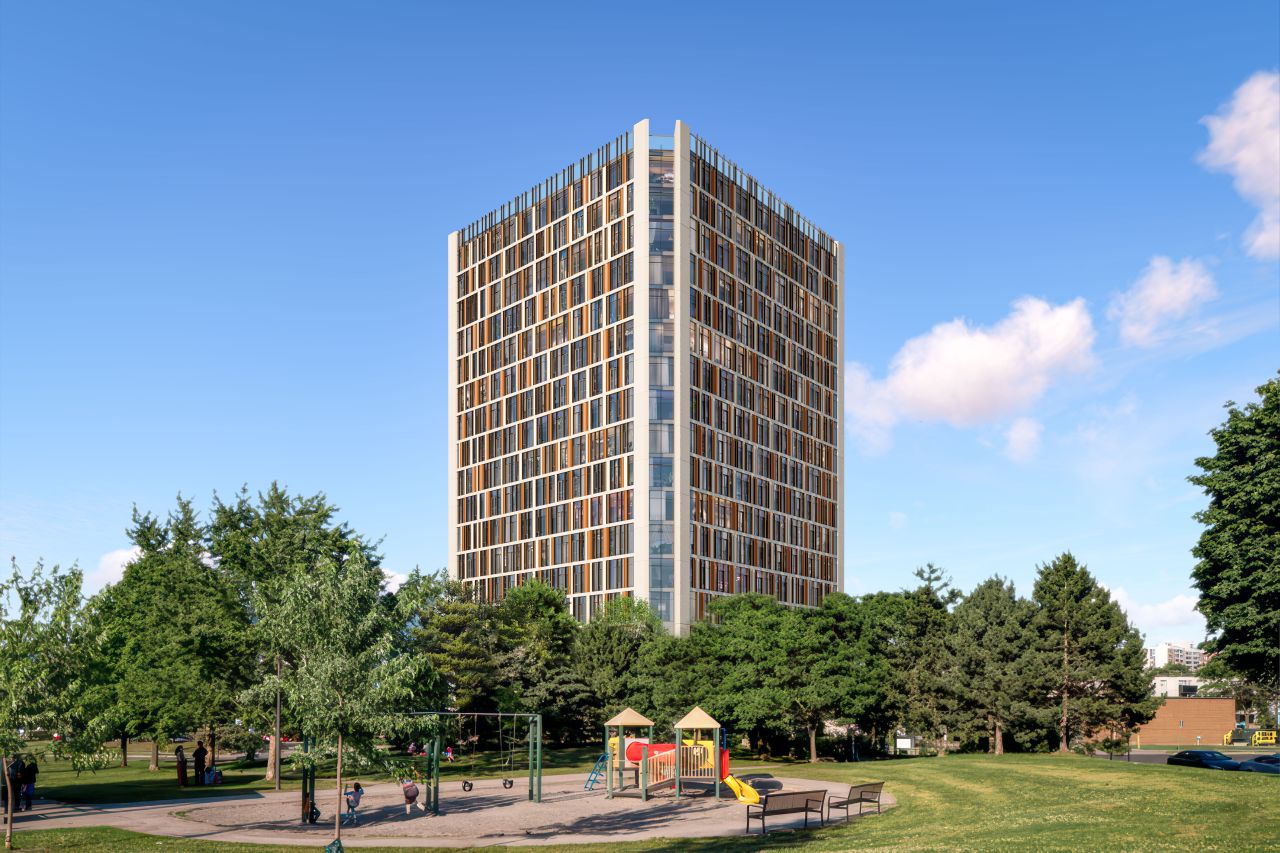
The unit mix also deserves attention from anyone tracking housing supply strategy. With 131 one-bedroom, 168 two-bedroom, and 32 three-bedroom rentals, the project leans toward family-capable inventory rather than the studio-heavy stock that has dominated much of the recent rental pipeline. Paired with a 14,000 square foot rooftop patio, co-working space, and roughly 112 square metres of ground-floor commercial space for a neighbourhood café, this reads as a project built for long-term tenancy and neighbourhood integration, not quick turnover.
Reusing an existing structure is not just an environmental choice. It is a timeline and feasibility choice, and those are the decisions that determine whether a project actually gets built.
Amexon brings more than fifty years of development history to this site, and the company’s portfolio, including The Residences at Central Park, suggests this is not an isolated conversion but part of a broader development philosophy. For a city still short on rental supply, and for landowners sitting on aging office stock that no longer serves its original purpose, e lofts offers a template worth studying: identify underused structures near confirmed transit investment, retain what already works structurally, and build the housing mix the neighbourhood actually needs.
Source: UrbanToronto, “Amexon’s e lofts Wins OHBA High-Rise Building of the Year”