Danforth Avenue Shows What Coordinated Land Strategy Can Deliver
Every city with a housing shortage eventually confronts the same question. Can government, non-profit operators, and private capital actually move at the same speed toward the same goal? On Danforth Avenue in Toronto, the answer just broke ground. Two adjacent sites, 1111 and 1117 Danforth, are being built out together under a single coordinated design and approvals process, and the result is more than 400 purpose-built rental homes moving forward at once instead of in isolated phases.
This is the part of housing delivery that rarely gets the attention it deserves. Everyone talks about unit counts and affordability ratios, but the real story here is sequencing. Woodbourne, a private developer, and Neighbours Community Homes, a non-profit housing provider, are building next to each other under synchronized approvals and shared infrastructure planning. When the City of Toronto’s development review team aligns timelines across two ownership structures like that, construction costs come down and delivery speeds up. That is land strategy working the way it is supposed to.
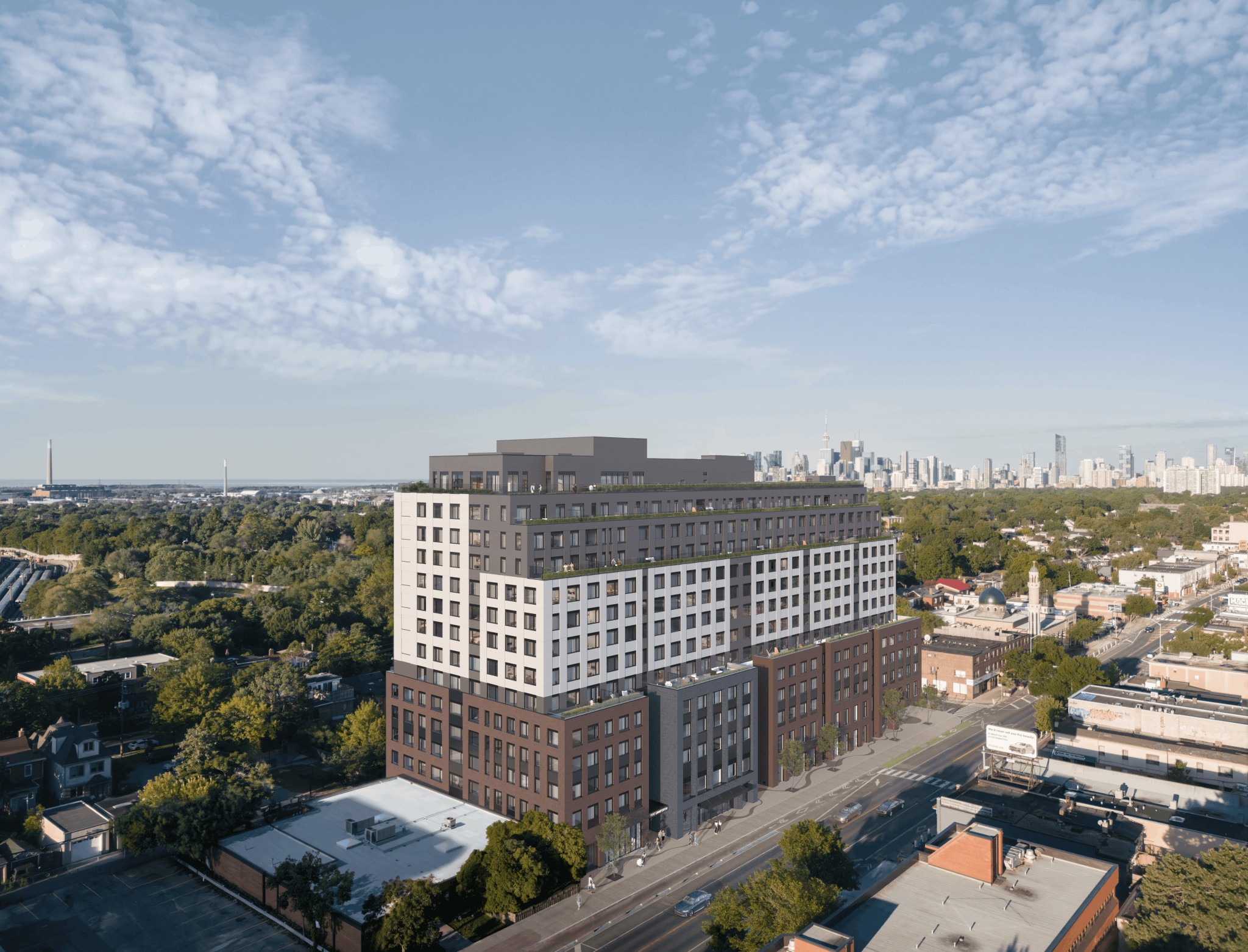
The unit mix itself reflects a maturing approach to income-blended housing. The non-profit building at 1117 Danforth replaces 27 existing rental homes and adds 81 new units, including 40 affordable homes and 41 rent-controlled units, owned and operated long term by Neighbours Community Homes. The adjacent Woodbourne site rounds out the project with market-rate supply and a street-level home for Le Théâtre français de Toronto, embedding cultural infrastructure directly into the development rather than treating it as an afterthought. That combination of affordable, deeply affordable, rent-controlled, and market-rate units under one coordinated footprint is exactly the kind of blended model that large-scale housing strategy needs more of.
Public capital made the timeline work. The City of Toronto committed more than 13 million dollars in direct capital funding and more than 14 million dollars in incentives through its Rental Housing Supply Program. That is a meaningful public stake, and it signals how municipalities are increasingly willing to underwrite the risk of complex, multi-party projects when the housing outcome is strong enough to justify it.
Strong projects are built from that wider understanding, land, timing, policy, and the future identity of a community.
For anyone tracking how cities actually add housing supply at scale, this project is a template worth watching. Toronto currently has 50 affordable housing developments under construction, and the developments that move fastest and cost the least tend to be the ones where public and private partners align their approvals from the start rather than negotiating them separately. Mayor Olivia Chow framed the groundbreaking as proof of what happens when the city finds the right partners committed to solving the housing crisis. From a development strategy standpoint, the more precise lesson is about process. Two sites, two ownership models, one synchronized plan, and a faster path to occupancy for everyone involved.
As Toronto and other growth cities look for ways to unlock more housing without waiting years for single projects to clear approvals one at a time, Danforth Avenue offers a working blueprint. The land was there. The demand was there. What made the difference was the coordination.
Source: Construction Canada