



Cities are under pressure from every direction. They need to add housing, support economic growth, maintain aging infrastructure, adapt to climate change, and improve quality of life at the same time. For decades, many municipalities approached these challenges through separate systems. Stormwater was handled by pipes and ponds, transportation by roads, parks by recreation departments, and environmental concerns by a different set of policies entirely. That fragmented model no longer matches the realities of urban growth. Today, the most successful cities are moving toward integrated systems, and green infrastructure has become one of the most practical tools in that transition.
Table Of Content
- What Green Infrastructure Really Means in an Urban Context
- Why Green Infrastructure Has Become Essential for Sustainable Urban Growth
- The Economic Case: Why Natural Systems Make Fiscal Sense
- Major Green Infrastructure Strategies Cities Are Using Today
- Urban Forests and Street Trees
- Bioswales, Rain Gardens, and Bioretention Systems
- Permeable Pavement
- Naturalized Stormwater Ponds and Wetlands
- Green Roofs and Green Walls
- Public Health, Livability, and Quality of Life Benefits
- Why Implementation Matters More Than Vision Statements
- How Municipalities Can Integrate Green Infrastructure Into Growth Planning
- Key Planning Priorities for Scalable Implementation
- Equity, Access, and the Geography of Urban Benefit
- Common Misconceptions That Still Hold Projects Back
- The Strategic Opportunity Ahead
- Conclusion
Green infrastructure is often misunderstood as beautification or landscaping. In reality, it is functional infrastructure that uses natural systems and hybrid engineered solutions to perform critical urban services. It captures and slows runoff, reduces flood risk, cools overheated neighborhoods, improves air and water quality, supports biodiversity, and creates attractive public spaces that make communities more valuable and more livable. Federal agencies in both Canada and the United States increasingly frame green infrastructure as a multi benefit strategy that can strengthen municipal resilience while delivering measurable economic returns.
That shift matters because urban growth is getting more expensive. As cities intensify, impervious surfaces expand, combined sewer systems are strained, and localized flooding becomes more frequent. At the same time, residents expect better neighborhoods, healthier public spaces, and climate responsible development. Green infrastructure helps reconcile those demands. It is not a replacement for every conventional asset, but it is an essential part of a smarter urban investment strategy that aligns land use, infrastructure, public health, and long term fiscal stability.
This article explores why green infrastructure is now central to sustainable urban growth, what forms it takes, where its economic value comes from, and how municipalities can implement it successfully. The most important takeaway is simple. Green infrastructure is not an optional environmental layer added after growth decisions are made. It is a core framework for shaping growth in a way that is more resilient, cost effective, and beneficial for the people who live in cities every day.
What Green Infrastructure Really Means in an Urban Context
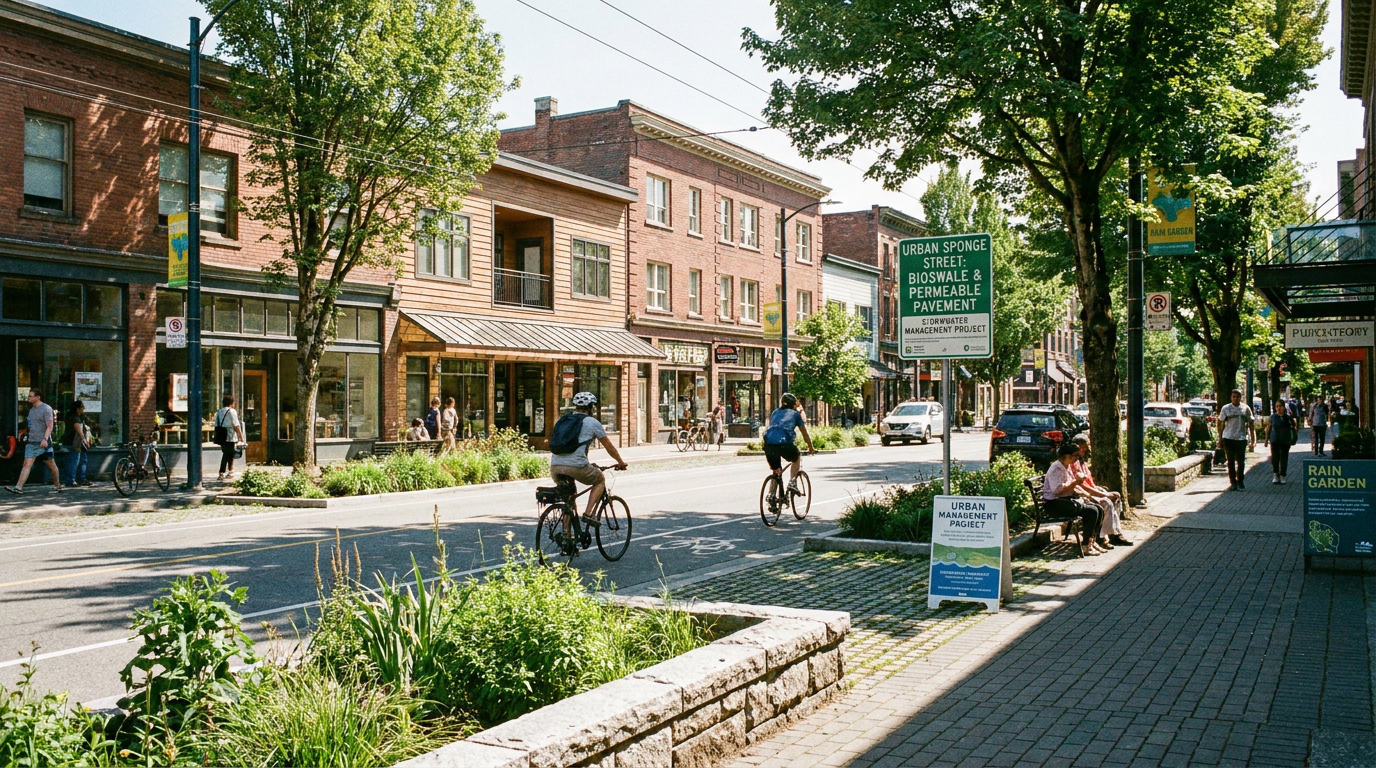
Green infrastructure refers to natural or nature based systems that deliver infrastructure functions inside the built environment. That includes urban forests, street trees, bioswales, rain gardens, wetlands, permeable pavement, green roofs, green walls, naturalized stormwater ponds, living shorelines, and rainwater harvesting systems. In many cases, these systems are combined with conventional infrastructure to create hybrid networks that are more adaptable and more efficient than purely gray systems.
The distinction between ordinary green space and green infrastructure is important. A lawn or decorative planting bed may add visual value, but unless it is designed to retain water, reduce heat, provide habitat, filter pollutants, or perform another measurable function, it is not infrastructure in the full sense. Green infrastructure is purposeful. It is planned, engineered, and maintained to deliver public benefits that would otherwise require larger investments in pipes, storage tanks, treatment systems, or emergency response.
In practice, green infrastructure works by reintroducing natural processes into urbanized landscapes. Instead of moving rainwater away as quickly as possible, it slows, infiltrates, stores, filters, and evapotranspires water close to where it falls. Instead of allowing pavement and roofs to intensify local temperatures, it adds shade and vegetation that cool the surrounding environment. Instead of treating public realm design as separate from utility performance, it creates spaces that can be both beautiful and highly functional.
This systems approach is especially relevant in rapidly growing cities. Every new development creates choices about surface coverage, drainage, tree canopy, street design, public space, and long term maintenance. When those decisions are coordinated around green infrastructure principles, cities can build neighborhoods that perform better from the beginning rather than paying later to retrofit areas that were designed too narrowly.
Why Green Infrastructure Has Become Essential for Sustainable Urban Growth
The urgency around green infrastructure is not driven by theory alone. It is a response to real urban stress. Canadian and North American cities are facing more intense rainfall events, longer heat waves, expanding development footprints, and increasing costs tied to infrastructure failure. Conventional systems still matter, but on their own they are often too rigid and too expensive to handle future conditions efficiently.
Stormwater is one of the clearest examples. When land is covered by roofs, asphalt, and concrete, rainfall moves rapidly into drainage systems that were often designed for a different era. The result is localized flooding, sewer overflows, erosion, water pollution, and expensive pressure on municipal assets. Green infrastructure helps absorb and reduce runoff before it enters those systems. According to U.S. Environmental Protection Agency guidance, these practices can reduce infrastructure costs, lower flood damage, and produce broad environmental and social benefits. That makes them relevant not just to sustainability departments, but to finance teams, planners, engineers, and development decision makers.
Heat is another critical factor. Urban heat islands emerge when dense built surfaces absorb and retain solar energy, pushing local temperatures above those in surrounding areas. This has direct consequences for public health, energy demand, outdoor comfort, and neighborhood equity. Vegetation, tree canopy, and green roofs can meaningfully reduce local heat while making streets and open spaces more usable. In a growth context, that matters because a hotter city is not only less healthy, but also less attractive for investment and less supportive of long term livability.
There is also a strategic land use dimension. Cities are no longer judged only by how much they build. They are judged by how well growth is integrated with resilience, mobility, environmental performance, and quality of life. Green infrastructure helps cities deliver on all of those fronts simultaneously. It supports denser development while making neighborhoods more pleasant, more stable, and more adaptable to climate stress. That is why it increasingly sits at the center of sustainable urban growth discussions rather than at the margins.
Green infrastructure works best when it is viewed as a city building investment, not a decorative extra. Its value comes from doing multiple jobs at once in places where land, infrastructure capacity, and public expectations are all under pressure.
The Economic Case: Why Natural Systems Make Fiscal Sense
One of the strongest arguments for green infrastructure is economic. Municipal budgets are constrained, infrastructure backlogs are growing, and climate related damage is increasingly expensive. In that context, strategies that reduce life cycle costs and avoid future losses deserve serious attention. Green infrastructure does exactly that when it is planned and managed properly.
The first economic benefit is cost avoidance. Green stormwater infrastructure can reduce the need for oversized pipes, detention facilities, and downstream system upgrades by managing runoff at the source. It can also lower flood related losses by reducing the volume and speed of water entering stressed urban drainage systems. EPA flood loss modeling has found that in selected growth areas, applying green stormwater infrastructure to new development and redevelopment could save hundreds of millions of dollars over time. Even where those savings vary by local conditions, the principle is clear. Preventing flood damage is usually cheaper than repairing it.
The second economic benefit is asset efficiency. Traditional gray infrastructure typically performs a narrow technical function. A buried pipe moves water. A green system can manage water while also cooling a street, improving public space, extending pavement life, and raising the attractiveness of adjacent land. That layered value matters in urban economics because it increases the return on public investment. A bioswale integrated into a complete street is not merely a drainage feature. It is part of place making, climate adaptation, and neighborhood quality.
The third benefit is value creation. Attractive, well shaded, walkable neighborhoods tend to be more desirable. Public realm improvements, healthier tree canopy, visible water sensitive design, and better access to nature can support stronger property values and commercial appeal. This does not mean every green intervention produces immediate market uplift, but it does mean that urban environments with better environmental performance often become more competitive over time. For cities trying to attract residents, employers, and long term private investment, that is a meaningful advantage.
There is also a labor market and industry dimension. Green infrastructure requires design, installation, horticultural expertise, monitoring, inspection, and ongoing maintenance. That can support local jobs and specialized career pathways. As municipalities scale up implementation, they create demand for landscape architects, civil engineers, arborists, environmental technologists, maintenance contractors, and data specialists. In other words, green infrastructure is not only about cost savings. It is also part of the emerging resilience economy.
Major Green Infrastructure Strategies Cities Are Using Today
There is no single template for green infrastructure because urban conditions vary widely. Dense downtowns, postwar suburban corridors, industrial waterfronts, and new greenfield communities each have different land constraints and servicing needs. Still, several strategies have become particularly important because they perform well across many contexts and can be adapted to local conditions.
Urban Forests and Street Trees
Urban forests are among the most visible and valuable forms of green infrastructure. Street trees provide shade, reduce heat island effects, intercept rainfall, improve air quality, and make streets more comfortable for walking and cycling. They also shape how residents perceive neighborhood quality. A well designed canopy strategy can change the experience of an entire district while supporting climate adaptation goals at scale.
However, tree planting only becomes durable infrastructure when it is paired with the right conditions. Soil volume, root space, species selection, irrigation planning, and long term maintenance are critical. Too many cities treat tree planting as a symbolic gesture rather than a technical system. If the goal is infrastructure performance, then urban forestry must be planned with the same seriousness as any other utility network.
Bioswales, Rain Gardens, and Bioretention Systems
Bioswales and rain gardens are designed to collect and filter runoff from streets, parking areas, and roofs. They allow water to infiltrate into the ground or move through engineered soil media before entering drainage networks. These systems can reduce pollutant loads, moderate peak flows, and improve the visual quality of streetscapes and open spaces.
In redevelopment corridors, bioswales can be integrated into medians, curb extensions, boulevards, and public plazas. In residential contexts, they can support more distributed stormwater management while softening hardscape dominated environments. Their success depends on proper sizing, overflow design, and maintenance, especially in climates with snow storage and road salt exposure.
Permeable Pavement
Permeable pavement allows water to pass through the surface into an underlying stone reservoir, reducing runoff and supporting infiltration. It is particularly useful in parking lanes, sidewalks, low speed roads, plazas, and some low traffic lots. For cities with increasing storm intensity, this can be a practical way to reduce pressure on drainage systems without requiring large visible interventions in every location.
Cold climate performance requires careful detailing. Freeze thaw cycles, sediment loading, and winter maintenance practices can all affect long term results. Even so, Canadian research indicates that these systems are increasingly recognized as effective tools for urban flood mitigation when designed for local conditions and supported by monitoring.
Naturalized Stormwater Ponds and Wetlands
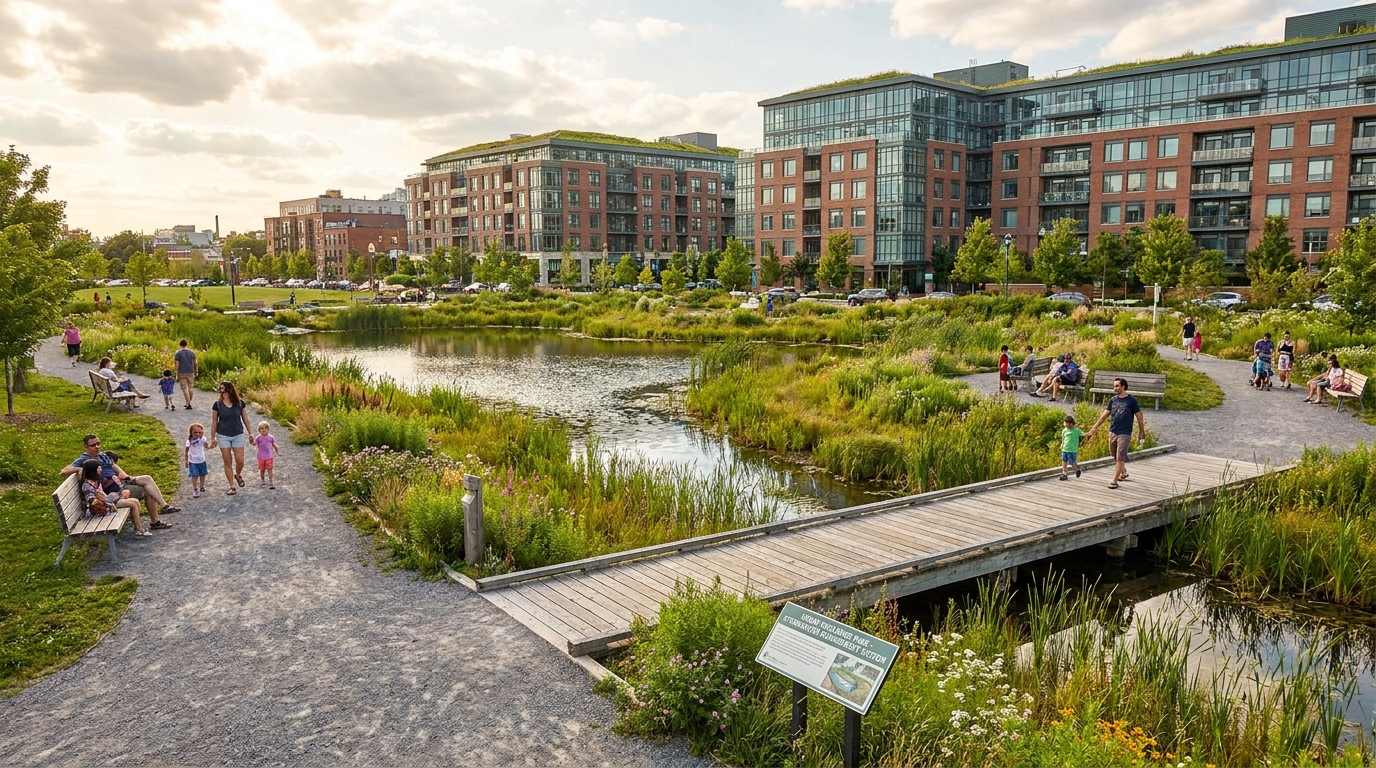
Naturalized stormwater ponds represent a strong example of dual purpose infrastructure. Rather than functioning only as fenced engineering basins, they can be designed as attractive public spaces with native planting, walking paths, habitat value, and recreational amenities. Recent Canadian project announcements have emphasized this model because it combines flood protection with public realm benefits that communities can see and use.
Wetlands and naturalized ponds also support biodiversity, water quality improvement, and seasonal landscape value. They can anchor new communities or retrofit existing districts with a much richer environmental function than conventional detention systems. Their greatest strength is that they show how resilience infrastructure can also create neighborhood identity and social value.
Green Roofs and Green Walls
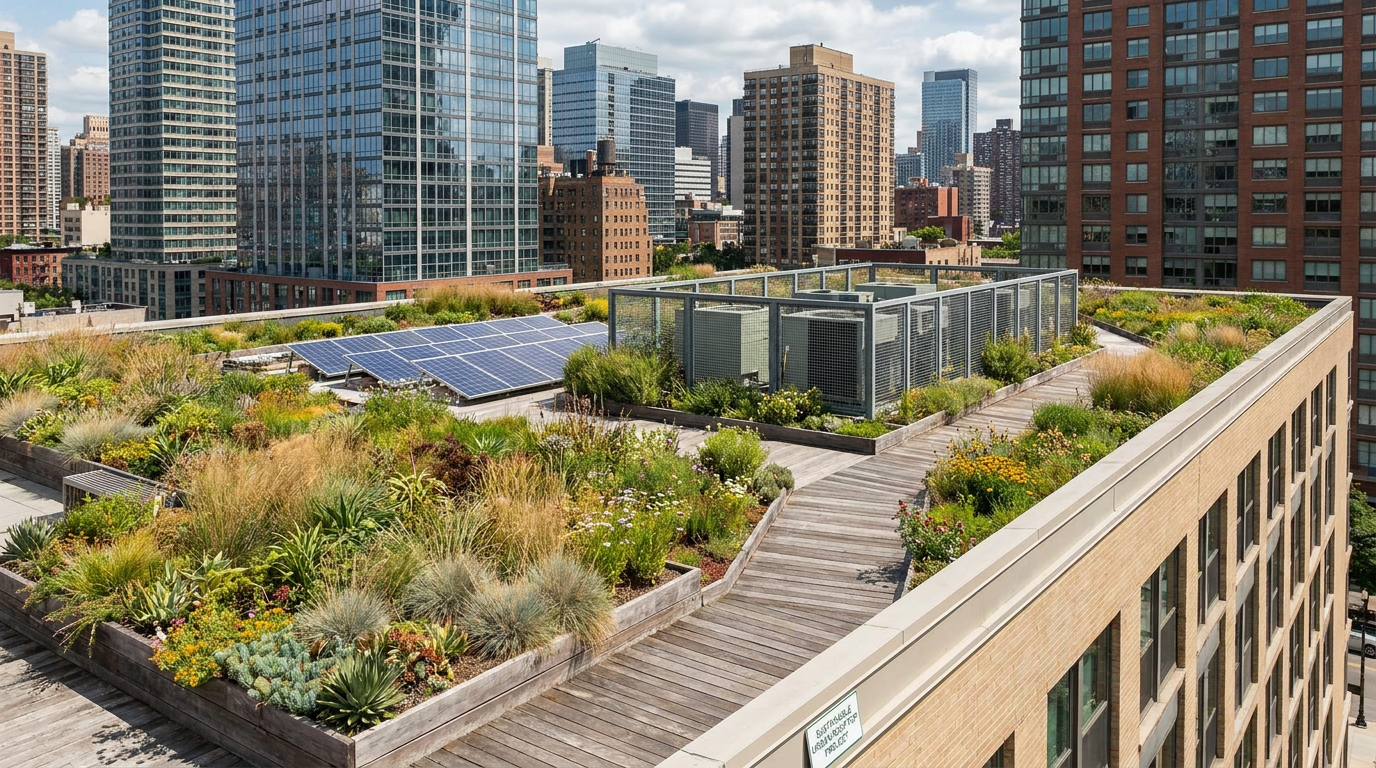
In dense urban districts where land is limited, rooftops and building envelopes offer an important opportunity. Green roofs absorb rainfall, reduce heat gain, support insulation performance, and in some cases provide habitat or amenity space. Green walls can also contribute to cooling and visual improvement, especially in highly built up areas with limited room for trees.
These systems are not universal solutions, and they require structural assessment, waterproofing expertise, and maintenance planning. But in transit oriented districts, mixed use centers, and institutional campuses, they can play a meaningful role in a broader stormwater and heat mitigation strategy. Their value is especially clear when cities need infrastructure performance without sacrificing development intensity.
Public Health, Livability, and Quality of Life Benefits
Urban growth cannot be called successful if it produces neighborhoods that are hotter, harsher, and less healthy to live in. One of the most compelling aspects of green infrastructure is that it improves environmental performance in ways residents can feel immediately. Cooler sidewalks, shaded parks, cleaner air, quieter streets, and more accessible natural spaces all influence daily quality of life.
Heat mitigation is especially important. EPA guidance notes that vegetation can reduce urban heat island effects and provide measurable cooling benefits. For residents in apartment heavy areas, older neighborhoods with limited canopy, or communities with large expanses of asphalt, this is not a minor improvement. It affects health outcomes, comfort, physical activity, and social use of public space. A street that is shaded and walkable supports very different patterns of daily life than one that is exposed and overheated.
Access to nature also has broader social value. Green infrastructure can connect residents to greener and bluer public spaces without requiring them to leave the city. Naturalized ponds, urban parks, tree lined streets, and restored waterways create everyday contact with nature, which supports mental well being and neighborhood pride. These benefits are often difficult to quantify in a narrow budget document, yet they are central to whether people experience growth as an improvement or a burden.
There is also a community safety and cohesion dimension. Well designed public landscapes can encourage walking, increase passive surveillance, and create gathering places that support stronger social interaction. When infrastructure also becomes public realm, the city gains more than technical function. It gains civic value.
Why Implementation Matters More Than Vision Statements
Many municipalities now acknowledge the importance of green infrastructure, but acknowledging it is not the same as implementing it effectively. One reason progress remains uneven is that cities often launch pilots without creating the standards, funding frameworks, and institutional coordination needed for scale. National Research Council Canada research has noted that many municipalities remain in pilot phases because they lack region specific design guidance and long term performance data, especially in cold climate conditions.
This is a crucial point. Green infrastructure is not a trend that succeeds through aspiration alone. It requires technical clarity. Cities need design standards that account for freeze thaw cycles, snow storage, salt exposure, maintenance access, drainage performance, and lifecycle durability. A rain garden that works well in one climate or street condition may underperform in another if local constraints are ignored.
Maintenance is equally important. One of the most common failures in infrastructure policy is to fund capital delivery while underfunding operations. Green assets need inspection, sediment removal, pruning, replanting, invasive species control, and periodic rehabilitation. If cities do not define responsibility clearly between departments, developers, utilities, and private landowners, performance declines and public trust erodes. The strongest programs treat maintenance as part of the business case from day one.
Monitoring is the third pillar. Cities need performance data to improve standards, justify spending, and build confidence among engineers, elected officials, and the public. That includes data on runoff reduction, water quality improvement, canopy survival, temperature impacts, maintenance costs, and lifecycle outcomes. In a strategic sense, monitoring converts green infrastructure from a promising concept into a credible investment class.
How Municipalities Can Integrate Green Infrastructure Into Growth Planning
For green infrastructure to shape urban growth meaningfully, it must be embedded into planning and development systems rather than treated as a special project category. The most successful cities use policy, zoning, capital planning, street standards, park planning, and development review to create alignment across departments and across phases of growth.
The first step is to connect green infrastructure to land use planning. Growth areas should be assessed not only for density and transportation capacity, but also for runoff generation, heat vulnerability, canopy deficits, and access to open space. That allows municipalities to identify where green infrastructure will produce the highest public return. Infill corridors, flood prone neighborhoods, and high heat districts are often strong candidates for targeted investment.
The second step is to update development standards. If stormwater retention, tree planting conditions, permeable surfaces, and rooftop greening are left entirely to voluntary uptake, results will be inconsistent. Municipalities should define clear performance expectations for new development and redevelopment, while allowing enough design flexibility for different site conditions. Hybrid systems are often the most realistic path, combining conventional servicing requirements with nature based performance targets.
The third step is to align capital budgets and infrastructure programs. Green infrastructure should appear in the same long range discussions as road reconstruction, sewer upgrades, transit oriented development, school site planning, and park expansion. When streets are rebuilt, green interventions should be considered as part of the base project rather than as optional extras. When growth related servicing is planned, upstream runoff reduction should be part of the analysis.
Finally, cities need a governance model that breaks down silos. Planning, engineering, parks, water, public works, finance, and public health all have a stake in outcomes. Without cross departmental coordination, green infrastructure tends to stall between mandates. With coordination, it becomes a practical systems strategy.
Key Planning Priorities for Scalable Implementation
- Target high need areas first by mapping flood risk, heat exposure, canopy gaps, and underserved neighborhoods.
- Adopt clear design standards that reflect local climate, soils, maintenance realities, and redevelopment conditions.
- Budget for maintenance upfront so assets continue performing after ribbon cutting.
- Use hybrid infrastructure models where natural systems complement pipes, storage, and engineered drainage.
- Track performance over time to improve designs and strengthen the business case for future investment.
Equity, Access, and the Geography of Urban Benefit
Not all neighborhoods experience climate stress equally. Low canopy areas, flood prone districts, and communities with limited access to quality parks often face the highest environmental burdens. If green infrastructure is deployed only where land is easy to assemble or where political pressure is strongest, it can reinforce existing inequities instead of correcting them.
That is why equity focused siting matters. The best programs direct investment toward places where green infrastructure can reduce exposure to heat, improve drainage resilience, and expand access to nature for residents who need those benefits most. This is not only a social objective. It is a smart resilience strategy because vulnerable neighborhoods are often where municipal risk is concentrated.
Canadian federal policy has increasingly linked natural infrastructure with access to nature, biodiversity, climate adaptation, and community benefit. Programs such as the Natural Infrastructure Fund reflect a broader policy understanding that these projects are part of long term public resilience. The fund also allocates a portion of its envelope to Indigenous led projects, which is a reminder that infrastructure planning is strongest when it recognizes a wider range of knowledge systems, stewardship practices, and community priorities.
In practical terms, equity means asking different questions. Which neighborhoods flood repeatedly after heavy rain. Which apartment districts have the least shade. Which school routes expose children to the hottest conditions. Which redevelopment areas could integrate public green space before land prices rise further. Strategic planning starts by identifying where benefits are most needed, not just where implementation is easiest.
Common Misconceptions That Still Hold Projects Back
Despite growing evidence, several misconceptions continue to slow adoption. The first is that green infrastructure is simply landscaping. That framing undervalues its technical role and makes it easier for decision makers to dismiss it during budget discussions. In reality, these are functioning assets that manage water, heat, habitat, and public realm quality in measurable ways.
The second misconception is that green infrastructure is always cheaper upfront than conventional infrastructure. Sometimes it is, but not always. Land constraints, design complexity, and maintenance requirements can raise initial costs. The more accurate argument is that green infrastructure can reduce lifecycle costs, avoid future damage, and produce multiple co benefits that improve overall value.
The third misconception is that it only works in warm climates. Canadian research shows that nature based stormwater systems can work in cold climate cities, though they need appropriate design for frost, snow, and freeze thaw conditions. That means adaptation, not dismissal.
The fourth misconception is that green infrastructure replaces all gray infrastructure. It does not. Most successful systems are hybrid. Pipes, culverts, storage, and treatment facilities remain essential in many contexts. The strategic question is not whether cities should choose one or the other. It is how they can combine both in ways that reduce risk and improve urban performance.
The Strategic Opportunity Ahead
The cities that will perform best over the next several decades are not simply those that build faster. They are the ones that build with a broader understanding of resilience, land value, infrastructure efficiency, and public expectation. Green infrastructure sits at the intersection of all four. It allows cities to treat natural systems as part of the urban balance sheet rather than as leftover space or aesthetic enhancement.
This is especially important in an era of intensification. As more people live in denser neighborhoods, the quality of shared urban systems matters more. Streets need to do more than move vehicles. Parks need to do more than provide passive recreation. Stormwater assets need to do more than hide runoff underground. Every square metre of public investment needs to work harder, serve more purposes, and deliver visible value. Green infrastructure is one of the clearest ways to achieve that.
There is also a competitive advantage in getting this right. Cities that are cooler, greener, more flood resilient, and more attractive will be better positioned to retain residents, support housing demand, and maintain investor confidence. In a period when insurance pressures, infrastructure liabilities, and climate exposure are all rising, resilience itself becomes a form of economic development.
For municipalities, developers, and urban institutions, the message is clear. Green infrastructure should not be treated as a pilot, a branding exercise, or an optional layer of environmental goodwill. It should be planned as core infrastructure with clear standards, stable maintenance funding, performance monitoring, and deliberate integration into growth strategy. When implemented that way, it can reduce long term costs, improve quality of life, and help cities grow in a way that is both more durable and more humane.
Conclusion
Implementing green infrastructure for sustainable urban growth is ultimately about making better long term decisions. It is about recognizing that the health of a city depends on how well its systems work together. Water management, public space, climate resilience, mobility, housing growth, biodiversity, and fiscal stability are not separate conversations anymore. They are parts of the same urban equation.
Green infrastructure offers a practical response to that complexity. It captures runoff, reduces flood risk, cools neighborhoods, improves environmental quality, supports biodiversity, and enhances the everyday experience of city life. Just as importantly, it can lower lifecycle costs, reduce pressure on aging assets, and strengthen the economic case for resilient growth. Those are not side benefits. They are central to how successful cities will plan and invest in the years ahead.
If the goal is to build cities that are prosperous, adaptable, and genuinely livable, then green infrastructure must be part of the foundation. Not as decoration, not as an afterthought, and not only in isolated demonstration sites. It belongs in the core logic of urban development, where infrastructure decisions shape the future of communities for generations.

No Comment! Be the first one.