When the MLS Feed Follows You Home: What Phantom Realty Engine’s New Apps Reveal About the Intelligence Layer in Real Estate
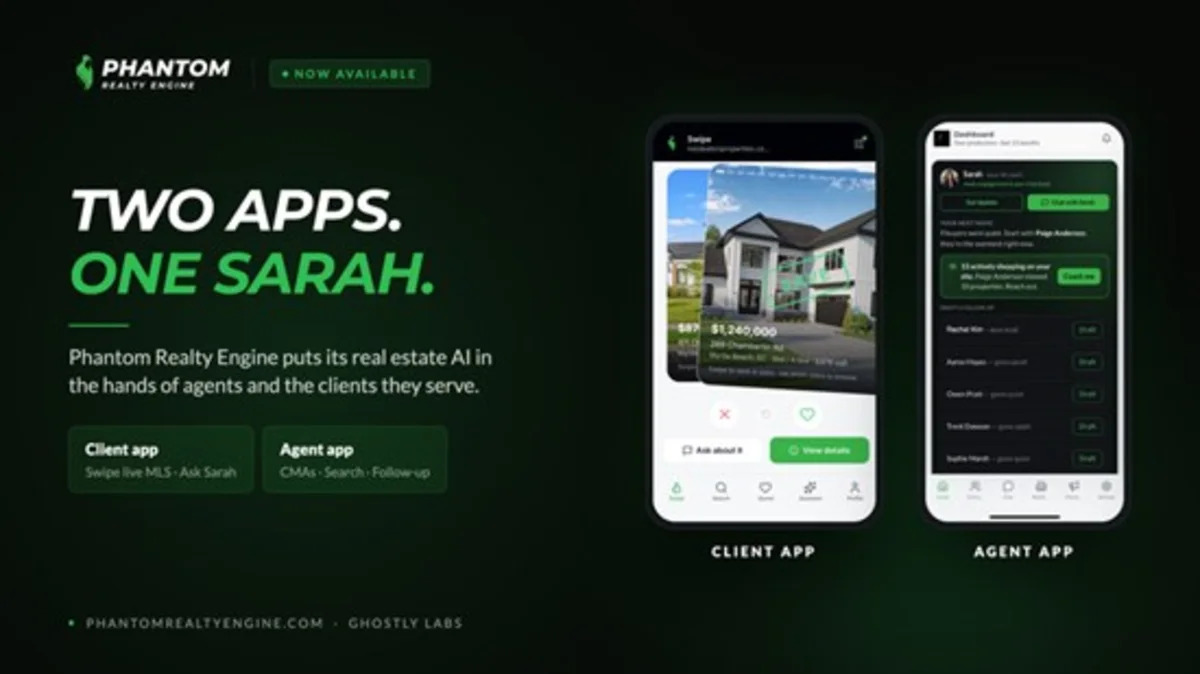
Every housing market generates the same raw material: listings, price history, days on market, buyer behavior. What separates a good platform from a forgettable one is what happens to that data after it is collected. This week, Ghostly Labs gave a clear answer with the launch of two mobile applications for its Phantom Realty Engine, putting its AI assistant, called Sarah, directly into the hands of both agents and the buyers they represent.
On the surface, this looks like a convenience story. Buyers get a branded app to swipe through live MLS listings, save homes, invite a partner into a shared list, and ask questions at any hour. Agents get a mobile version of their CRM, able to run comparative market analyses, pull comps and price-per-square-foot data, and see which leads are warming up, all from a phone in the field. But the more interesting signal sits underneath the interface. Sarah reads directly from each client’s live MLS feed rather than a national aggregate, which means the same intelligence layer can answer a hyper-local question in a Toronto neighborhood and an equally specific one in a market three provinces away, without losing accuracy at the edges.
That architecture choice matters more than the app icons. National aggregators are often a step or two behind the true local feed, which is fine for browsing but weak for decision making. A platform built on live, market-level data can support real judgment calls, the kind buyers and agents actually need when timing an offer or reading a shifting local trend.
There is also a retention story here that anyone tracking property technology should watch closely. According to the company, Sarah’s first deployment in July took in more than 15,000 cold leads, warmed nearly half of them, and converted more than 1,400 into active buyers, while average time on site rose 6.4 times. Those figures point to a pattern seen across property intelligence tools generally: the value is rarely in the data itself, it is in keeping the person engaged with that data long enough for it to shape a decision.
The best signals are only useful if the person who needs them is still looking when the answer arrives.
Rob Deaton, a Realtor and co-founder of the platform, framed the problem plainly: buyers who could not find an answer on an agent’s website simply went elsewhere, and that elsewhere often resold the same buyer to competing agents. Extending the assistant into a mobile app closes that gap by keeping the query, and the data trail behind it, inside the agent’s own system rather than leaking to a third party.
For readers tracking where property technology is heading, this launch is a small but telling data point. The next competitive edge in real estate software will not simply be who has access to listings, since nearly everyone does. It will be who can turn a live feed into a continuous, mobile conversation that keeps both sides of a transaction inside the same intelligent system. That is the layer worth watching.