Australian property values have slipped more than 5 per cent below their peak, and the banks are not calling a bottom yet. For investors who spent the past few years treating capital growth as close to guaranteed, that should be a wake-up call rather than a footnote.
Four rate hikes this year have stripped roughly $90,000, about 9 per cent, from the borrowing capacity of a median-income household, according to Cotality. Roy Morgan data shows more than 32 per cent of borrowers are now at risk of mortgage stress, up 8.4 percentage points since January. Forecasts from the major banks point to a peak-to-trough fall of 7 to 15 per cent, while Morgan Stanley has gone further, flagging the steepest correction in four decades. None of that is noise. It is a direct signal about serviceability, leverage and the margin for error in every geared portfolio.
What makes this moment genuinely useful for investors is that Australia is not the first market to walk this road. New Zealand and Canada both ran through similar pandemic-era booms, and both began correcting years before Australia did. Their experience offers something rarer than a forecast: a working model of how a geared, overheated market actually unwinds.
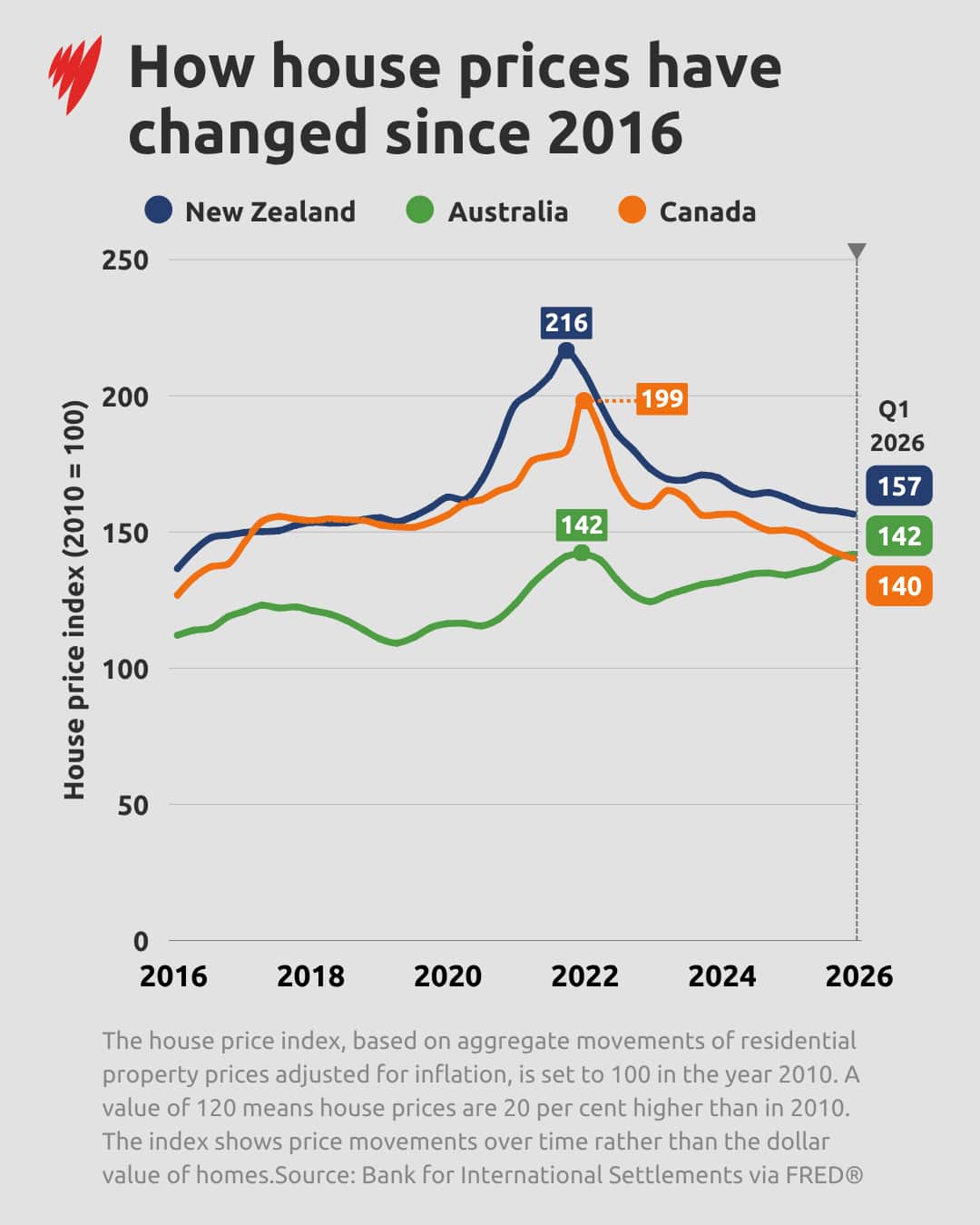
New Zealand’s market fell around 18 per cent from its 2022 peak over 18 months, after the Reserve Bank of New Zealand lifted its cash rate 12 times in a row. Cotality New Zealand’s Nick Goodall notes the national value-to-income ratio, a core affordability metric investors should be tracking in Australia too, dropped from 9.8 to 6.7 as rates rose and then fell. Crucially, the recovery since has been muted, not explosive, partly because of supply reforms that allowed greater housing density in cities like Auckland.
Enabling more properties to be built on the same area of land that was available previously for only one property certainly has led to less growth, or maybe a greater decline, in prices.
That is the part of the story investors tend to skip past in favour of headline price moves. Rate cuts alone did not fully restore NZ affordability; structural supply changes did meaningful work too. If Australian state governments lean further into density and planning reform while the Reserve Bank eases, the eventual rebound here could look more like New Zealand’s gradual re-rating than a sharp V-shaped recovery.
For portfolios built on the assumption of continuous capital growth, the practical takeaway is to stress-test against a 10 to 15 per cent peak-to-trough scenario, reassess serviceability buffers now rather than after a further rate move, and watch value-to-income ratios and supply policy as leading indicators, not just cash rate decisions. Australia’s downturn is still young. New Zealand and Canada suggest it has further to run before it is done resetting the market.
Source: SBS News.