
Four Generations, One Lot: What a Rare Baldwin Street Listing Tells Us About Multi-Unit Value
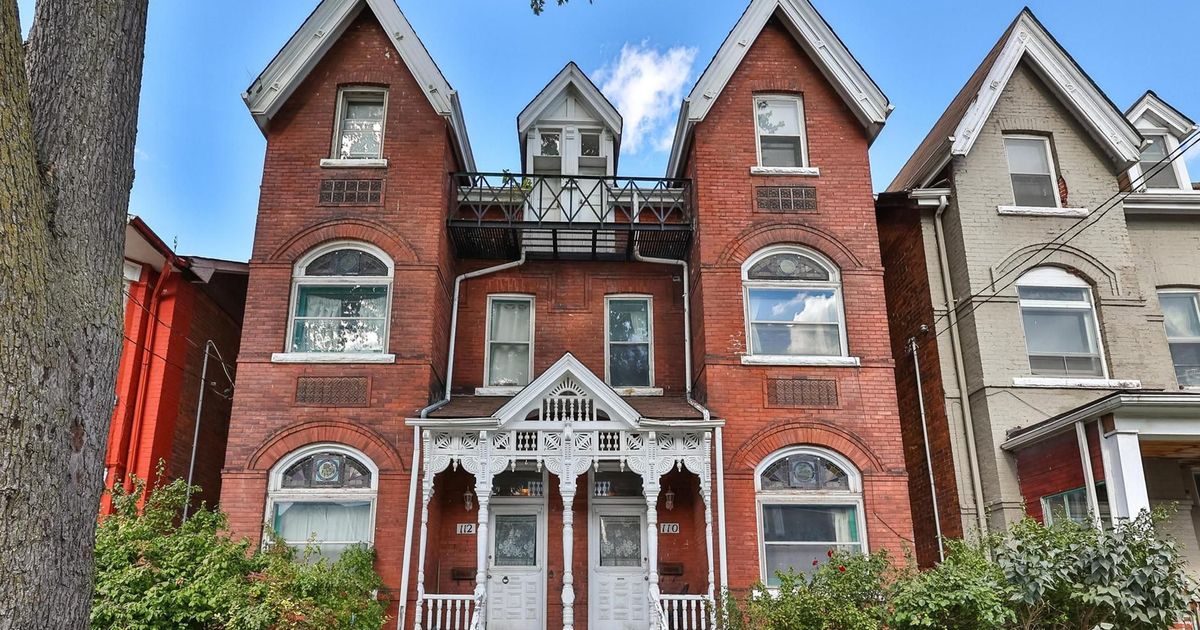
When a property has stayed inside one family for four generations, it rarely comes to market cleanly. There is no polished staging, no aggressive renovation pushing the price ceiling. What you get instead is something more valuable to a disciplined investor: a clear read on what the asset actually is, undisturbed by trend chasing. That is exactly what is happening on Baldwin Street in downtown Toronto, where two adjoining 1880s Victorians, held by the same family since the 19th century, have just hit the market.
The headline number is a combined asking price of 2,998,000 dollars for both properties, or 1,499,000 dollars each if purchased individually. On paper, that is a meaningful entry point for downtown Kensington Market adjacent real estate. But the detail that matters most to an investor is not the brick facade or the stained glass. It is the configuration: seven kitchens and seven bathrooms spread across the two buildings, with 110 Baldwin offering three kitchens and three bathrooms over three storeys, and 112 Baldwin offering four of each over its own three storeys.
That is not an accident of renovation. It is a built-in income structure. Properties already subdivided into multiple functional units, each with its own kitchen and bathroom, carry a different risk and return profile than a single-family conversion project. The listing itself points to multi-generational living or rental income as viable paths forward, and both basements, one finished, one unfinished, add further flexibility for an owner looking to maximize usable square footage without a full gut renovation.
Location strengthens the thesis. Steps from Kensington Market, Chinatown, and dense walkable amenities, with transit and parks within reach and parking already available off the laneway, this is the kind of micro-location that tends to hold rental demand regardless of broader market cycles. The listing also notes potential to build laneway housing, subject to approvals, which would add a third income stream to an already multi-unit site.
The strongest opportunities are rarely found by looking at price alone. They come from understanding configuration, location strength, and the long term direction of rental demand.
Of course, discipline matters here. The listing photos show age consistent with a 146 year old structure, and a buyer should budget seriously for deferred maintenance alongside the purchase price. This is not a turnkey yield play. It is a value add opportunity where the entry price, the existing income infrastructure, and the irreplaceable location do the heavy lifting, provided the capital plan accounts for renovation realistically rather than optimistically.
What makes this listing worth watching is not sentiment about a family holding property for generations. It is what that long hold reveals: a downtown asset that was never flipped, never over-leveraged, and never stripped of its multi-unit flexibility. For investors looking at core downtown Toronto, that combination of income structure, location, and underlying land value is increasingly hard to find.
Source: blogTO, “Pair of 1880-built Toronto homes in same family for four generations now up for grabs”