
Indigenous House: An Architecture of Reconciliation at the Heart of Campus
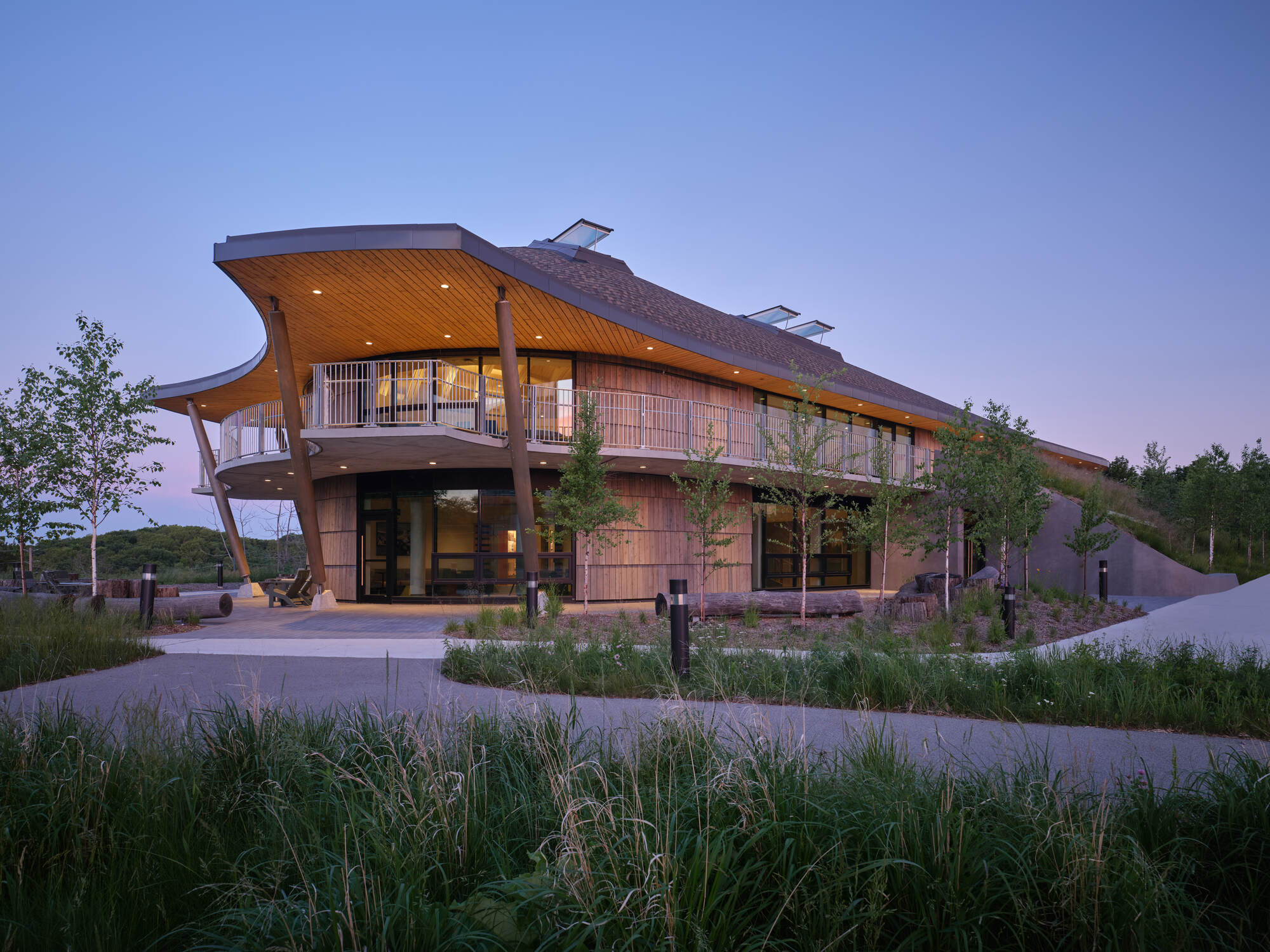
Some buildings decorate a site. Others redefine what a site means. Indigenous House, raised at the very centre of the University of Toronto Scarborough campus by Formline Architecture + Urbanism alongside LGA Architectural Partners, belongs firmly to the second category. Its placement alone tells a story: this is not a building tucked at the edge of things, but one planted where every path on campus must eventually pass it.
What draws my eye first is the intention behind the commission itself. The university describes the project as part of its effort to renew and strengthen its relationship with Indigenous communities, a response to Canada’s Truth and Reconciliation Commission Calls to Action. In design terms, that is an extraordinarily delicate brief. A building asked to carry cultural meaning cannot simply perform symbolism on its surface. It has to be felt in proportion, material, and sequence, in the way a person moves through a room and what that movement asks of them.
Formline’s involvement is telling. The firm has built its reputation on Indigenous-led design, and pairing that sensibility with LGA’s institutional precision creates exactly the kind of collaboration this project demanded, one voice rooted in cultural authorship, another fluent in the practical choreography of a university building. The consultant list reinforces how seriously the ambition was taken: Public Work handling the landscape, Equilibrium Engineering on structure, Introba responsible for both mechanical systems and environmental sustainability, MTE on civil works, and acoustic consulting from Swallow I Thornton Tomasetti. For a single building to draw this much specialized care speaks to how holistic the vision had to be. Architecture of this kind is never just a façade exercise. It is landscape, structure, air, sound, and light considered together as one gesture.
A building asked to hold cultural meaning cannot simply decorate its surface. It must be felt in proportion, material, and the quiet choreography of movement.
I find myself most interested in what this project represents for institutional architecture more broadly. Campuses are often cautious clients, inclined toward neutral boxes that offend no one and inspire even less. Indigenous House suggests a different posture is possible, one where a university places a culturally significant building not at the periphery of its planning but at its literal centre, surrounded by doublespace photography’s images of a structure that feels grounded rather than monumental, present rather than performative.
For readers who care about where design and meaning intersect, this Toronto project offers a quiet lesson. Beauty in architecture does not always announce itself through scale or spectacle. Sometimes it is found in restraint, in the decision to let a building’s position, its materials, and its collaborators speak on behalf of the community it was built to honour. Indigenous House does not need to shout to be understood. Its presence at the centre of a campus already says enough.
Source: ArchDaily.