



How to Improve Home Ventilation for a Fresher, Healthier Living Space
There is a certain kind of comfort that is hard to describe until you feel it. A well ventilated home simply feels better. The air seems lighter, rooms feel cleaner, and daily routines become more pleasant, whether you are cooking dinner, getting children ready for bed, or settling in for a quiet evening. Good ventilation is not only about avoiding stale air. It is one of the simplest ways to support a healthier home while also protecting the surfaces, fabrics, and finishes you live with every day.
Table Of Content
- Why home ventilation matters more than you think
- Start with the simplest ventilation habits
- Quick daily actions that help air move better
- Use bathroom and kitchen exhaust fans with intention
- Keep vents, registers, and air pathways clear
- Manage humidity for comfort and mould prevention
- Signs your home may have a humidity problem
- Know when filtration helps and when it is not enough
- Consider your home’s age, layout, and airtightness
- When to upgrade to an HRV or ERV
- Be thoughtful about outdoor air quality
- Do not overlook hidden pollution sources
- Create a room by room ventilation routine
- A practical weekend checklist
- The comfort payoff of fresher air
This matters more than many people realize. Health Canada notes that Canadians spend about 90 percent of their time indoors, which means indoor air quality has a major effect on daily life. When air does not circulate properly, moisture and pollutants can linger longer than they should. That can contribute to a home that feels heavy, damp, stuffy, or just not as fresh as it could be. In practical terms, improving ventilation can help reduce humidity, remove cooking byproducts, clear bathroom moisture, and move everyday odors out of the rooms where your family spends the most time.
The good news is that better ventilation does not have to begin with a major renovation. Some of the most effective changes are small and easy to implement. Opening windows strategically, using exhaust fans more intentionally, keeping air pathways clear, and paying closer attention to humidity can all make a meaningful difference. If your home is newer and more airtight, or if your climate makes open-window ventilation difficult for much of the year, there are also smart mechanical options that can improve comfort without sacrificing efficiency.
In this guide, we will look at practical, approachable ways to improve home ventilation for a fresher living space. The goal is not to make your home feel clinical or overly technical. It is to help it feel easier to live in, more breathable, and more supportive of everyday wellbeing in every season.
Why home ventilation matters more than you think
Ventilation is the process of bringing fresh air in and moving stale air out. It sounds basic, but it influences many of the things homeowners notice first when a space feels off. Rooms can smell stuffy. Windows may collect condensation. Bathrooms stay damp too long after showers. Bedrooms may feel stale in the morning. In kitchens, smoke, grease, moisture, and gases produced during cooking can remain suspended in the air if they are not exhausted properly.
Health Canada emphasizes that ventilation helps remove pollutants and moisture, and that poor ventilation is a major contributor to dampness and mould growth. That connection between airflow and moisture is especially important. When excess humidity stays trapped indoors, it can create ideal conditions for mould and dust mites. It can also affect comfort in a more immediate, visible way by making the air feel muggy and leaving surfaces damp long after daily routines should be over.
The air inside a home can also contain contaminants that are easy to overlook because many of them are not obvious. Health Canada lists common indoor pollutants such as carbon monoxide, radon, fine particles, nitrogen dioxide, mould, and volatile organic compounds. The U.S. Environmental Protection Agency also notes that inadequate ventilation increases indoor pollutant levels because there is not enough outdoor air coming in to dilute and remove emissions. In other words, fresh air is not simply pleasant. It is part of how a home manages what should not be lingering inside.
This is why ventilation deserves a place alongside the upgrades people often focus on first, such as lighting, storage, or paint color. It changes the way a home feels at a foundational level. Better ventilation supports clearer air, a more comfortable humidity level, and a fresher atmosphere that can make even familiar rooms feel calmer and more inviting.
Start with the simplest ventilation habits
If you want to improve your home ventilation quickly, begin with habits rather than equipment. In many homes, the issue is not a complete lack of ventilation tools. It is that the tools already in place are not being used consistently enough. Everyday actions can improve circulation and air freshness more than people expect, especially when they are part of a regular routine.
Opening windows is still one of the most accessible ways to bring in fresh air when outdoor conditions are suitable. The key is to think strategically rather than leaving a single window cracked randomly. If possible, open windows on opposite sides of the home to create cross ventilation. Even a short period of intentional airflow can help clear out stale indoor air, especially after cooking, cleaning, or hosting guests. The Centers for Disease Control and Prevention continues to recommend increased fresh air, including through opening windows and doors when it is safe to do so.
That said, opening windows is not always the right answer. Health Canada points out that window only ventilation can increase energy costs and make humidity control harder in winter and summer. Outdoor air quality also matters. During very cold weather, humid weather, wildfire smoke events, or days with high outdoor pollution, open windows may not support the fresher and healthier home you are trying to create. A good ventilation routine is responsive to season and location, not automatic.
Another simple habit is to leave interior doors open when privacy is not needed. This helps air move more freely from room to room and prevents parts of the home from feeling closed off and stagnant. Bedrooms, hallways, and upper floors often benefit from this especially if some rooms tend to trap warmth or feel stale compared with the rest of the house. Air circulation is often less about force and more about making pathways available.
Quick daily actions that help air move better
- Open windows on opposite sides of the home for short periods when outdoor air is clean and temperatures allow.
- Open interior doors during the day to reduce stagnant air in bedrooms and secondary rooms.
- Run ceiling fans on a gentle setting to keep air circulating, especially in rooms that feel heavy.
- Move large furniture slightly away from vents, radiators, and baseboards so air can travel properly.
- Check curtains and rugs to make sure they are not blocking registers or return vents.
None of these steps is complicated, which is exactly why they are effective as a starting point. They fit into real life. They are inexpensive. And they can shift the feeling of a room surprisingly quickly.
Use bathroom and kitchen exhaust fans with intention
Two of the most important ventilation features in any home are the bathroom fan and the kitchen range hood. These spaces create moisture and pollutants at the source, which means exhausting them immediately is one of the smartest and easiest things a homeowner can do. It is a form of source control, and it often works better than trying to correct lingering humidity or odors later.
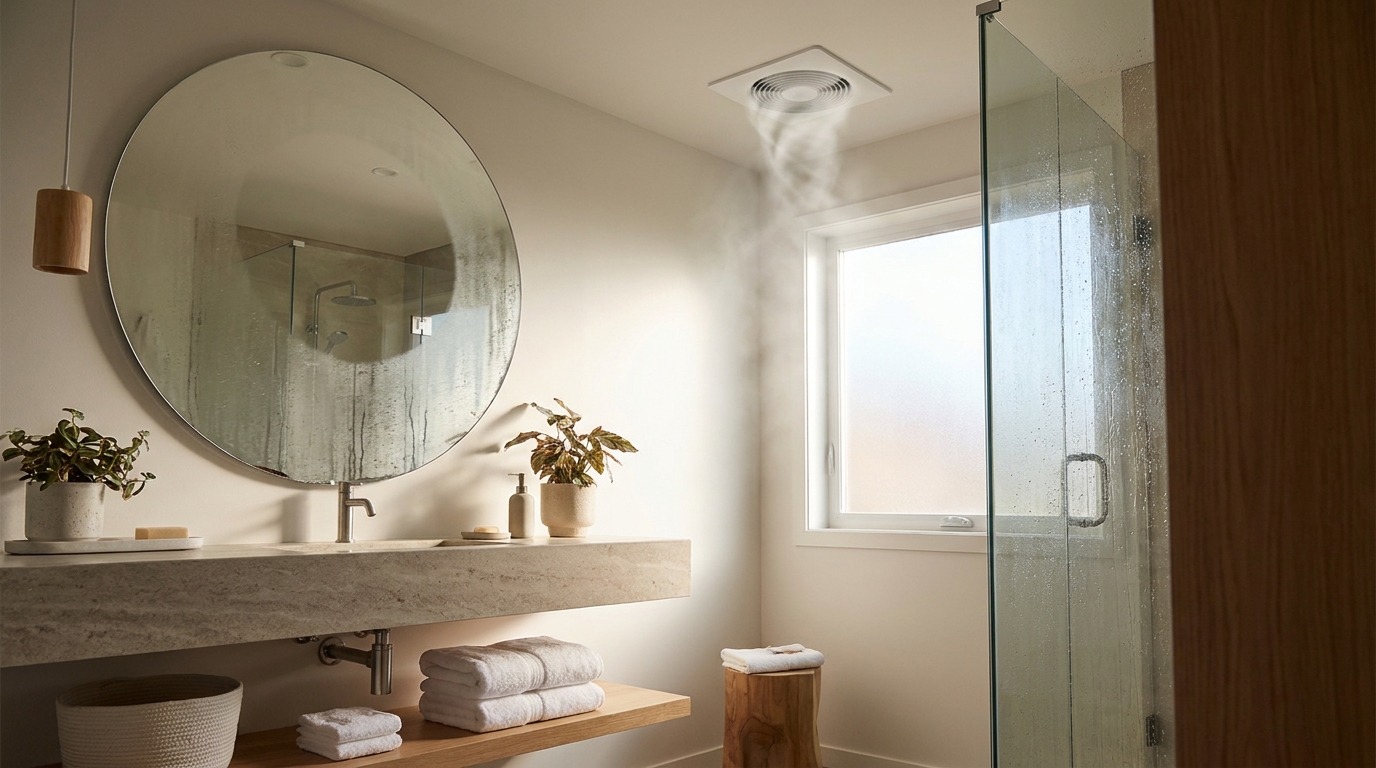
In bathrooms, moisture is the main concern. A shower can leave warm damp air clinging to walls, ceilings, mirrors, and grout if it is not vented out promptly. Over time, that repeated moisture can lead to peeling paint, mildew smells, condensation problems, and eventually mould growth. Running the exhaust fan during every shower or bath is essential, and it should continue running afterward until the room has had time to dry out. If your bathroom fan is noisy, underpowered, or rarely used because it feels ineffective, replacing it may be one of the best small comfort upgrades you can make.
In kitchens, the picture is broader. Cooking releases steam, grease particles, odors, and in some cases gases and combustion byproducts. Health Canada specifically notes that using the kitchen range hood on the high setting can reduce humidity and particles or gases by more than 80 percent compared with slower speeds. That is a significant improvement from a simple behavior change. If you usually avoid the high setting because of sound, remind yourself that it is most valuable exactly when cooking intensity is highest.
A common misconception is that kitchen and bathroom fans are mainly for odors. In reality, their role goes much further. They help remove moisture and pollutants even when a room does not smell bad. A bathroom that smells neutral can still be holding too much humidity. A kitchen that looks clear can still contain fine particles from frying or cooking on a gas stove. Using exhaust systems consistently is one of the easiest ways to improve indoor air quality without changing your décor, budget, or floor plan.
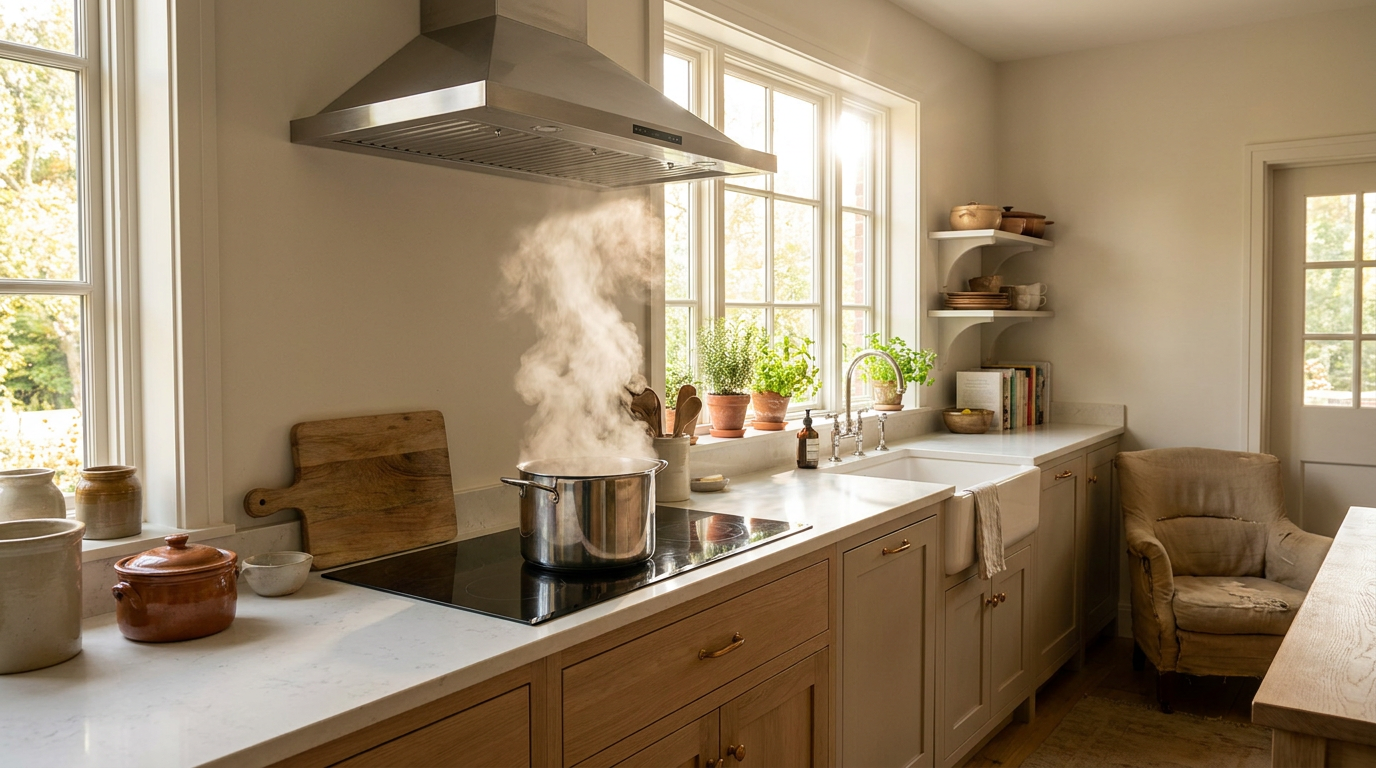
A simple rule to remember: Vent moisture and cooking byproducts at the moment they are created. It is much easier to remove them at the source than to fix stale, damp air later.
Keep vents, registers, and air pathways clear
Sometimes a home feels stuffy not because it lacks a ventilation system, but because the system cannot do its job properly. Air has to move through the home, and that movement can be interrupted by very ordinary things such as furniture placement, dusty vents, heavy drapes, or overfilled utility areas. These are easy details to miss because they blend into daily life, but they affect how fresh and balanced a room feels.
Walk through your home and look closely at every supply vent, return vent, register, and baseboard area. Is a sofa covering a register in the living room. Is a bed pushed against a vent in the guest room. Are curtains draped over a return air grille. Is a bookshelf packed too tightly into a corner where air should circulate. These quiet little obstacles can trap warm or damp air and leave some rooms under served while others feel overly warm or drafty.
Dust is another issue worth addressing. Dirty vent covers and clogged returns can reduce airflow and contribute to a stale feeling. A gentle vacuuming and wipe down of accessible covers can help your system move air more effectively. This is not about making the house perfect. It is about giving your ventilation pathways a clearer route so the air in your home can do what it is meant to do.
If there are rooms you rarely use, remember that closed doors and blocked vents can make those spaces isolated pockets of still air. Even opening those rooms periodically, letting them breathe, and checking for signs of dampness can improve the overall freshness of the home. Ventilation works best when it is thought of as a whole home pattern rather than something that matters only in one problem area.
Manage humidity for comfort and mould prevention
Humidity deserves its own attention because it plays such a large role in how a home feels. Air that is too humid can feel heavy, sticky, and uncomfortable, while too much moisture also encourages mould growth and dust mites. Health Canada recommends keeping indoor relative humidity between 30 and 50 percent, and that range offers a useful target for most households trying to balance comfort and cleanliness.
One of the easiest ways to start is by using a simple digital hygrometer or indoor humidity monitor. These are inexpensive, easy to read, and helpful because they turn guesswork into something practical. A room may feel slightly damp without you realizing why. A monitor can tell you whether the issue is temporary after a shower or part of a larger pattern in a basement, bedroom, or laundry area.
Controlling humidity often starts with moisture reduction at the source. That means using bathroom fans, covering pots while cooking if appropriate, venting dryers correctly, and fixing leaks promptly. Health Canada advises homeowners to repair moisture problems immediately, and that is important because chronic moisture rarely improves on its own. A small plumbing drip, recurring condensation around windows, or a damp corner in the basement can quietly shape indoor air quality over time.
Season matters here too. In winter, many people assume more humidity is always better because heated air can feel dry. But excess humidity indoors during cold weather can lead to condensation on windows and walls, which can then create conditions for mould. In summer, the challenge may be sticky air and poor drying after showers or cooking. Better ventilation supports better humidity control in both directions by helping moisture leave the space instead of hanging around.
Signs your home may have a humidity problem
- Condensation regularly forms on windows or mirrors long after normal activities end.
- Bathrooms stay damp for too long after showers.
- You notice a persistent musty smell in closets, basements, or bedrooms.
- Paint peels, caulking darkens, or mildew returns quickly after cleaning.
- The air feels sticky or heavy even when the temperature is comfortable.
If these signs are familiar, a combination of better exhaust fan use, moisture repair, and humidity monitoring can often make a visible difference before larger upgrades are needed.
Know when filtration helps and when it is not enough
Air cleaners and better HVAC filters can absolutely support fresher indoor air, but they are often misunderstood. The Environmental Protection Agency says portable air cleaners and upgraded furnace or HVAC filters can help improve indoor air quality, especially for particles, but they do not replace ventilation. This is an important distinction because filtration and ventilation are related, not interchangeable.
Ventilation brings in outdoor air and pushes stale air out. Filtration captures particles circulating in the air, such as dust, pollen, smoke particles, and some other fine debris depending on the filter. What filtration does not do well on its own is remove moisture or fully address gases. That means a portable air cleaner can be useful in a bedroom or living area, but it will not solve a humid bathroom or a kitchen where cooking emissions need to be exhausted directly.
For homeowners with forced air heating or cooling, filter upgrades can be a worthwhile comfort improvement. ASHRAE, the widely used benchmark organization for ventilation standards, has moved toward higher residential filtration expectations, including a shift from MERV 6 to MERV 11 in the 2025 edition of its residential ventilation standard. While not every existing home system can accommodate every filter type, this trend reflects growing attention to cleaner indoor air in everyday housing.
If you are considering an upgraded HVAC filter, check what your system can handle and change filters on schedule. A higher efficiency filter that is left dirty for too long can reduce airflow, which works against comfort. For many homes, the best approach is to think in layers. Use ventilation to move stale air out, filtration to capture particles, and source control to reduce pollutants before they spread.

Consider your home’s age, layout, and airtightness
Not every home breathes the same way. Older homes often have more natural air leakage through construction gaps, aging windows, or less insulated building envelopes. While that can sometimes help air exchange happen passively, it can also create drafts and inconsistent comfort. Newer homes, by contrast, are often tighter and more energy efficient. That is good for heating and cooling efficiency, but it also means stale air and indoor pollutants may have fewer ways to escape unless mechanical ventilation is doing the job intentionally.
Health Canada notes that mechanical ventilation is particularly important in airtight houses. This matters because many homeowners assume that if a home is new and well built, it must automatically have excellent indoor air quality. In reality, a tightly sealed home often needs thoughtfully designed ventilation more than an older one does. Without it, moisture, cooking byproducts, and everyday pollutants can remain trapped inside a very efficient shell.
The layout of your home also shapes how air moves. Open concept spaces often allow better natural circulation, while narrow hallways, closed doors, finished basements, bonus rooms over garages, and upper floors can each create airflow challenges. If one part of your home consistently feels stale, stuffy, or humid compared with the rest, the issue may be less about the whole house and more about a specific area where air exchange is limited.
This is where observation becomes valuable. Notice where condensation tends to appear first, where laundry dries slowly, or where overnight air feels stale by morning. Those patterns can guide simple fixes such as leaving doors open, adding a dehumidifier in one area, adjusting fan use, or eventually investing in a more balanced whole home ventilation solution.
When to upgrade to an HRV or ERV
If easy habits and small fixes have helped but your home still struggles with stale air, moisture, or seasonal comfort issues, it may be time to consider a mechanical ventilation upgrade. Two of the most relevant options today are the heat recovery ventilator, or HRV, and the energy recovery ventilator, or ERV. These systems are especially useful in tighter, more energy efficient homes where window ventilation is not always practical or comfortable.
An HRV exchanges stale indoor air with fresh outdoor air while recovering heat from the outgoing air in colder months. This helps maintain energy efficiency while improving ventilation. An ERV works in a similar way but also helps manage moisture transfer, which can make it helpful in climates or homes where balancing humidity is part of the challenge. Both systems support a more controlled, whole home approach than simply opening windows whenever a room feels stuffy.
For homeowners in colder parts of North America, this can be especially appealing. Health Canada warns that relying only on windows for ventilation can increase energy costs and make humidity harder to manage in winter and summer. An HRV or ERV offers a more balanced solution because it allows fresh air exchange without the same abrupt heat loss, cold drafts, or discomfort.
You do not need to become highly technical to know whether this kind of upgrade may suit your home. If your house is relatively airtight, if you often deal with condensation or lingering indoor air issues, or if opening windows is frequently impractical because of weather, allergies, smoke, or outdoor pollution, a professional conversation about balanced ventilation may be worthwhile. Think of it as an investment not only in air quality, but also in the calm, even feeling of the home throughout the year.
Be thoughtful about outdoor air quality
Fresh air is wonderful, but it is important to remember that outdoor air is not always ideal. This is one reason ventilation advice has become more nuanced. On beautiful mild days, opening windows can be a lovely and effective way to refresh a home. On smoky days, high pollen days, or periods of heavy traffic pollution, bringing outdoor air in may worsen the situation instead of improving it.
This matters increasingly in regions affected by wildfire smoke. Fine particles from smoke can enter the home through open windows and make indoor air much less healthy, even if the breeze initially feels pleasant. On those days, a better strategy may be to keep windows closed, use properly maintained HVAC filtration, and run a portable HEPA air cleaner in the rooms where your family spends the most time.
There is also a lifestyle element here. The goal is not to create rigid rules. It is to develop awareness so you can choose the best approach for the day. A fresh spring morning may invite cross ventilation and open doors. A bitterly cold winter evening may call for short fan based ventilation and humidity control instead. A smoky summer afternoon may be better managed through filtration and sealed windows. Good ventilation is responsive and seasonal, which makes it feel supportive rather than disruptive.
Do not overlook hidden pollution sources
One of the most useful shifts in thinking about ventilation is to move beyond the idea that it is only about odors. Many indoor pollutants are odorless, and some of the sources are easy to forget because they are part of ordinary life. Attached garages, for example, can allow fumes to enter the home if doors are left open or air sealing is poor. Fuel burning appliances need proper venting and maintenance. Renovation products, paints, new furniture, and cleaning products may release volatile organic compounds, especially in poorly ventilated rooms.
Cooking is another everyday source that deserves more attention. Even a clean and beautiful kitchen can accumulate fine particles and gases when frying, searing, or using gas burners. Running the range hood every time you cook is not excessive. It is one of the easiest ways to maintain a fresher and cleaner feeling throughout the main living space, especially in open plan homes where the kitchen flows directly into dining and sitting areas.
For safety, it is also wise to remember that ventilation is only one part of protection from serious contaminants such as carbon monoxide and radon. These require proper detectors, testing, and mitigation where appropriate. Still, a home that is attentive to ventilation often becomes a home that is more aware overall of how daily activities affect indoor air quality. That awareness supports healthier routines without making the home feel fussy or difficult.
Create a room by room ventilation routine
Sometimes the easiest way to make improvement feel manageable is to think room by room. In the bedroom, focus on fresh overnight air, clear vents, and periodic airing out when weather allows. In the bathroom, the priority is moisture removal before it settles into surfaces. In the kitchen, the aim is to capture steam and cooking pollutants immediately. In living rooms and family rooms, maintaining clear airflow and using filtration if needed can help support the spaces where people gather most often.
Basements deserve extra attention because they are more prone to dampness and limited airflow. If a basement feels musty, look first at humidity levels, signs of moisture intrusion, and whether the area receives enough active air exchange. A dehumidifier may be useful there in addition to broader ventilation improvements. Laundry spaces also benefit from attention, especially if they are enclosed or if the dryer vent needs inspection. Warm, moist utility spaces can quietly shape the comfort of nearby rooms.
By assigning each room a simple ventilation priority, the task stops feeling abstract. You are no longer trying to solve “indoor air quality” all at once. You are making each part of the home function a little better based on what actually happens there. This is often the most realistic way to create lasting change.
A practical weekend checklist
- Test every bathroom fan and listen for weak or unusual operation.
- Run the kitchen hood and check whether it effectively captures steam.
- Walk room to room and clear anything blocking vents or baseboards.
- Wipe or vacuum accessible vent covers and return grilles.
- Check indoor humidity with a hygrometer and note problem areas.
- Look for condensation, musty smells, or slow drying in bathrooms and basements.
- Replace HVAC filters if they are due and confirm the correct filter type for your system.
- Review whether a portable air cleaner would help in a bedroom, office, or family room.
Even doing half of this list can put you on a much better path. Small maintenance steps often bring a home back into balance more quickly than expected.
The comfort payoff of fresher air
When ventilation improves, the benefits are both visible and subtle. Mirrors clear faster after showers. Bedrooms feel more pleasant in the morning. Cooking smells do not settle into fabrics as easily. Basements feel drier. The whole home seems to carry less heaviness. These are not dramatic design changes, but they shape everyday life in a way that feels deeply worthwhile.
There is also a quiet emotional benefit to breathing easier in your own home. A fresher space can feel more restful, more cared for, and more welcoming to family and guests. It supports routines that are healthier without demanding that the house feel institutional or complicated. In many ways, better ventilation is one of the most generous upgrades you can make because it improves the atmosphere of the home itself.
If you are deciding where to begin, start small and stay observant. Use the bathroom fan every time. Turn the kitchen hood to the right setting. Open windows thoughtfully when outdoor conditions are favorable. Keep airflow pathways clear. Monitor humidity and take moisture seriously. Then, if your home needs more support, consider better filtration or a balanced mechanical system that matches the way your house is built and the climate you live in.
Ventilation is not only a technical subject. It is a quality of life upgrade. A fresher living space feels lighter, healthier, and easier to enjoy every day, which is exactly what a well loved home should offer.



No Comment! Be the first one.