
King Street West’s Multi-Year Rebuild Signals a Bigger Bet on Downtown Infrastructure
Toronto is about to spend several years tearing up one of its busiest downtown corridors, and that decision says more about the city’s long term growth strategy than it does about potholes. Beginning Monday, crews will start a phased renewal of watermain and streetcar infrastructure along King Street West, a project that will stretch from Dufferin Street to University Avenue and run well into 2027.
For readers who think about cities at scale, this is not a routine repair job. It is a coordinated program between the City of Toronto and the TTC that has been underway since 2020, sequencing watermain replacement and streetcar track renewal so the corridor is not repeatedly dug up over the coming decades. That kind of sequencing is the unglamorous but essential groundwork that determines whether a dense, mixed use corridor can keep functioning as the city around it intensifies.
King Street West has become one of the clearest test cases in North America for how a city manages competing demands on a single stretch of road. It carries transit riders, delivery traffic, restaurant and retail frontage, and a growing residential population, all within a corridor the city has already experimented with through transit priority measures. Renewing the infrastructure underneath that corridor is effectively a bet that King Street West will keep absorbing growth for decades, and that the pipes and tracks beneath it need to match that trajectory.
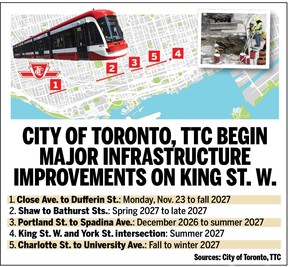
The phasing itself is worth watching closely. Work begins between Dufferin and Close Avenue this week, with the Spadina to Portland stretch expected to start as early as December. The section between Bathurst and Shaw follows in spring, the York Street intersection continues into the following summer, and the final phase, between Charlotte Street and University Avenue, does not begin until next fall. That is a multi-year rolling closure pattern, not a single disruptive event, and it reflects a deliberate strategy to limit how much of the corridor is under construction at any one time.
Strong projects are built from a wider understanding of timing, access, and the future identity of a community, and that logic applies just as much to a city’s pipes and tracks as it does to its towers.
For anyone tracking development feasibility near King Street West, the practical takeaway is access management. The city has said sidewalks, business access, and property access will be maintained throughout, with traffic control personnel, signal adjustments, and signage used to manage the lane reductions and intermittent intersection closures. TTC service will see temporary diversions, which matters for any project in the pipeline that leans on transit access as part of its value proposition.
Infrastructure renewal rarely makes headlines the way a new tower or rezoning does, but it is the layer that makes everything else possible. A corridor with aging watermains and worn streetcar tracks eventually limits what can be built and sustained around it. Toronto appears to be choosing to address that constraint now, on its own multi-year timeline, rather than later under pressure.
Source: Toronto Sun