



How to Monitor Building Settlement: A Homeowner’s Guide to Early Detection
Building settlement sounds technical, but the basic idea is simple. Over time, a house can move downward as the soil beneath it compresses, dries out, shrinks, erodes, or shifts. Some movement is expected in many homes, especially as a building adjusts to its site and seasonal moisture changes. The important question for a homeowner is not whether a house has ever moved, but whether it is still moving, whether that movement is uneven, and whether the signs are getting worse.
Table Of Content
- What Building Settlement Really Means
- Why Early Detection Matters
- Start With a Baseline Before You Monitor Anything
- Simple Tools Homeowners Can Use
- How to Track Cracks the Right Way
- How to Monitor Doors, Windows, and Interior Fit
- How to Check Whether Floors Are Getting More Uneven
- Why Moisture and Drainage Belong in Every Settlement Log
- A Practical Homeowner Inspection Routine
- Suggested items to record each time
- What Signs Are More Concerning Than Others
- Common Misunderstandings That Lead Homeowners Off Track
- When DIY Monitoring Is Enough and When It Is Not
- Call a professional sooner if you notice any of the following
- What a Professional Will Want From You
- Practical Prevention While You Monitor
- Final Thoughts
That distinction matters because uniform settlement and differential settlement are not the same problem. If the whole house settles together in a relatively even way, damage may be limited. If one part of the house settles more than another, the building can distort. That is when you may start seeing cracks that widen, doors that stick, floors that slope more noticeably, gaps at trim joints, or utility lines placed under stress. For a homeowner, that is the movement pattern worth watching closely.
The good news is that useful monitoring does not require expensive engineering equipment. A careful homeowner can learn a lot with a phone camera, a ruler, a notebook, a basic level, painter’s tape, and regular observations. The key is to stop looking at settlement as a one-time inspection and start treating it as a change-over-time problem. A hairline crack that looks the same six months later is a different situation from a hairline crack that reopens after patching, spreads diagonally, or grows after a wet season.
This guide focuses on practical ways to monitor building settlement yourself. It will show you how to establish a baseline, what signs to track, how moisture and drainage affect the reading of those signs, and when to stop the do-it-yourself approach and bring in a professional. The goal is not to turn you into a structural engineer. The goal is to help you notice early movement, document it clearly, and make better decisions before small shifts become expensive repairs.
What Building Settlement Really Means
Settlement is the downward movement of a structure caused by changes in the supporting ground. Soil is not a perfectly stable material. It reacts to moisture, temperature, loading, fill quality, and the way water moves around the site. If one area under the foundation compresses more than another, the house does not just drop. It twists, leans, or bends slightly, and that distortion shows up in finishes and openings.
Research and building guidance consistently point to differential movement as the main structural concern. A visible crack by itself does not tell the whole story. Drywall can crack from shrinkage, plaster can crack from age, and concrete can crack from normal curing behavior. What deserves attention is the pattern of movement. A crack that continues to widen, a line that extends across masonry in a stair-step pattern, or a floor that feels more out of level over time suggests an active issue rather than a one-time cosmetic blemish.
Several factors can drive settlement. Local variations in soil compressibility, poorly compacted fill, changing moisture levels, erosion, drainage problems, footing size, load concentration, and excavation activity nearby can all play a role. In some regions, expansive clays shrink and swell with moisture changes. In colder regions, freeze-thaw cycles and even permafrost degradation can affect how the ground supports a home. That is why there is no single crack shape that automatically proves the cause.
For homeowners, that last point is important. You do not need to diagnose the soil mechanics to monitor your house well. What you need is a repeatable way to observe the same conditions over time. Good monitoring helps you answer practical questions: Is the movement active, seasonal, stable, or accelerating? Is it affecting one area or many? Is it connected to wet weather, snowmelt, drainage overflow, or dry spells? Those answers are often what a professional will need first anyway.
Why Early Detection Matters
Settlement problems are easier to manage when they are caught early. A crack that is measured, photographed, and tracked from the beginning gives you a clear record. That record helps you avoid two common mistakes. The first is panic over harmless cosmetic changes. The second is ignoring signs that are slowly becoming more serious because they developed so gradually that they felt normal.
Early detection also helps with timing. If a crack widens after heavy rainfall, after snowmelt, or during a prolonged dry spell, that pattern points toward moisture-related soil movement. If doors start sticking only during humid months, the explanation might be material swelling rather than settlement. If a basement corner becomes damp at the same time a wall crack extends, you may be dealing with both water intrusion and foundation movement together. Patterns like that are hard to see without records.
There is also a cost benefit to monitoring. Major structural repairs are disruptive and expensive, and they should never be based on guesswork or fear. On the other hand, drainage improvements, downspout extensions, gutter fixes, and grading corrections are often manageable steps that can reduce risk early. Careful monitoring helps you tell the difference between a condition that needs observation and one that needs immediate action.
The most useful homeowner tool is not a gadget. It is a consistent log. Settlement is about change over time, and a written and photographic record is often more valuable than a single close look.
Start With a Baseline Before You Monitor Anything
The first step is to create a baseline. Without one, you are relying on memory, and memory is poor at noticing slow changes. Pick a dry day with good light and walk through the house methodically. Look at the foundation walls, basement slab, garage slab, exterior masonry if you have it, drywall corners, ceiling-to-wall joints, window corners, door frames, trim joints, and floors that already seem suspicious.
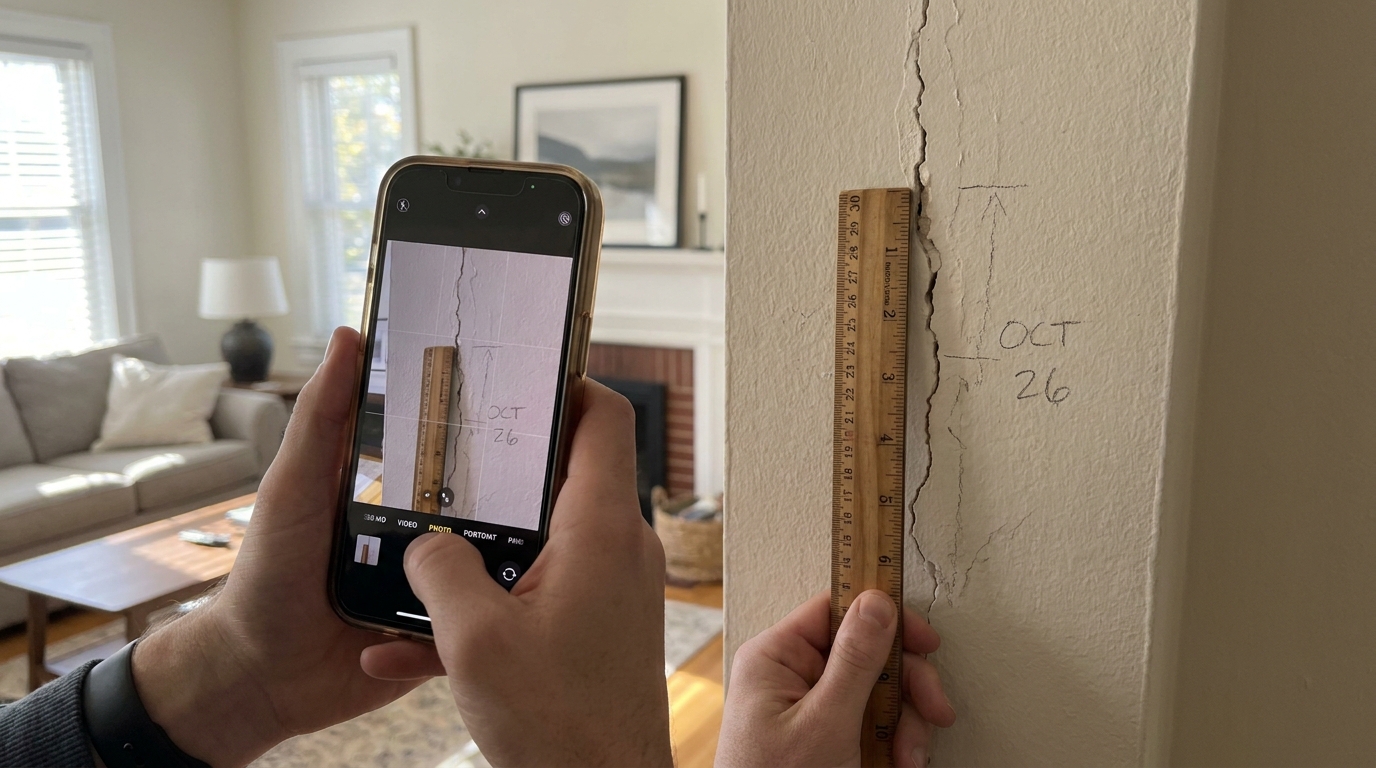
Photograph every crack or irregularity you think might matter. Do not just take a wide room photo. Take one photo showing the location in context and one close-up photo with a ruler, coin, or tape measure for scale. If possible, use the same camera angle each time you repeat the inspection. The idea is to make later comparisons clean and reliable rather than approximate.
Make a simple house map or use a printed floor plan if you have one. Label cracks and signs by room or wall. Use names that will still make sense six months later, such as “basement north wall crack near water heater” or “main floor dining room window upper left corner.” Date every entry. If you are using a phone note or spreadsheet, keep one row for each condition and update the same row over time instead of creating scattered notes in different places.
At this stage, do not overinterpret what you find. Many homes already have minor cracks or unevenness that have been stable for years. The baseline is not a diagnosis. It is your starting point for seeing whether a condition is active, seasonal, or unchanged.
Simple Tools Homeowners Can Use
You do not need specialized surveying gear to monitor basic settlement signs. A small set of simple tools is enough for most homes. A smartphone is useful for photos, time-stamped records, and even inclinometer apps that estimate slope. A ruler or crack width card helps with repeat measurements. Painter’s tape or a pencil can mark crack ends and measurement points without causing damage. A 4-foot or longer spirit level is better than a short torpedo level for checking floors. A flashlight helps in crawlspaces, basements, and utility areas.
If you want to be a bit more precise, a laser level can help compare floor elevations or reference lines across a room. An inexpensive moisture meter may also help if you are trying to connect movement with persistent dampness, though it should be used carefully and not treated as a structural diagnostic tool. Some homeowners also use simple crack monitors or tell-tales, but for many houses a well-documented photo series and width measurements are enough to establish trends.
The important thing is consistency, not complexity. Use the same ruler, the same floor-check locations, the same reference photos, and the same note format each time. If your process changes every month, your data becomes less useful. Straightforward methods done carefully usually beat more advanced methods done casually.
How to Track Cracks the Right Way
Crack monitoring is one of the most accessible parts of settlement tracking. Start by recording the crack location, direction, material, and approximate length. Then photograph it with a scale object placed beside it. Measure the width at one or more consistent points. If a crack is irregular, pick a few fixed spots and note where they are. That way you are not measuring a different part each time.
You can place a light pencil tick at the current ends of a crack and date the marks. If the crack grows beyond those marks later, you know it is extending, not just changing width in place. Painter’s tape can also work as a temporary marker near the crack, especially on finished surfaces where you do not want to write directly. Keep the markings discreet but clear enough to find again.
Pay attention to pattern and recurrence. A repaired crack that reappears in the same place often tells you more than a random surface blemish elsewhere. Diagonal cracks, stair-step cracks in masonry, and cracks that radiate from window or door corners can all matter, but none of them should be interpreted in isolation. What matters is whether they are changing and whether other signs of movement are appearing at the same time.
A practical schedule is to check active-looking cracks once a month, plus after heavy rainfall, rapid snowmelt, freeze-thaw swings, or long dry periods. Stable hairline cracks can be checked less often once you have several months of no change. If a crack changes suddenly over days rather than months, that is a different category and should lower your threshold for calling a professional.
How to Monitor Doors, Windows, and Interior Fit
Doors and windows are often among the first functional clues that something is moving. A door that used to swing freely but now rubs at one top corner may signal frame distortion. A window that suddenly binds, will not latch properly, or opens unevenly can tell a similar story. Again, one sticky window is not proof of settlement, because humidity and seasonal swelling also affect wood and trim. The value comes from tracking change and looking for a pattern across the house.
Create a short checklist for key doors and windows. Note whether they open smoothly, latch normally, and show even gaps around the frame. If a door sticks, note where it sticks and whether the issue is seasonal. You can even take close-up photos of gap lines around selected frames to compare later. This sounds basic, but repeated observations often catch active distortion before cracks become dramatic.
Also watch trim joints and wall-to-ceiling connections. Small separations at crown molding, baseboard gaps that reopen after caulking, and new shadow lines at corners can indicate movement. These signs are less direct than crack measurement, but when several of them change together in one zone of the house, they strengthen the case that the structure is shifting rather than just the finishes aging.
How to Check Whether Floors Are Getting More Uneven
Sloping floors can be one of the clearest signs of differential settlement, but they are also easy to misjudge by feel alone. Many older homes have some unevenness that has been there for decades. The question is whether the slope is increasing. That is why you want repeatable measurements from the same locations rather than a quick walk-through impression.
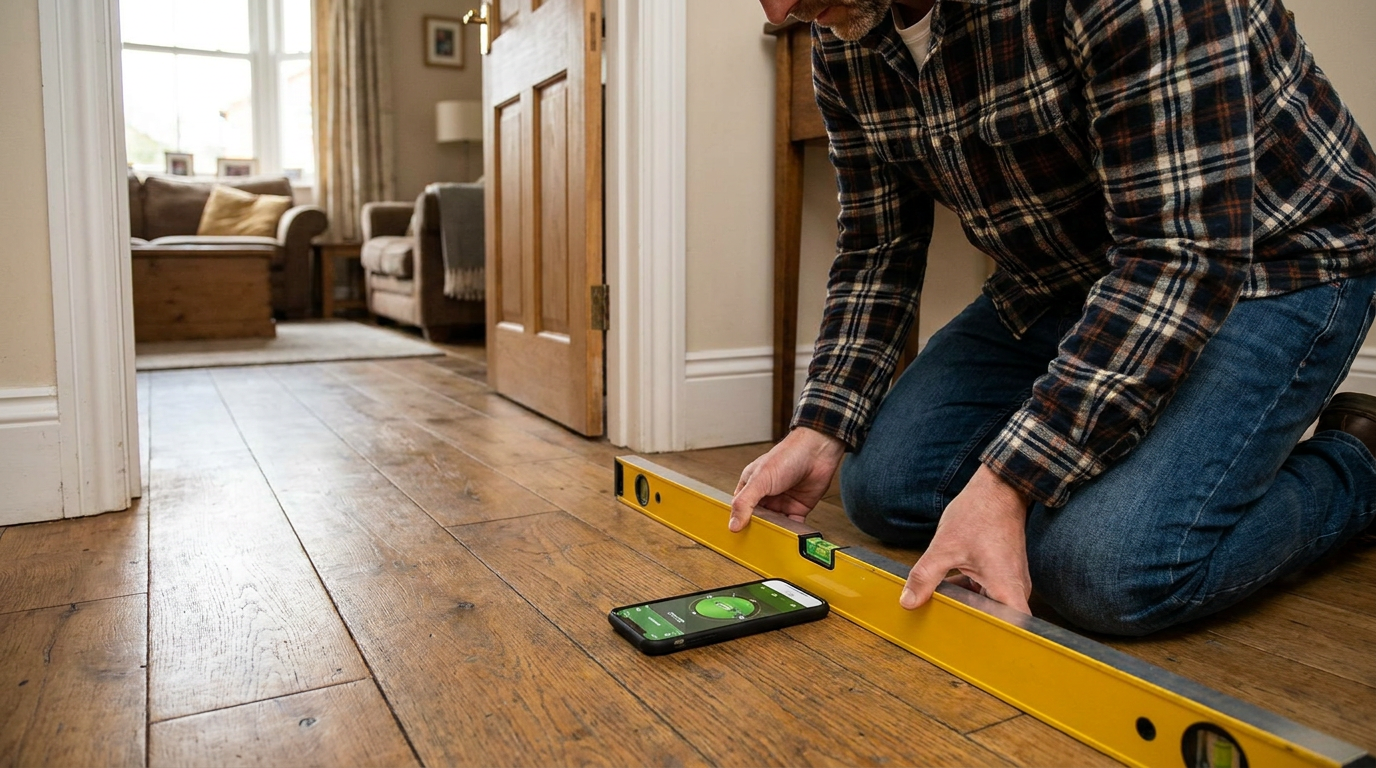
Use a long spirit level on the floor in a few chosen spots, especially near suspected problem areas. If the bubble is off center, note the direction and amount if your level markings allow it. A smartphone inclinometer app can provide a digital reading, though phone sensors vary, so consistency matters more than perfect precision. Place the phone or level in the exact same orientation each time and document where you measured.
A simple method is to choose a hallway, a room edge near an exterior wall, and one area near the center of the house. Mark those spots on your sketch and take readings monthly or quarterly. If you want a more visual check, place a marble on the floor and note whether it rolls, but do not rely on that as your only method. It can confirm a slope exists, but it will not give you a reliable trend record.
Progression matters more than the starting point. A floor that has a slight stable slope may not be urgent. A floor that shows an increasing slope over several checks, especially near active cracking or jamming doors, deserves a closer look. Monitoring several signs together always gives you a stronger read than any one symptom alone.
Why Moisture and Drainage Belong in Every Settlement Log
One of the biggest mistakes homeowners make is treating water issues and settlement issues as separate subjects. In reality, they are often connected. Soil behavior changes with moisture. Too much water can soften supporting soils, wash fines away, or increase pressure around the foundation. Too little water in shrink-swell soils can cause drying and contraction. That means your settlement log should include weather and drainage observations, not just cracks.
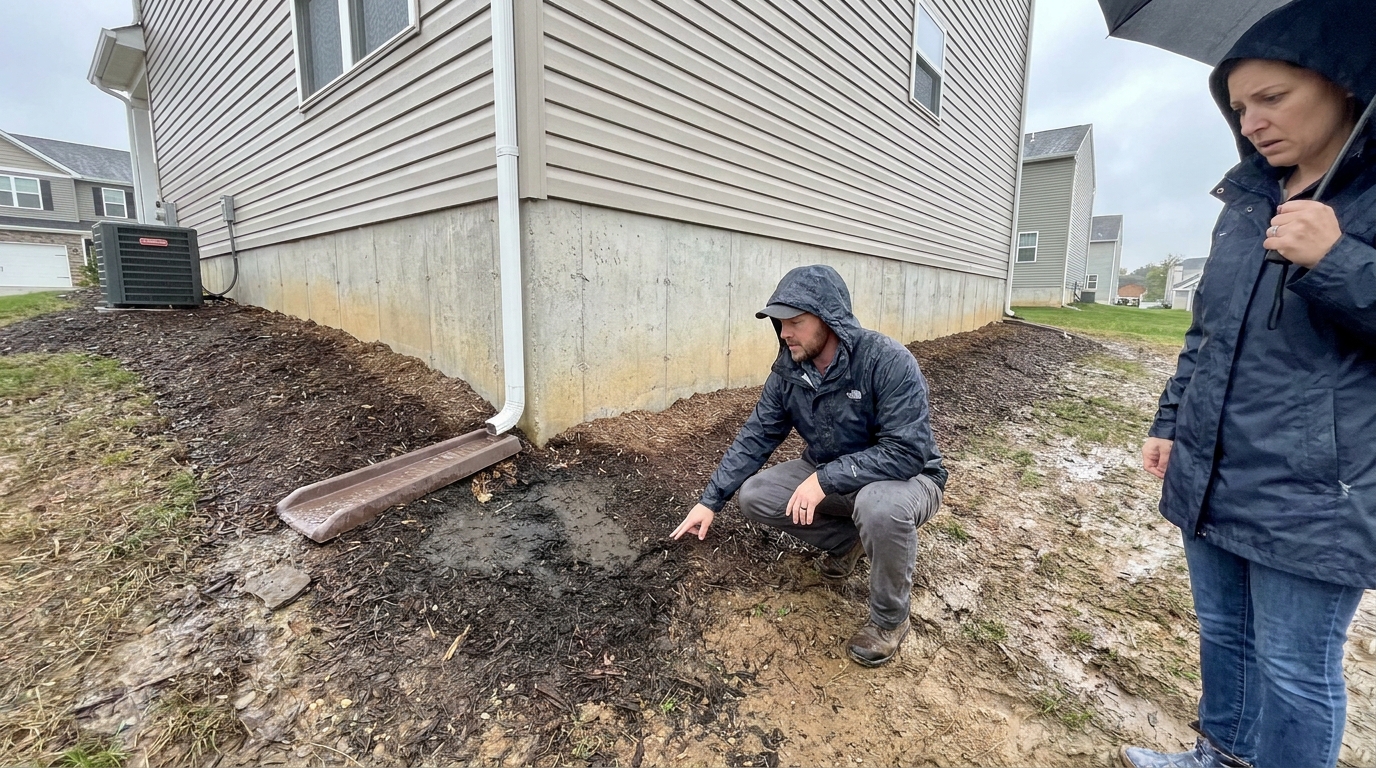
Walk the outside of the house after heavy rain. Check whether downspouts discharge far enough from the foundation. Look for gutter overflow, low spots that hold water, splash marks on siding, damp soil right against the wall, and erosion channels where runoff is concentrating. The ground should slope away from the house rather than funnel water toward it. These conditions matter even if you have not seen standing water inside.
Inside the basement or crawlspace, watch for damp corners, musty smells, water staining, efflorescence, peeling finishes, or seasonal wet spots near cracks. If these appear around the same time cracks open or widen, that timing is useful information. Foundation cracks can admit rain, groundwater, and snowmelt, especially when the water table is high. Water intrusion and movement often reinforce each other, so they should be documented together.
It is worth adding a weather note to every inspection entry. Write down whether the period was unusually wet, dry, frozen, thawing, or marked by rapid temperature swings. In cold climates, freeze-thaw cycles can change what you see at the foundation and nearby soils. In northern settings, changing ground conditions and permafrost-related effects can raise the risk of both heaving and settlement. You do not need advanced climate analysis. You just need enough context to connect movement with site conditions.
A Practical Homeowner Inspection Routine
If you want a simple monitoring system that is realistic to maintain, build it into a routine. Do a full interior and exterior walk-through at the change of each season. Then do shorter checks after major rain events, snowmelt periods, or unusual dry spells. The point is not constant worry. The point is catching movement when conditions are most likely to reveal it.
A strong routine usually includes five parts. First, re-photograph key cracks and compare them with your baseline images. Second, re-measure crack width at the same marked points. Third, test selected doors and windows for smooth operation. Fourth, check a few fixed floor-slope locations. Fifth, inspect drainage and moisture conditions around the foundation. If you update the same log each time, patterns will start to show.
Many homeowners find that a spreadsheet works well because it allows dates, measurements, weather notes, and photo file names in one place. Others prefer a binder with printed photos and hand notes. The format does not matter much as long as it is organized and easy to update. The biggest enemy of useful settlement monitoring is not lack of equipment. It is inconsistency.
Suggested items to record each time
- Date of inspection and recent weather conditions.
- Location of each crack or symptom.
- Current crack width and whether length changed past previous marks.
- Whether nearby doors or windows bind, rub, or latch poorly.
- Whether floor slope readings changed at fixed checkpoints.
- Whether any new dampness, staining, pooling, or drainage overflow was observed.
- Whether any repairs, caulking, patching, or landscaping changes were made since the last check.
What Signs Are More Concerning Than Others
Not every defect carries the same weight. A single stable hairline crack in drywall is usually less important than a combination of widening cracks, distortion at openings, and a clear floor slope trend. Homeowners should think in terms of clusters of evidence. When several signs line up in the same area of the house, confidence increases that the issue is structural movement rather than isolated cosmetic wear.
Some signs deserve more attention because they often point to differential movement. Stair-step cracking in masonry is one. Diagonal cracks that lengthen from openings are another. Sudden binding in several doors or windows, especially in the same section of the house, is more telling than one sticky interior door. Separation at wall and ceiling joints, recurring trim gaps, and utility strain near pipe penetrations can also be relevant.
Water changes raise the stakes. If movement signs appear alongside new moisture intrusion, wet basement corners, or persistent exterior pooling, the problem may be active and tied to site conditions that can get worse. In that case, it is not enough to patch the crack and move on. You need to understand whether the foundation support conditions are changing.
Do not focus only on the size of a crack. A small crack that keeps changing is often more useful as a warning sign than a larger crack that has been stable for years.
Common Misunderstandings That Lead Homeowners Off Track
One of the most common misconceptions is that any foundation crack means dangerous settlement. That is not true. Concrete and finishes crack for several reasons, including shrinkage, thermal movement, and normal aging. Another common mistake is the opposite one: assuming a hairline crack is always harmless. Small cracks can still indicate active movement if they widen, extend, or reopen after repair.
Another misunderstanding is that settlement is always uniform and therefore not a big deal. The bigger issue is whether one area moves more than another. That uneven movement creates distortion, and distortion is what damages finishes and framing connections. Homeowners also sometimes believe they need specialized professional instruments before any monitoring can be useful. In practice, simple tools and regular observations can provide valuable trend information.
There is also a tendency to judge the cause of movement based on crack shape alone. That can be misleading. Similar-looking cracks can come from different causes, and different materials show movement in different ways. Your job as a homeowner is not to produce a perfect diagnosis from one visual clue. Your job is to document whether the condition is active, worsening, and associated with other signs or moisture issues.
When DIY Monitoring Is Enough and When It Is Not
DIY monitoring is appropriate when signs are minor, the cause is not obvious, and you need to determine whether the condition is stable or active. This often includes hairline cracks, minor sticking that may be seasonal, or slight floor unevenness with no known history. A good homeowner log over a few months can clarify whether the issue is changing or simply part of the house’s long-term condition.
There is a point, however, where monitoring should stop being the main strategy and become support information for a professional assessment. Rapidly widening cracks, obvious stair-step cracking in masonry, long diagonal cracks that continue to grow, doors or windows that suddenly jam, significant new floor slope progression, or separation at wall-to-floor and wall-to-ceiling joints all move the issue into a more serious category. Any sign of movement paired with new water intrusion should also lower your threshold for making a call.
The local context matters too. If your home sits on fill soils, expansive clay, poorly drained ground, or in a region with freeze-thaw extremes, permafrost effects, or nearby excavation and vibration, err on the cautious side. Those conditions can make differential movement more likely. In that setting, even moderate changes deserve quicker review.
Call a professional sooner if you notice any of the following
- Cracks that widen noticeably over weeks or a few months.
- Stair-step cracking in brick, block, or other masonry.
- Diagonal cracks that lengthen or branch.
- Several doors or windows in one area suddenly binding.
- Clear increase in floor slope at repeated checkpoints.
- Wall or ceiling separations that are opening up, not just visible.
- New water intrusion appearing with the movement signs.
- Evidence of exterior drainage failure, erosion, or persistent pooling near the foundation.
What a Professional Will Want From You
If you do need outside help, your monitoring log becomes extremely useful. A structural engineer, foundation specialist, or experienced building professional will want to know when the signs first appeared, how they changed, and whether the changes correlate with weather or drainage events. Clear photos with dates, measurement records, and a simple floor plan save time and reduce guesswork.
This record can also help prevent overreaction. Professionals often arrive after a homeowner has been told that every crack means a major foundation repair is coming. A calm record of stable conditions can show otherwise. Just as important, a trend log can help confirm that something really is active and needs more than cosmetic repair. Good records improve the quality of the decision, whichever way it goes.
Practical Prevention While You Monitor
Monitoring is not only about watching. It should go hand in hand with sensible prevention. Keep gutters clear and make sure downspouts discharge well away from the foundation. Correct low spots that hold water beside the house. Maintain grading so surface water moves away instead of back toward the wall. Avoid creating irrigation patterns that keep one side of the home consistently wetter than the other if your soil is moisture-sensitive.
Be cautious with quick cosmetic fixes. Filling and painting over a crack may make a room look better, but it also erases evidence if you did not document it first. Always photograph and measure before patching. If you do repair a crack for appearance, note the date and watch whether it reappears. A recurring crack tells you far more than a newly discovered one because it proves the movement path remained active enough to reopen the finish.
Also pay attention to site changes. New patios, large planters, redirected downspouts, removed trees, new drainage trenches, or nearby construction can all influence soil moisture and movement patterns. Settlement monitoring works best when it includes a plain record of what changed around the house, not just what changed in the walls.
Final Thoughts
For homeowners, settlement monitoring is less about finding one dramatic clue and more about building a reliable picture over time. The real concern is usually differential settlement, where one part of the structure moves more than another and starts distorting the house. That kind of movement often reveals itself gradually through patterns: widening cracks, sticking openings, increasing floor slope, repeated trim separation, and moisture conditions that keep returning around the foundation.
The practical approach is straightforward. Create a baseline, photograph and measure what you see, check the same locations regularly, and include drainage and weather context in your notes. Use simple tools well rather than chasing complicated methods. A ruler, a level, a phone camera, and disciplined record keeping can give you a solid early-warning system.
Just as important, keep the limits of DIY monitoring in mind. You can observe and document, but you should not force a diagnosis from one crack pattern or wait too long when signs are accelerating. If movement appears active, widespread, or tied to water intrusion, get qualified help. Good monitoring does not replace professional evaluation when it is needed. It helps you know when it is needed and gives you better information when that time comes.
A house rarely hides every warning sign. Most of the time, it gives small hints first. Homeowners who pay attention to those hints, record them clearly, and respond practically are in the best position to protect both the building and their budget.



No Comment! Be the first one.