



Harnessing AI for Smarter Construction Analytics
Construction has never had a data shortage. The real problem is that most projects generate more information than teams can realistically absorb at the pace decisions need to be made. Schedules shift, costs move, weather disrupts sequencing, subcontractors submit updates in different formats, and field conditions often change faster than reporting cycles can capture. In that environment, artificial intelligence is not most useful as a futuristic talking point. It is useful as an interpretation engine that helps project teams understand what matters now, what is drifting off plan, and where risk is accumulating before it becomes expensive.
Table Of Content
- Why construction needs an analytics upgrade
- AI in construction is broader than generative AI
- Why project managers benefit first
- Key AI applications in construction analytics
- Predictive scheduling and delay forecasting
- Cost overrun detection and forecasting
- Document extraction and workflow intelligence
- Computer vision for progress verification
- Safety analytics and hazard detection
- Equipment maintenance and utilization forecasting
- AI, BIM, and the rise of the intelligence layer
- Why prefabrication and modular construction fit naturally with AI analytics
- What stakeholders gain beyond the jobsite
- The productivity case is real, but not automatic
- The risks construction firms should not ignore
- How to implement AI construction analytics in a practical way
- Common misconceptions that hold the industry back
- Real world momentum is building
- What the next few years will likely look like
- Conclusion: AI as a decision support system for modern construction
AI construction analytics uses artificial intelligence to help project teams process fragmented project information faster, without replacing project managers, estimators, or safety leaders. It surfaces cost anomalies, flags schedule conflicts, detects progress gaps in images, identifies safety patterns, and turns dense project documentation into clear, actionable insight for faster decisions. For owners, lenders, developers, and public stakeholders, that means better visibility. For site teams, it means less time chasing signals buried in spreadsheets, photos, reports, and disconnected software.
The timing matters. In Canada, official statistics show that AI adoption across businesses has risen quickly. According to Statistics Canada, 6.1% of businesses were using AI to produce goods or deliver services in the second quarter of 2024, and by the second quarter of 2026 that figure had climbed to 19.2%. Yet construction has not been among the fastest sectors to embrace generative AI. In early 2024, 85.6% of construction businesses said they were unlikely to adopt generative AI. That gap creates an important insight for the industry. Construction may not be the earliest adopter by instinct, but it is one of the clearest high value cases for analytics because project data is fragmented, time sensitive, and operationally expensive when misunderstood.
There is also a broader productivity context that makes this conversation more urgent. Statistics Canada reported that labour productivity in construction was unchanged in the first quarter of 2024. Federal housing and infrastructure reporting has also pointed to a roughly 10% decline in construction productivity from 2001 to 2023, falling from about $54 per hour to $49 per hour. When an industry is under pressure to build more housing, deliver more infrastructure, control costs, and meet decarbonization targets, the ability to interpret project information faster becomes more than a technical upgrade. It becomes a strategic capability.
This article looks at how AI simplifies data interpretation in construction projects, with a focus on the practical value for project managers and stakeholders. It also explains where AI is already proving useful, where it still needs caution, and why the smartest implementations are built around human judgment rather than automation hype. The central point is simple. AI is most powerful in construction when it turns scattered project data into usable intelligence.
Why construction needs an analytics upgrade
Construction is a coordination business disguised as a building business. Every project depends on dozens or hundreds of interdependent decisions involving design, procurement, sequencing, labour availability, site access, inspections, weather, cost approvals, and safety compliance. The challenge is not just that these variables exist. The challenge is that they are usually tracked across multiple systems and by multiple parties, each using their own formats, assumptions, and update rhythms. That makes interpretation slower than it should be.
Traditional project reporting has limits. Weekly progress meetings, spreadsheet trackers, PDF field reports, and manually updated dashboards can still be valuable, but they often present a snapshot after important conditions have already changed. By the time cost variance is visible in a monthly report, the underlying issue may have been active for weeks. By the time a sequencing conflict appears in a revised look ahead plan, it may already be affecting crews on site. AI helps close that interpretation gap by continuously analyzing more data than a typical manager could reasonably review in one sitting.
This matters because construction data is not clean by default. One update arrives as a subcontractor email, another as a daily report, another through a BIM model revision, another through drone imagery, and another through a procurement system. Without a stronger analytics layer, teams spend too much time reconciling information instead of acting on it. AI can reduce that burden by extracting patterns, structuring unorganized inputs, and ranking what deserves immediate attention. The value is not that software knows construction better than people. The value is that software can scan, sort, compare, and flag at a scale people cannot sustain manually.
For project managers, this changes the nature of oversight. Instead of spending hours compiling status, they can spend more time validating exceptions and solving the most relevant issues. For executives and owners, it changes the quality of reporting. Instead of receiving broad statements that a project is on track, they can receive more nuanced insight into risk concentration, forecast drift, cost pressure, and likely scenarios. In a sector where timing and margins are tight, better interpretation is a real operational advantage.
AI in construction is broader than generative AI
One of the biggest misconceptions in the market is that AI in construction mainly means chatbots or text generation. Generative AI gets attention because it is visible and easy to demonstrate, but it is only one part of the larger AI landscape. In construction analytics, the highest value often comes from predictive analytics, machine learning, computer vision, optimization models, and anomaly detection. These systems are less flashy than a conversational assistant, but they often create more direct business value.
For example, a generative AI tool might summarize a meeting, extract action items from an RFI, or draft a site memo. That is useful. However, a predictive model that detects a likely schedule overrun based on historical performance, crew productivity, procurement status, and weather exposure may be even more valuable. A computer vision model that compares drone imagery to a planned BIM sequence can reveal whether physical progress matches the schedule. A risk scoring model can identify change order patterns that tend to precede cost growth. These are not speculative use cases. They are practical forms of project intelligence.
That distinction is important because it helps stakeholders evaluate the right outcomes. AI should not be judged only by whether it can generate polished text. It should be judged by whether it helps construction teams interpret reality more accurately and respond earlier. In many cases, the best results come from combining several layers of intelligence. A system might extract data from documents, compare those signals to project controls, forecast risk based on prior trends, and then present the output in a dashboard or narrative summary that managers can review quickly.
In other words, AI in construction is best understood as an intelligence stack. Data collection comes first. Structuring and integration come next. Predictive or classification models sit on top of that. Then comes the user layer, which may include dashboards, alerts, summaries, and workflow recommendations. When people say AI is changing construction analytics, this is what they often mean in practice.
Why project managers benefit first
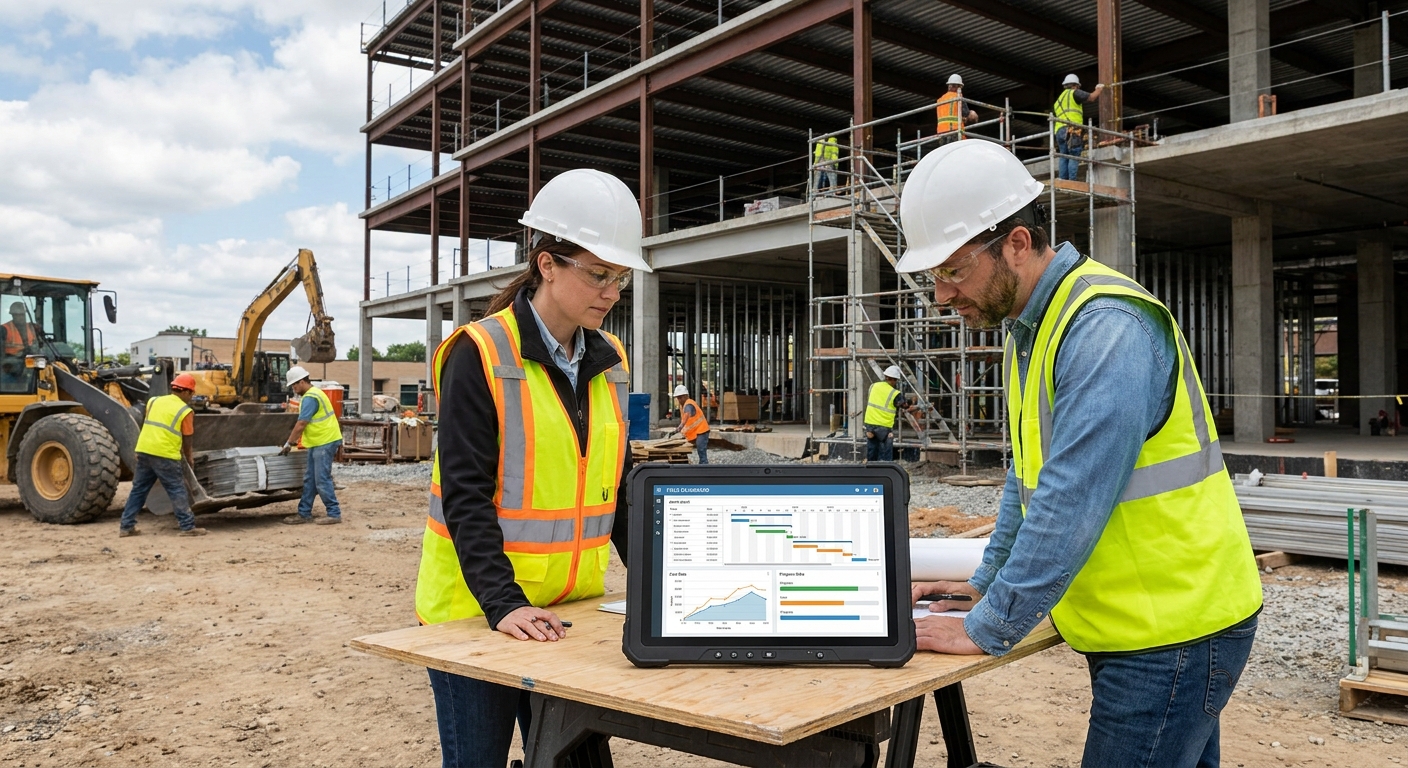
Project managers sit at the center of construction information flow, which makes them the first major beneficiaries of better analytics. They are expected to understand the schedule, cost exposure, procurement status, field progress, subcontractor coordination, owner expectations, and compliance requirements at the same time. Most of that work is not conceptually difficult for an experienced manager. It is cognitively heavy because it requires stitching together signals from many different sources and deciding which ones matter most today.
AI helps by reducing noise and accelerating interpretation. If a system can compare current productivity against historical performance on similar tasks, it can alert the manager when an activity is likely to slip before the critical path visibly changes. If it can read invoices, change requests, and progress claims in bulk, it can help identify cost categories that are trending beyond budget. If it can analyze field notes and detect repeated mentions of access constraints, inspection delays, or material shortages, it can surface emerging patterns that might otherwise remain anecdotal.
This is not about removing accountability from the manager. It is about sharpening situational awareness. A strong project manager already knows that construction issues rarely appear as isolated events. A delayed delivery becomes idle labour. Idle labour creates productivity loss. Productivity loss drives cost pressure. Cost pressure changes owner conversations. AI can help connect those dots faster by analyzing linked datasets in near real time and presenting the likely implications earlier in the chain.
There is a reporting benefit too. Project managers often spend significant time translating operational reality for stakeholders who are less immersed in daily construction detail. AI enhanced dashboards can help convert technical data into clearer narratives around progress, cost, risk, and forecast. That improves not only internal management but also owner confidence, lender visibility, and executive oversight. In projects where trust depends on timely and credible reporting, that matters.
Key AI applications in construction analytics
The practical applications of AI in construction analytics are already clearer than many people assume. They are not limited to futuristic robotics or autonomous jobsites. Most of the near term value comes from better interpretation of existing project information. These applications tend to work best when they are embedded into familiar workflows such as project controls, BIM coordination, quality assurance, safety review, and executive reporting.
Predictive scheduling and delay forecasting
Schedule management has always been central to project success, but schedule interpretation is often reactive. Teams usually notice the impact of delays only after planned work starts slipping in the field or a look ahead plan becomes visibly unrealistic. AI can improve this by analyzing schedule logic, activity dependencies, weather patterns, trade performance, inspection cycles, and procurement timing together. It can then estimate where slippage is likely to occur and which activities deserve intervention first.
That does not mean the software suddenly becomes the scheduler. Instead, it becomes a warning system and scenario engine. A project manager might see that one delayed material package will likely affect three downstream trades over the next two weeks. The system can rank those downstream risks, estimate the probable float erosion, and suggest where resequencing may protect milestone dates. That is useful because construction scheduling problems rarely come from one catastrophic event. They usually build from small delays that spread through the network unnoticed until options narrow.
For stakeholders, predictive scheduling improves transparency. Owners care about completion dates, revenue timing, occupancy, and financing impacts. Lenders care about draw timing and project stability. Executives care about portfolio level resource planning. AI helps each group see not only where a schedule stands, but where it is most likely to move next. That is a more decision ready form of reporting.
Cost overrun detection and forecasting
Construction cost control is another area where AI can provide strong leverage. Most project teams already monitor committed costs, actual costs, approved changes, contingency, and forecast to complete. The challenge is that early signals of cost pressure can be subtle. They may appear as repetitive small changes, invoice timing irregularities, productivity erosion, or procurement adjustments that do not look alarming in isolation. AI can detect these patterns earlier by comparing live cost behavior with historical project baselines and expected trajectories.
Imagine a system that reads change order logs, subcontractor applications for payment, equipment utilization, and labour production records together. It may detect that a specific work package is behaving like a historical pattern that previously led to a 5% or 8% budget overrun. It can flag the package, explain the drivers, and highlight the confidence level of the forecast. That does not eliminate the need for commercial judgment. It simply gives commercial teams more time to investigate, negotiate, resequence, or recover.
Research supports the broader impact of digital transformation here. McKinsey has reported productivity gains of 14% to 15% and cost reductions of 4% to 6% in construction related digital transformation contexts. Those figures should not be treated as automatic promises for every project, but they reinforce an important point. Better data interpretation is not merely administrative. It can influence real financial performance.
Document extraction and workflow intelligence
Construction projects produce large volumes of text heavy documents, including RFIs, submittals, specifications, meeting minutes, contracts, safety reports, deficiency logs, and change requests. Much of this information is critical, but not all of it is easy to process quickly. AI can help by extracting structured data from unstructured documents, classifying content, identifying repeated issues, and summarizing what changed between versions.
This has major implications for speed and consistency. A project team can use AI to scan incoming RFIs for themes, identify unresolved design coordination issues, or map submittal delays against schedule impacts. Commercial teams can use it to review change documentation at scale and detect language or scope patterns associated with dispute risk. Owners can use it to gain faster visibility into project correspondence trends without reading every source document personally.
The practical benefit is cumulative. Saving ten minutes on one document may not seem transformative. Saving those minutes across hundreds or thousands of documents, while also reducing the chance that an important issue remains buried in text, becomes highly meaningful. Construction management is full of small frictions that compound. AI helps reduce those frictions.
Computer vision for progress verification
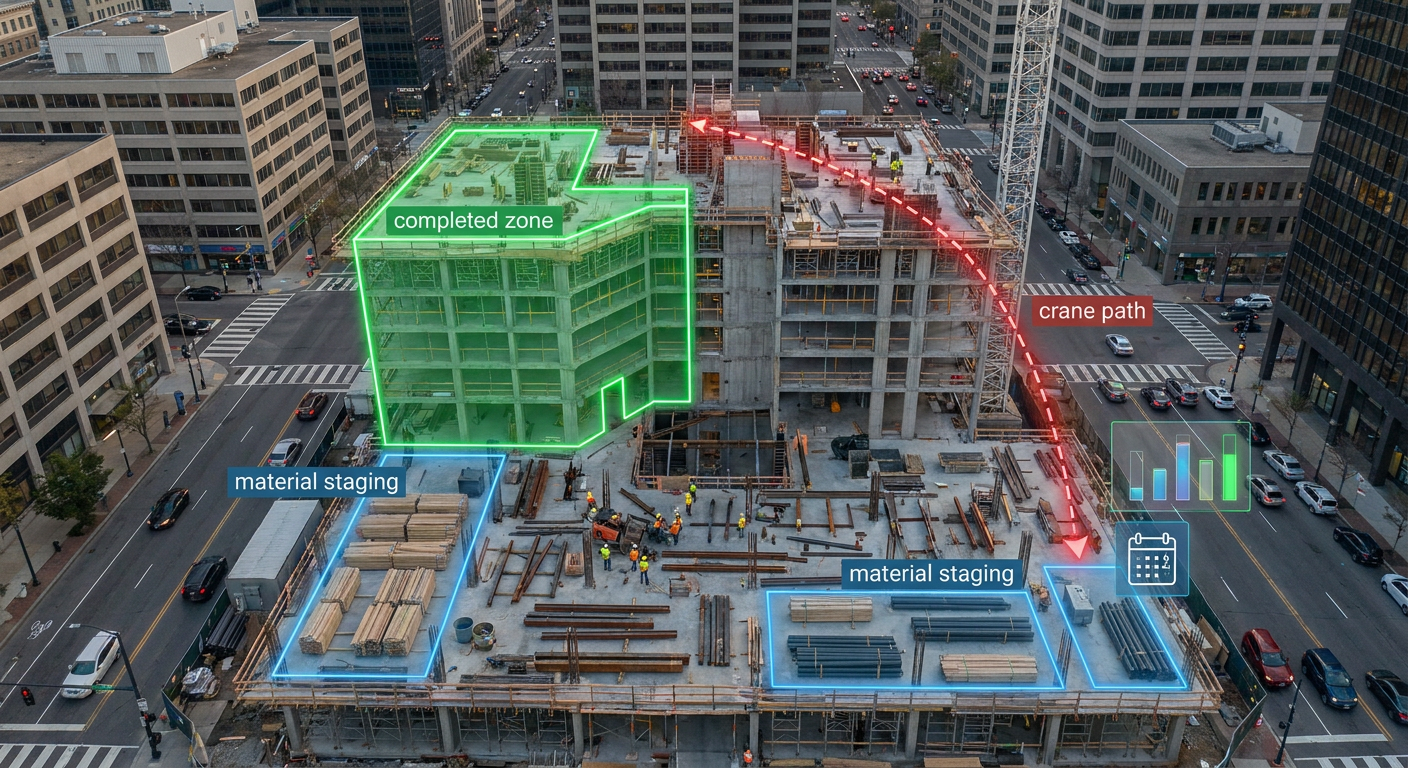
One of the most compelling applications of AI construction analytics is computer vision. By analyzing images from site cameras, smartphones, or drones, AI systems can compare visible project progress against planned milestones or BIM models. That means teams can verify whether installed work aligns with expected sequencing and identify areas where progress appears slower than reported.
This is particularly useful because progress reporting can be subjective. Different stakeholders may interpret percentage complete in different ways. Computer vision introduces a more consistent evidence layer. A system might detect that exterior envelope installation is behind the plan shown in the last update, or that a floor plate has less completed mechanical work than field reports suggested. Used well, this does not create surveillance for its own sake. It creates more reliable status intelligence.
Computer vision also improves communication. Owners, developers, and financiers often struggle to interpret technical schedule language without visual context. AI assisted image analysis can connect the physical state of the site to the digital project plan more clearly. That makes progress discussions more grounded, especially on complex or distributed projects.
Safety analytics and hazard detection
Safety is one of the most important and sensitive areas for AI in construction. According to the Canadian Centre for Occupational Health and Safety, AI can support hazard detection, incident prediction, worker health monitoring, and training simulations. At the same time, CCOHS also warns that AI outputs can be inaccurate, biased, opaque, and privacy sensitive. That balance matters. The strongest safety analytics programs do not attempt to replace supervisors or safety professionals. They help them identify patterns earlier.
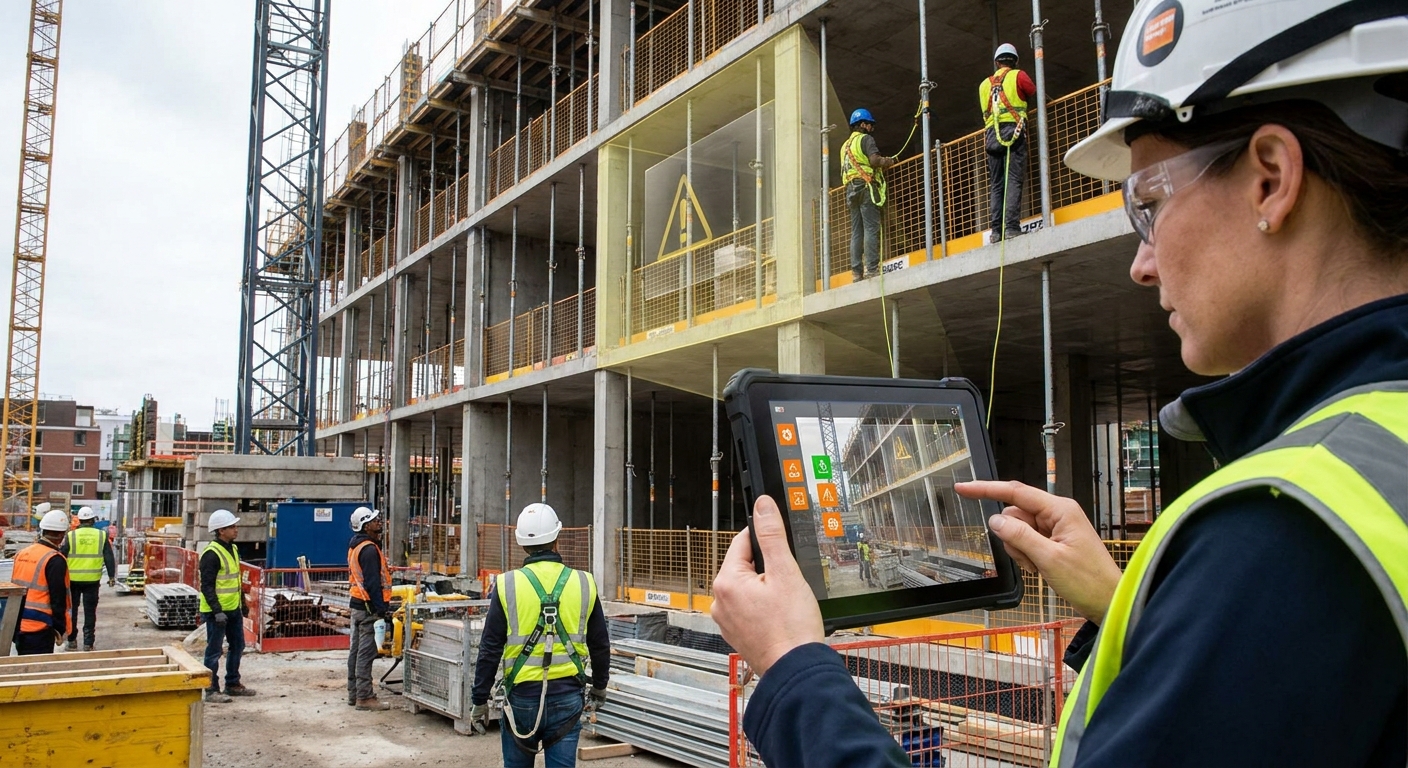
For example, AI can analyze near miss reports, equipment data, weather conditions, wearable signals, and task types to estimate where elevated risk may be forming. If repeated incidents occur around a certain access route, time of day, or subcontracted activity, the system can highlight the pattern before a serious injury occurs. It can also support visual detection, such as identifying missing protective equipment, unsafe proximity to hazards, or recurring housekeeping concerns in image feeds.
The benefit for site leadership is prioritization. Safety risks are numerous, and not every signal deserves the same level of urgency. AI can help rank risk exposure based on recurrence, severity patterns, and operating context. However, its role should remain advisory. Construction environments are too dynamic and ethically significant for blind trust in automated safety conclusions. Human validation is essential.
Equipment maintenance and utilization forecasting
Equipment is expensive, and equipment downtime often has ripple effects across labour, schedule, and subcontractor coordination. AI can improve equipment analytics by forecasting maintenance needs, identifying inefficient utilization, and spotting usage patterns associated with breakdown risk. This is especially valuable on projects where crane time, earthmoving equipment, lifts, or specialized machinery are tightly linked to critical path productivity.
Instead of relying only on fixed maintenance intervals or reactive repairs, project teams can use sensor and telematics data to predict when equipment is likely to need attention. That reduces sudden stoppages and improves planning. It also creates stronger cost intelligence. Underused equipment can be redeployed or off rented sooner, while overused assets can be protected before they fail at the worst possible moment.
For contractors managing multiple projects, utilization analytics can also inform fleet decisions across the portfolio. AI turns raw operational data into resource planning insight, which is exactly the kind of interpretation layer construction has often lacked.
AI, BIM, and the rise of the intelligence layer
Building Information Modelling has already transformed how many projects handle design coordination and digital representation. The next step is making BIM more analytically alive. A model is useful, but a model connected to schedule, cost, quality, permitting, and field performance becomes much more powerful. This is where AI starts to function as the intelligence layer on top of digital construction infrastructure.
In Canada, this direction is supported by broader digitalization efforts. The National Research Council of Canada has a Construction Sector Digitalization and Productivity Challenge program running from 2023 to 2029. NRC’s 2024 to 2025 work also includes a Centre of Excellence for Advanced Prefabrication and Digitalized Construction, along with support for standards aligned with ISO 19650 based BIM practices and digital tools for plans, permits, and virtual inspections. These are not abstract policy signals. They suggest that digital construction workflows are becoming part of national productivity strategy.
When AI is layered onto BIM, several use cases become stronger. Models can be checked against site imagery for progress verification. Quantity changes can be connected to procurement and cost risk. Design revisions can be compared to schedule exposure. Clash patterns can be analyzed to identify recurrent design coordination failures that delay field execution. AI can also support digital twins by helping teams interpret live performance data against the designed intent of the building or asset.
The practical effect is that BIM evolves from a reference environment into a decision environment. That is a meaningful shift for project managers and stakeholders who need clearer visibility across design, delivery, and operational performance.
Why prefabrication and modular construction fit naturally with AI analytics
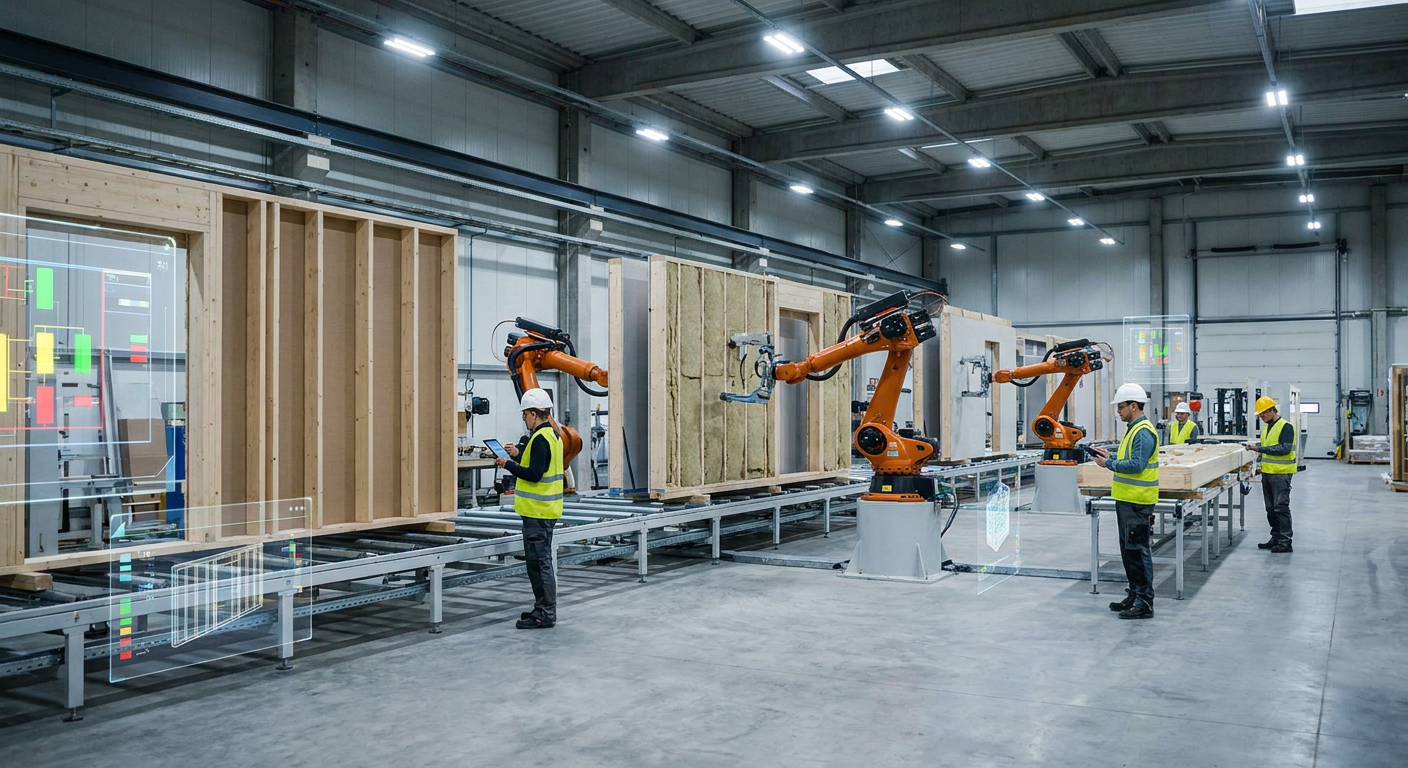
Prefabrication and modular construction are especially strong environments for AI because they generate repeatable processes and measurable data. Traditional site built construction can be variable and exposed to uncontrolled conditions. Prefabricated workflows, by contrast, often involve more standardized components, production sequences, quality checkpoints, and logistics coordination. That structure creates better data, and better data makes AI more effective.
In a prefab setting, AI can help optimize production schedules, forecast defects, monitor throughput, and align factory output with site readiness. If module production is ahead of transport capacity or site installation, inventory and staging costs rise. If it falls behind, site crews wait. AI can connect those variables and identify the most efficient flow. It can also support quality analytics by learning which process conditions or material patterns are associated with recurring defects.
This is one reason prefabrication is increasingly linked to productivity and decarbonization discussions. A digitalized production environment is easier to measure, optimize, and improve over time. In Canada, NRC’s focus on advanced prefabrication and digitalized construction reflects that logic. AI does not create industrialized construction on its own, but it can make industrialized workflows more intelligent and more responsive.
For stakeholders, the combination is attractive because it supports more predictable delivery. Better forecasting in prefabrication can improve schedule confidence, reduce waste, and enhance reporting quality. Those are core concerns for housing delivery and infrastructure projects under pressure to scale.
What stakeholders gain beyond the jobsite
Construction analytics is often discussed from the contractor perspective, but owners, developers, lenders, insurers, and public agencies also stand to gain significantly. Their needs are different from day to day site coordination. They want confidence that budgets are credible, risks are visible, schedules are realistic, and reporting is not hiding material drift. AI helps meet those needs by creating a more transparent analytical bridge between field activity and executive decision making.
For owners and developers, AI enhanced dashboards can improve milestone tracking, budget forecasting, and change trend interpretation. Instead of waiting for broad monthly summaries, they can review leading indicators. If a cluster of RFIs suggests design ambiguity in one system, or if image based progress lags behind reported completion in another, the owner sees it sooner. That supports earlier intervention and better governance.
For lenders and investors, AI can improve monitoring discipline. Construction finance depends on confidence in progress, cost to complete, and draw reliability. Analytics tools that compare visual progress, schedule status, and payment claims can reduce blind spots. They do not replace formal due diligence, but they can strengthen it with more timely evidence. That is especially useful on complex capital projects where information asymmetry is a common concern.
For public sector stakeholders, the appeal includes accountability, housing delivery, infrastructure resilience, and productivity improvement. If governments are investing in digital permitting, virtual inspections, BIM standards, and productivity challenge programs, AI analytics becomes part of a broader modernization agenda. Better information flow can help projects move with fewer avoidable delays while also supporting safety and compliance outcomes.
The productivity case is real, but not automatic
It is tempting to treat AI as a guaranteed productivity fix, especially in an industry under pressure to do more with constrained labour and capital. That would be a mistake. AI can contribute to better productivity, but only when it is implemented in the right operational context. A poor dataset, weak process discipline, and disconnected systems will not suddenly become high performance because a machine learning layer is added.
Still, the productivity case is real. Construction has structural inefficiencies tied to fragmented information, repeated coordination failures, and delayed interpretation of risk. AI addresses exactly those pain points. It can help teams spend less time gathering status and more time responding to it. It can help identify waste in sequencing, equipment use, document handling, and issue escalation. And when embedded properly into workflows, it can support more consistent decisions across projects and portfolios.
That is why the Canadian productivity backdrop matters. When labour productivity stalls and housing delivery becomes a policy priority, the sector needs tools that improve the intelligence of execution rather than merely increase reporting volume. AI is not the whole answer, but it is a meaningful part of the answer because it strengthens how decisions are informed.
The smartest use of AI in construction is not to automate judgment. It is to make judgment faster, clearer, and better supported by evidence.
This framing also helps avoid disappointment. Companies that expect instant transformation from a standalone AI product often struggle. Companies that treat AI as a layer inside better project controls, better data governance, and better digital workflows are far more likely to see value.
The risks construction firms should not ignore
AI in construction analytics comes with real risks, and serious firms should be explicit about them. The first is data quality. If site reports are inconsistent, cost codes are loosely managed, or schedule logic is unreliable, AI outputs will inherit those weaknesses. More data does not automatically mean better insight. In fact, bad data can create a dangerous illusion of confidence when polished dashboards hide weak inputs.
The second risk is overreliance. AI models can surface probabilities, detect patterns, and produce summaries, but they do not carry legal accountability or practical site experience. A project manager still has to decide whether a flagged issue is real, material, and actionable. A safety leader still has to verify whether a hazard alert reflects actual site conditions. A commercial manager still has to interpret contract exposure in context. Human review remains non negotiable.
The third risk is privacy and transparency, especially in safety and workforce monitoring. CCOHS has emphasized that AI outputs may be biased, opaque, or privacy sensitive. That matters if companies are using wearables, image analysis, or health related data. Teams need clear policies around consent, proportionality, access, and validation. Workers should understand what is being monitored, why it is being monitored, and how decisions are made from that information.
The fourth risk is implementation mismatch. Some firms buy broad AI tools without defining a specific use case, owner, workflow, or success metric. The result is often low adoption. In construction, the best AI deployments are targeted. They solve one clear problem, integrate with existing systems, and prove value before scaling. Ambition matters, but sequence matters more.
How to implement AI construction analytics in a practical way
Companies do not need to become software labs to benefit from AI. They need a disciplined implementation approach. The best starting point is a specific workflow where data exists, decisions are repetitive, and the cost of late interpretation is high. In many firms, that means progress reporting, schedule forecasting, document extraction, cost anomaly detection, or safety trend analysis. Starting with a focused use case makes it easier to define return on effort and gain user trust.
After selecting the use case, the next step is data readiness. That includes checking whether source systems are stable, whether naming conventions are consistent, whether project controls are disciplined, and whether the business can actually access the information needed for analysis. AI projects often fail not because the model is weak, but because the surrounding data environment is fragmented or poorly governed.
Then comes workflow design. A useful AI system should fit how people already work, not force entirely new habits without reason. If a project manager already reviews a dashboard each morning, the AI output should appear there. If a commercial team already works from cost reports and change logs, anomaly flags should connect to those tools. Adoption is strongest when AI feels like a practical extension of existing control systems rather than an extra layer of administration.
Validation is equally important. Before teams rely on forecasts or alerts, they should test the system against historical outcomes and live conditions. Which warnings are accurate. Which are noisy. Which blind spots remain. In construction, trust is earned through performance. People will use tools that consistently help them make better calls. They will ignore tools that generate generic or unreliable outputs.
Finally, governance should be formalized. Someone must own model performance, data quality, user training, and escalation when results are uncertain. AI is not a one time procurement exercise. It is an operational capability that needs maintenance and accountability.
Common misconceptions that hold the industry back
Several misconceptions continue to slow progress in AI construction analytics. The first is the fear that AI replaces professional judgment. In reality, the strongest systems augment people rather than displace them. Construction projects are too contextual, contractual, and dynamic for fully automated decision making. The goal is not to remove the project manager. The goal is to give the project manager sharper tools.
The second misconception is that AI is only relevant to megaprojects. Large capital programs certainly generate rich datasets, but smaller contractors can also benefit. Document extraction, schedule pattern detection, equipment maintenance forecasting, and basic safety analytics can create value on mid sized or even small projects if the tools are right sized and the workflow is clear. The threshold is not project size alone. It is whether the use case solves a real recurring problem.
The third misconception is that generative AI and construction AI are the same thing. They are not. Generative tools can be very helpful for summaries, drafting, and interface design, but much of the deeper value comes from predictive models, optimization logic, computer vision, and integrated analytics. Firms that focus only on chatbot style features may miss the more durable operational benefits.
The fourth misconception is that buying software is the same as becoming data driven. It is not. Real value depends on governance, integration, process discipline, and leadership willingness to act on the signals produced. AI cannot compensate for weak management basics. It can, however, amplify strong management practices dramatically.
Real world momentum is building
The broader market signals suggest that construction analytics is moving from experimentation toward implementation. Autodesk’s 2024 State of Design and Make research, based on a global survey of 5,399 industry leaders, futurists, and experts, identified AI, cost control, talent, and resilience as central themes. That combination is revealing. It suggests that organizations are not treating AI as a novelty. They are linking it to operating pressure and strategic performance.
In Canada, the momentum is also institutional. Rising business adoption of AI across the economy means the technology is becoming more mainstream in operational workflows. At the same time, federal and national research initiatives are tying digitalization, BIM, modular construction, and virtual inspections to larger goals around housing, productivity, and low carbon delivery. This is exactly the environment where AI construction analytics can become practical rather than experimental.
That does not mean every firm will move at the same speed. Construction remains a cautious industry for understandable reasons. Margins are thin, project conditions are variable, and operational disruptions are costly. But the direction is increasingly clear. The question is shifting from whether AI belongs in construction to how quickly firms can embed AI enabled interpretation into core workflows without creating confusion or unmanaged risk.
What the next few years will likely look like
Looking ahead, the most relevant change is not a single breakthrough tool. It is the gradual embedding of AI into everyday construction systems. BIM platforms will become more analytically responsive. Project controls dashboards will become more predictive. Permit and inspection workflows will become more digital. Prefabrication facilities will generate better operational feedback loops. Safety monitoring will become more pattern aware. And document heavy processes will become easier to search, summarize, and connect to live risk indicators.
For project managers, this means their role becomes more strategic, not less. As AI handles more scanning, structuring, and first pass interpretation, managers can focus more on tradeoffs, stakeholder alignment, recovery planning, and execution quality. For stakeholders, it means reporting becomes less about retrospective explanation and more about forward looking visibility. The best systems will not simply say what happened. They will help explain what is likely to happen next and why.
There will also be pressure for stronger standards. As AI touches more project decisions, firms will need clearer rules around model validation, data provenance, privacy, accountability, and interoperability. This is especially important in safety, public infrastructure, and regulated workflows. Maturity in construction analytics will come not just from better algorithms, but from better governance around how those algorithms are used.
In practical terms, the winners are likely to be firms that combine domain knowledge with digital discipline. Construction has always rewarded operational competence. AI does not change that. It raises the value of organizations that can capture, connect, and act on information more intelligently than their competitors.
Conclusion: AI as a decision support system for modern construction
Construction does not need more dashboards for their own sake. It needs clearer insight into what is changing, what is at risk, and what action matters most now. That is the real promise of AI construction analytics. By helping teams interpret schedules, costs, field reports, images, safety signals, and BIM related data faster, AI can improve the speed and quality of decision making across the project lifecycle.
The strongest case for AI in construction is not that it replaces people. It is that it helps people work through complexity with greater confidence and less delay. Project managers gain earlier warnings and cleaner reporting. Owners and investors gain stronger visibility into progress and risk. Safety teams gain better pattern detection. Prefabrication and digital construction workflows gain a smarter operational layer. In a sector facing productivity pressure, housing demand, and cost volatility, those advantages are increasingly hard to ignore.
Canada’s current trajectory reinforces the point. AI adoption across businesses is rising quickly, public institutions are investing in construction digitalization, and productivity challenges remain unresolved. That combination creates a practical opening for smarter analytics. The firms that move well will not be the ones chasing hype. They will be the ones using AI carefully, validating it rigorously, and embedding it where construction decisions are made every day.
In the end, the most important shift is conceptual. AI in construction is not best understood as a machine that builds. It is better understood as a system that helps people see the project more clearly. And in an industry where clarity is often the difference between control and drift, that is a meaningful transformation.


No Comment! Be the first one.