



Artificial intelligence has moved out of the experimental lab and into the daily workflow of modern businesses. What felt like a large enterprise advantage only a few years ago is now becoming more accessible to small and medium sized enterprises, often through cloud software, low code tools, and ready made automation platforms. For many business owners, the real question is no longer whether AI automation matters. It is how quickly they can apply it in ways that create measurable value.
Table Of Content
- Why AI Automation Matters More Now
- What AI Automation Actually Means in a Workplace
- Where SMEs Are Seeing the Fastest Wins
- The Productivity Case for SMEs
- Common Misconceptions That Hold Businesses Back
- How SMEs Should Approach Implementation
- The Role of Human in the Loop Controls
- Challenges SMEs Need to Prepare For
- Why Government Support and Infrastructure Matter
- What the Next Few Years Will Likely Look Like
- A Practical Framework for SME Leaders
- Questions every SME should ask before deploying AI automation
- Conclusion: AI Automation as the New Efficiency Layer
That shift matters because smaller firms have always had to compete with tighter budgets, leaner teams, and less margin for operational inefficiency. Large corporations can absorb delays, duplicate labor, and fragmented systems more easily than a growing company can. AI automation changes part of that equation by giving smaller organizations a way to increase output without hiring at the same pace, improve responsiveness without building large departments, and make smarter decisions without waiting for a full analytics team. It is not a shortcut to effortless growth, but it is becoming a meaningful competitive lever.
Recent Canadian data shows the momentum is already real. In the first quarter of 2024, about 9.3% of Canadian businesses were already using generative AI and another 4.6% planned to use it, creating a combined 13.9% adoption pipeline. In information and cultural industries, adoption was much higher at 24.1%, which suggests that some sectors are moving quickly from curiosity to practical use. Across OECD countries, firm level AI use has also risen sharply, reinforcing the idea that AI automation is now part of a broader economic transition rather than a niche technology trend. For small and medium sized enterprises, the opportunity is not about building their own frontier models or matching the research budgets of global companies. It is about identifying repeatable work that consumes time, introduces delays, or creates avoidable errors, then applying the right AI tools with clear oversight.
That can mean automating customer inquiry triage, document drafting, invoice processing, lead qualification, scheduling, internal search, marketing support, and management reporting. These are not glamorous experiments. They are operational improvements that help smaller businesses behave with the speed and structure of much larger organizations.
This article explores how AI automation is transforming modern workplaces through a practical SME lens. It looks at where the strongest gains are appearing, why implementation often works best when it starts narrow, what misconceptions still slow businesses down, and how companies can introduce AI responsibly without losing control of quality or trust. The main idea is simple: AI automation is no longer just a technology story. It is a productivity story, a competitiveness story, and increasingly a survival story for ambitious smaller firms.

Why AI Automation Matters More Now
Many business technologies arrive with heavy marketing and modest impact. AI automation is different because it connects directly to the daily mechanics of work. It affects how information is captured, how decisions are supported, how tasks move between people, and how quickly a business can respond to customers. That makes it less like a single software category and more like an intelligence layer that sits across functions.
There is also a timing advantage for SMEs right now. Large enterprises still have scale, but they also have legacy systems, procurement complexity, and organizational friction. Smaller firms can often move faster when a tool is easy to deploy and a process is clearly defined. If a mid sized company can automate proposal drafting, lead routing, support summaries, and weekly performance reporting in a few months, it may close part of the efficiency gap that once favored larger competitors.
Research supports this urgency. McKinsey reported in 2024 that 65% of surveyed organizations said they were regularly using generative AI. That matters not because every use case is mature, but because it shows that adoption has moved beyond experimentation in many organizations. Businesses are increasingly putting AI into production in months rather than years, especially in marketing and sales, product and service development, and IT. The competitive risk for SMEs is no longer just adopting too early. It is adopting too late and discovering that faster rivals have reset customer expectations.
In Canada, the policy environment is also becoming more supportive. Federal commitments to AI investment, skills, safety, and compute access are lowering some of the barriers that historically limited smaller firms, especially around expertise and infrastructure. Programs focused on helping SMEs adopt and adapt AI solutions suggest that governments now see AI diffusion as part of broader economic development. In practical terms, that means more support for training, experimentation, implementation, and trusted access to tools.
What AI Automation Actually Means in a Workplace
One reason AI automation is misunderstood is that the term covers several different technologies. Some tools generate text, images, or summaries. Some classify documents or extract information from them. Some route tasks based on patterns or predicted urgency. Others connect software systems so that work can move automatically once certain conditions are met. In a modern workplace, AI automation usually works best when these capabilities are combined rather than treated as isolated features.
A useful distinction is between generative AI and workflow automation. Generative AI can draft a client email, summarize a meeting, or produce a first version of a sales proposal. Workflow automation decides what happens next, such as sending the proposal for approval, updating the CRM, notifying the sales team, and logging the activity for reporting. When businesses confuse the two, they either expect too much from a chatbot or too little from a broader automation strategy. The real value often comes from linking AI output to operational flow.
For SMEs, this usually means starting with software they already use. An accounting platform may support invoice capture and categorization. A customer service system may offer AI assisted response suggestions and triage. A document platform may summarize contracts or extract fields from forms. A knowledge management tool may allow staff to search internal policies using natural language. None of these requires a company to become an AI developer. They require the business to understand its own processes well enough to know where delays and friction are most expensive.
That is why successful AI automation tends to begin with a simple question: Where are people spending time on work that is repetitive, rules based, and high volume, but still important enough that mistakes create real cost? The answer often reveals a better starting point than broad strategic language ever will.
Where SMEs Are Seeing the Fastest Wins
Small and medium sized businesses usually gain the most from AI automation when they target workflows that are frequent, structured, and measurable. Customer service is one of the clearest examples. Many incoming requests involve common questions, account lookups, routing decisions, and response templates. AI can classify the issue, suggest a response, retrieve knowledge base content, and escalate only the more complex cases to staff. The result is not a fully automated support function. It is a faster front line with better consistency and less manual sorting.
Finance and administration offer another strong use case. Invoice processing, expense categorization, payment reminders, and monthly reconciliation are all areas where employees often spend hours moving information between systems. AI assisted document extraction combined with workflow automation can reduce data entry, flag anomalies, and shorten processing cycles. For a smaller firm, even modest savings in administrative time can free up capacity for customer work, sales, or operational planning.
Marketing and sales are also moving quickly because generative AI is especially useful for content drafting, campaign variation, lead scoring, CRM updates, and follow up support. A lean marketing team can use AI to create first drafts of email copy, social posts, ad variants, landing page text, and customer segment summaries. A sales team can automate meeting notes, proposal outlines, and lead qualification prompts. Used well, this does not replace the human voice of the business. It reduces the blank page problem and accelerates execution.
Internal reporting is one of the most underrated opportunities. Many SMEs have data spread across accounting systems, CRM platforms, project tools, spreadsheets, and customer support software. Managers spend valuable time stitching together weekly updates, KPI summaries, pipeline snapshots, and performance reviews. AI assisted dashboards and query tools can simplify reporting and improve decision support, especially when paired with strong definitions for the metrics that matter most.
Common high value workflows often include the following:
- Customer inquiry triage and response drafting
- Invoice capture, coding, and exception handling
- Lead qualification and sales follow up preparation
- Scheduling and calendar coordination
- Contract and document summarization
- Internal knowledge search and policy retrieval
- Weekly operational reporting and KPI summaries
- Marketing content production and campaign testing
The key pattern is that these functions exist in almost every industry. AI automation is not limited to software companies or research intensive firms. Retailers, service businesses, manufacturers, agencies, logistics providers, healthcare offices, real estate teams, and professional services firms all have repeatable workflows that can benefit from automation.

The Productivity Case for SMEs
AI automation is often framed in dramatic terms, but the most useful business lens is productivity. Smaller firms rarely need theoretical transformation. They need to process work faster, reduce avoidable errors, respond more consistently, and increase the output of existing staff. That is why the connection between AI adoption and productivity is so important. Statistics Canada has linked AI adoption with firm labor productivity and has framed diffusion as relevant to the country’s broader productivity challenge.
OECD analysis also indicates that AI adoption can significantly boost firm productivity and that top performing firms often show much higher adoption rates than less productive peers. This does not mean AI automatically creates gains by itself. It means productive firms tend to find better ways to integrate technology into decision making and workflow design. For SMEs, that is an encouraging signal because it suggests productivity improvement is less about company size alone and more about operational discipline.
Consider what happens when a ten person company saves one hour per employee each day from better automation, search, drafting, and reporting. That can translate into meaningful weekly capacity without adding headcount. If customer response times fall, invoice cycles tighten, and managers spend less time preparing updates manually, the impact compounds. Speed improves service. Better data supports faster decisions. Staff can focus on exceptions, relationships, and higher value tasks rather than repetitive processing.
In that sense, AI automation is not just a cost reduction tool. It can also improve revenue generation. Faster quote creation can help win deals. Better lead triage can improve conversion. More reliable follow up can reduce drop off in the sales pipeline. More responsive support can improve retention. Productivity in modern workplaces is tightly connected to customer experience, not just internal efficiency.
For most SMEs, the most valuable AI project is not the most advanced one. It is the one that saves time every day, reduces friction every week, and improves decisions every month.
Common Misconceptions That Hold Businesses Back
One of the biggest misconceptions is that AI automation is only realistic for companies with large budgets and dedicated data science teams. In reality, many useful implementations now come through tools that are already embedded in widely used business software or available through subscription platforms. An SME may not need custom model development at all. It may need better workflow mapping, a small implementation budget, and a manager who can define success clearly.
Another common misunderstanding is that generative AI equals full automation. It does not. A model that drafts text or summarizes documents is only one part of the system. Business automation usually requires approvals, conditions, escalations, records, and integration with existing tools. The strongest results typically come from combining AI with process design, not from expecting a single prompt driven interface to run an entire operation.
There is also a persistent fear that AI automation always means replacing people. In most current SME scenarios, the more realistic outcome is augmentation. Employees spend less time on repetitive setup work, first drafts, manual categorization, and information retrieval, then more time on judgment, customer interaction, quality control, and problem solving. Some roles will change, and some tasks will shrink, but the near term value often comes from reallocating time rather than eliminating staff entirely.
Another misconception is that AI is mainly relevant to technology companies. The opposite is increasingly true. Non technical business functions are often where the fastest deployment happens because the workflows are common and the software ecosystem is mature. Customer service, finance, HR, marketing, operations, logistics, and administration all contain structured processes that lend themselves well to automation.
Finally, many firms underestimate the importance of oversight. AI outputs can be inaccurate, incomplete, biased, or poorly timed if the surrounding process is weak. Responsible deployment requires policies for sensitive data, role based access, review rules, and clear accountability for decisions. The OECD AI Principles emphasize trustworthy, human centered, and accountable use for a reason. Businesses that ignore governance often discover that speed without control creates new risk instead of real improvement.
How SMEs Should Approach Implementation
The most effective AI automation programs usually begin with process selection, not tool selection. Before comparing vendors or licenses, a business should identify a workflow with high volume, clear rules, visible pain points, and measurable outcomes. That could be support triage, onboarding paperwork, report generation, invoice processing, or sales follow up preparation. The right starting point is often narrow enough to manage but important enough to matter.
Once a candidate workflow is selected, the next step is to map it in detail. Who does what today. What information is needed. Where does work get delayed. Which steps are repetitive. Which steps require judgment. Which mistakes are most costly. This exercise often reveals that only certain parts of a process should be automated while other parts should remain human reviewed. That is exactly what a practical implementation should uncover.
Then the business can define success metrics. For SMEs, good early metrics usually include time saved, response speed, throughput, error reduction, rework reduction, customer satisfaction, and employee adoption. If the business cannot measure whether the process improved, it will struggle to know whether the automation should be expanded. Early wins need evidence, not just enthusiasm.
A sensible implementation path often looks like this:
- Select one workflow with high volume and clear pain
- Map the current process and identify repeatable steps
- Choose off the shelf tools that integrate with existing systems
- Define where human review is mandatory
- Run a pilot with clear metrics and a limited user group
- Measure results and document failures as well as gains
- Refine prompts, rules, and permissions
- Expand only after the process is stable and trusted
This approach helps SMEs avoid a common trap, which is trying to automate too much too quickly. AI automation delivers the best results when it is operationalized with discipline. A narrow pilot that works is far more valuable than a broad initiative that confuses staff and weakens trust.
The Role of Human in the Loop Controls
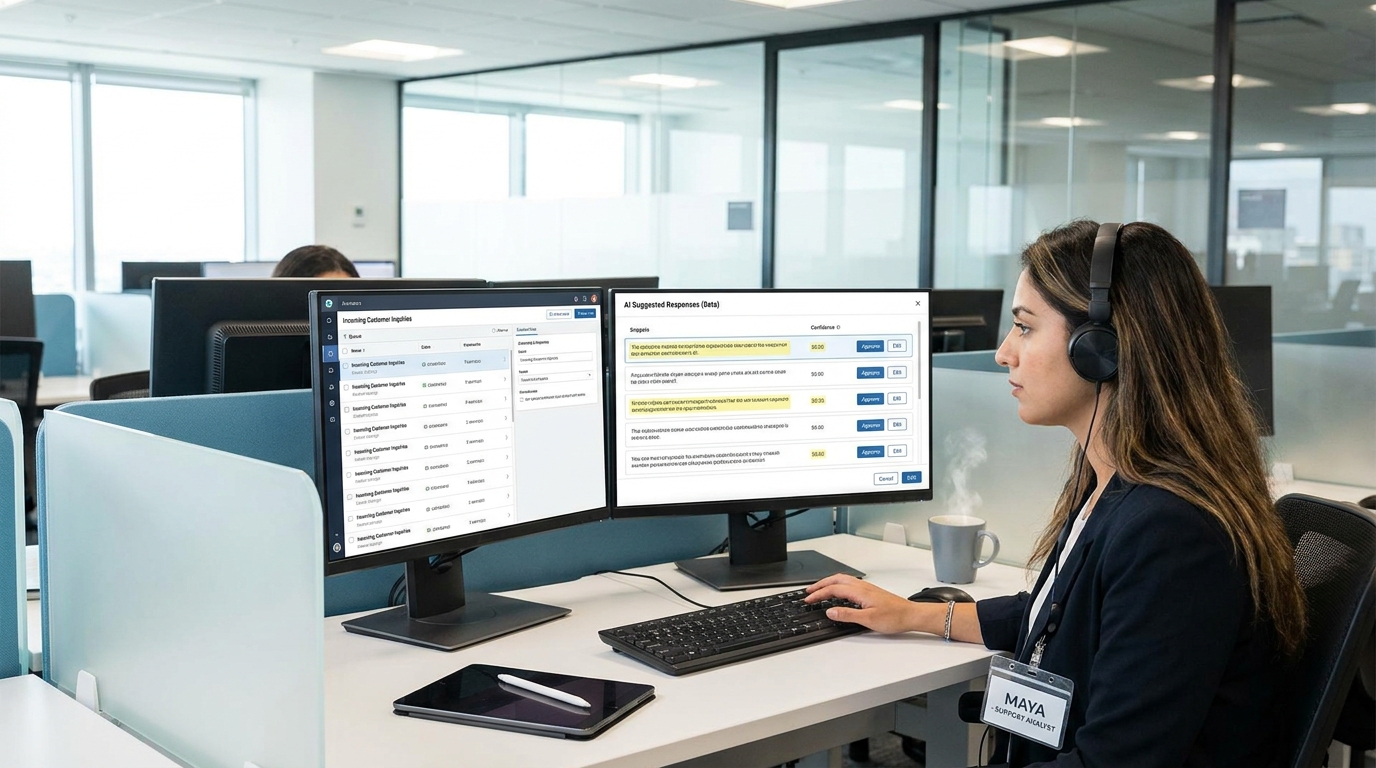
Human in the loop governance is one of the most important ideas in practical AI automation. It means that AI can assist, suggest, classify, summarize, or trigger action, but people remain responsible for reviewing outputs where risk, ambiguity, or sensitivity is high. For SMEs, this model is especially useful because it balances efficiency with trust. It also reduces the fear that automation requires handing over control to a system that may not fully understand context.
Not every task needs the same level of review. A low risk internal summary might be allowed to flow with minimal checks. A customer refund decision, contract clause summary, hiring recommendation, or compliance related message may require formal approval. The point is not to slow everything down. It is to match the level of oversight to the level of business risk.
Good human in the loop design usually includes explicit review triggers. For example, if an AI system has low confidence in a document classification, if a customer complaint includes certain keywords, or if a financial amount crosses a threshold, the item is automatically routed to a person. This makes the process more scalable than pure manual review while still protecting quality. It also creates useful data about which scenarios are easy to automate and which still require stronger human judgment.
SMEs should treat this as a strength, not a compromise. The goal is not to imitate a fully autonomous system for branding value. The goal is to build a process that staff trust and customers experience as reliable.
Challenges SMEs Need to Prepare For
AI automation is practical, but it is not frictionless. Data quality is often the first challenge. If customer records are inconsistent, documents are stored chaotically, or metrics are defined differently across teams, AI tools may produce weak outputs because the underlying information is weak. In that sense, automation often reveals process problems that already existed. It does not create them, but it makes them harder to ignore.
Integration is another common obstacle. Smaller firms may use a patchwork of software adopted over several years, with varying levels of compatibility. An AI tool that works well on its own may deliver limited value if it cannot connect to the CRM, finance platform, help desk, or file system where work actually happens. This is why low code and no code automation platforms have become so important. They allow smaller organizations to connect systems without full custom development, though the design still needs care.
Skills and change management also matter more than many leaders expect. Staff need to know when to rely on AI, when to question it, how to protect sensitive information, and how success will be measured. Resistance often appears when automation is introduced as a mysterious top down directive rather than a practical solution to everyday frustrations. People adopt tools more readily when they can see how those tools remove low value tasks and improve performance fairly.
Cybersecurity and privacy cannot be treated as secondary concerns. Businesses need to know where data is going, how it is stored, which users have access, and whether prompts or documents are being used to train external models. These questions are especially relevant in regulated sectors or any workflow involving customer, financial, legal, or employee information. Trustworthy adoption depends on answering them before scale increases.
Why Government Support and Infrastructure Matter
One reason this moment is different from earlier technology waves is that public policy is now actively shaping SME access to AI. Canada has committed significant funding to AI development, adoption, skills, and safety, including initiatives that lower the barriers facing smaller firms. Support for compute access is particularly notable because advanced infrastructure has traditionally been concentrated among larger organizations and specialized technology players.
For SMEs, these investments matter less as abstract national strategy and more as practical leverage. Better access to training, adoption programs, and implementation support can reduce the risk of getting started. It can also help firms make more informed choices about vendors, governance, and use case prioritization. If a smaller company can gain access to trusted guidance and domestic infrastructure, it becomes easier to adopt AI without feeling dependent on opaque systems or inaccessible expertise.
The discussion around sovereign or domestic AI infrastructure is also becoming more relevant. As businesses rely more heavily on AI for operational decisions, concerns about cost stability, security, resilience, and jurisdiction grow. Smaller firms may not think about infrastructure strategy first, but over time it will shape what services are available, how affordable they remain, and how comfortable businesses feel using them for sensitive work.
What the Next Few Years Will Likely Look Like
The biggest trend is the move from pilot projects to operational deployment. Organizations are becoming less interested in one off experiments and more interested in repeatable, governed systems that create measurable business value. That trend favors SMEs that can act with clarity. A small company that deploys three useful automations with clear ownership may generate more value than a larger one still trapped in endless exploration.
Another likely development is that AI capability will become more deeply embedded in existing business software. Instead of buying a separate AI strategy in every category, firms will increasingly encounter AI features inside the tools they already use for sales, finance, HR, support, and operations. This will lower barriers further, but it will also require more discipline around which features are actually useful and which simply add noise.
Workforce upskilling will become a defining advantage. Businesses that teach staff how to evaluate AI outputs, improve prompts, understand workflow logic, and monitor risk will get more value than those that treat AI as a black box. In practice, the future workplace will reward employees who can work alongside intelligent systems while applying judgment where context matters most. That is especially true in smaller companies where each person often spans multiple responsibilities.
Over time, competitive differentiation may come less from whether a business uses AI at all and more from how well it integrates AI into operations. Two firms can buy similar tools, but one may redesign workflows, train staff properly, track metrics, and improve continuously. The other may simply switch features on and hope for productivity. The gap between those outcomes can be substantial.
A Practical Framework for SME Leaders
Leaders who want to move from interest to action can use a simple framework. First, identify one process where volume is high and quality matters. Second, determine which steps are repetitive and which require human judgment. Third, test a tool that fits existing systems rather than forcing a major platform change. Fourth, establish rules for review, privacy, and accountability. Fifth, measure the results honestly and decide whether to scale.
This practical mindset is important because AI automation works best when it is treated as an operating improvement, not a branding exercise. A business does not need to announce that it is AI first to benefit from AI. It needs faster processes, clearer information flow, and better use of employee time. If automation helps achieve those outcomes, then the strategy is working.
It is also wise to think in stages. Early stage adoption should focus on efficiency and consistency. Middle stage adoption can expand into decision support, forecasting, and cross functional reporting. Later stage adoption may include more advanced personalization, predictive models, and deeper workflow orchestration. This staged progression helps SMEs build confidence while avoiding unnecessary complexity too early.
Questions every SME should ask before deploying AI automation
- Which workflow currently wastes the most time each week
- Where do errors create the highest financial or customer cost
- What data does the process depend on, and is it reliable enough
- Which outputs must be reviewed by a person before action
- How will we measure time saved, quality change, and employee adoption
- What privacy, security, and access rules must apply from the start
These questions are simple, but they create discipline. They keep the focus on operations and business value rather than novelty alone.
Conclusion: AI Automation as the New Efficiency Layer
AI automation is changing modern workplaces because it reduces the distance between information and action. It helps businesses find patterns faster, process routine work more efficiently, and support decisions with less manual effort. For small and medium sized enterprises, that shift is especially important because every hour, every process, and every employee decision carries visible weight.
The strongest message for SMEs is not that they need to become AI companies. It is that they can become better run companies through targeted AI adoption. The most effective path is usually narrow at first: choose a workflow, automate the repeatable parts, maintain human oversight where it matters, and measure results carefully. From there, the gains can expand across teams and functions.
Current data shows that adoption is rising, productivity benefits are becoming harder to ignore, and government support is making access easier. At the same time, trustworthy use, governance, and workforce skills are becoming more important. That combination creates a clear strategic moment. Smaller businesses do not need to outspend larger corporations to compete more effectively. They need to move intelligently, implement practically, and use AI automation to build the kind of speed, consistency, and insight that modern markets increasingly reward.
In the years ahead, the businesses that win will not necessarily be the ones with the biggest AI budgets. They will be the ones that understand where intelligence belongs inside the workflow, where humans add the most value, and how to turn technology into everyday operational advantage. For SMEs, that is not a distant future. It is already starting now.



No Comment! Be the first one.