



Computer vision is one of those technologies that many people use every day without naming it. It unlocks phones with a glance, helps organize photo libraries, supports quality checks in factories, and assists clinicians reviewing medical scans. The phrase sounds technical, but the core idea is surprisingly intuitive. It is the part of artificial intelligence that allows machines to interpret images and video, then turn that visual input into information that can drive a decision, an alert, or an action.
Table Of Content
- What Computer Vision Actually Means
- How AI Turns Images Into Meaning
- Where You Already Encounter Computer Vision Every Day
- How Computer Vision Is Reshaping Work
- The Most Important Applications to Know
- Why the Current Wave Feels Different
- The Limits of Computer Vision That People Should Understand
- Why Data Quality, Bias, and Trustworthiness Matter So Much
- Computer Vision and the Future of Everyday Life
- Questions People Should Ask Before Trusting a Vision System
- Final Thoughts
What makes computer vision so important today is not just the science behind it, but how deeply it is woven into modern life and work. Visual data is everywhere. Cameras are embedded in phones, cars, warehouses, hospitals, retail stores, farms, and public infrastructure. As a result, organizations increasingly need systems that can make sense of what those cameras capture at speed and at scale. That demand has pushed computer vision from a specialized research area into a practical layer of the digital economy.
For readers trying to understand what is actually happening under the surface, one useful framing is this: computers do not see the way humans see. They do not look at a street and instantly understand a child crossing, a cyclist approaching, or a familiar face in a crowd in the rich, contextual sense that people do. Instead, they convert visual signals into numerical representations, compare patterns learned from training data, and output predictions such as pedestrian, stop sign, fracture likely, or package detected. That difference matters because it explains both the power and the limitations of computer vision.
This article explores how computer vision works, why it has become so relevant to daily routines and the workplace, where it is already making an impact, and what the next wave of innovation may look like. It also addresses the common misconceptions that surround AI vision systems, especially the idea that they possess a human-like understanding of the world. In reality, computer vision is both highly impressive and highly specific. It can be remarkably accurate in narrow settings, yet fragile when the real world changes in ways its training data did not anticipate.
Computer vision does not literally replicate human sight. It transforms pixels into mathematical features that models can classify, detect, segment, track, and analyze.
What Computer Vision Actually Means
Computer vision is a branch of artificial intelligence focused on interpreting visual information such as still images, live video, medical scans, satellite imagery, and security footage. A system receives data from a camera or sensor, processes it, and looks for patterns that matter for a given task, from identifying whether an image contains a cat to measuring whether a manufactured part has a defect. Core computer vision tasks include image classification, which assigns a label to an entire image; object detection, which locates specific items within a frame; image segmentation, which labels individual pixels or regions; and optical character recognition (OCR), which extracts text from images and scanned documents. Other capabilities include pose estimation, action recognition, and tracking objects across video. Together, these tasks let machines convert raw visual data into structured information that can drive a decision, an alert, or an action — the essential job of computer vision in any real-world system.
These functions matter because visual tasks in the real world are rarely simple. A smartphone app might need to recognize a face under low light. A warehouse robot might need to avoid people while locating cartons on a shelf. A vehicle assistance system might need to detect lane markings in rain. In each case, the machine is not just labeling a picture. It is converting visual data into a usable interpretation of a scene, often in real time.
Modern computer vision is closely connected to machine learning and deep learning. Traditional image processing methods still exist and remain useful in some products, especially when the task is tightly structured. But many of today’s most capable systems rely on neural networks trained on very large datasets. These models learn statistical relationships between visual patterns and desired outputs. That is why data quality is so central. If the training examples are incomplete, biased, or poorly labeled, the resulting vision system will inherit those weaknesses.

How AI Turns Images Into Meaning
To understand why computer vision feels almost magical at times, it helps to break the process into stages. An image begins as raw pixel data. Each pixel contains numerical information about brightness and color. To a human, that immediately resolves into meaningful shapes and objects. To a machine, it begins as a grid of values. The challenge is turning those values into features that a model can use to make a reliable prediction.
In many modern systems, deep learning models analyze visual patterns across multiple layers. Early layers may capture simple structures such as edges, corners, and textures. Deeper layers combine those features into more abstract representations, such as wheels, eyes, windows, or road boundaries. Over time, with enough training data, the model becomes better at mapping visual signals to categories or actions. This is why large datasets and extensive training have been so important to progress in the field.
Computer vision systems also vary by context. A model trained to classify pets in social media photos is very different from a system designed to identify defects in steel components or support radiology review. The stakes, the data types, and the tolerance for error all change. In a casual consumer app, a wrong suggestion may be mildly annoying. In healthcare or public safety, a missed detection can have serious consequences. This is one reason why trustworthiness, testing, and monitoring matter as much as benchmark accuracy.
Recent research has improved how models handle detail. Work reported by MIT in 2024 showed that recovering higher resolution visual features can improve object detection, depth prediction, and interpretability. That may sound abstract, but the practical implication is straightforward. Better visual representations can help models preserve fine details that matter in real scenes, whether that means distinguishing small road hazards, identifying subtle medical patterns, or improving a robot’s understanding of object boundaries.
At the same time, progress has not erased every gap between machines and people. MIT researchers also reported in 2024 that some AI vision models still lag human performance on peripheral vision tasks. Humans are very good at interpreting context outside the center of direct focus, especially in dynamic environments. That finding is a useful reminder that AI can outperform people in narrow visual tasks while still falling short in other aspects of perception that we take for granted.
Where You Already Encounter Computer Vision Every Day
One reason computer vision deserves attention beyond technical circles is that most people already interact with it constantly. Smartphones are the easiest place to start. Face unlock, portrait effects, photo search, automatic tagging, document scanning, and translation from a camera feed all depend on machine vision. When a phone recognizes a receipt, finds every picture of a beach, or stabilizes a video around a moving subject, computer vision is doing the work quietly in the background.
Retail is another familiar environment. Vision systems are used to monitor shelf inventory, reduce checkout friction, scan items, and analyze in-store traffic patterns. In some cases, the technology supports assisted checkout rather than full automation. In others, it helps store operators understand where congestion happens, which displays attract attention, and when stock needs replenishing. Consumers may notice convenience. Operators see labor efficiency, data, and faster decisions.
Transportation offers some of the most visible examples. Driver assistance systems rely on computer vision to detect lanes, signs, vehicles, and pedestrians. Transit and traffic systems may use vision for monitoring and safety. Delivery companies and logistics operators use it to identify parcels, verify loading steps, and improve routing workflows. Even when a fully autonomous system is not involved, visual AI is often part of the perception layer that makes mobility systems more informed.
Home security is also increasingly vision driven. Cameras can distinguish people from animals, identify package deliveries, and trigger alerts based on specific motion patterns. These systems are marketed as convenience products, but they also reveal a broader trend. Computer vision is becoming a standard interface between the physical world and digital decision making. The camera no longer only records. It interprets.
For office workers and knowledge professionals, the use cases are less obvious but still significant. OCR extracts text from scans and invoices. Vision tools classify documents, flag compliance issues, and connect images to searchable databases. In hybrid workplaces, visual AI can support access control, occupancy analysis, and equipment monitoring. The technology is no longer confined to labs, factories, or security settings. It has become part of the invisible infrastructure behind administrative work as well.
How Computer Vision Is Reshaping Work
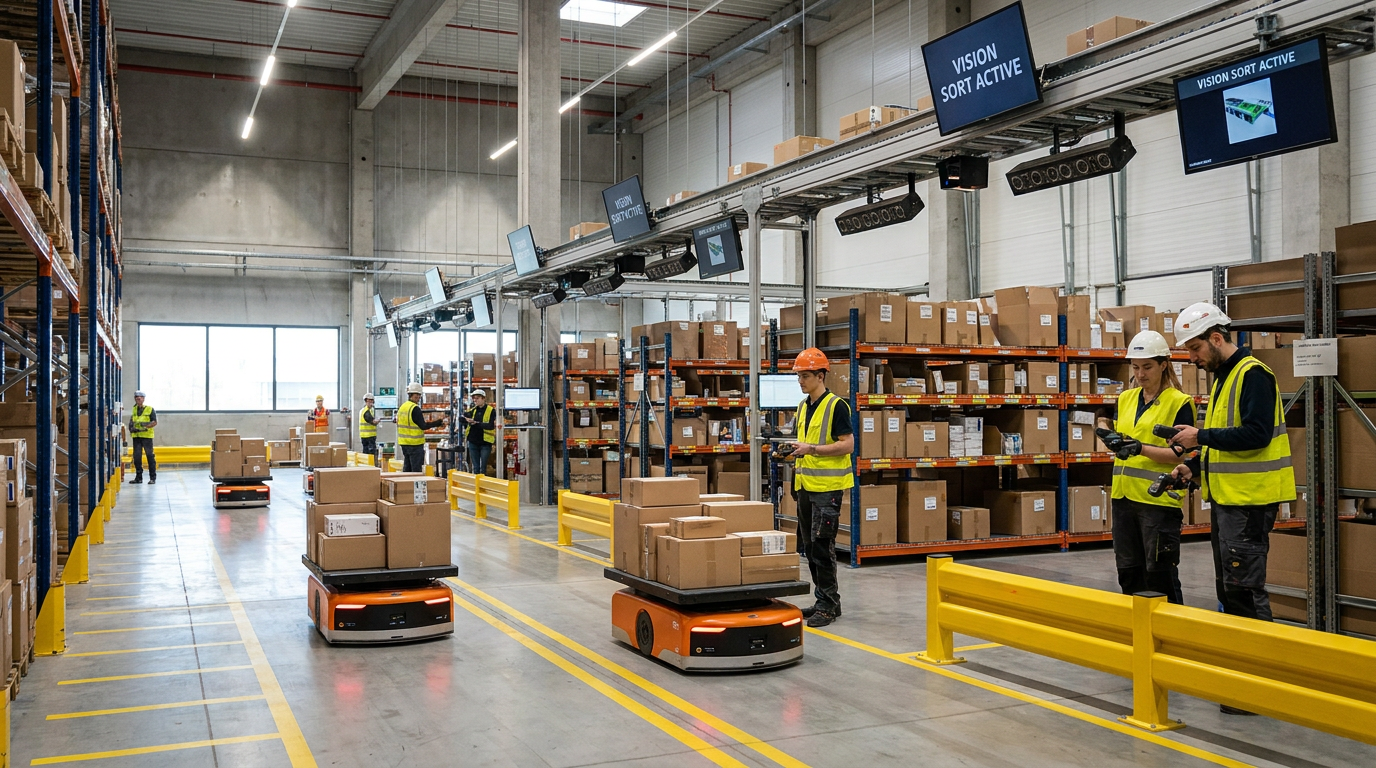
In the workplace, computer vision often succeeds because it handles repetitive visual tasks at a scale that humans cannot maintain consistently for long periods. Factories are a strong example. Automated inspection systems can check products for cracks, misalignment, contamination, color variation, or missing components with speed and consistency. Instead of replacing every human role, these systems often shift people toward exception handling, oversight, process tuning, and root-cause analysis.
Warehousing and logistics have become especially active areas. Facilities use visual AI to scan barcodes, read labels, count inventory, and guide robots through storage environments. Cameras combined with machine learning help identify packages, optimize sorting, and improve worker safety by monitoring shared zones where humans and machines move together. The result is not just faster throughput. It is a more measurable operation where visual events become data for planning and forecasting.
Construction, property technology, and urban operations are also beginning to benefit from this shift. Vision systems can monitor site progress, document conditions, detect safety gear compliance, and identify anomalies in infrastructure. For an industry like real estate, which increasingly depends on data-rich workflows, computer vision adds a new kind of intelligence layer. It can transform photos, inspections, drone imagery, and video streams into operational signals rather than static records.
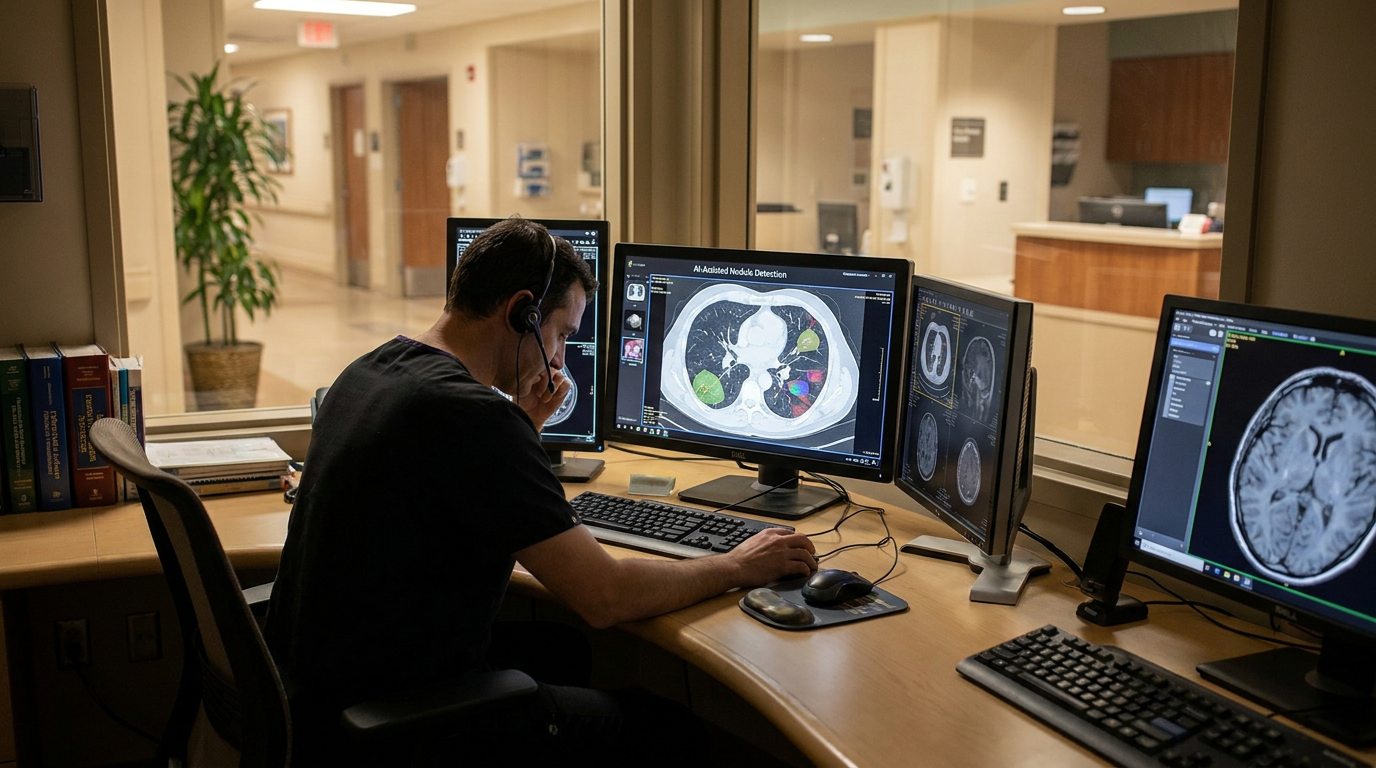
Health care is one of the most consequential domains. Computer vision can help clinicians review X-rays, CT scans, MRIs, pathology slides, and dermatology images. It does not replace medical judgment, but it can support triage, highlight suspicious regions, and reduce some routine burden. In settings with high imaging volume, that assistance matters. It can improve consistency, speed, and prioritization when used carefully and validated rigorously.
The Most Important Applications to Know
It is useful to group computer vision applications into a few broad categories because the field is so wide. Some use cases are consumer facing and familiar. Others sit deep inside industrial systems that people rarely see. Together, they show how visual AI has moved from novelty to infrastructure.
- Consumer devices: face unlock, photo organization, augmented reality filters, document scanning, translation, and accessibility features.
- Retail and commerce: shelf monitoring, checkout assistance, demand observation, inventory counting, and loss prevention support.
- Transportation: driver assistance, traffic monitoring, fleet safety, parcel verification, and navigation support.
- Healthcare: imaging analysis, triage support, pathology review, dermatology screening, and workflow prioritization.
- Manufacturing and industry: quality inspection, defect detection, predictive maintenance signals, and worker safety monitoring.
- Robotics and automation: object recognition, scene understanding, manipulation, navigation, and collaborative robot operation.
- Agriculture and remote sensing: crop analysis, yield monitoring, land mapping, and environmental observation.
IBM has highlighted applications across agriculture, autonomous vehicles, healthcare, robotics, and even space exploration. That breadth matters because it shows the technology is not tied to one sector or one style of product. It is a general capability for extracting structure from visual information. Once a workflow depends on images or video, computer vision becomes a candidate tool.
In Canada and across North America, the topic is particularly relevant because research and public sector interest continue to intersect with practical adoption. Transportation, healthcare, remote sensing, and industrial operations are all active areas. For readers, that means computer vision is not a distant concept imported from science fiction. It is already influencing services, workplaces, and infrastructure much closer to home.
Why the Current Wave Feels Different
Computer vision has existed for decades, but recent progress has made the field feel qualitatively different. One reason is the rise of larger models that connect visual understanding with language. Instead of treating an image as a narrow classification task, vision-language models can describe scenes, answer questions about images, relate pictures to text, and support richer multimodal workflows. This broadens the usefulness of computer vision from pure detection toward more flexible reasoning interfaces.
Stanford HAI’s 2025 and 2026 AI Index materials show that computer vision remains an active benchmark area with continued gains in model performance. Those reports also note changing gaps between open and proprietary models, which matters for businesses deciding whether to build on open ecosystems or commercial stacks. To a general reader, the practical takeaway is simple: progress in visual AI is ongoing, competitive, and not limited to one company or one model family.
Efficiency is another major trend. Powerful models are valuable, but only if they can be deployed where they are needed. That is why edge AI has become so important. Instead of sending every image to the cloud, some systems now process visual data directly on a phone, camera, vehicle, robot, or industrial device. This can reduce latency, lower bandwidth needs, improve privacy in some settings, and make real-time applications more practical.
Sensor fusion is also changing what vision systems can do. A camera alone may struggle in fog, low light, or cluttered scenes. But when visual data is combined with inputs from lidar, radar, thermal sensors, GPS, or depth sensors, the system can build a richer picture of the environment. This is especially relevant in vehicles, robotics, and industrial safety systems, where no single sensor is sufficient in all conditions.
Synthetic data has emerged as another important development. Collecting and labeling massive real-world datasets is expensive and sometimes difficult, especially in rare or hazardous scenarios. Synthetic images and simulated environments can help fill gaps, expand diversity in training examples, and speed up development. They are not a perfect substitute for real-world validation, but they have become an increasingly useful part of the modern computer vision toolkit.
The Limits of Computer Vision That People Should Understand
For all its strengths, computer vision is often misunderstood. The first misconception is that it represents general intelligence. It does not. A system may excel at detecting defects on a production line or recognizing handwritten text, yet remain useless outside that specific scope. It is accurate to think of computer vision as highly specialized pattern recognition, not broad understanding.
The second misconception is that a strong demo means a system is ready for the real world. In practice, computer vision models can be brittle. Lighting changes, camera angles shift, weather interferes, motion blur appears, and background clutter increases. A model that performs beautifully in controlled tests may degrade significantly in operational settings. This is where distribution shift becomes important. When the real-world data no longer resembles the training data, performance can fall quickly.
Another common misconception is that facial recognition defines the field. Facial recognition is only one application, and often a controversial one. Computer vision is much broader. It includes OCR, object detection, segmentation, pose estimation, robotics perception, medical imaging support, and many other tasks that have nothing to do with identifying individuals. Narrowing the public conversation to facial recognition alone obscures both the field’s diversity and its practical value.
It is also wrong to assume that modern computer vision is only deep learning. Deep learning dominates many cutting-edge systems, but classical image processing and hybrid pipelines still matter. In tightly constrained industrial settings, simpler methods can be more efficient, interpretable, or easier to validate. The best engineering choice often depends on the problem, the environment, the cost of error, and the deployment constraints.
Myth: If an AI can identify objects in a photo, it understands the scene like a person. Reality: It is inferring statistical patterns from training data and sensor inputs, not experiencing visual meaning in a human sense.
Why Data Quality, Bias, and Trustworthiness Matter So Much
If there is one issue the public should understand about computer vision, it is this: the system is only as good as the data it learns from and the conditions in which it is tested. Models do not arrive with common sense. They inherit assumptions from their datasets, labels, architectures, and deployment environments. That is why responsible AI is not a separate conversation from performance. It is part of performance.
Data quality begins with coverage. Does the training set include enough variation in lighting, weather, device quality, geography, age groups, skin tones, body types, packaging formats, and environmental conditions? If not, the model may produce uneven results across situations or populations. Annotation quality is equally important. Poor labels teach bad patterns. In regulated settings such as healthcare or public safety, those weaknesses can become serious trust and safety risks.
NIST’s work on AI trustworthiness is useful here because it frames these systems in terms of risk, validity, reliability, explainability, and governance. Those principles matter in computer vision because a model often looks impressive right up until it encounters an edge case. A safety system that misses unusual objects on the road, or a medical tool that performs less reliably on underrepresented patient groups, is not just technically imperfect. It can be operationally unacceptable.
Bias in visual AI is particularly important because images reflect social reality in uneven ways. Historical datasets may overrepresent some groups and underrepresent others. Camera quality may differ across contexts. Labeling processes may contain human assumptions. Even the placement of cameras can shape what is visible and what is ignored. Responsible deployment requires auditing, robustness testing, continuous monitoring, and a willingness to limit or reject use cases where the system cannot be made trustworthy enough.
For businesses, this creates a practical lesson. Benchmark accuracy is not the whole story. Teams need to ask how a model behaves under shift, how it was evaluated, how failures are detected, what fallback procedures exist, and whether the use case should remain human supervised. These questions are not obstacles to innovation. They are part of building technology that can survive real-world complexity.
Computer Vision and the Future of Everyday Life
Looking ahead, computer vision will likely become less visible as a standalone feature and more common as a background capability built into products and spaces. Homes, workplaces, vehicles, clinics, and public infrastructure will increasingly include visual sensing that supports automation, safety, personalization, and analytics. In many cases, people will experience the result rather than consciously interact with the technology itself.
That future will be shaped by multimodal AI. Systems that combine vision with language, audio, and structured data can support more natural interfaces and more contextual decisions. A worker may be able to ask a device what it sees, why it flagged a defect, or which packages are delayed. A clinician may use a system that combines image findings with notes and patient history. A homeowner may receive more meaningful alerts because the system can interpret not just motion, but context.
Efficiency will matter just as much as intelligence. Real-time applications depend on models that run quickly and reliably on limited hardware. This is especially true for phones, robots, vehicles, and industrial devices. Advances in compression, architecture design, and edge deployment will likely determine how broadly the next generation of computer vision can be used outside large cloud environments.
There is also a lifestyle dimension that often gets overlooked. As visual AI becomes more capable, it changes user expectations. People begin to expect cameras to search, summarize, translate, and assist rather than merely capture. In work settings, managers begin to expect measurable visibility into operations that were once hard to quantify. In both cases, computer vision turns images into a source of structured intelligence, and that shift has consequences for convenience, productivity, privacy, and governance.
Questions People Should Ask Before Trusting a Vision System
Because computer vision is becoming more embedded in everyday workflows, it is worth asking practical questions when evaluating a product or service that depends on it. The best questions are not purely technical. They focus on reliability, fit, and accountability.
- What exact task is the system designed to perform, and how narrow is that scope?
- What kind of data was it trained and tested on?
- How does it perform under difficult conditions such as poor lighting, weather, occlusion, or unusual angles?
- Is the system running on-device, in the cloud, or through a hybrid approach?
- How are false positives and false negatives handled?
- Is there human oversight for high-stakes decisions?
- What privacy, retention, and governance policies apply to the visual data being captured?
These questions help shift the conversation from hype to fit. A computer vision system can be valuable without being magical. In fact, the most successful deployments are often the least theatrical. They solve a defined problem, perform well in known conditions, and include strong safeguards when uncertainty rises.
Final Thoughts
Computer vision is one of the clearest examples of AI moving from abstract promise into daily utility. It helps machines interpret the visual world, not in the rich human sense of seeing, but in a computational sense that can still be enormously useful. That distinction explains why the technology has become so important across phones, retail, logistics, healthcare, transportation, and industrial work. Images and video contain huge amounts of information. Computer vision turns that information into action.
The field is advancing quickly through better models, vision-language systems, higher resolution visual features, edge deployment, sensor fusion, and synthetic data. Research from organizations such as Stanford HAI and MIT shows real momentum, but also real limits. Some tasks are improving rapidly. Others still reveal gaps between machine perception and human perception, especially in messy, shifting environments.
For the public, the most useful mindset is neither fear nor blind awe. It is informed curiosity. Computer vision is powerful when used in well-scoped settings with strong data, careful testing, and responsible oversight. It becomes risky when people assume that visual AI is the same as understanding, or that a polished demo guarantees reliability in the real world. As this technology continues to shape modern lifestyle and work, the winners will not simply be those who use it most. They will be those who understand where it works, where it fails, and how to deploy it with judgment.
In that sense, computer vision is more than a technical field. It is part of a broader shift in how society turns the physical world into digital intelligence. The camera is no longer just a recording device. It is increasingly a sensor for decision making, analysis, and automation. Knowing how that process works is becoming a basic form of digital literacy.



No Comment! Be the first one.