



Construction projects are built in the field, but their success is often decided long before crews pour concrete or install steel. The critical difference is not only design quality or team experience. It is the ability to anticipate what is likely to happen next. Construction forecasting is the practice of using historical data, current project data, and external market signals to predict cost movement, schedule pressure, labor demand, procurement risk, and overall project exposure before those issues turn into expensive field surprises. It gives owners, contractors, developers, and project controls teams a structured, continuously updated view of where a project is actually heading, rather than a static plan that assumes nothing will change. That shift, from a one-time prediction to an ongoing forecast, is what allows teams to intervene early instead of reacting after cost and schedule problems have already taken hold.
Table Of Content
- What construction forecasting actually means
- Why forecasting has become essential in construction
- The practical applications of construction forecasting
- Cost forecasting and budget control
- Schedule forecasting and delivery confidence
- Labor forecasting and workforce planning
- Procurement forecasting and supply-chain resilience
- Risk forecasting and contingency planning
- How the forecasting workflow works in real projects
- Common forecasting inputs
- Forecasting as a response to Canadian construction realities
- Technology is changing how forecasting is done
- Common misconceptions about construction forecasting
- How forecasting improves project success in measurable ways
- What a mature construction forecasting practice looks like
- Getting started with better forecasting
- Conclusion
That practical value matters because construction remains one of the most volatile delivery environments in the economy. Projects depend on hundreds of moving parts that rarely stay still for long. Material pricing can shift, subcontractor availability can tighten, weather can disrupt sequencing, and regulatory or tariff changes can create procurement friction with almost no warning. In that environment, forecasting acts as an intelligence layer that helps teams update expectations continuously instead of relying on a static plan created months earlier.
The business case is not theoretical. McKinsey has reported that 98% of megaprojects suffer cost overruns or delays, and that 77% are at least 40% late. Another McKinsey summary notes that nine out of ten infrastructure megaprojects face cost overruns averaging about 70% above budget. Those numbers explain why forecasting has become central to modern project delivery. It does not guarantee perfect outcomes, but it gives decision-makers earlier visibility into probable outcomes, which is often the difference between manageable adjustment and major failure.
For North American construction, and especially for Canada, forecasting has become even more significant. Housing demand, infrastructure investment, labor shortages, productivity pressure, and changing procurement conditions are all converging at the same time. BuildForce Canada now provides forward-looking construction and maintenance labor forecasts through 2034 to help stakeholders understand what lies ahead. That is a clear sign that the industry no longer sees forecasting as a niche analytical exercise. It is now part of practical planning for real projects with real financial consequences.
This article explains how construction forecasting works, what it is used for in day-to-day project delivery, why it matters for reducing risk, and how it transforms project success by making planning more realistic, adaptive, and data-driven. The goal is not to make forecasting sound abstract or overly technical. It is to show how it helps teams answer the questions they face every week, from whether a project is still on track to whether enough skilled labor will be available when the next phase begins.
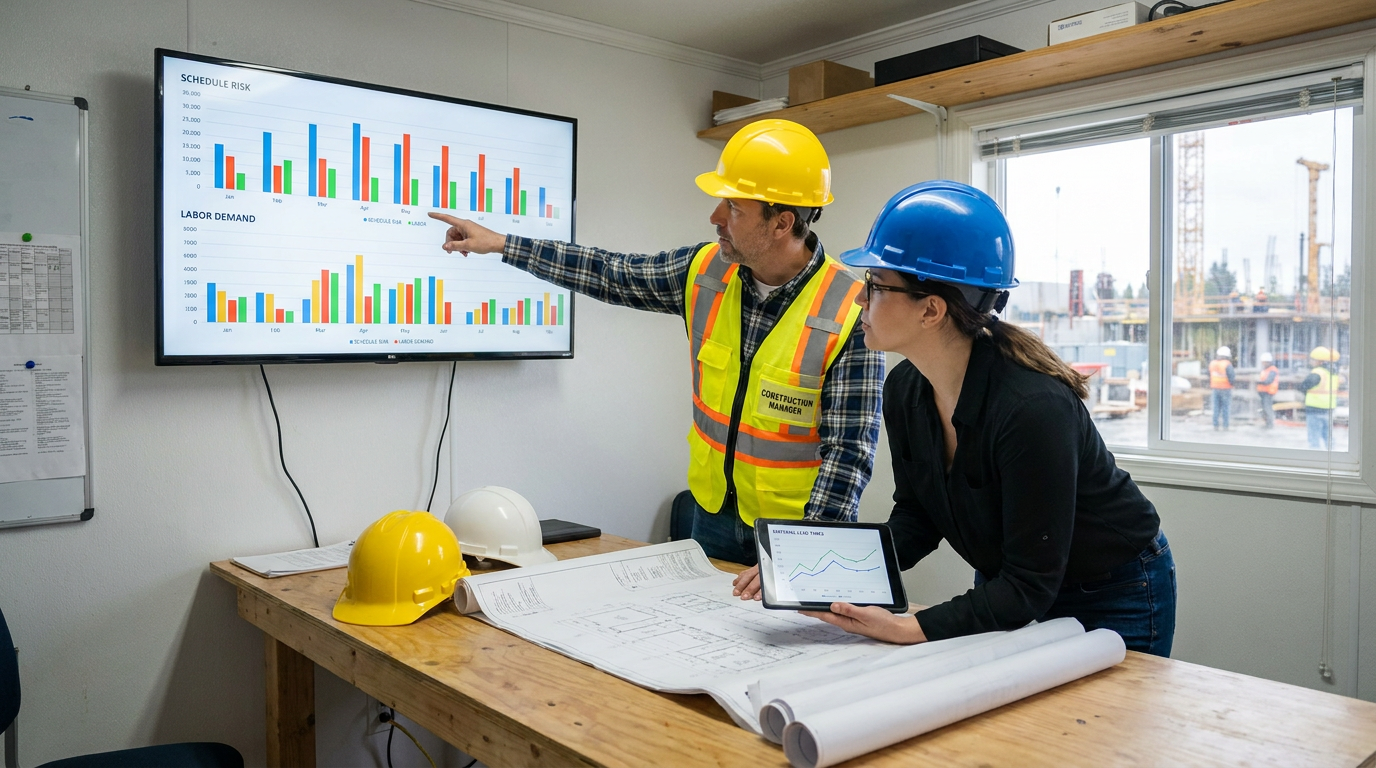
What construction forecasting actually means
At its simplest, construction forecasting is the practice of using historical data, current project data, and external market signals to predict future project outcomes. Those outcomes usually include cost, schedule, labor needs, productivity, procurement timing, cash flow, and risk exposure. Forecasting takes planning beyond a one-time estimate and turns it into an ongoing process of updating expected results as conditions change.
That distinction matters because forecasting is often confused with estimating. Estimating is essential, but it is not the same thing. AACE International defines a cost estimate as a prediction of the probable costs of a project for a defined scope, location, and point in time. In other words, an estimate reflects what a project is expected to cost based on the information available at a specific stage. A forecast, by contrast, keeps evolving. It asks whether the project is still likely to finish at that expected cost, on that schedule, with that labor plan, under current conditions.
A useful way to think about forecasting is as a decision-support system. It does not simply produce a number. It helps teams decide whether to re-sequence work, increase contingency, lock in materials earlier, add labor, adjust subcontracting strategy, or communicate revised expectations to owners and lenders. This is why forecasting has become closely connected to project controls, earned value management, procurement planning, labor analysis, and executive reporting.
Forecasting also improves as a project becomes better defined. Early in preconstruction, predictions are based on conceptual scope, comparable projects, broad market assumptions, and benchmark rates. As design progresses and field production starts, forecast accuracy usually improves because teams can compare actual quantities, actual labor hours, and real lead times against the plan. Better project definition does not eliminate uncertainty, but it narrows it.
Why forecasting has become essential in construction
Construction has always involved uncertainty, but the scale and speed of disruption have increased. Cost escalation can happen within a procurement cycle. A labor shortage in one region can delay mobilization across several projects. Lead times for critical components can shift enough to change the logic of the schedule. Owners and contractors cannot afford to discover those issues only after they hit the field. They need systems that identify pressure earlier.
This is where forecasting creates value. A forecast highlights trends before they become outcomes. If labor hours are running above plan in one work package, that may suggest a productivity issue, a sequencing problem, or a scope gap that could grow into a schedule delay. If material delivery windows start moving, the forecast can show which downstream activities are at risk. If quantity growth appears in structural packages or civil works, the likely cost impact can be identified before invoices accumulate.
Recent industry analysis has reinforced this need. PwC highlights leading indicators such as bulk quantity growth, labor-hour growth, and planning or sequencing errors as early warning signals of overruns. Deloitte’s 2026 engineering and construction outlook also points to pressure from procurement delays, tariffs, price sensitivity, and margin stress. These are not isolated technical problems. They are interconnected signals that change how a project should be managed in real time.
In practical terms, forecasting supports better decisions because it reduces uncertainty rather than pretending to erase it. A good forecast does not promise a flawless result. It tells the team what is becoming more likely, what assumptions are weakening, and where intervention can still make a difference. That is an important cultural shift for the industry. Instead of treating the baseline schedule or budget as fixed truth, high-performing teams treat them as reference points that must be tested continuously against current reality.
Forecasting does not eliminate construction risk. It makes risk visible early enough for teams to respond intelligently.
The practical applications of construction forecasting
The reason forecasting matters is not because it sounds advanced. It matters because it solves practical problems. Every project team needs to understand whether the budget is holding, whether the schedule is slipping, whether enough workers will be available, and whether key materials will arrive when promised. Forecasting gives structure to those questions.
Cost forecasting and budget control
Cost forecasting is one of the most familiar applications. It begins with the baseline estimate and updates expected final cost based on committed contracts, approved changes, quantity growth, labor productivity, market rates, and known exposures. Teams often use tools such as RSMeans to develop budgets, validate costs, and benchmark assumptions against current labor, equipment, and material data. But modern cost forecasting goes beyond reference pricing. It connects estimate assumptions to actual field performance and procurement behavior.
For example, if excavation production is slower than planned or a structural package comes back from the market above estimate, the forecast should reflect the probable downstream impact. That may include added general conditions, revised cash flow timing, extended equipment rentals, or larger contingencies. Without that update, the reported budget may remain technically unchanged while the real project risk has already moved.
Good cost forecasting also helps owners avoid false confidence. A project may still appear on budget if it has not yet recognized incomplete scope, market volatility, or pending claims. Forecasting forces teams to ask a harder question than what has been spent so far. It asks what the project is now likely to cost at completion, given what is known and what is emerging.
Schedule forecasting and delivery confidence
Schedule forecasting applies the same thinking to time. A baseline schedule shows the plan. A schedule forecast shows the likely finish date if current productivity, constraints, logic, and delivery conditions continue. This is crucial because schedule slippage rarely starts with a dramatic collapse. It usually begins with small deviations that compound across trades, approvals, access windows, or procurement milestones.
If steel delivery is delayed by three weeks, that is not just a purchasing issue. It may affect concrete sequencing, crane utilization, envelope installation, interior mobilization, and financing assumptions. A schedule forecast captures these dependencies and gives managers time to create recovery options. Those options may include resequencing work, adding shifts, accelerating shop drawing approvals, or changing temporary works strategy.
On many projects, schedule forecasting is strongest when it combines long-range CPM planning with short-term lookahead data from the field. The long-range view shows the critical path and milestone structure. The short-range view reveals whether crews, space, information, and materials are aligned to support the next several weeks of work. If not, the schedule forecast can begin to show risk before the official completion date moves.
Labor forecasting and workforce planning
Labor forecasting has become especially important in Canada and across North America. BuildForce Canada’s forecast platform projects construction employment needs through 2034 and is designed to help stakeholders understand future market conditions. BuildForce also reported a possible retirement-recruitment gap of more than 61,000 workers in its national 2023 to 2032 construction forecast. This is not a minor planning issue. It affects whether projects can secure the right trades at the right time and at sustainable cost.
Labor forecasting helps teams estimate crew demand by phase, identify peak labor periods, compare internal staffing plans with subcontractor capacity, and assess regional competition for talent. It also supports strategic decisions before a project starts. If labor availability is expected to tighten in a region, contractors may choose to pursue different package strategies, invest earlier in recruitment, or increase prefabrication to reduce field labor dependency.
Statistics Canada research published in 2026 noted that labor productivity in Canadian residential construction has declined over time. That trend gives labor forecasting even more weight. When productivity is under pressure, simply assuming that more workers will solve schedule issues is risky. Teams need to forecast not only headcount but also expected output, supervision requirements, skill mix, and learning curves for new or relocated labor.
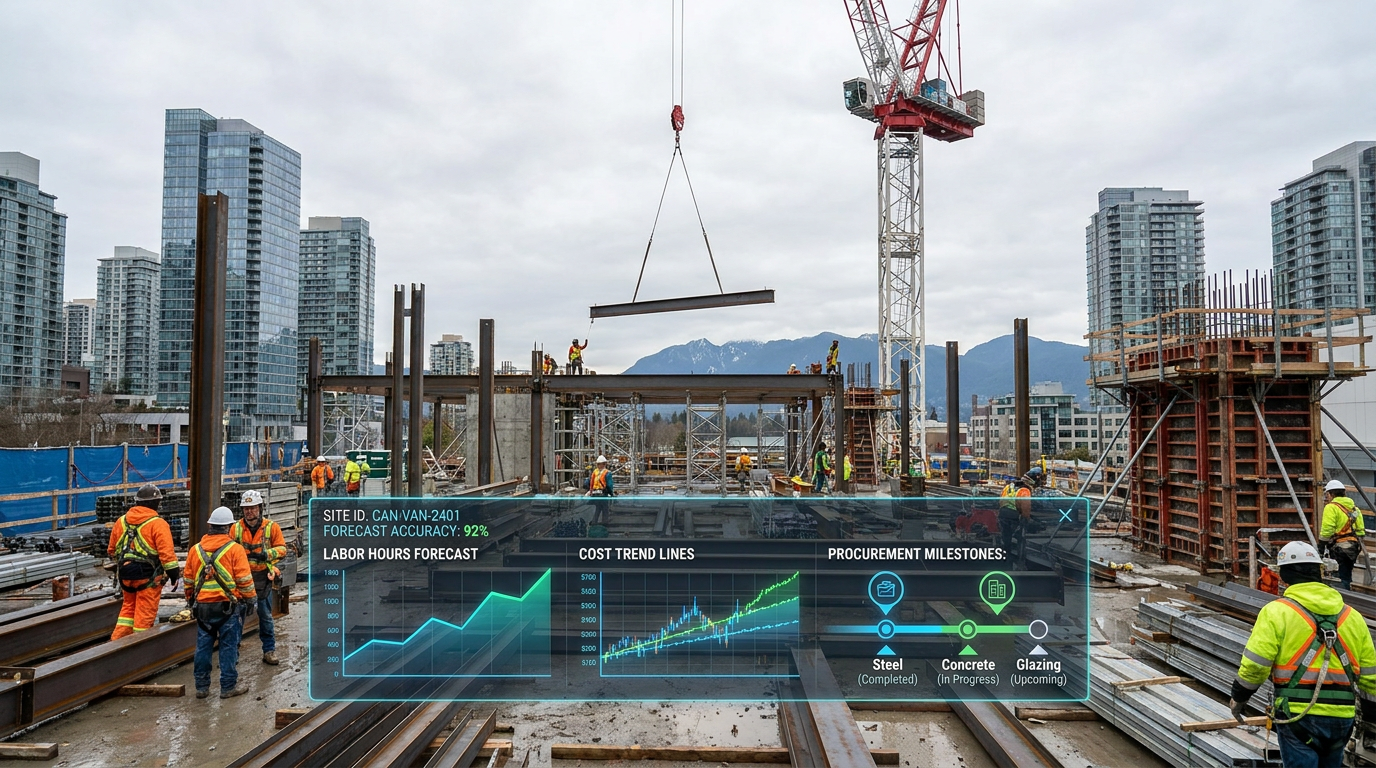
Procurement forecasting and supply-chain resilience
Procurement forecasting focuses on what materials and equipment are needed, when they must be ordered, how long they will take to arrive, and what market conditions may disrupt supply. This has become much more important as tariffs, shipping delays, manufacturing bottlenecks, and price volatility affect project timing and margins. A static procurement log is no longer enough for complex work.
Forecasting in procurement means looking ahead at long-lead items and testing scenarios. What happens if switchgear slips by eight weeks. What if façade components are delayed at customs. What if a mechanical supplier revises lead times after award. The purpose is to move from passive tracking to active anticipation. Teams can then make decisions earlier, such as approving alternates, releasing fabrication packages sooner, adjusting installation sequencing, or increasing storage planning to support earlier delivery.
Done well, procurement forecasting protects more than the schedule. It also reduces exposure to premium freight, rushed substitutions, idle labor, and downstream claims. This is a direct link to project success because many field disruptions are really procurement visibility failures that became visible too late.
Risk forecasting and contingency planning
Construction risk registers often contain long lists of possible issues, but forecasting helps teams prioritize the ones that are becoming most likely and most impactful. This is where contingency planning becomes more disciplined. Rather than carrying a generic allowance, teams can tie contingency use to actual forecast drivers such as quantity growth, labor underperformance, weather exposure, design changes, and market escalation.
Risk forecasting also supports communication with owners, lenders, and executive sponsors. These stakeholders rarely need every project detail. They need a clear view of probable outcomes, range of scenarios, and recommended actions. Forecast-based reporting makes that possible because it connects raw data to decision relevance. A risk is no longer just noted. Its potential schedule, cost, and operational consequences are quantified and explained.
How the forecasting workflow works in real projects
Although forecasting methods vary by project type and organization maturity, most strong workflows follow a similar pattern. They start with a baseline, collect current data, compare planned versus actual performance, and update expectations based on leading indicators. The process is iterative rather than one-and-done. Every cycle improves visibility.
A practical workflow often includes estimate benchmarking, productivity tracking, procurement lead-time analysis, labor-market intelligence, and scenario testing. Historical project data provides a starting point, but current performance matters just as much. If a team planned for a specific production rate based on past jobs, the forecast must test whether that rate is actually being achieved on the current site, under current conditions, with the current workforce.
The best workflows also connect data across departments. Estimating, scheduling, procurement, field operations, and finance often operate in separate systems. Forecasting becomes much more powerful when those streams are aligned. Quantity growth from design coordination should influence cost and labor forecasts. Procurement delays should influence the schedule forecast. Labor shortages should influence productivity assumptions and subcontracting strategy. This integrated view is one reason forecasting is increasingly associated with digital dashboards and construction intelligence platforms.
Another critical part of the workflow is forecast cadence. Monthly updates may be sufficient for some owner-side reporting, but active projects often need weekly or even daily signal monitoring in key areas. The faster the project environment changes, the more valuable continuous forecasting becomes. This is why the industry trend is moving away from static spreadsheets toward live dashboards and operational analytics.
Common forecasting inputs
High-quality forecasting depends on using the right inputs and interpreting them well. No single data point is enough. Most teams need a combination of historical benchmarks, current project controls data, and external market indicators to build a reliable view.
- Historical cost and schedule data from comparable projects to establish initial assumptions.
- Estimate and quantity data tied to the current level of project definition.
- Actual labor hours and productivity rates from field reporting systems.
- Procurement status and lead times for critical materials and equipment.
- Labor-market intelligence related to regional workforce availability and wage pressure.
- Change-order and design development data that may affect scope growth.
- External signals such as tariffs, regulatory changes, weather trends, and macroeconomic pricing pressure.
Forecasting quality depends on more than volume of data. It depends on relevance, timeliness, and context. More numbers do not automatically create better insight. If project definitions are weak, field reporting is inconsistent, or teams fail to interpret leading indicators correctly, the forecast may create false precision rather than clarity.
Forecasting as a response to Canadian construction realities
Canada is a particularly strong example of why forecasting has moved from optional to essential. The country faces simultaneous pressure from housing demand, infrastructure requirements, labor constraints, and productivity challenges. In this environment, construction decisions cannot rely solely on backward-looking reports or optimistic assumptions about labor and materials arriving as needed.
BuildForce Canada has become a key source of forward-looking labor intelligence, and its forecasting tools reflect the industry’s need for better planning horizons. When employment needs are projected years ahead, project teams gain a clearer understanding of where labor competition may intensify and where recruitment or training investments may be necessary. That affects not only major infrastructure programs but also private development, institutional work, and regional housing delivery.
Labor market volatility reinforces the point. Statistics Canada reported that construction employment in Canada was down 13,700 from its recent peak in December 2024 as of July 2025. A changing employment picture can create both opportunity and risk depending on region, trade mix, and project timing. Forecasting helps teams interpret whether an apparent easing in one period is likely to be temporary, localized, or offset by future shortages elsewhere.
The productivity issue is equally important. If labor productivity in residential construction has declined over time, then forecasting cannot treat schedule duration as a simple arithmetic result of headcount. Teams need to examine installation rates, rework exposure, supervision quality, prefabrication opportunities, and sequencing constraints. This is where forecasting starts to influence not just planning but delivery strategy itself.
In Canada, construction forecasting is not only about money. It is about whether the right people, materials, and sequence can come together when the work is supposed to happen.
Technology is changing how forecasting is done
For many years, construction forecasting lived mostly in spreadsheets, monthly reports, and disconnected departmental updates. Those methods are still common, but they are increasingly inadequate for projects facing rapid change. The current trend is toward continuous, data-rich forecasting supported by dashboards, integrated project controls, and predictive analytics.
Interactive platforms now make it easier to visualize what is happening beneath headline numbers. BuildForce has expanded interactive data visualization in its forecasting platform, which reflects a broader industry move toward more accessible intelligence. Instead of reading static tables, users can explore regional labor trends, compare scenarios, and understand what a shift in one variable may mean for resource planning. This kind of visibility supports faster and more confident decision-making.
On projects themselves, digital forecasting tools can combine cost reports, schedule updates, procurement logs, daily reports, quantity tracking, and field productivity data into a single view. That matters because most construction problems are interconnected. If teams only see one dimension at a time, they often miss the chain reaction until it is expensive. A live dashboard can show that procurement slippage is increasing labor idle risk, which may then affect cost to complete and milestone confidence.
Predictive analytics adds another layer by identifying patterns that humans may overlook in large datasets. That might include subtle labor-hour growth in specific trades, recurring change-order clustering around particular design packages, or correlations between sequencing disruptions and future cost exposure. Used well, these tools do not replace experience. They amplify it by helping experienced managers focus on the signals that matter most.

Common misconceptions about construction forecasting
One of the biggest misconceptions is that forecasting and estimating are interchangeable. They are not. Estimating creates an initial prediction based on a defined scope and assumptions at a point in time. Forecasting is the ongoing process of revising expected outcomes as the project and market evolve. Teams need both, but they serve different purposes.
Another misconception is that forecasting should produce certainty. In reality, it improves decision quality by clarifying probabilities and scenarios. A strong forecast may still differ from the final outcome because weather, design changes, market shocks, or labor disruptions can alter the trajectory. That does not mean the forecast failed. It means construction is dynamic, and forecasting is meant to adapt with it.
Some teams also assume that more data automatically means better forecasts. This is only partly true. Poorly structured data, inconsistent field reporting, or incomplete scope definition can make forecasts look sophisticated while remaining weak in substance. The value comes from disciplined inputs, relevant indicators, and teams who understand how to interpret them.
Finally, forecasting is often treated as a financial exercise when it is much broader. It certainly includes cost, but it also covers labor availability, material lead times, schedule risk, productivity trends, change exposure, and contingency use. The most successful projects forecast across all of these dimensions rather than isolating budget from operations.
How forecasting improves project success in measurable ways
Project success is often defined by a few visible outcomes such as on-time completion, budget performance, and client satisfaction. Forecasting improves all three by enabling earlier intervention. When teams identify probable problems sooner, they have more choices and lower-cost responses. That may mean adjusting bid assumptions before contract award, resequencing activities before delay spreads, or securing labor before the market tightens.
Forecasting also supports more credible planning. Owners can choose budgets that reflect actual market conditions instead of idealized assumptions. Contractors can submit bids with a clearer understanding of labor and procurement risk. Lenders and executive sponsors receive better insight into likely cash flow timing and contingency needs. Across the board, decisions become more grounded in evidence.
There is also a softer but important operational benefit. Forecasting improves alignment. When estimating, field operations, procurement, and leadership all work from a shared forecast, discussions become more objective. Instead of debating opinions in isolation, teams can compare assumptions, test scenarios, and agree on action based on current signals. That creates a healthier project culture where risk is surfaced earlier rather than hidden until it becomes unavoidable.
Over time, organizations that forecast well also build stronger institutional knowledge. Each project improves the benchmark database for the next one. Production rates become more realistic. Contingency practices become more disciplined. Procurement assumptions become sharper. This is how forecasting turns from a project tool into a competitive advantage.
What a mature construction forecasting practice looks like
A mature forecasting practice is not defined by software alone. It is defined by process discipline, cross-functional collaboration, and a willingness to update assumptions honestly. Strong organizations create clear ownership for forecasts, standardize reporting logic, and review leading indicators regularly. They treat the forecast as a living management tool, not a compliance document.
These organizations also understand the importance of scenario planning. Rather than relying on a single expected outcome, they test ranges. What happens if concrete prices rise again. What if labor productivity underperforms by 10 percent. What if a major electrical component slips by a month. Scenario planning turns forecasting into a strategic tool because it prepares teams for multiple plausible futures.
Another sign of maturity is linking forecasting to action. A dashboard that highlights risk but triggers no response has limited value. Effective teams connect forecast signals to specific decisions, such as releasing alternates, adding supervision, increasing prefabrication, adjusting milestone commitments, or revising contingency. Insight without intervention does not transform outcomes.
Finally, mature teams close the loop at project end. They compare forecast accuracy against final results, identify where assumptions broke down, and improve their models. This feedback cycle is what separates one-off analysis from a real construction intelligence capability.
Getting started with better forecasting
Not every company needs a complex predictive analytics platform on day one. Many improvements begin with process rather than technology. Start by defining a clear baseline budget and schedule, tracking actual labor and quantities consistently, identifying a few leading indicators, and updating expected outcomes on a regular cadence. Even this basic structure can reveal trends that static reporting misses.
From there, teams can strengthen forecasting by integrating procurement tracking, labor-market intelligence, and scenario analysis. Organizations operating in Canada may benefit from using BuildForce labor outlooks as part of workforce planning, especially for trade-intensive or long-duration projects. Cost teams can benchmark assumptions with resources such as RSMeans while still grounding final forecasts in actual project conditions.
It is also important to involve both field and office perspectives. Forecasts built only in the back office often miss operational nuance. Forecasts built only from field instinct may miss broader market signals and financial consequences. The best results come when project managers, superintendents, estimators, schedulers, procurement leads, and executives contribute to a shared picture.
Above all, teams should remember that forecasting is valuable because it improves judgment. It helps construction professionals ask better questions sooner. Are we seeing quantity growth. Are labor hours drifting above plan. Is a procurement issue about to affect critical path work. Is our contingency still realistic. Those questions, asked early and answered honestly, are what change project outcomes.
Conclusion
Construction forecasting transforms project success because it changes how decisions are made. Instead of relying on static assumptions, teams can use real data, market intelligence, and leading indicators to understand what is likely to happen before problems become expensive. That makes forecasting one of the most practical tools available for reducing risk, strengthening planning, and improving delivery performance.
Its significance is especially clear in today’s market. With labor shortages, productivity pressure, procurement volatility, and persistent overrun risk, construction teams need more than traditional reporting. They need a forward-looking system that connects estimating, scheduling, procurement, labor planning, and contingency management into one coherent view. Forecasting provides that view.
The most important point is simple. Forecasting does not create certainty, and it does not remove every source of disruption. What it does is far more useful. It reduces uncertainty enough for owners, contractors, and planners to act with better timing, better evidence, and better control. In an industry where delays and overruns remain common, that shift is not incremental. It is transformative.


No Comment! Be the first one.