



Construction scheduling systems sound technical, but the basic idea is straightforward. Every building project has to answer the same practical questions: what happens first, what has to wait, what can happen at the same time, who is needed, what materials must arrive, and what delays could affect the finish date. A schedule is the working tool that organizes those answers. When it is built well and updated honestly, it becomes one of the most useful control systems on the entire job.
Table Of Content
- Why construction scheduling systems matter in real projects
- What a good construction schedule actually includes
- The Critical Path Method remains the backbone of construction scheduling
- How CPM looks in a real-world scenario
- Resource leveling keeps the plan realistic
- Milestone schedules and baseline schedules serve different purposes
- Lean scheduling methods bring field reality into the plan
- Lookahead planning and weekly work planning
- Pull planning and takt planning
- Cloud-based scheduling and 4D BIM are changing how teams coordinate
- How scheduling systems apply to homeowners and smaller contractors
- Common scheduling mistakes that hurt projects
- Best practices for implementing a scheduling system that actually works
- A practical framework for building a better construction schedule
- How scheduling supports smoother project management from start to finish
- Final thoughts on mastering scheduling systems
For homeowners, a schedule helps explain why a kitchen renovation cannot jump straight from demolition to finished paint in a week. For contractors and project managers, it coordinates trades, deliveries, inspections, owner decisions, and crew loading. For larger commercial teams, it also becomes part of contract administration, risk management, and delay analysis. In every case, the schedule is not just a calendar with dates on it. It is a map of the work and a guide for how the project will actually be built.
That is why scheduling deserves more attention than it usually gets. A surprising number of schedules look polished on paper but perform poorly in the field. SmartPM’s 2025 State of Construction Scheduling Report found that 88% of baseline schedules failed quality benchmarks, based on analysis of more than 70,000 schedules. That matters because a weak baseline makes it harder to forecast finish dates, manage change, or explain delay impacts later. Good software helps, but software cannot rescue weak logic, missing updates, or poor field coordination.
This article breaks scheduling systems down in practical terms. We will look at the most common methods, including the Critical Path Method, resource leveling, milestone scheduling, lookahead planning, and the Last Planner System. We will also cover newer tools such as cloud-connected scheduling and 4D BIM. The goal is simple: give you a clear, real-world understanding of how scheduling systems work and how to use them to manage projects with fewer surprises.
Why construction scheduling systems matter in real projects
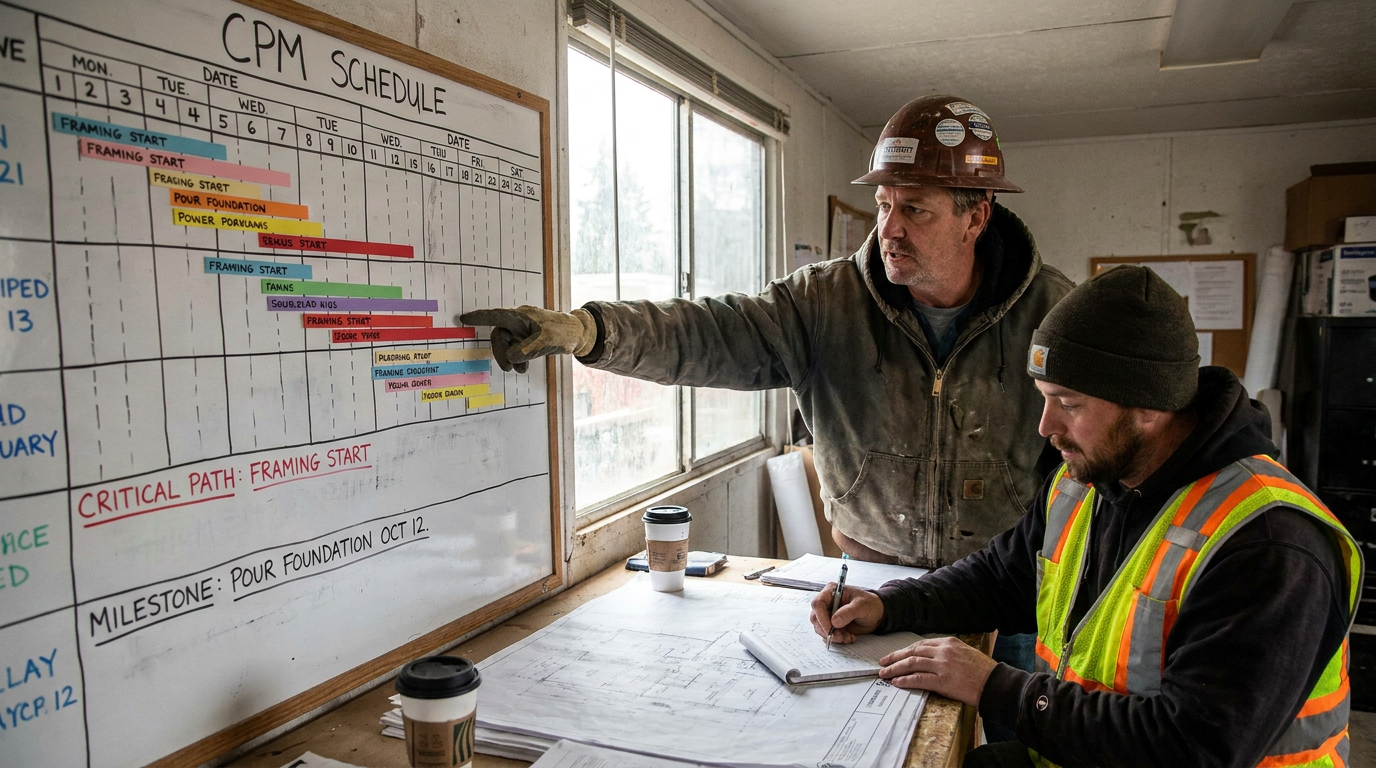
Every construction project is a chain of dependent events. Excavation must finish before foundations can be placed. Concrete may need cure time before structural loading. Framing often has to finish in key areas before mechanical, electrical, and plumbing rough-ins begin. Inspections must happen before walls are closed. Finish trades cannot work productively if spaces are still full of tools, debris, or unresolved deficiencies. Scheduling systems exist because construction is not a random collection of tasks. It is a sequence of linked commitments.
When teams skip disciplined scheduling, they usually pay for it somewhere else. Crews show up before an area is ready. Materials arrive too early and get damaged or stored in the way. Long-lead items are not ordered in time. Owners approve changes after the point when those decisions can be absorbed cleanly. Inspections get missed and trades have to return. None of that looks dramatic in a meeting, but on site it causes overtime, idle labor, stacking of trades, rework, and frustration.
A practical schedule reduces those problems by turning broad project scope into an organized sequence. It identifies major milestones, assigns durations, connects dependencies, and shows where float exists and where it does not. It also gives the team a common reference point. If the electrician says the floor is ready but the drywall contractor says it is not, the schedule becomes part of the conversation. It helps move decisions away from assumptions and toward visible planning.
In North America, scheduling also sits close to contract risk. Baseline schedules are often used to measure progress and compare planned performance against actual performance. If weather, late approvals, labor issues, or owner changes affect the work, a reliable schedule makes it easier to track that impact. That does not eliminate disputes, but it gives the project team a stronger factual record. On a healthy project, the same discipline that helps avoid claims also helps avoid confusion.
What a good construction schedule actually includes
Many people think of a schedule as a list of dates, but a useful construction schedule contains much more than that. It starts with a clear scope broken into manageable activities. Those activities need durations that make sense, logic ties that show what depends on what, and milestones that mark important handoffs or completion points. If the schedule is too vague, it cannot guide work. If it is too detailed without good maintenance, it quickly becomes outdated and ignored.
A solid schedule also reflects real field conditions. That means accounting for submittals, procurement, fabrication, delivery windows, inspections, permit requirements, access constraints, weather exposure, and crew availability. It should match the execution plan, not some idealized version of the job. PMI identifies Critical Path Method scheduling and resource leveling as key processes because the plan has to fit the available time and resources. In plain terms, there is no value in promising a sequence the labor force or supply chain cannot support.
Most effective schedules include several layers. A master schedule gives the overall path from notice to proceed to substantial completion. A milestone schedule highlights major dates that owners and lenders care about. A lookahead schedule focuses on the next few weeks of actual field execution. Weekly work plans narrow things further to the commitments crews can realistically complete. Those layers are not redundant. They serve different decisions at different levels of the project.
Good schedules also need regular updates. A baseline is important, but it is only the reference point. Real project management happens when actual progress is measured, remaining durations are reviewed, logic is corrected if the sequence changes, and new risks are introduced into the forecast. A schedule that is never updated may still look neat in a meeting package, but it is not managing anything.
The Critical Path Method remains the backbone of construction scheduling
If there is one scheduling system every construction professional should understand, it is the Critical Path Method, usually called CPM. CPM identifies the sequence of activities that directly controls the project finish date. If one of those activities slips and there is no available float, the project completion date slips too. That is why project teams pay close attention to the critical path. It shows where schedule risk is most concentrated.
In practice, CPM works by assigning durations to activities and connecting them through logic relationships. The schedule then calculates the earliest and latest dates those activities can occur. Activities with zero or near-zero float are critical or near critical. This is useful because not every delay matters equally. If a task has ten days of float, a short delay might not affect completion. If a task is critical, even a small problem can move the finish line.
CPM is still widely used because it gives structure to complicated projects. A mid-rise building, hospital renovation, school addition, or industrial plant shutdown can involve hundreds or thousands of linked tasks. Without a logical network, it is almost impossible to understand the consequences of change. CPM lets project teams test scenarios such as delayed steel, late shop drawings, phased turnover, or additional owner scope. It is one of the few tools that can connect all those moving parts in a usable way.
That said, CPM is often misunderstood. Some people assume the critical path is fixed for the whole project. It is not. As work progresses and delays or accelerations happen, the critical path can shift. Others assume any schedule built in CPM software is automatically reliable. That is not true either. A bad network with missing logic, unrealistic durations, or improper constraints may look professional but still produce poor forecasts. CPM is powerful, but only when it is built on sound planning discipline.
How CPM looks in a real-world scenario
Imagine a residential addition with a new foundation, framing, roofing, windows, rough-ins, insulation, drywall, trim, flooring, cabinets, and final inspections. A homeowner may think the key driver is cabinet delivery because that is the visible finish item they are waiting for. In reality, the critical path may run through permit approvals, foundation completion, framing, roof dry-in, inspections, drywall finishing, and flooring cure times before cabinets can even be set. If one of those early activities slips, later trades compress into each other and quality usually suffers.
Now picture a commercial office fit-out. The owner wants an aggressive move-in date. The schedule may show that long-lead air handling equipment and electrical service upgrades drive the critical path more than interior painting or ceiling tile. That changes where the project manager focuses attention. Instead of chasing every small task equally, the team watches procurement, utility coordination, and commissioning milestones closely. That is exactly what CPM is supposed to do. It helps focus effort where it protects the finish date most effectively.
Resource leveling keeps the plan realistic
A schedule can look perfect until you compare it to the people and equipment actually available. That is where resource leveling comes in. Resource leveling adjusts the sequence or timing of activities so labor, subcontractors, crews, and equipment are used in a way the project can realistically support. It is one thing to draw six rooms being finished at once. It is another thing to have enough drywall crews, painters, and finish carpenters to do it without chaos.
PMI highlights resource leveling as a core scheduling process because duration alone does not make a plan executable. In practical construction terms, you need to know whether the concrete crew is tied up elsewhere, whether the crane is shared across multiple work fronts, or whether a specialist installer is booked months in advance. If the schedule ignores those realities, it may create a false sense of confidence. Then the field team ends up improvising around shortages that should have been recognized much earlier.
Resource leveling is especially important on smaller projects where the same subcontractor may be juggling several jobs at once. A custom home builder might have one trusted tile installer and one trim crew serving multiple houses. On paper, each house could move into finishes at the same time. In reality, the trades must rotate based on availability. That does not mean the project is poorly run. It means the schedule needs to reflect actual capacity instead of wishful thinking.
On larger jobs, resource leveling also supports safety and productivity. Too many trades stacked into one zone often creates congestion, access problems, and inefficiency. A leveled schedule spreads work more intelligently, giving crews the room and sequence they need. The result is usually steadier progress and fewer disruptions, even if the schedule appears slightly longer on paper. A realistic plan beats an aggressive fiction every time.
Milestone schedules and baseline schedules serve different purposes
One common source of confusion is the difference between a milestone schedule and a baseline schedule. A milestone schedule is a high-level summary that shows major dates such as permit issuance, foundation completion, dry-in, rough-in inspection, substantial completion, and handover. It is useful for owners, lenders, and executives who want to understand the broad shape of the project without reviewing hundreds of detailed activities.
A baseline schedule, on the other hand, is the approved reference version of the detailed schedule against which progress is measured. It is the benchmark used to compare planned dates to actual dates as the job unfolds. That makes it essential for progress tracking, variance analysis, and delay evaluation. A baseline is not a perfect prediction. It is a disciplined starting point for measuring what changed and when.
The misconception to avoid is thinking the baseline is untouchable or magically accurate. It should be stable enough to serve as a reference, but it also has to be built properly in the first place. If the baseline contains poor logic or unrealistic durations, the project team will spend months managing against a weak standard. That is one reason schedule quality matters so much at the start of the job.
For homeowners and small contractors, the same principle applies at a simpler scale. Even if you are not using enterprise scheduling software, you still benefit from an agreed starting plan. If the original target was to have framing complete by a certain date and the owner later adds structural changes, the team needs a clear before-and-after record. Without that, every time slip feels subjective and every conversation gets harder than it needs to be.

Lean scheduling methods bring field reality into the plan
Traditional CPM scheduling is effective for overall logic and contractual control, but many teams have learned that a master schedule alone is not enough to create reliable weekly production. That is where Lean construction methods come in. Instead of relying only on top-down planning, Lean systems bring superintendents, foremen, and trade partners into more frequent planning conversations. The goal is to build workflow that is not just planned, but dependable.
The best-known Lean scheduling approach is the Last Planner System, often called LPS. The Lean Construction Institute defines it as a production planning and control system developed by Glenn Ballard and Greg Howell, with superintendents and foremen often serving as last planners in practice. It focuses on collaborative planning, lookahead planning, weekly work planning, and learning from plan-versus-actual performance. That makes it especially valuable in the field, where conditions shift faster than master schedule updates can capture.
One reason LPS matters is that weekly work is often less reliable than teams assume. The Lean Construction Institute reports that, on average, only about 54% of weekly planned work is completed within the allotted schedule in traditional design and construction settings. That number is a useful reality check. It suggests that many projects do not fail because nobody made a schedule. They fail because short-term commitments are made without checking whether the work is truly ready.
Readiness is a major Lean concept. Before an activity is promised for next week, the team checks whether prerequisites are actually in place. Are drawings approved? Are materials on site? Is the prior trade finished? Is access available? Are inspections passed? This sounds simple, but it is one of the most effective habits a field team can build. It prevents the common pattern of assigning work that crews cannot complete, then blaming execution for a planning failure.
Lookahead planning and weekly work planning
Lookahead planning usually focuses on the next two to six weeks, depending on project complexity. It bridges the gap between the long-range master schedule and next week’s field commitments. During this window, the team screens upcoming tasks for constraints and works to remove them before the work hits the field. That might mean finalizing submittals, confirming deliveries, coordinating access, or resolving design questions.
Weekly work planning narrows things even further. It asks the people closest to the work what they can genuinely commit to completing in the coming week. That is different from what they hope to do or what management wants them to do. Reliable commitments are more valuable than optimistic promises because they create stability from trade to trade. When one crew finishes what it said it would finish, the next crew can actually plan around that result.
For example, on a school renovation, the drywall foreman may say one corridor can be completed this week, but a second corridor is still waiting on inspection. A traditional meeting might push for both areas anyway to keep the chart looking strong. A Lean approach would rather make one honest commitment and complete it than set up two partial failures. Over time, that discipline builds trust and improves forecasting.
Pull planning and takt planning
Pull planning works backward from a milestone to define the sequence of trade handoffs needed to reach it. Instead of a scheduler drafting the sequence alone, the trades help map how the work should flow. This often reveals practical constraints that office planning misses, such as cure times, access limitations, crew handoffs, or inspection bottlenecks. Pull planning is especially useful for turnover phases, tenant fit-outs, healthcare renovations, and other work where coordination density is high.
Takt planning is another Lean method that creates a steady rhythm of work across zones. It is often used on repetitive projects such as multifamily, hospitality, healthcare, or interior fit-out work. The idea is to move trades through defined areas at a controlled pace so handoffs become predictable. It takes discipline to set up, but when it works, crews stop tripping over each other and production becomes easier to manage.
The important point is that Lean methods and CPM are not competing systems. In many of the best-run projects, the team uses a master CPM schedule for long-range forecasting and contract control, then uses lookahead planning, pull planning, or takt planning to manage field execution. That hybrid approach gives the project both strategic direction and day-to-day reliability.
Cloud-based scheduling and 4D BIM are changing how teams coordinate
Modern construction scheduling is no longer limited to a desktop file sitting with one scheduler or project manager. Cloud-based platforms are making schedules easier to share across office and field teams. Autodesk describes construction schedule management software as a way to centralize schedules in the cloud and give teams real-time visibility. That matters because delays often grow in the gap between what the office thinks is happening and what the field is actually facing.
With cloud-connected systems, updates can be viewed faster by project managers, superintendents, owners, and trade partners. Field reports, photos, RFIs, submittal status, and progress information can be tied more closely to schedule conversations. This does not automatically create a great schedule, but it does make collaboration easier. When everyone sees current information, it becomes harder for problems to hide until they become expensive.
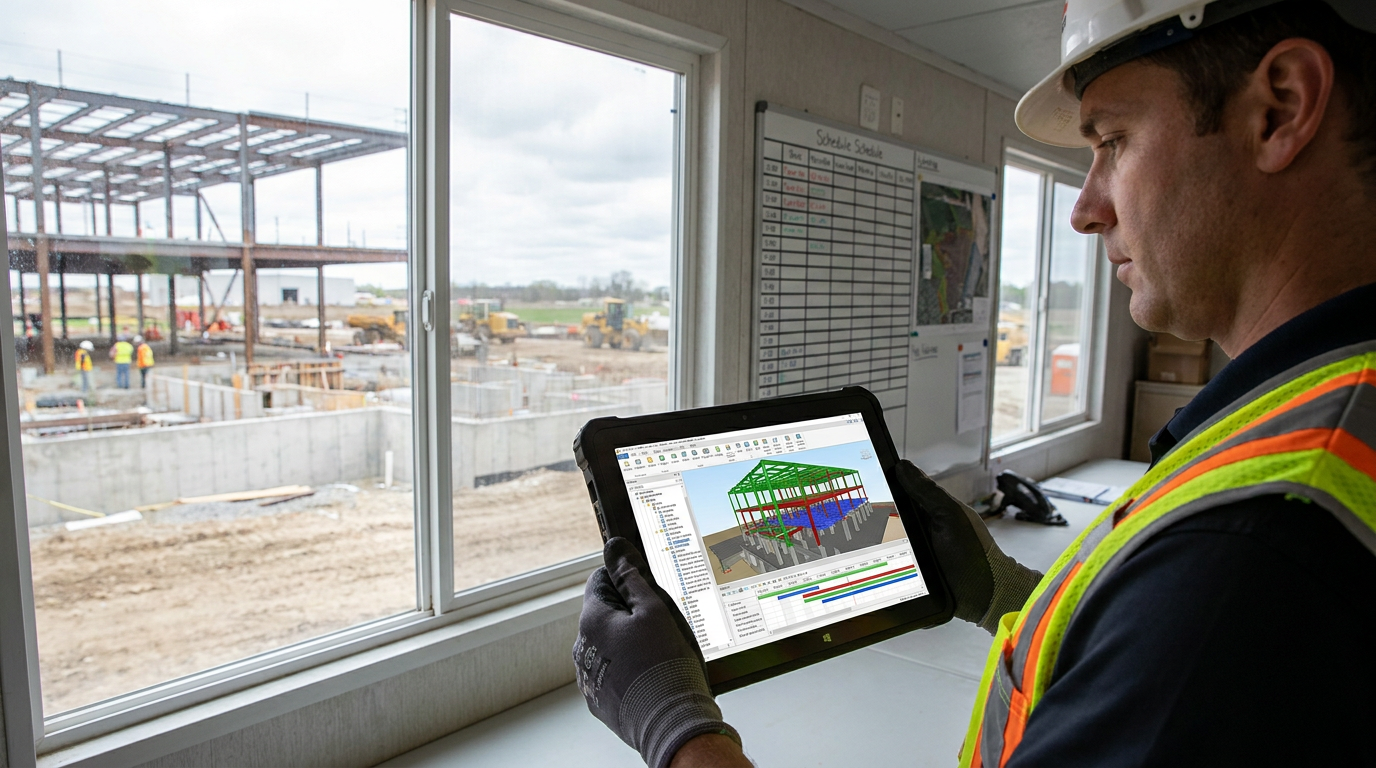
Another major development is 4D BIM, which links model elements to schedule activities so teams can simulate the sequence of construction over time. Autodesk highlights this as a way to improve planning, coordination, and communication. For practical users, 4D BIM can make the schedule more visible and easier to understand, especially for complex logistics, phased work, crane usage, site access, or occupied renovations where timing matters as much as geometry.
Imagine planning a hospital renovation where noisy demolition, infection control barriers, temporary routes, and shutdown windows all need exact coordination. A standard bar chart can show the dates, but a 4D sequence can help everyone visualize what the schedule means in physical space. The same is true for high-rise formwork cycles, prefabricated installation sequences, or campus projects with tight access. Visual scheduling does not replace logic-based planning, but it can make the plan more actionable.
How scheduling systems apply to homeowners and smaller contractors
Scheduling often gets presented as if it only matters on airports, towers, and large commercial developments. That is a mistake. Small residential projects have fewer activities, but they still depend on sequence, trade coordination, and decision timing. If anything, small projects can be less forgiving because they have less staffing depth and less float to absorb mistakes. One late cabinet order or missed inspection can throw off the whole finish sequence.
A homeowner managing a renovation does not need a hundred-page schedule report. But they do need a clear plan that identifies key milestones, long-lead purchases, permit or inspection dates, and the order of trades. If flooring is delayed, the painter, trim carpenter, and cabinet installer all feel it. If a plumbing fixture selection is not made early enough, the rough-in or finish installation may stall. These are scheduling issues even when nobody calls them that.
Smaller contractors benefit from simple systems that are maintained consistently. A practical approach might include a master milestone plan, a three-week lookahead, and a weekly check-in with active trades. The key is visibility. Keep the schedule where the team can see it, update it when changes happen, and verify dependencies before promising dates to the client. Fancy software is optional. Discipline is not.
For homeowners, it also helps to understand why contractors ask for timely approvals and selections. Those requests are not just paperwork. They are often tied directly to the schedule. Tile, windows, appliances, custom millwork, and specialty fixtures can all become long-lead items. The earlier those decisions are made and documented, the more stable the schedule becomes.
Common scheduling mistakes that hurt projects
Many schedule failures come from a handful of repeated mistakes. The first is building the schedule too late or too quickly. If the plan is assembled after procurement has already started or after work is underway, important assumptions may never get tested properly. Another common problem is weak logic. Activities are entered in sequence without meaningful ties, or dates are forced with constraints that hide underlying conflicts instead of solving them.
A third mistake is using unrealistic durations. Teams sometimes shorten activities to satisfy an external target without asking whether the crews, access, and materials support that pace. That creates a schedule that looks competitive in a proposal or meeting, but collapses once actual execution begins. A fourth mistake is failing to update the schedule regularly. Progress updates become cosmetic, remaining durations stay untouched, and the forecast stops reflecting the real job.
Poor field input is another major issue. Schedules built only in the office often miss practical site conditions that superintendents and foremen can see immediately. That is one reason hybrid systems work so well. Long-range structure comes from the master schedule, while short-range realism comes from field collaboration. When those two levels stay connected, the plan becomes much more reliable.
Finally, many teams fail to track constraints and decisions with enough discipline. The schedule says a trade should start Monday, but materials are not approved, access is blocked, or the prior work is incomplete. If no one manages those prerequisites in advance, the plan turns into guesswork. Better scheduling is often less about complicated math and more about following through on basic planning habits.
Best practices for implementing a scheduling system that actually works
The first best practice is to choose a scheduling system that fits the size and complexity of the project. A homeowner addition does not need the same process as a high-rise tower, but both need visible milestones, clear sequencing, and regular updates. Match the tool to the work, then commit to using it consistently. An overly complicated system that nobody maintains is worse than a simple one that the team trusts.
The second best practice is to start with a sound work breakdown structure. Break the project into manageable pieces based on phases, areas, systems, or trade scopes. Then sequence those pieces using real construction logic, not just preference or habit. When in doubt, ask the people who will actually perform the work. Good schedules are not written in isolation.
The third best practice is to combine long-range and short-range planning. Use a master CPM or milestone schedule to set the overall path, then support it with lookahead planning and weekly work plans. This layered approach gives leadership a strategic forecast while giving field crews something practical to act on. It also makes it easier to catch problems before they hit the critical path.
The fourth best practice is to manage long-lead items aggressively. Procurement is often one of the biggest hidden schedule drivers. Identify materials and equipment with long design, fabrication, or shipping timelines early, and tie them to submittal and approval deadlines. A schedule that ignores procurement usually looks better at the start than it performs later.
The fifth best practice is to treat updates as management work, not clerical work. Each update should answer real questions. What was completed? What slipped? Why did it slip? Has the critical path changed? Are there new constraints or opportunities? Are owner decisions, RFIs, inspections, or trade commitments aligned with the next phase? If the update does not support decisions, it is just decoration.
The sixth best practice is to measure plan reliability. If weekly commitments are repeatedly missed, do not just push harder. Ask why. Were tasks planned before they were ready? Were durations unrealistic? Did one trade inherit incomplete work from another? Lean planning methods are useful here because they force teams to learn from plan-versus-actual performance instead of simply rewriting the next week and hoping for better results.
A practical framework for building a better construction schedule
If you want a usable framework, think in terms of six steps. First, define the scope clearly enough that the project can be broken into real activities. Second, establish major milestones and owner decision dates. Third, sequence the work with proper dependencies, including procurement, permitting, inspections, and access constraints. Fourth, test the plan against actual labor and resource availability. Fifth, create a baseline and communicate it to everyone who matters. Sixth, update the schedule routinely and connect those updates to field reality.
- Define scope so activities are specific enough to manage.
- Set milestones for major handoffs, approvals, and completion targets.
- Build logic that reflects how the project will truly be constructed.
- Level resources against real crews, equipment, and subcontractor capacity.
- Establish a baseline as the reference point for progress and changes.
- Update and learn through lookaheads, weekly plans, and variance review.
That framework works on almost any project scale. On a large job, it may involve scheduling software, dashboards, and formal governance. On a small job, it may live in a spreadsheet, whiteboard, or shared project platform. What matters is that the process stays grounded in actual construction conditions and current information.
The most effective construction schedule is not the one with the most detail. It is the one the team understands, updates, and uses to make better decisions before problems hit the field.
How scheduling supports smoother project management from start to finish
Strong scheduling improves project management because it connects so many parts of the job. Estimating assumptions become execution sequences. Procurement deadlines become visible. Owner decisions get tied to their real downstream impact. Trade coordination becomes more objective. Site logistics become easier to plan. Progress meetings become more useful because the conversation has structure instead of just opinions.
Scheduling also improves accountability in a healthy way. When commitments are documented and reviewed, teams can see where the system is working and where it is breaking down. That does not mean using the schedule as a blame tool. In fact, the best teams use it as a problem-solving tool. If work did not happen, they ask what prevented it and how to remove that barrier before the next cycle.
Over time, mature scheduling also improves forecasting. Teams get better at estimating durations, recognizing constraint patterns, and identifying recurring handoff problems. That creates more reliable planning on future jobs. It also helps companies protect margins because they are not constantly absorbing preventable disruption. A disciplined schedule is not only a time-management tool. It is a business-management tool.
For owners and homeowners, the benefit is confidence. Even when the news is not ideal, a well-run schedule gives a clearer picture of what is happening, why it is happening, and what can be done next. That transparency matters. Construction always involves uncertainty, but uncertainty is easier to handle when the process is organized and visible.
Final thoughts on mastering scheduling systems
Mastering construction scheduling systems does not mean memorizing software menus or turning every project into a complicated chart. It means understanding how work flows, how decisions affect downstream activities, and how to keep planning tied to actual field conditions. The core lesson is practical: a schedule is not paperwork to satisfy a contract file. It is one of the main tools that helps the project team build in the right order with the right resources at the right time.
CPM remains the backbone for long-range planning and critical path analysis. Resource leveling keeps the plan honest. Baselines and milestones give the team a reference for progress and accountability. Lookahead planning, weekly work plans, and the Last Planner System improve short-term reliability where many jobs struggle most. Cloud tools and 4D BIM add visibility and coordination power, especially on more complex projects.
If you take only one idea from this article, let it be this: better scheduling usually starts with better habits, not better promises. Keep the plan visible. Review dependencies before making commitments. Involve the people closest to the work. Update the schedule with real progress, not wishful progress. Build buffers for inspections, deliveries, weather, and rework where they are justified. Those practical habits are what turn scheduling from a document into a working management system.
Whether you are managing a home renovation, a commercial fit-out, or a major ground-up build, the same principle applies. Projects run better when the schedule reflects how the building will actually come together. That is the real foundation of seamless project management.



No Comment! Be the first one.