



Regional competitiveness has become one of the defining questions in urban development. Every city wants growth, investment, jobs, and a stronger tax base, but not every city is positioned to capture them. In practice, competitiveness is about how effectively a region can attract firms, workers, capital, and public investment relative to other places that are competing for the same opportunities. It is not simply a branding exercise, and it is not limited to business incentives. It is the result of a city’s ability to convert land, infrastructure, housing, institutions, and governance into a productive urban system.
Table Of Content
- What Regional Competitiveness Means in Urban Development
- Why Housing Supply Has Become a Core Competitiveness Issue
- The role of missing middle and mixed income growth
- Land Value Creation as a Strategic Lever
- Why value capture matters
- Approvals, Governance, and the Cost of Delay
- Predictability versus speed alone
- Infrastructure as the Platform for Growth
- Talent, Livability, and the Modern Competitive City
- Climate Resilience Is Now a Competitiveness Issue
- Strategic Actions Cities Can Take to Improve Competitiveness
- Common Misconceptions That Weaken Competitiveness Strategy
- Conclusion: Competitive Cities Are Deliberately Built
For Canadian and North American cities, the competitive landscape has changed meaningfully in recent years. Housing affordability has become an economic development issue, not just a social one. Infrastructure constraints now shape where growth can happen and how quickly projects can move. Investors are increasingly sensitive to regulatory uncertainty, construction costs, climate risk, and local capacity. At the same time, many regions are trying to retain talent in an era marked by aging populations, changing migration patterns, and intensifying competition between metropolitan areas.
The strongest urban regions tend to perform well across several connected dimensions. They use land efficiently, approve development predictably, provide strong transportation links, maintain access to talent, and ensure the housing market can absorb growth. The OECD has long described competitiveness through lenses such as productivity, innovation, infrastructure, and sustainability. The World Bank’s work on cities similarly emphasizes productive density, market connectivity, investment attractiveness, and public private coordination as fundamental drivers of urban performance. These principles matter because development success is rarely created by any one intervention. It is built through coordination.
This is the central point that many cities still underestimate. A transit line without supportive zoning will not unlock its full value. Fast approvals without enough utility capacity may produce bottlenecks rather than momentum. Density without access to jobs, schools, parks, and services can create friction instead of competitiveness. Likewise, efforts to attract employers will struggle if workers cannot find attainable housing nearby. In today’s environment, competitiveness means shaping growth so that a city remains affordable, accessible, investable, and resilient over time.
That is especially important in Canada, where the relationship between housing supply and economic performance has become impossible to ignore. CMHC reported that housing starts rose 6 percent in 2025, supported by record rental construction and more missing middle housing, yet ownership oriented development weakened as condominium presales collapsed and unsold inventory increased. CMHC has also argued that doubling the pace of housing construction is achievable only with a much larger and more modernized workforce, more private investment, fewer delays, and lower development costs. Those are not narrow housing sector concerns. They are regional competitiveness issues in their most practical form.
When a city cannot approve housing in a timely way, cannot deliver services to growth areas, or cannot keep development financially viable, it loses more than units. It loses labor market flexibility, business attractiveness, fiscal efficiency, and future tax base expansion. This is why assessing regional competitiveness requires a broader view of urban development. It is not enough to ask whether a city is growing. The real question is whether it is growing in a way that strengthens its long term capacity to compete.
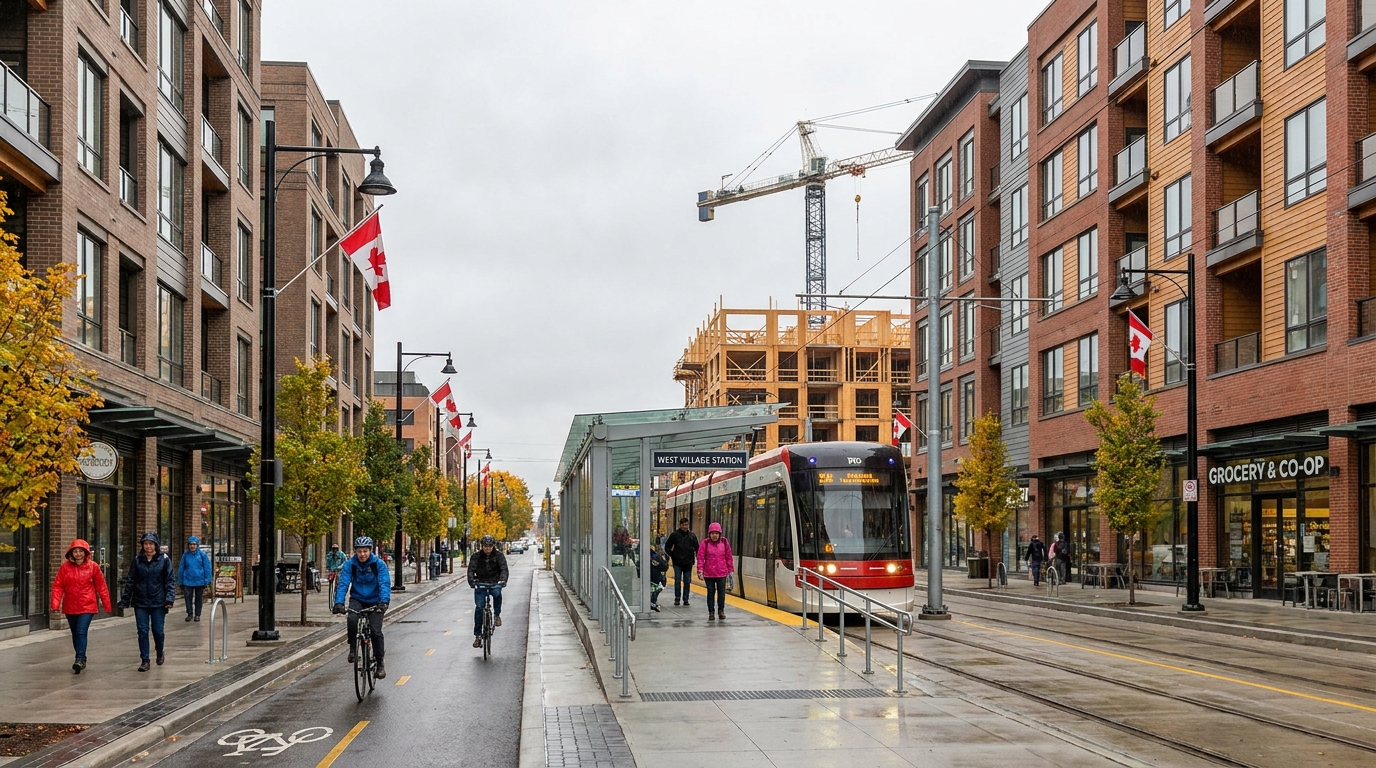
What Regional Competitiveness Means in Urban Development
In the context of urban development, regional competitiveness refers to a city or metropolitan area’s ability to generate and sustain economic performance compared with peer regions. That includes attracting business investment, retaining and growing talent, enabling efficient movement of goods and people, and translating public infrastructure into private sector confidence. At a deeper level, it also involves the capacity to absorb growth without letting rising costs, congestion, institutional delays, or land scarcity undermine future performance. In practice, this means a competitive region aligns housing supply, land use, transportation, and governance so that growth strengthens rather than strains the local economy. Cities that manage this alignment well tend to retain talent, sustain investment, and keep development financially viable even as demand and costs rise. This is why competitiveness assessments increasingly look beyond GDP growth alone toward the underlying systems, such as housing, infrastructure, and approvals, that determine whether growth can be sustained.
This is where development economics and planning intersect. Land use decisions influence productivity because they shape how close people live to jobs, how efficiently infrastructure is used, and how quickly businesses can scale. Transportation systems influence labor markets because they determine how many workers can access employment nodes within a reasonable commute. Housing supply affects regional competitiveness because it directly affects the cost of living, wage pressure, recruitment, and household mobility. In a high cost region with weak supply elasticity, growth can become self defeating.
Many cities still approach competitiveness too narrowly. They focus on business attraction campaigns, major events, or tax incentives while underinvesting in the basic urban systems that make investment possible. Yet firms do not make location decisions in a vacuum. They pay attention to land availability, entitlement timelines, infrastructure reliability, talent depth, and operating costs. Households do the same. They consider housing options, travel times, schools, amenities, and resilience to environmental risk. A competitive city therefore has to succeed as both an investment platform and a place to live.
There is also a scale dimension to competitiveness. A strong downtown may anchor a region, but if suburban growth is disconnected, low density, and infrastructure heavy, the overall metro can lose efficiency. Similarly, a cluster of high value office or innovation space may boost GDP figures, but if workers are priced out and transportation networks are strained, that advantage becomes fragile. The most competitive regions think at the metropolitan scale. They understand that employment lands, housing corridors, logistics assets, research institutions, and mobility networks must function as one system.
Competitiveness is not just about attracting growth. It is about shaping growth so the city remains affordable, connected, and resilient enough to keep competing over time.
Why Housing Supply Has Become a Core Competitiveness Issue
Housing is now central to any serious discussion about urban competitiveness. For years, many cities treated housing affordability as a social policy challenge operating beside economic development. That separation no longer makes sense. If workers cannot find attainable housing near jobs, employers face recruitment challenges, wage pressure rises, commuting burdens increase, and the city’s appeal weakens. In expensive regions, housing shortages act like a tax on productivity.
Recent Canadian evidence makes this especially clear. CMHC’s 2026 housing supply reporting showed that housing starts increased in 2025, but the composition of that growth matters. Rental activity and missing middle forms helped support starts, while ownership oriented development softened under tighter financing conditions, weak presales, and rising unsold inventory. That points to a broader structural challenge. Even where demand remains strong, delivery becomes less reliable if financing, approvals, charges, and market timing do not align.
The competitiveness implication is straightforward. A city that cannot maintain a healthy housing pipeline becomes less attractive to workers and employers alike. It may still generate jobs, especially in knowledge sectors or finance, but those gains become harder to sustain as people are forced farther from employment centers. Long commutes reduce quality of life and labor market efficiency. Businesses then begin weighing whether growth is easier in competing regions with lower costs and faster approvals.
CMHC has stated that doubling housing construction in Canada is possible, but only if the sector gains a larger and modernized workforce, more private capital, fewer delays, and lower development costs. These conditions reinforce the idea that urban competitiveness is operational. It depends on the practical capacity to move projects from concept to completion. If timelines stretch, carrying costs rise. If development charges are too high relative to market depth, projects stall. If labor shortages persist, production slows. Each of these factors affects housing outcomes, but each also shapes investment confidence more broadly.
Cities that want to compete need to see housing through a strategic lens. That means enabling a wider range of built forms, including rental, missing middle, infill, and mixed use redevelopment. It means coordinating land use with servicing and transportation so that growth can occur where it is most efficient. It also means recognizing that affordability is not solved only by subsidies. It is strongly influenced by supply responsiveness, approval predictability, and the cost structure imposed by local policy.
The role of missing middle and mixed income growth
One of the most promising shifts in current urban policy is the renewed focus on missing middle housing. Mid rise apartments, multiplexes, stacked townhouses, and small scale mixed use buildings can add meaningful supply in established neighborhoods without requiring large greenfield expansion. From a competitiveness standpoint, these forms improve housing choice, support local retail, and use existing infrastructure more efficiently than low density sprawl. They also help cities retain households that might otherwise leave in search of more attainable options.
Mixed income growth is equally important. A region that only produces luxury units narrows its labor pool over time. Essential workers, young professionals, and families need options at multiple price points if the city wants to maintain a diverse and stable workforce. Competitive cities understand that inclusive housing systems are not only socially beneficial. They support economic durability by broadening access to opportunity and reducing displacement pressure near employment centers.
Land Value Creation as a Strategic Lever
Regional competitiveness is also about how well a city creates and captures land value. Land is one of the most powerful economic assets in urban development, yet many regions underperform because they do not align transportation, zoning, utilities, and approvals in ways that unlock higher productivity. When done well, strategic land value creation can expand the tax base, support infrastructure finance, and convert underused sites into new centers of employment and housing.
Transit oriented development is a leading example. World Bank urban development work has highlighted that transit and rail investment can trigger meaningful land use change and create opportunities for value capture. But transit alone does not guarantee these outcomes. The uplift happens when improved accessibility is matched with supportive policy. If zoning remains restrictive, if land assembly is fragmented, or if approvals are uncertain, a major public investment may fail to translate into development intensity or fiscal return.
Competitive cities therefore approach transit as a land strategy, not just a mobility project. They identify station areas where added density can be absorbed. They upgrade utility capacity ahead of demand. They create clear urban design and built form rules that reduce ambiguity. In some cases, they use public land around stations to seed mixed use districts and influence market confidence. When these steps are coordinated, accessibility gains become real estate gains, tax revenue gains, and productivity gains.
This matters greatly in North American metros still shaped by sprawl and fragmented land use. Many have large corridors of underused commercial land, aging industrial parcels, oversized parking lots, or obsolete retail sites near valuable infrastructure. These lands often represent a significant competitiveness opportunity. Their redevelopment can deliver housing, office space, community services, and public realm improvements in places already connected to the broader city. That is a more efficient and often more resilient growth model than pushing outward indefinitely.

Why value capture matters
Value capture has become a more important part of the competitiveness conversation because it helps cities finance improvement without relying solely on general taxation. When public action increases nearby land values, municipalities can design tools to recover part of that uplift and reinvest it in infrastructure, public space, or servicing. This is not a simple formula, and it requires legal, institutional, and market sophistication. Still, where applied carefully, it can strengthen the relationship between growth and fiscal capacity.
The strategic value of value capture lies in its discipline. It pushes cities to think more carefully about where infrastructure should go, what land use changes should accompany it, and how public and private interests can align. In competitive regions, infrastructure is not treated as an isolated cost. It is part of a growth platform that can generate long term returns if planned with precision.
Approvals, Governance, and the Cost of Delay
One of the most underappreciated drivers of regional competitiveness is governance quality. Investors can navigate complex regulations if the rules are clear and the process is reliable. What undermines confidence is not simply regulation itself, but unpredictability, delay, and layered approvals that add time without improving outcomes. In urban development, time is cost. The longer a project sits in review, the greater the financing burden, the higher the risk, and the lower the chance that the original business case remains viable.
This is why permitting and entitlement reform have moved to the center of competitiveness strategy. Cities that simplify approvals, clarify standards, and coordinate internal reviews send a strong signal to the market. They do not need to abandon planning rigor. In fact, the most successful places often pair clear policy expectations with faster decisions. By reducing uncertainty, they enable better project underwriting, stronger land transactions, and more stable housing delivery.
CMHC has emphasized development charges, regulatory delays, and supply chain constraints as direct influences on what gets built and where. Development charges are especially significant because they affect project feasibility at the front end. In strong markets, charges may be absorbed more easily, though still imperfectly. In marginal markets or weaker submarkets, they can make projects unworkable. CMHC’s analysis has suggested that municipalities with high development charges stand to gain substantially from reductions because lower charges can encourage more supply and revive the residential construction chain.
For a city leader, the strategic lesson is not simply to reduce every fee. The lesson is to understand how the local cost stack affects development viability and whether public objectives are being financed in ways that suppress the very growth needed to sustain them. Competitive governance is disciplined governance. It aligns charges, timelines, and servicing realities with actual market capacity.
Predictability versus speed alone
There is an important distinction between fast approvals and effective approvals. A city can accelerate timelines on paper yet still produce weak results if infrastructure is unavailable, if policy is inconsistent, or if the development industry receives mixed signals about acceptable forms and uses. Predictability is often more valuable than speed alone. When standards are known and internal coordination is strong, developers can design better proposals and price risk more accurately. That stability benefits not only private capital but also public planning outcomes.
Competitive cities therefore invest in process architecture. They digitize applications, streamline interdepartmental review, prezone growth areas where possible, and establish realistic servicing plans. They also communicate clearly with the market about priorities, whether those involve intensification corridors, employment preservation, affordable housing objectives, or climate adaptation standards. In this sense, governance is not an administrative footnote. It is core economic infrastructure.
Infrastructure as the Platform for Growth
No region can remain competitive if its infrastructure lags its growth. Transportation, water, wastewater, energy, digital connectivity, and social infrastructure all shape whether land can move to higher value uses. When these systems are strong, they reduce friction, improve productivity, and support private investment. When they are weak, they constrain supply, increase uncertainty, and push costs upward across the urban economy.
This is one reason large metropolitan economies can appear strong in aggregate while struggling in practice. Toronto is a clear example of both immense strength and persistent stress. The OECD’s territorial review found that the Toronto region generates almost one fifth of Canada’s GDP and 45 percent of Ontario’s GDP. That level of economic concentration is extraordinary. Yet concentration by itself does not secure long term competitiveness. Housing pressure, congestion, affordability challenges, and uneven infrastructure can erode the advantages that scale initially creates.
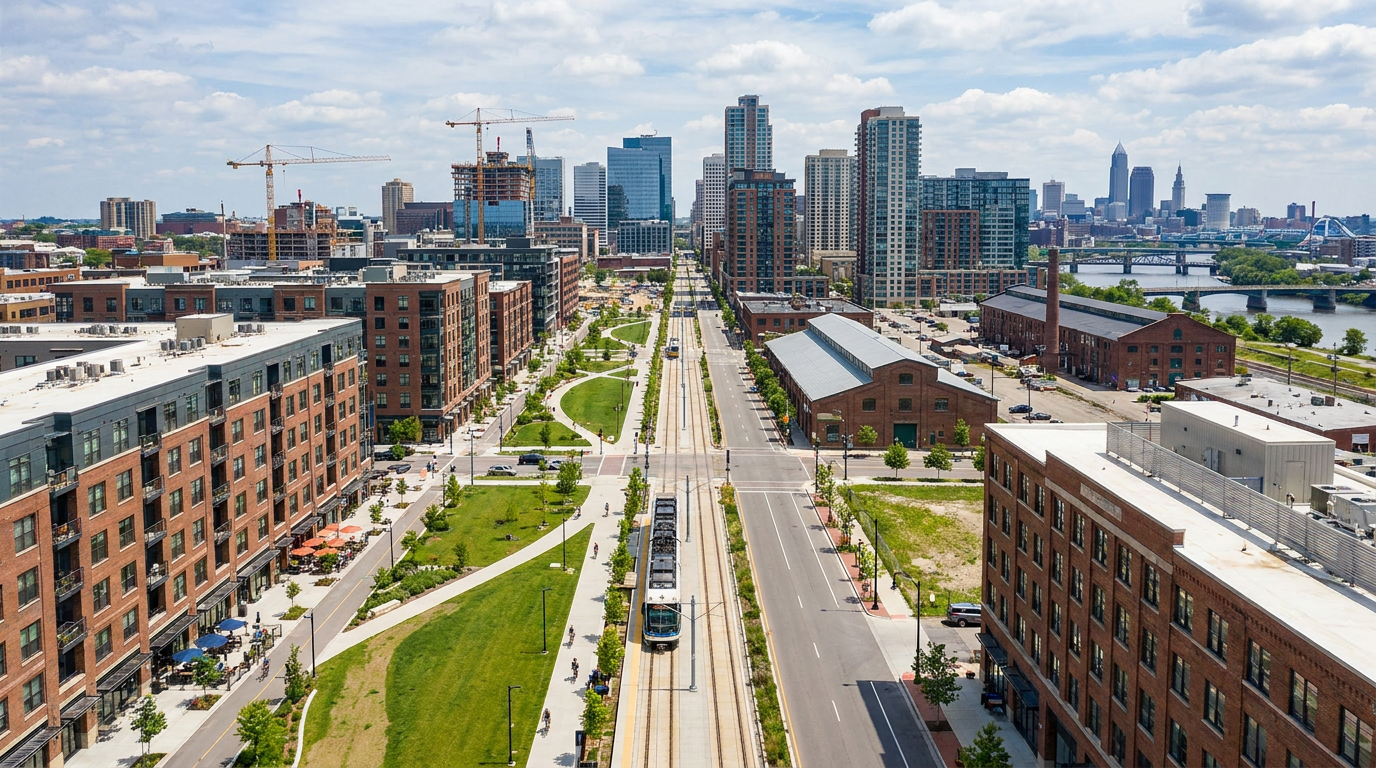
Competitive infrastructure strategy is therefore not only about building more. It is about sequencing investments to support productive density. A new rail line has greater economic value when station areas are zoned for mixed use growth. Utility upgrades generate more return when they unlock redevelopment in high demand areas. Public realm and street redesign can support retail resilience and neighborhood intensification when they are tied to broader land use strategy. The objective is to create urban systems where infrastructure and development reinforce each other.
This is also where regional collaboration matters. Labor markets and travel patterns rarely align neatly with municipal boundaries. If transit planning, housing growth, and employment lands are handled in isolation by separate local governments, the metro as a whole can become less efficient. A region may add homes in one municipality while jobs cluster in another, forcing long commutes and costly infrastructure duplication. Coordinated regional planning can mitigate these imbalances and strengthen the overall competitiveness of the metropolitan system.
Talent, Livability, and the Modern Competitive City
Economic development professionals often speak about talent attraction, but talent retention is just as important. A city can draw students, immigrants, and young workers through universities, employers, and cultural energy, then lose them a few years later if housing becomes unattainable or daily life becomes too burdensome. This is one reason livability is increasingly central to regional competitiveness. People evaluate places not only by wages but by the broader quality of urban experience.
The OECD’s more recent regional work has pointed to aging populations and urban population decline in core areas as emerging competitiveness challenges in North America. That observation matters because demographic pressure changes how cities must think about growth. Retaining working age residents, welcoming newcomers, and supporting family formation become more important when labor force expansion can no longer be taken for granted. A city that loses population dynamism may find that investment and innovation follow.
Livability, however, should not be confused with superficial placemaking. It is built through access and functionality. Good transit, nearby housing choices, safe public spaces, quality schools, healthcare access, and reliable municipal services all shape whether a city feels workable for households over the long term. These conditions influence not only individual decisions but also employer decisions. Firms want to locate where they can hire across income levels and where employees can realistically build stable lives.
Universities, colleges, hospitals, and major employers also play an outsized role in this equation. They are often anchor institutions in regional competitiveness strategy because they generate innovation, training, and steady employment. Cities that build strong partnerships with these institutions can align land use, housing, mobility, and workforce development more effectively. This is especially valuable around innovation districts, healthcare campuses, and transit linked employment hubs where public and private decisions have large multiplier effects.
Climate Resilience Is Now a Competitiveness Issue
Climate resilience has moved from the margins of planning to the core of investment decision making. Investors, insurers, developers, and households are paying closer attention to flood risk, heat exposure, infrastructure vulnerability, and adaptation costs. A region that underestimates these risks may still attract growth in the short term, but over time it can face rising insurance costs, service disruptions, asset impairment, and weakened investor confidence. In that sense, resilience is no longer separate from competitiveness. It is part of it.
For urban development, this means cities need to assess where and how they grow with greater discipline. Intensification in serviced, transit accessible areas can reduce emissions and improve land efficiency, but those same areas must be prepared for stormwater pressure, heat management, and grid reliability. Growth in vulnerable locations may appear easier at first, yet create larger fiscal burdens later. Competitive cities increasingly understand that resilience planning protects both communities and balance sheets.
There is also a market signaling dimension. Capital tends to favor places where long term risk is understood and managed. Clear adaptation standards, robust infrastructure planning, and transparent environmental assessment can strengthen confidence even when risks are real. By contrast, uncertain or reactive approaches create pricing problems. Investors must assume higher risk premiums, which can dampen development activity and raise housing costs. Resilience planning, then, is not only prudent public policy. It can improve the terms on which a city competes for investment.
Strategic Actions Cities Can Take to Improve Competitiveness
The most effective competitiveness strategies are coordinated and pragmatic. They do not rely on one grand project or one policy headline. Instead, they strengthen the development system across multiple fronts so that private and public investment can reinforce each other. The exact approach will vary by region, but several actions consistently matter.
-
Reform approvals to improve predictability. Clear policy frameworks, digital permitting, defined review timelines, and better interdepartmental coordination can reduce uncertainty and lower carrying costs without sacrificing planning quality.
-
Link land use to infrastructure delivery. Upzoning alone is not enough. Growth areas need water, wastewater, transportation, power, schools, and public realm improvements if they are to support serious development and retain community confidence.
-
Expand the housing mix. Competitive cities legalize and encourage missing middle, rental, mixed use infill, and higher density housing around transit while preserving space for employment and community services.
-
Use public land strategically. Surplus or underused public parcels can be assembled and deployed to support mixed income housing, station area development, institutional expansion, or catalytic district building.
-
Calibrate charges and fees to market reality. Municipal finance tools should support long term infrastructure goals without shutting down viable projects, especially in areas where new supply is urgently needed.
-
Build regional coalitions. Employers, universities, utilities, transit agencies, developers, and municipalities should work from a shared growth agenda rather than fragmented priorities.
-
Integrate resilience into growth planning. Flood protection, heat mitigation, energy reliability, and insurance risk need to be embedded in development strategy from the outset.
What ties these actions together is a shift in mindset. Competitive cities do not view development as a series of isolated applications. They see it as a long term system for producing housing, jobs, mobility, and fiscal capacity. That perspective allows them to prioritize reforms that have compounding value.
Common Misconceptions That Weaken Competitiveness Strategy
Several misconceptions continue to distort local debates about regional competitiveness. One is the belief that tax breaks or business subsidies are the primary drivers of urban success. Incentives can influence decisions at the margin, but they rarely compensate for structural weaknesses in housing, infrastructure, approvals, or talent access. Another misconception is that density itself guarantees competitiveness. Density creates opportunity, but only when it is paired with transit, services, and high quality urban management.
A third misconception is that infrastructure spending automatically creates land value. In reality, value uplift depends on market demand, supportive zoning, development capacity, and implementation quality. Without these conditions, major capital spending may improve mobility or service levels without unlocking significant redevelopment. A fourth misconception is that housing affordability belongs only in the social policy lane. In high cost regions, affordability directly influences labor supply, business attraction, and long term productivity.
Finally, some assume that any acceleration of approvals is inherently positive. Speed matters, but if approvals outpace infrastructure readiness or overlook growth management fundamentals, the result can be weak urban outcomes and public backlash. Competitiveness comes from alignment, not haste for its own sake.
Conclusion: Competitive Cities Are Deliberately Built
The future of regional competitiveness in urban development will be shaped less by slogans and more by execution. Cities that outperform will be those that treat housing supply, land use, infrastructure, transit, and governance as parts of a single strategic agenda. They will understand that land value is created through coordination, that talent follows livability as much as wages, and that resilience is now part of economic performance. Most importantly, they will recognize that growth must be shaped, not merely welcomed.
For Canada and North America, the stakes are high. Major metros remain powerful economic engines, but their advantages can erode when affordability deteriorates, approvals slow, or infrastructure fails to keep pace. The evidence from CMHC, the OECD, and the World Bank points in the same direction. Productive density, market connectivity, public private coordination, and housing capacity are essential to urban competitiveness. Regions that align these factors will be best positioned to attract investment and sustain it.
In practical terms, that means simplifying approvals, planning infrastructure with discipline, expanding the housing mix, using public land more strategically, and building stronger partnerships across sectors and jurisdictions. These are not abstract planning ideals. They are the operational foundations of urban success. A competitive city is not simply a place with growth. It is a place with the systems, capacity, and vision to convert growth into long term prosperity.
That is the real test of regional competitiveness. Not whether a city can win the next project announcement, but whether it can continue creating value, opportunity, and resilience decade after decade. The cities that understand this will not only attract development. They will shape stronger urban futures.



No Comment! Be the first one.