



Creating the Perfect Kids’ Playroom: A Step-by-Step Guide to a Safe, Personalized, Organized Space
There is something deeply joyful about a room designed just for play. A great kids’ playroom is not simply a place to keep toys out of the living room. It is a space that encourages imagination, supports daily routines, and gives children a setting where they can move, build, read, pretend, and rest in a way that feels natural. When it is designed thoughtfully, a playroom can also make family life calmer, cleaner, and more connected.
Table Of Content
- Why a Playroom Matters More Than You Might Think
- Step 1: Start with Your Family’s Real Life, Not a Trend
- Step 2: Choose the Best Location and Define Its Purpose
- Step 3: Put Safety at the Center of the Plan
- Step 4: Create Zones That Support Different Kinds of Play
- Step 5: Build an Organization System Children Can Actually Use
- Step 6: Personalize the Space Without Overcommitting to a Theme
- Step 7: Choose Furniture That Supports Comfort, Safety, and Longevity
- Step 8: Design for Active Play, Not Just Quiet Toys
- Step 9: Add a Calm-Down Corner for Emotional Wellness
- Step 10: Make Art and Creativity Easy to Access
- Step 11: Plan Carefully for Shared Sibling Spaces
- Step 12: Keep the Room Flexible as Your Child Grows
- A Simple Step-by-Step Checklist to Pull It All Together
- Common Mistakes to Avoid
- Final Thoughts: Create a Room That Feels Good to Live In
What matters most is not perfection or a magazine-ready look. The best playrooms feel welcoming, easy to use, and responsive to the real children who live in the home. They reflect a child’s interests without becoming so fixed that the room feels outdated six months later. They also support wellness by making space for active play, reducing clutter, and creating a better balance between screen time and hands-on activity.
Research consistently shows that play supports children’s social-emotional, cognitive, language, and self-regulation development. That means a playroom is more than a decorative project. It can become an environment that actively supports growth, confidence, and creativity. If you approach the room as a system rather than just a styled corner, you can create a space that serves your family beautifully now and continues to work as your child grows.
In this guide, we will walk through the process step by step, from choosing the right room and setting priorities to handling safety, storage, personalization, and future flexibility. The goal is simple: to create a playroom that feels fun for children, manageable for adults, and full of the warmth that makes a house feel more like home.
Why a Playroom Matters More Than You Might Think
Children do not need a giant space or expensive furnishings to play well, but they do benefit from an environment that makes play feel possible. When toys are accessible, books are visible, and movement is encouraged, children are more likely to engage independently and creatively. A well-planned playroom can support pretend play, sensory exploration, construction, problem solving, and quiet time, all within the rhythm of everyday life.
This matters because play is closely tied to healthy development. Pediatric and child development guidance connects play to learning, language growth, emotional regulation, and social skills. It also helps children process experiences and practice independence. In practical terms, a thoughtfully arranged room can support everything from storytelling and reading to gross motor movement and calm-down routines.
There is also a family lifestyle benefit that should not be overlooked. When children have a space that is designed around their needs, the entire home often feels less chaotic. Cleanup becomes easier when everything has a place. Shared rooms become more peaceful when activities are zoned. Parents can supervise more comfortably when the layout is open and intentional. A good playroom does not remove the mess of childhood entirely, but it can make that beautiful mess feel far more manageable.
A successful playroom is not just cute. It is safe, flexible, easy to maintain, and supportive of the kind of play that helps children grow.
Step 1: Start with Your Family’s Real Life, Not a Trend
Before buying storage bins or choosing a wall color, take a step back and think about how your family actually lives. The most satisfying playrooms begin with honest observation. Consider your child’s age, interests, energy level, and daily routine. Think about whether the room needs to support messy art, active movement, reading, sibling sharing, or a little of everything.
It is also helpful to think about what is not working elsewhere in the home. Maybe blocks are always taking over the dining area. Maybe your child wants a cozy spot for books, but their bedroom feels too stimulating at bedtime. Maybe older siblings need a place for puzzles and games that younger children cannot safely access. The answers to these everyday frustrations often shape the smartest playroom plan.
Style trends can be inspiring, but they should not lead the entire design. A neutral playroom with beautiful shelves can still fail if it lacks floor space for building. A heavily themed room might feel exciting at first, but it can become limiting quickly. Start instead with function, mood, and family habits. Once those foundations are clear, the visual layer becomes much easier to create.
Ask yourself a few practical questions before you begin. How many children will use the room? What ages are they? Will an adult often sit in the room too? Does the space need to include reading, movement, art, and storage all together? Answering these questions early will save time, money, and frustration later.
Step 2: Choose the Best Location and Define Its Purpose
Not every family has a spare room to dedicate to play, and that is perfectly fine. A playroom can be a finished basement, a converted guest room, part of a family room, a large bedroom corner, or even a well-organized loft area. What matters most is that the space feels visible, safe, and usable. Good supervision and easy daily access are often more important than square footage.
If your children are younger, a playroom near the kitchen or living area may work best because adults can keep an eye on them while moving through the day. If your children are older and more independent, a bonus room or basement can offer more freedom for hobbies, building projects, games, and creative sprawl. Shared spaces can work beautifully too, as long as the room is clearly zoned and storage is thoughtfully divided.
Once you know where the playroom will live, define its main purpose. Is it primarily a creative play space, an activity room, a calm reading room, or an all-in-one family zone? A room can absolutely serve multiple functions, but you will get better results if you identify the top priorities first. For many families today, the ideal setup includes active play, open-ended toys, books, art, and low-stress storage in one adaptable environment.
It is also worth considering how the room may evolve. A toddler playroom and a school-age hangout have different needs, yet the most practical rooms are designed with both in mind. Choosing a location that can support future transitions makes every design decision more worthwhile.
Step 3: Put Safety at the Center of the Plan
Safety should be the first design layer in any kids’ playroom. It is easy to focus on paint, furniture, and decor, but none of that matters if the room has preventable hazards. A common misconception is that anything sold for a nursery or playroom is automatically safe. In reality, parents still need to think carefully about furniture anchoring, toy age labels, cord management, storage height, and loose parts.
Health Canada advises keeping small toys and loose parts away from children under three because of choking risk. That guidance should shape not just what you buy, but how you store it. If older siblings use magnetic tiles with tiny accessories, craft kits with beads, or toys with button-cell batteries, those items need secure, adult-managed storage. The same is true for high-powered magnets and battery-operated items with easy-access compartments, both of which remain serious hazards in children’s spaces.
Choose toys that are age appropriate and check labels carefully. In the United States, toys intended for children 12 and under must be third-party tested and certified under federal rules that include the ASTM F963 toy safety standard. In practical terms, that means the age guidance on packaging matters. It is not just a suggestion about skill level. It can also signal important safety information related to choking, misuse, or ingestion hazards.
Beyond toy selection, make the room physically safe. Anchor tall furniture to the wall to reduce tip-over risk. Keep cords out of reach and avoid blinds with hazardous loops. Choose stable, rounded furniture where possible. Make sure rugs do not slide. Store batteries securely and check that battery compartments on toys are screw-closed. If the room includes climbing elements, soft flooring and close supervision become even more important.
A safe playroom still feels beautiful and welcoming. In many ways, good safety choices enhance comfort. Low furniture makes the room feel open. Hidden cable management creates calm. Smart storage reduces visual clutter. The safest rooms are often the ones that feel the easiest to live in.
Step 4: Create Zones That Support Different Kinds of Play
One of the most effective ways to design a playroom is to think in zones rather than in furniture pieces. Children naturally move between different play modes throughout the day. They may want to build on the floor, read in a corner, draw at a table, and then move into pretend play or active play. Zoning helps the room feel more intuitive and reduces the sense of chaos that comes from having every toy and activity mixed together.
A simple zoning plan often includes an open floor area, a reading nook, a creative table, and dedicated storage. If space allows, you can also add a pretend play corner, a sensory area, or a calm-down space. These zones do not need walls or expensive built-ins. They can be created with rugs, shelving orientation, lighting, and the placement of furniture.
The open floor zone is the heart of many playrooms because it supports building, puzzles, imaginative games, and movement. Keep this area relatively clear and flexible. Children often use the floor in ways adults do not fully anticipate, so preserving that open space is one of the kindest design choices you can make.
The quiet zone should feel soft and inviting. A low bookshelf, floor cushions, and a washable rug can turn a small corner into a beloved reading retreat. This matters because a playroom should not only energize children. It should also support moments of rest, focus, and self-regulation. The best family spaces often balance activity and calm in equal measure.
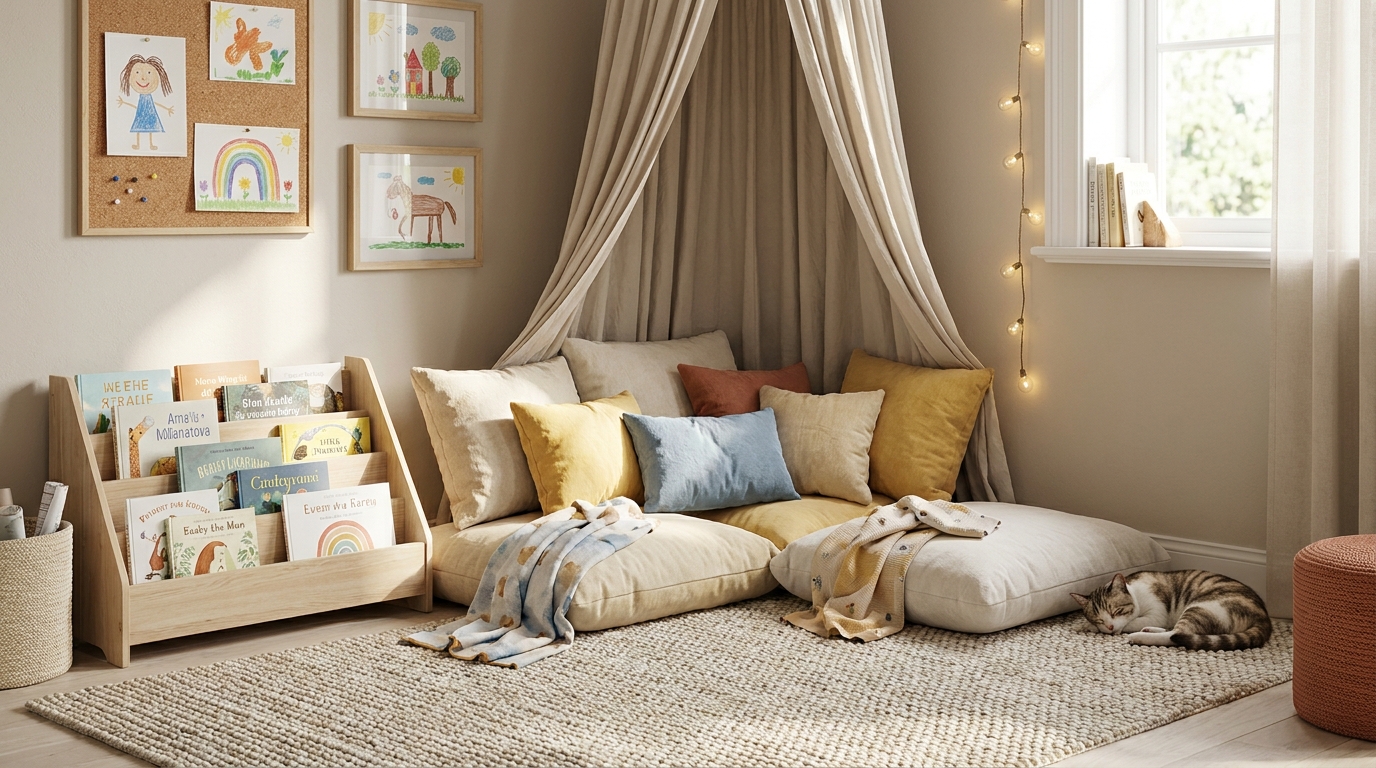
The creative zone benefits from surfaces that are easy to clean and supplies that are thoughtfully edited. A child-sized table works well for coloring, puzzles, clay, and simple crafts. The goal is not to display every marker and sticker all at once. Instead, create a setup that feels usable without becoming visually overwhelming.
If your child needs more physical activity indoors, consider a gross motor zone as well. This might be as simple as soft mats, a balance board, stepping stones, or enough open space for movement games. Public health guidance in Canada recommends one hour of physical activity daily for children ages five to eleven, and a home playroom can absolutely help support that goal, especially during cold or rainy seasons.
Step 5: Build an Organization System Children Can Actually Use
A beautiful playroom will not stay functional for long without an organization system that matches a child’s age and habits. This is where many rooms struggle. Adults often create storage that looks orderly in a photo but is too complicated for everyday use. Children are much more likely to clean up and play independently when toys are visible, reachable, and grouped in a way that makes sense.
Open storage is especially effective in playrooms. Health Canada’s nursery guidance recommends open toy storage such as baskets or canvas bins, and that advice translates well here. Soft-sided bins reduce hard corners, make cleanup faster, and allow children to see what they have. Low shelves also support independence because kids can choose activities and put them away with less help.
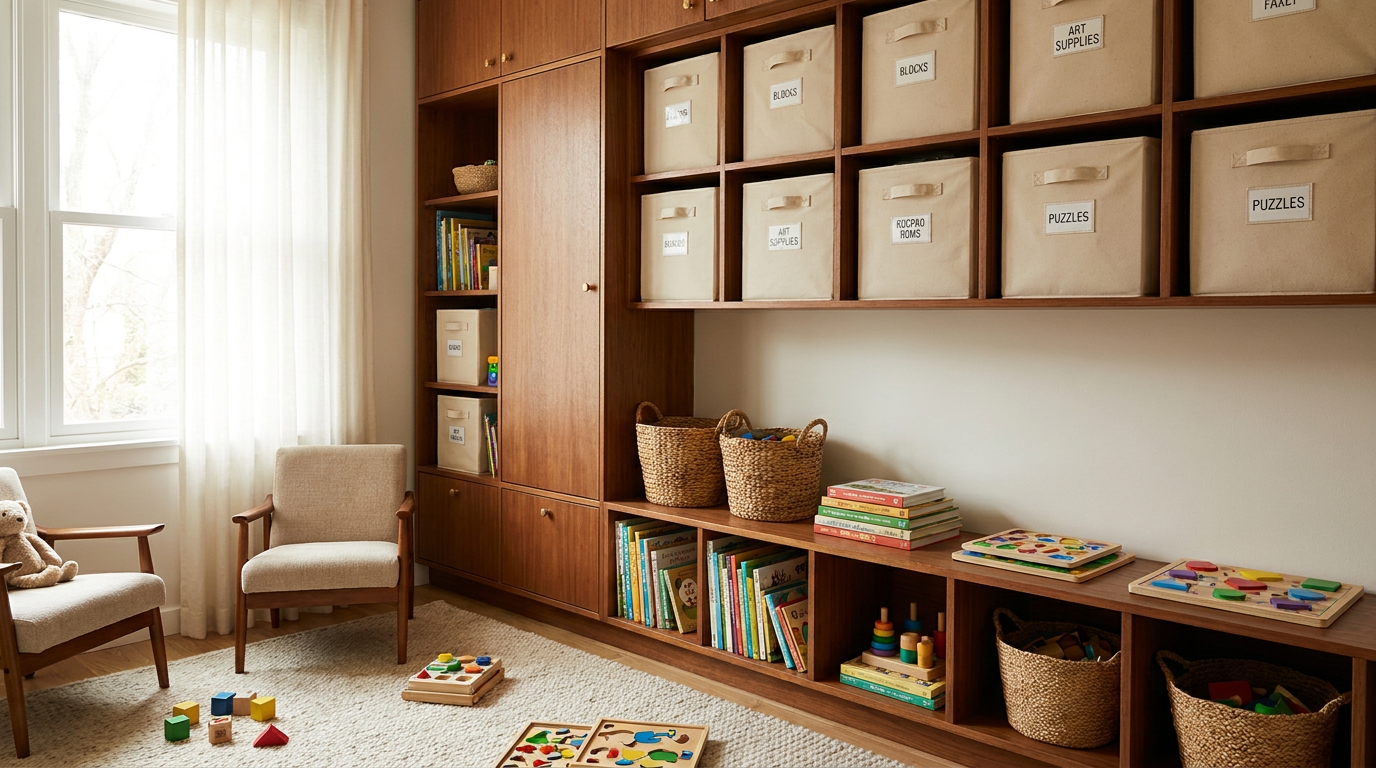
The key is to separate storage by both category and access level. Everyday favorites should live low and within reach. Puzzles, dolls, blocks, dress-up pieces, and books often belong in this category. More complex items such as craft materials, board games with many parts, magnetic sets, or age-gated toys should be stored higher. This creates a natural safety layer while also preventing overuse of messy materials when supervision is limited.
Labeling can make a big difference, especially for preschoolers and school-age children. Labels with words, pictures, or both help children learn where items belong and participate in cleanup more confidently. The goal is not a rigid system that feels stressful. It is a gentle structure that helps the room reset quickly at the end of the day.
Toy rotation is another useful tool if the room feels cluttered. Instead of storing every toy in the playroom at once, keep some items tucked away and rotate them every few weeks. This can make the room feel fresh without adding more to it. It also helps children engage more deeply with what is available rather than bouncing constantly from one option to the next.
Most importantly, try not to let storage become purely decorative. The playroom should not feel like a showroom where children are afraid to disturb the arrangement. It should feel intuitive, forgiving, and easy to maintain. Real organization supports real life.
Step 6: Personalize the Space Without Overcommitting to a Theme
Personalization is what transforms a useful room into a beloved one. Children feel seen when their interests are reflected in their environment. That might mean a space for dinosaur figurines, a wall shelf for favorite books, a nature table, framed artwork, or a pretend kitchen stocked for imaginary cafe mornings. These details bring warmth and identity into the room.
The smartest approach is to personalize through layers that can change over time. Use a flexible base with adaptable furniture, neutral larger pieces, and a layout that can evolve. Then bring in your child’s personality through art, textiles, removable wall decals, display ledges, and activity stations. This lets the room feel current without becoming locked into a single age or obsession.
For example, a child who currently loves outer space may adore star prints, books about planets, and a rocket tent. But instead of painting a giant mural that dominates the room, consider adding space-themed cushions, rotating artwork, and a dark blue reading corner that can later shift into something else. The room still feels special, but it remains easy to refresh as interests change.
Displaying your child’s own creations is one of the most meaningful personalization tools of all. A simple gallery rail, magnetic board, or framed art wall instantly makes the room feel alive and personal. It also reinforces the idea that the playroom is a place for expression, not just consumption. Children often respond strongly to seeing their work valued in the home.
Color can support personality too. You do not need to avoid color to achieve a polished design. A calm base with playful accents often works beautifully. Soft greens, warm whites, dusty blues, sandy neutrals, and gentle corals can all feel cheerful without becoming visually exhausting. A room that feels lively and grounded tends to age more gracefully than one built entirely around bright novelty.
Step 7: Choose Furniture That Supports Comfort, Safety, and Longevity
Furniture in a playroom should feel scaled, comfortable, and durable. It should invite use without creating unnecessary hazards. Low shelving, a washable rug, child-sized seating, and a sturdy table are often enough to form the foundation of the room. If you are working with a larger space, you can add a daybed, floor cushions, a bench with hidden storage, or a small wardrobe for dress-up clothes.
Look for rounded edges, stable bases, and surfaces that are easy to wipe down. Soft furnishings should be durable and washable because they will inevitably be used for forts, snack breaks, tumbles, and the occasional marker mishap. Avoid overcrowding the room with too many furnishings. Children need clear visual access and floor freedom far more than they need lots of tiny decorative objects.
It is also wise to think long term. A tiny toddler table may be perfect now, but an adjustable table or simple children’s desk might last much longer. Cubby shelves can hold board books today and chapter books or games later. A bench with bins underneath can shift from stuffed animals to school supplies over time. The more adaptable each piece is, the more sustainable and cost-effective the room becomes.
If adults will spend time in the room, add at least one comfortable spot for them too. A supportive chair, upholstered ottoman, or compact loveseat can make a tremendous difference in how often the room is used. Children are usually drawn to spaces where connection feels easy. A playroom that welcomes both play and togetherness often becomes one of the most loved rooms in the house.
Step 8: Design for Active Play, Not Just Quiet Toys
Many playrooms are designed around shelves and seated activities, but children also need movement. Active play supports coordination, confidence, and energy regulation, and it can be especially valuable when outdoor time is limited. This does not mean every playroom needs climbing walls or gym equipment. It simply means the room should leave space for the body as well as the imagination.
Think about how your child naturally moves. Do they build obstacle courses, dance, tumble, or jump from cushion to cushion? If so, preserve floor space and include soft, movable elements they can use safely. Large floor pillows, foam mats, stepping stones, and balance toys can bring an active quality to the room without overwhelming it visually.
This is also where screen balance comes into the conversation. While some digital tools can be entertaining or educational, they should not dominate the playroom. Pediatric guidance emphasizes that off-screen physical and imaginative play offers benefits that screens cannot fully replace. A room that leads with open-ended activities tends to invite longer, richer engagement.
If your child is school-age, active play can be incorporated in more subtle ways. A basket of movement cards, a yoga mat, a mini indoor basketball setup, or simply enough open space for music and dance can make the room feel much more dynamic. The atmosphere you create matters. When movement feels welcome, children are more likely to use the room in healthy, energetic ways.
Step 9: Add a Calm-Down Corner for Emotional Wellness
One of the most thoughtful additions you can make to a playroom is a calm-down corner. This is not a punishment space. It is a supportive area where children can reset, breathe, and regulate when they feel overstimulated, frustrated, or tired. In a room full of color, noise, and activity, a quiet retreat can be incredibly grounding.
A calm-down corner can be very simple. A soft rug, a few cushions, a canopy, sensory bottles, favorite books, and gentle lighting may be all you need. Some families like to include emotion charts, stuffed animals, or headphones for quiet listening. The goal is to create a corner that feels comforting and separate without feeling isolated.
This type of zone supports self-regulation, which is one of the many developmental benefits connected to play. It also sends a lovely message about home life. Feelings are welcome here. Rest is part of play. Quiet moments matter too. In family spaces, those subtle messages shape atmosphere just as much as design choices do.
For children who share the playroom, a calm corner can also help reduce conflict. When one child wants stimulation and another needs quiet, a designated retreat gives both needs a place in the room. That kind of emotional flexibility is often what makes a shared play space truly work.
Step 10: Make Art and Creativity Easy to Access
Creative play deserves a place of its own because it invites children to invent, experiment, and express themselves. An art area does not need to be elaborate, but it should be practical. Children are much more likely to draw, cut, paint, and build when the setup feels inviting and manageable rather than complicated or overly precious.
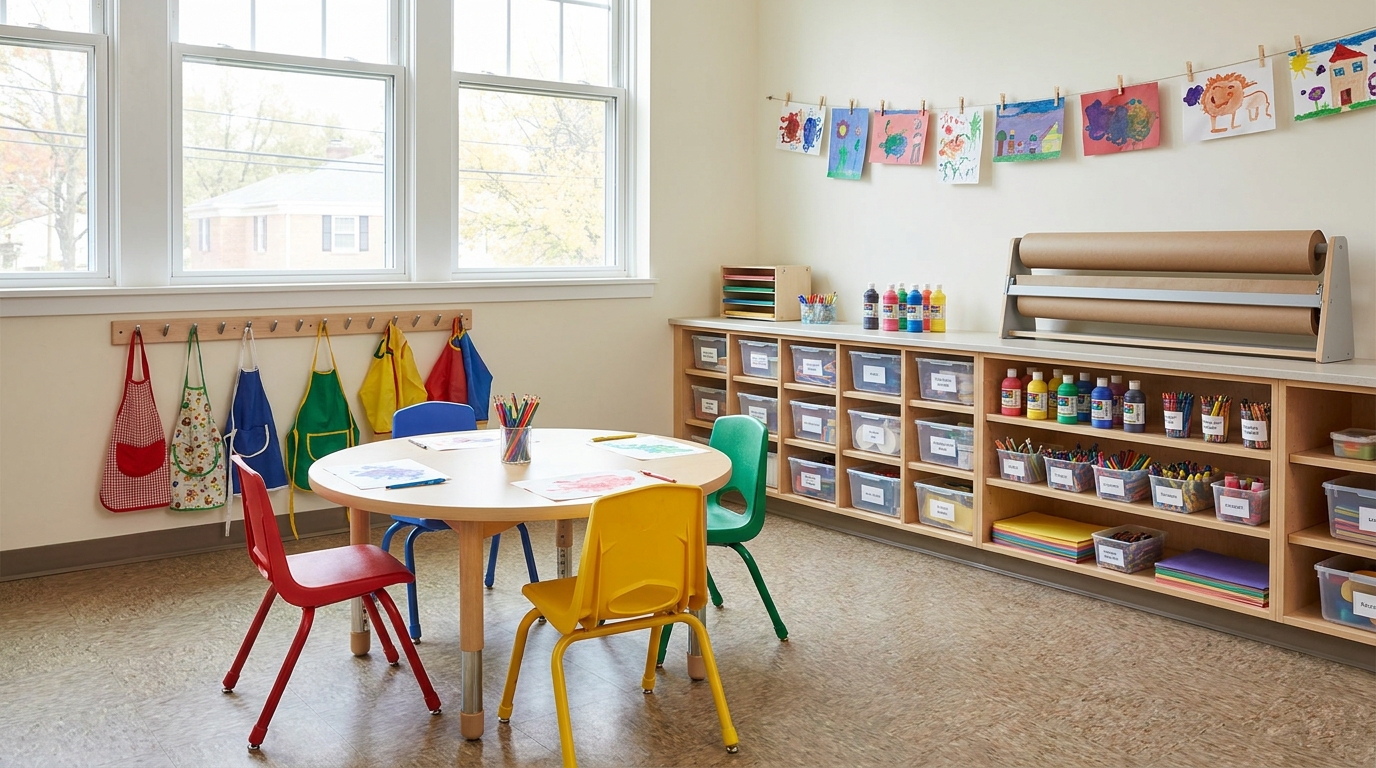
Choose a table and chairs that fit comfortably within the room and leave enough surrounding space for movement. Keep a few core materials available, such as crayons, washable markers, paper, glue sticks, and child-safe scissors, depending on age. Store more advanced or messier supplies higher up so they can be used with supervision. This creates a healthy balance between independence and safety.
If possible, include a place to display current artwork. A line with clips, a corkboard, or a slim shelf can help the room feel more personal while celebrating process rather than perfection. Children often take pride in returning to a room where their ideas are visible and respected.
Try to keep the setup edited. Too many supplies can create decision fatigue and more mess than creativity. A smaller, well-organized selection often leads to deeper, more satisfying engagement. The playroom should inspire making, not overwhelm it.
Step 11: Plan Carefully for Shared Sibling Spaces
Many playrooms are shared by siblings of different ages, which adds complexity but also beautiful possibilities. A shared room can encourage collaborative play, imagination, and family connection. It just needs stronger zoning and clearer storage boundaries to work safely and peacefully.
When toddlers and older children share a space, age grading is essential. Small pieces, magnets, batteries, and advanced building sets should be stored out of reach and ideally in closed containers managed by adults. Even if an older sibling is responsible most of the time, loose parts can easily travel across the room. This is one of the most common and important safety issues in family play spaces.
Try to give each child a sense of ownership within the room. This might mean separate bins, a dedicated shelf, or a particular corner for favorite activities. Shared spaces function best when they honor both togetherness and individuality. A room that belongs to everyone can still include moments that feel personal to each child.
Consider rhythm as well as storage. If one child uses the room for homework while another wants to play pretend, furniture placement and sound management become more important. Rugs, bookcases, and soft textiles can subtly divide activity zones and make the room feel calmer for everyone.
Step 12: Keep the Room Flexible as Your Child Grows
The most successful playrooms are designed with change in mind. Childhood moves quickly, and rooms that adapt gracefully are always more useful than rooms built only for one stage. Today’s doll corner may become tomorrow’s LEGO table, reading lounge, or homework nook. Flexibility keeps the room relevant and prevents constant redesign.
Start with foundational pieces that can shift over time. Open shelving, tables, benches, and soft seating are more versatile than highly specific novelty furniture. Leave wall space available for changing art, interests, and storage needs. Avoid overfilling every corner. Empty space is valuable because it allows the room to evolve naturally.
As children grow, the balance of the room may shift from toy-based play toward hobbies, games, reading, and creative work. You might replace toy bins with baskets for sports gear or art tools. You might add a desk lamp, bulletin board, or more mature bookshelves. If the room was designed around systems rather than a fixed theme, these transitions will feel easy instead of disruptive.
This idea can be reassuring for parents who hesitate to invest in a playroom. You are not designing a temporary fantasy. You are creating a supportive family space that can change shape as the people who use it change too.
A Simple Step-by-Step Checklist to Pull It All Together
If the process feels overwhelming, it helps to break the work into a clear sequence. You do not need to finish everything in a weekend. In fact, the best results often come from observing the room for a few weeks and adjusting as your child begins to use it.
-
Choose the location and define the room’s main functions based on your family’s habits, your child’s age, and the type of play you want to support.
-
Complete the safety layer first by anchoring furniture, managing cords, checking rugs, reviewing toy age labels, and separating any small parts, magnets, or batteries from toddler-accessible areas.
-
Create zones for open play, reading, art, and calm time using rugs, furniture placement, and lighting rather than cluttering the room with too many pieces.
-
Install accessible storage with low bins, open baskets, and labels that make cleanup simple for children and adults alike.
-
Add personality through books, art displays, favorite colors, and flexible decor that reflects current interests without locking the room into a short-lived theme.
-
Edit toys regularly, rotate what is available, and adjust the room over time as your child’s play patterns and developmental needs change.
Common Mistakes to Avoid
Even with the best intentions, a few common mistakes can make a playroom harder to use. One is prioritizing appearance over function. If the room looks lovely but children cannot reach their toys or use the furniture comfortably, it will not support independent play well. Another is storing too much in the room at once. Overcrowding often leads to mess, distraction, and reduced engagement.
Another frequent mistake is assuming that toy choice alone determines safety. In reality, safe playrooms depend just as much on how toys are stored, whether furniture is anchored, and whether loose parts are kept in the right places. Older siblings’ toys, especially those with tiny accessories, magnets, or batteries, deserve careful management.
Some families also lean too heavily on screen-based entertainment in the playroom. While technology may have a place in family life, a playroom should primarily invite imaginative and physical play. The room should make it easy for children to build, move, draw, read, and invent. That is where so much developmental richness lives.
Finally, try not to design the room too rigidly all at once. It is normal to adjust storage, swap zones, or simplify after seeing how your child actually uses the space. A playroom is a living room in the truest sense. It grows through use.
Final Thoughts: Create a Room That Feels Good to Live In
The perfect kids’ playroom is not the biggest, trendiest, or most expensive one. It is the one that works beautifully for your child and your household. It feels safe without feeling sterile. It feels organized without feeling stiff. It reflects your child’s personality while still leaving space for imagination, mess, movement, and growth.
When you focus on personalization, safety, and organization together, the room becomes much more than a container for toys. It becomes part of your family’s daily rhythm. It supports creativity on quiet mornings, active play on rainy afternoons, and little moments of independence that build confidence over time. It can even make the entire home feel calmer and more connected.
Most of all, a well-designed playroom honors something important about childhood. Play is not extra. It is essential. By creating a space that welcomes it fully, you are making a meaningful investment in your child’s development and in the atmosphere of your home. And that is the kind of design choice that always feels worthwhile.



No Comment! Be the first one.