



Family life rarely happens in perfect, picture-ready moments. It unfolds in the in-between spaces of the day, around a table after dinner, on the floor during a puzzle, in a corner chair with a stack of books, or during a spontaneous conversation while someone colors and someone else folds laundry nearby. Family activity spaces are the rooms or flexible zones in a home, such as a family room, dining nook, playroom corner, or multipurpose area, set up to support shared activities like games, reading, homework, and movement alongside quiet rest. They are not simply rooms with furniture. At their best, they become gentle frameworks for connection, creativity, rest, and routine, adapting to whatever the day actually calls for rather than serving just one fixed purpose.
Table Of Content
- Why intentional design changes the way a family lives
- Start with real family behavior, not an idealized room
- The best family spaces balance togetherness and autonomy
- How to create flexible zones in one room
- Choose comfort first, because comfort invites people to stay
- Storage is one of the kindest design decisions you can make
- Design for movement, creativity, and learning, not just lounging
- Make space for quiet regulation and emotional reset
- Natural light, plants, and warmth make a room feel alive
- Let personality in because family spaces should feel real
- Designing for multigenerational and accessible living
- How to improve a family activity space without renovating
- Small room ideas for family activity spaces
- What inviting family spaces really give back
When a home is designed with intention, it can support family interaction in ways that feel both natural and deeply comforting. Research on home environments suggests that the physical features of a dwelling are linked to family functioning, including emotional expression, responsiveness, and decision-making. In simple terms, the way a home is arranged can influence how easily people gather, how calmly they move through the day, and how much room there is for both togetherness and personal space. A well-loved family activity area should feel welcoming, flexible, and emotionally supportive rather than purely practical.
This matters in homes of every size. There is a common belief that better family life requires more square footage, but that is not necessarily true. What often matters more is how a home handles circulation, storage, noise, light, and the different rhythms of the people living there. Even a modest apartment or compact house can become a warm and functional family hub when its spaces are arranged around behavior, comfort, and real daily needs.
In this guide, we will look at how to create inviting family activity spaces that support board games, reading, homework, movement, movie nights, quiet decompression, and shared learning. We will also explore why flexibility, zoning, softness, and emotional warmth deserve just as much attention as style. Because a beautiful home is not only one that looks good. It is one that makes family life feel easier, calmer, and more connected.
Why intentional design changes the way a family lives
It is easy to think of design as visual. We notice color palettes, upholstery, shelving, and whether a room feels modern or traditional. But in family homes, the most meaningful design choices often influence behavior before they influence appearance. A thoughtfully placed table invites someone to sit down and stay a while. A basket near the sofa makes cleanup feel effortless. A reading lamp by the window quietly encourages a child to choose a book instead of a screen. These details shape the flow of daily life in subtle but powerful ways.
A SAGE research study on family interaction in homes found that homes that best facilitated family life needed to accommodate specific activities, multiple activities in the same location, household tasks, and aesthetic appeal. That combination is especially important today, when one room may need to support snack time, homework, conversation, active play, and quiet winding down, all within a single afternoon. The most successful family activity spaces are not rigidly designed for one purpose. They are layered enough to adapt with the day.
There is also an emotional dimension to intentional design that should not be overlooked. When a space feels easy to use, people are more likely to relax in it. When family members know there is a place for craft supplies, a corner for alone time, and a central spot for gathering, the home starts to feel more supportive and less chaotic. This can reduce everyday friction and make connection more likely.
The goal is not perfection. The goal is to create spaces that quietly invite your family to spend time together, return to familiar routines, and feel at home in the fullest emotional sense.
Intentional design also helps families respond to different ages and stages. A room that works beautifully for toddlers may feel restrictive once children are older. A corner once used for toy storage might become a homework station or a puzzle table. A home that can evolve without constant renovation is often one that serves family life best over time.
Start with real family behavior, not an idealized room
Before choosing paint colors or shopping for storage, it helps to pause and observe how your family already lives. Which activities happen most often. Where do people naturally gather. At what time of day does the home feel calm, and when does it feel congested. Which surfaces become clutter magnets, and which corners are always empty. These patterns reveal far more than trend boards ever could.
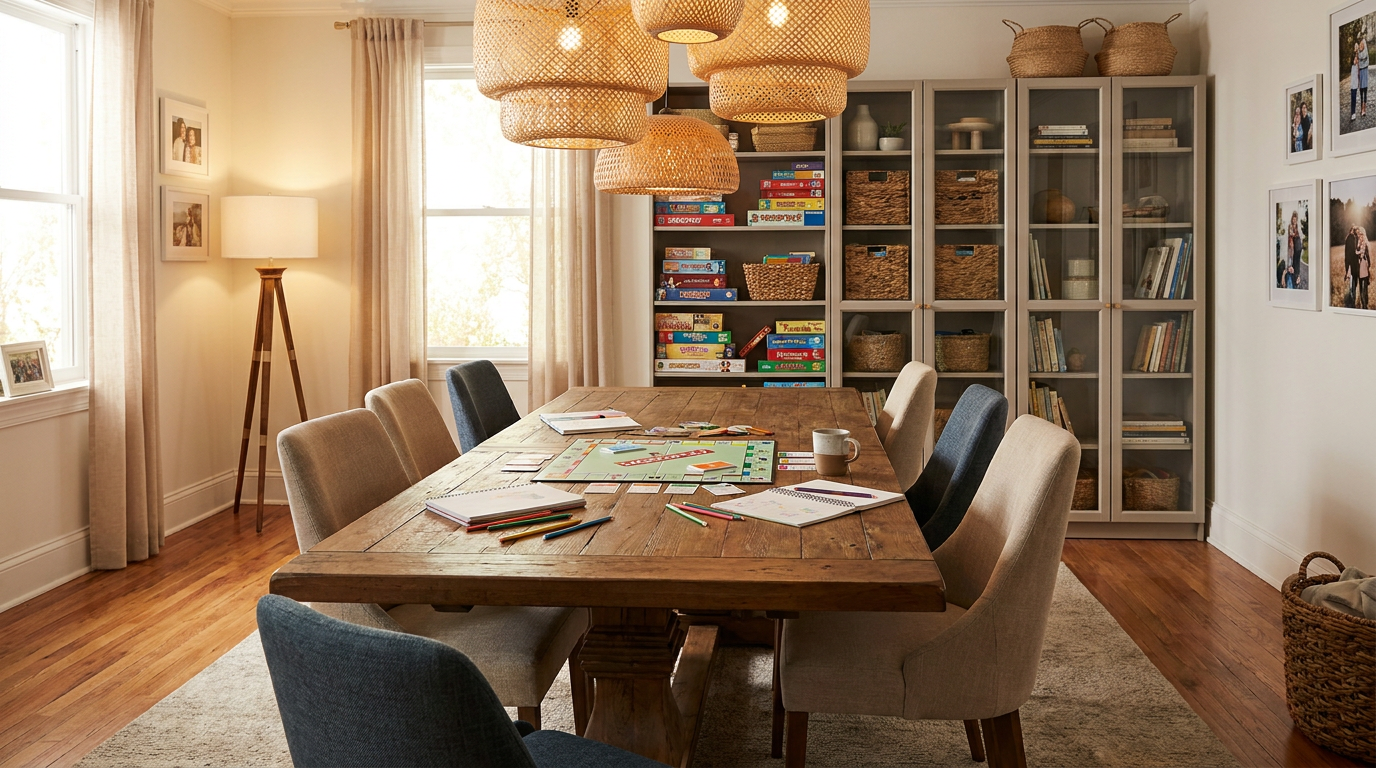
Designing around behavior means letting daily routines lead the plan. If your family loves board games after dinner, the dining area may need better lighting, more comfortable chairs, and a nearby cabinet for games. If children like to draw while adults cook, the kitchen may benefit from a small adjacent activity table. If someone in the family needs quiet after school or work, a tucked-away reading nook can become just as important as the main gathering room.
Research also supports this adaptability. A PubMed study of 739 preschool children found that parent-child interaction frequency varied by child age and sibling structure. That tells us something important for design. There is no one-size-fits-all family room. Spaces need to work across ages, personalities, and household compositions. A successful family activity area is one that can stretch and shift without losing its sense of ease.
One of the most useful exercises is to make a simple list of your household’s recurring activities. Include obvious ones such as meals, games, reading, homework, crafts, and movie nights, but also think about smaller rituals such as morning coffee together, after-school decompression, phone calls with grandparents, or weekend baking. These routines are often where emotional memory lives, and they deserve a home within the home.
The best family spaces balance togetherness and autonomy
One of the biggest misconceptions in family-centered design is that open, always-shared space is automatically best. In reality, family life tends to work more smoothly when there is a balance between gathering and retreat. People need connection, but they also need moments of regulation, privacy, and quiet. A room that offers both can feel far more generous than one that simply tries to keep everyone in the same place all the time.
Research and housing guidance consistently show that crowding and poor space allocation can undermine sleep, privacy, and positive interaction. The World Health Organization defines household crowding as inadequate space for living, sleeping, and normal family and household activities, and studies connect crowding with health and behavioral risks. That does not mean every home needs more rooms. It means that boundaries, zoning, and thoughtful space planning matter deeply.
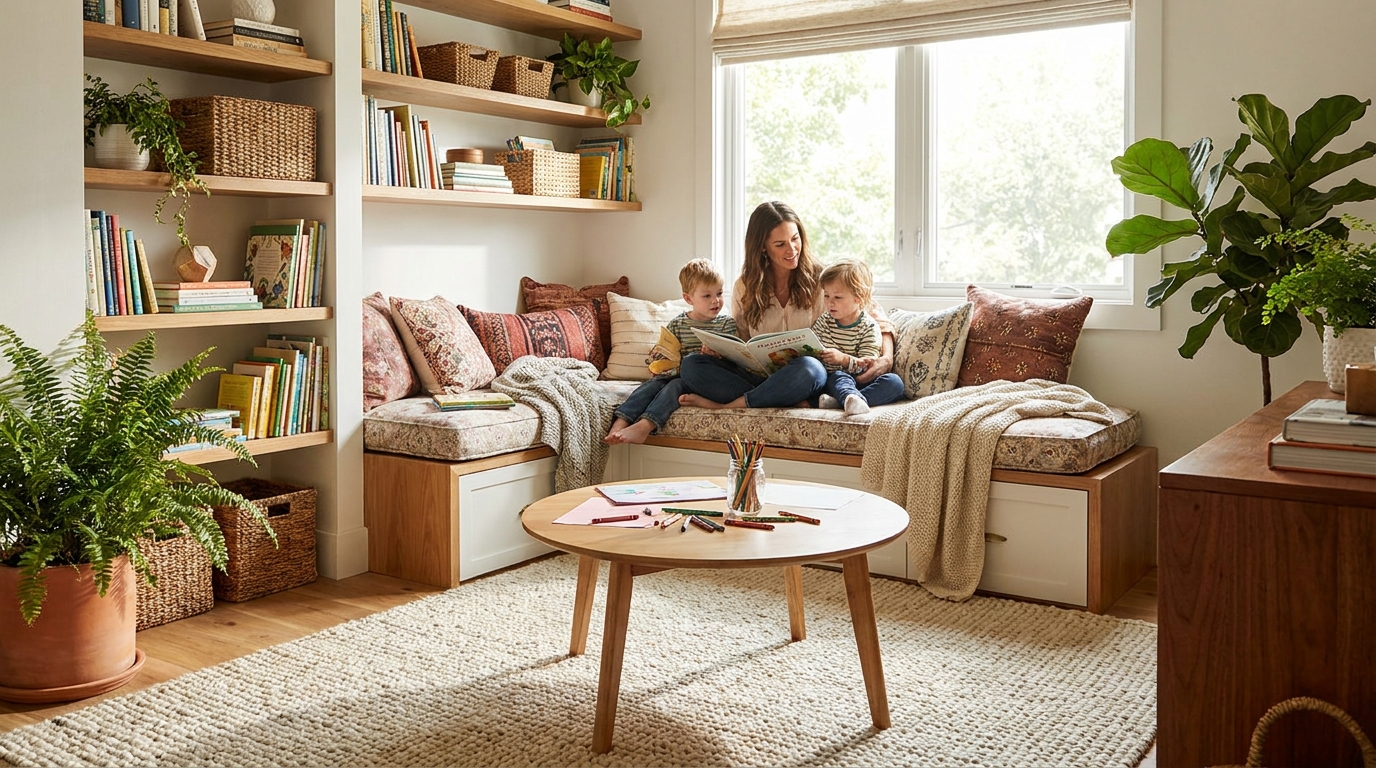
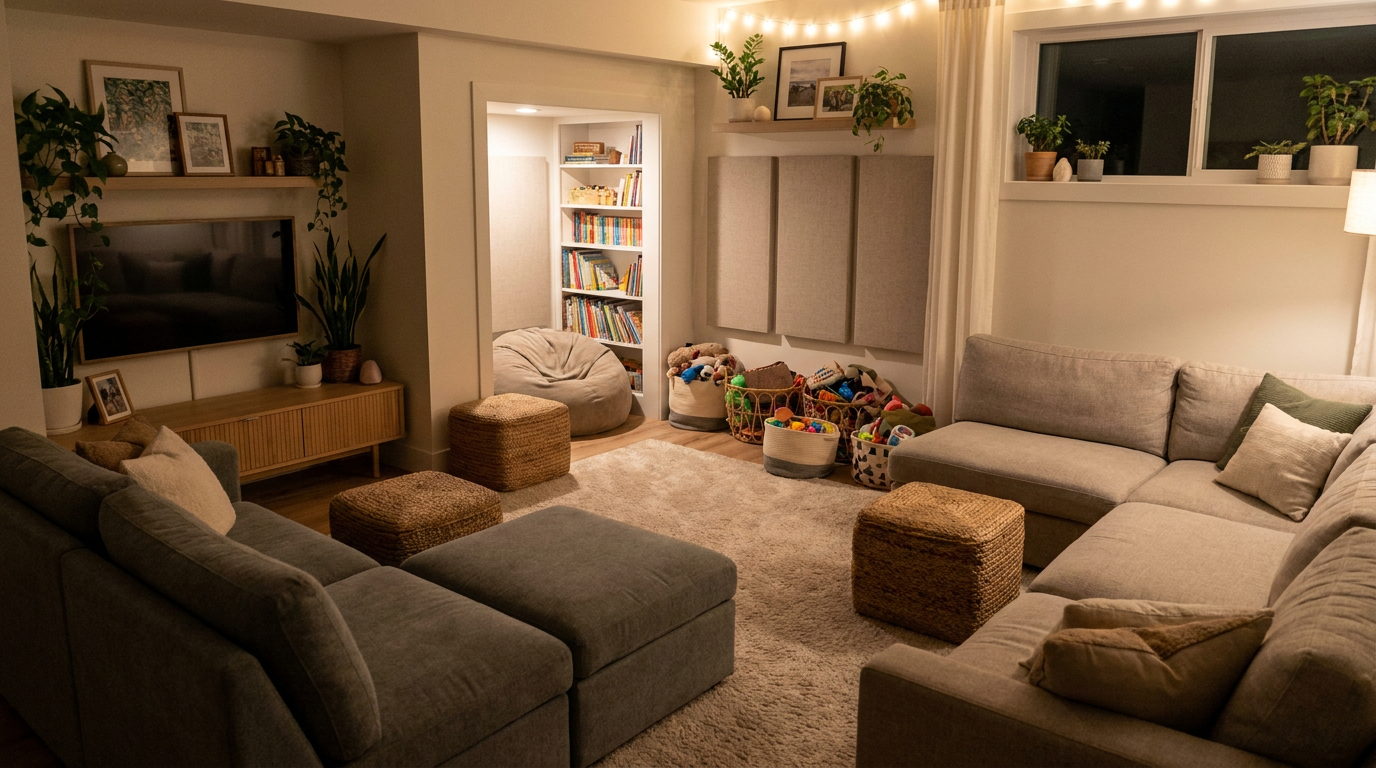
In practical terms, this may look like a central gathering area paired with smaller secondary zones. A family room might have a main seating area for conversation and movie nights, plus a nearby window seat for solo reading. A dining room might include the primary table for group activities, with a side console that becomes an independent homework surface. A basement den might support active play in one section and calm sensory rest in another. Togetherness feels better when it is chosen, not forced.
This balance is especially useful in homes shaped by remote work, hybrid schooling, after-school activities, and multigenerational living. In many North American households, the home must accommodate different energy levels and schedules at the same time. A grandparent may want quiet while a child builds with blocks and a teenager finishes homework. Good design does not eliminate these overlapping needs. It gives them room to coexist more peacefully.
How to create flexible zones in one room
Flexible zoning is one of the most valuable tools for creating a family activity space that actually gets used. Rather than assigning one room to one purpose, zoning allows different activities to happen within the same space without making the room feel chaotic. This is especially helpful in smaller homes, where every square foot has to work a little harder.
The first layer of zoning is furniture placement. A rug can visually define a play or conversation area. A bookshelf can act as a subtle divider between a reading corner and a homework zone. A round table can establish a craft or game area, while a sofa facing away from it creates separation without closing the room. These visual cues help family members understand how a space can be used without the need for rigid walls.
The second layer is lighting. Overhead light alone rarely supports different family activities well. A pendant over a table makes games, drawing, and puzzles easier. A floor lamp beside a chair gives quiet reading its own mood. Dimmer lighting in a lounge section can signal movie night or evening winding down. Layered lighting is not just decorative. It creates emotional clarity within a room.
The third layer is accessibility. The easier it is to begin an activity, the more likely it is to happen. If craft supplies are stored in difficult bins at the back of a closet, spontaneous creativity becomes less likely. If books are visible and within reach, children are more likely to browse. If blankets, chargers, pencils, and game pieces have obvious homes, the room feels more intuitive and less demanding. Good family design removes friction from the moments you want more of.
To make zoning feel natural, consider combinations that fit your own routines:
- Reading plus creativity with a cozy chair, a small table, art supplies, and open book storage.
- Dining plus games with durable seating, dimmable light, and a nearby cabinet for puzzles and cards.
- Lounging plus homework with modular seating, lap desks, and a secondary surface for writing.
- Active play plus decompression with open floor space, soft storage, and a quiet sensory corner.
- Family gathering plus multigenerational comfort with supportive seating, clear pathways, and easy-to-reach essentials.
These are not dramatic renovations. They are small planning decisions that can make family life feel significantly easier and more harmonious.
Choose comfort first, because comfort invites people to stay
A family activity space should be one of the most comfortable areas in the home. Not formal comfort that asks everyone to sit carefully, but lived-in comfort that welcomes stretching out, gathering close, and changing positions as the day unfolds. When comfort is missing, family members drift away to bedrooms, screens, or separate corners of the house. When comfort is present, the room naturally becomes a magnet.
Start with seating that supports more than one posture. A mix of deep seating, upright chairs, benches, floor cushions, and poufs gives people options that suit age, mood, and activity. A child doing a puzzle may prefer the floor. A grandparent may need a chair with arm support. A teenager may want a window seat. This variety makes a room feel inclusive and flexible.
Softness also matters more than many people realize. Rugs absorb sound and make spaces feel grounded. Curtains soften light and improve acoustic comfort. Throws and pillows add warmth and make a room easier to settle into. These tactile layers are not just decorative. They help create the emotional warmth that allows family spaces to feel welcoming rather than purely utilitarian.
Durability should sit alongside comfort, not replace it. Family-friendly fabrics, washable slipcovers, forgiving finishes, and sturdy surfaces can coexist with beauty. In fact, one of the most reassuring qualities in a family activity room is the sense that it can handle real life. Spaces that are too precious often become underused. Spaces that are stylish yet forgiving allow people to fully relax into them.
Storage is one of the kindest design decisions you can make
Clutter is more than a visual nuisance. In family homes, it can quietly increase stress, create friction, and make it harder to begin or finish the activities that bring people together. One reason some family spaces fail is not because the room is too small or unattractive, but because there is no graceful way to support the materials that daily life requires. Games, books, paper, chargers, blankets, art supplies, headphones, and toys all need a home.
The best storage for family activity spaces is easy, visible, and forgiving. Baskets on lower shelves, labeled bins, drawers with dividers, and cabinets near the point of use all make a difference. When children can reach what they need and put it away again without a complicated process, cleanup becomes less of a battle. When adults can quickly reset the room between activities, the space stays inviting instead of overwhelming.
Closed storage is helpful for visual calm, especially in multi-use rooms. Open shelving brings personality and access, but too much of it can feel busy. A balanced combination usually works best. Keep the most beautiful and frequently used items visible, such as favorite books, a puzzle stack, or a tray of colored pencils. Tuck the rest behind cabinet doors or inside benches and ottomans. This approach supports both aesthetic comfort and practical living.
Storage planning also makes room for spontaneity. If family members know where the craft caddy lives, they are more likely to pull it out after dinner. If the game shelf is inviting and organized, board night becomes easier to begin. If the room can be reset in five minutes, families are more likely to use it again tomorrow.
Design for movement, creativity, and learning, not just lounging
Family activity spaces should support more than passive relaxation. While cozy seating is important, the home environment also shapes movement patterns, screen habits, and child development. CDC-reviewed home environment research has found that household physical and social environments are associated with children’s physical activity, sedentary time, and screen time. In other words, the way a room is arranged can gently encourage either active participation or prolonged passivity.
A room that supports movement does not need to look like a play gym. It may simply include a clear stretch of floor, an ottoman that can be moved aside, or lightweight furniture that allows quick rearrangement. A basket of soft balls, movement cards, building blocks, or simple floor games can encourage activity without overwhelming the room. Parental support and activity-friendly spaces are associated with more active behavior, so even small cues within a family room can make a difference.
Creativity deserves equal support. A home learning environment is strongest when it includes books, educational toys, adult-child interactions, routines, warmth, and play-oriented materials. OECD research highlights these elements as especially beneficial for early literacy, numeracy, and social-emotional development. The good news is that these features do not require a dedicated schoolroom. A family activity space can weave them naturally into daily life through accessible books, writable surfaces, art materials, puzzles, and a table that welcomes shared projects.
For older children and teens, creative and learning spaces can evolve. Supplies may shift from crayons to sketchbooks, from alphabet games to card decks, from blocks to model kits or journals. What matters is preserving the message that the home supports curiosity. When a room tells family members, you are allowed to make, read, question, practice, and try again here, it becomes far more than attractive.
If you want to nudge the room away from overreliance on screens, think in terms of invitation rather than restriction. A visible puzzle on the table, a tray of drawing tools, a stack of family games, or a reading light switched on in the late afternoon can all draw attention toward more interactive choices. Screen-aware design is not about removing every device. It is about making connection and activity feel easier to choose.
Make space for quiet regulation and emotional reset
Not every meaningful family moment is energetic. Some of the most important experiences a home can support are the quieter ones, the few minutes a child spends decompressing after school, the place a parent sits with tea before the evening rush, the corner where someone can calm down without feeling isolated. Family activity spaces work best when they acknowledge that people need both stimulation and regulation.
This is where quiet zones become so valuable. A window seat with soft cushions, a low bookshelf and beanbag in the corner, a tucked-away armchair with a throw, or a small side table for journaling can all become sanctuaries within a larger room. They do not need to be elaborate. Their power comes from their emotional signal. This is a place where you can pause.
Acoustic comfort plays a role here too. Sound is often an overlooked source of stress in family homes. Hard floors, high ceilings, and sparse furnishings can make a room feel noisy and reactive. Rugs, curtains, upholstered furniture, cork accents, and even wall-mounted textile art can absorb sound and create a gentler atmosphere. In a multi-use family room, acoustic softness can be just as important as visual softness.
When children and adults know there is a place to regulate themselves without retreating entirely from the family, interactions often improve. Conflict can soften. Reentry into the group can feel easier. The home starts to support emotional rhythm rather than simply housing activity.
Natural light, plants, and warmth make a room feel alive
There is a reason family-oriented spaces feel better when they include natural light, organic materials, and a little greenery. Biophilic design, which draws on human connection to nature, has become increasingly relevant in home planning because it supports calm, comfort, and sensory ease. You do not need a wall of glass or a major renovation to benefit from it. Even modest choices can shift the feeling of a room considerably.
If possible, place your most frequently used activity areas near daylight. A table by a window feels more pleasant for crafts, homework, and board games. A reading nook with natural light tends to get used more often. Mirrors can help reflect brightness deeper into a room, while soft window treatments maintain privacy without blocking all illumination. CMHC materials on accessible and culturally appropriate housing also emphasize natural light and central gathering areas as important design features, especially for larger or multigenerational families.
Plants can bring softness and life into family spaces, even if you keep it simple. A few durable houseplants, a bowl of branches, or a small herb pot on a nearby sill can make a room feel more cared for. Natural textures such as wood, woven baskets, cotton, linen, and wool further support that sense of grounded warmth. These are the materials that help a room feel tactile, personal, and emotionally restorative.
Color matters too, but perhaps not in the way trend cycles suggest. Family activity spaces often benefit from a calm, warm base layered with personality. Soft neutrals, earthy greens, muted blues, terracotta, honey wood, and deep accent tones can all create richness without overstimulation. The point is not to create a flawless palette. It is to create visual warmth that welcomes people in.
Let personality in because family spaces should feel real
One of the loveliest shifts in interior design right now is the move away from overly minimal, untouchable rooms and toward spaces with more warmth, memory, and personality. Intentional maximalism and curated family living are growing for a reason. People want homes that reflect actual life. They want rooms that can hold favorite books, meaningful objects, children’s art, heirloom pieces, and the pleasant evidence of being lived in.
For a family activity room, this is especially appropriate. The space should feel like your people belong there. That might mean framed family photos mixed with open shelving, a pinboard for rotating artwork, a basket of old wooden games, a quilt from a grandparent, or travel keepsakes that spark conversation. Personal details help a room feel emotionally resonant, and they often invite storytelling, which is one of the quiet foundations of family connection.
This does not mean clutter for clutter’s sake. Intentional personality still benefits from editing and thoughtful arrangement. But a family-centered room should not feel as though it is waiting for guests to leave so real life can resume. It should already be prepared for real life. The best family spaces carry a sense of ease, memory, and welcome.
Designing for multigenerational and accessible living
Many homes today need to serve more than one generation, and that reality is reshaping what good family design looks like. Multigenerational living can be deeply enriching, but it also requires more thoughtful planning around privacy, mobility, noise, and routines. A family activity space that works beautifully for this kind of household tends to be one that is central, flexible, and easy for everyone to use.
Accessible design is especially helpful here, and it benefits far more than older adults. Clear walkways, seating with varied heights, supportive chair arms, easy-to-grip hardware, non-slip rugs, and good lighting all make a family room feel easier to move through. Universal design is not about making a space feel clinical. It is about making comfort and usability available to everyone, from toddlers to grandparents to guests with temporary injuries.
CMHC guidance highlights the importance of central gathering areas, open kitchens, natural light, and accommodation for larger or multigenerational families. Those principles translate beautifully into family activity spaces. A large table where several generations can sit comfortably, an open kitchen-adjacent area for conversation while meals are prepared, and quiet nearby zones for those who need rest all help support a household with different rhythms and abilities.
Accessibility also includes sensory and emotional access. Is there enough light for someone to read comfortably. Is the room easy to understand and move through. Are essentials within reach. Can someone participate without having to ask for constant help. These questions create not only a more functional room, but a more dignified and welcoming one.
How to improve a family activity space without renovating
One of the most persistent misconceptions is that creating a better family activity area requires a large budget or major renovation. In reality, some of the most effective changes are surprisingly simple. A room begins to work better when it becomes more usable, more comfortable, and more reflective of real routines. That can often be accomplished with thoughtful rearrangement and a few targeted additions.
If you want to make a noticeable difference quickly, start with a reset focused on function. Remove furniture that blocks movement or serves no real purpose. Bring in a table or surface that supports the activities your family actually enjoys. Add one lamp where good task light is missing. Introduce baskets or cabinets where clutter repeatedly gathers. Create one quiet corner, even if it is just a chair, a pillow, and a shelf of books. These are not glamorous changes, but they can dramatically shift the atmosphere of a room.
Here is a simple order of operations that often works well:
- Observe your family’s current habits for one week.
- Choose one room or one section of a room to improve first.
- List the top three activities you want that space to support.
- Rearrange furniture to create clearer pathways and zones.
- Add storage close to where those activities happen.
- Layer in softer light, textiles, and a few personal touches.
- Adjust after two weeks based on what your family actually uses.
This kind of gradual approach works because it respects the way family life changes. A room does not have to be solved all at once. It can become more supportive over time, one intentional decision at a time.
Small room ideas for family activity spaces
If your home is small, your design choices simply need to be more deliberate. The principles remain the same, but every piece should earn its place. Look for furniture that can do more than one job, such as a dining table that handles homework and games, an ottoman with storage, or a bench that works for seating and hidden organization. Vertical storage is especially useful in compact spaces because it preserves floor area while keeping essentials accessible.
It also helps to think seasonally and rotationally. Not every game, toy, or art material needs to be out all the time. Curating what is readily available can make the room feel calmer while keeping activities fresh. A smaller family space can feel abundant when it is carefully edited rather than overloaded.
Color and light can support spaciousness as well. A warm but airy palette, consistent flooring, mirrors, and well-placed lamps can help a compact room feel more open and less congested. If possible, choose pieces with softer edges and visible legs to maintain visual lightness. The goal is not to make the room feel empty. It is to make it feel breathable.
Most importantly, avoid comparing your home to larger ones. A small family activity space can be incredibly intimate, efficient, and emotionally rich. When every element is chosen with care, even one corner of a room can become a beloved family hub.
What inviting family spaces really give back
At first glance, a family activity room may seem like a practical design project. You need places to sit, store things, and support different activities. But beneath all of that is something more meaningful. These spaces influence how often people cross paths, how easily routines begin, how quickly stress settles, and how naturally small moments of connection can unfold. They shape the texture of family life.
An inviting family space does not guarantee closeness, of course. No room can solve every challenge or create instant harmony. But a thoughtfully designed environment can reduce the little points of friction that drain energy from daily life. It can make room for conversation, creativity, shared learning, active play, and rest. It can help a home feel more emotionally available to the people who live there.
That is why the most successful family activity spaces are designed around behavior, not just appearance. They consider comfort, accessibility, sound control, storage, natural light, flexibility, and personality. They understand that family life includes movement and mess, togetherness and privacy, laughter and decompression. And instead of resisting those realities, they welcome them.
If you are thinking about creating or improving one in your own home, start gently. Notice where your family already feels most like itself. Follow that energy. Add softness, support, and intention. Make the room easier to use and more pleasant to return to. Over time, those choices become more than design decisions. They become part of the memory of home.
In the end, the most beautiful family activity spaces are not the ones that look perfect all day. They are the ones that make people want to gather, linger, create, talk, rest, and come back again tomorrow.


No Comment! Be the first one.