



How Human Behavior Simulation Is Shaping Smarter Systems
Smart systems have improved rapidly over the last decade, but the most important shift is not simply faster software or better sensors. It is the growing ability of technology to account for human behavior. A traffic control network can process live road conditions, but it becomes far more useful when it can estimate how drivers respond to congestion. A workplace AI assistant can generate recommendations, but its real value appears when it understands how employees evaluate advice, when they trust it, and when they ignore it. A hospital platform can monitor vital signs, but the quality of care improves when it also models whether patients are likely to follow treatment plans, miss appointments, or change habits over time.
Table Of Content
- What human behavior simulation really means
- Why smart systems need the human layer
- How behavior simulation works in practice
- Smart cities are becoming laboratories for behavioral intelligence
- Evacuation planning and crowd safety
- Healthcare is turning behavior simulation into personalized support
- Where healthcare must stay careful
- Human-AI collaboration is moving from tool use to thought partnership
- Algorithm aversion is often a design problem
- Energy systems and smart communities depend on modeled behavior
- The biggest misconceptions about behavior simulation
- Ethics, trust, and the governance challenge
- What the next generation of smart systems will look like
- Final thoughts
Human behavior simulation is the practice of modeling how people are likely to move, decide, comply, learn, cooperate, or resist under different conditions, rather than assuming they will respond in fixed, purely rational ways. It sits at the intersection of psychology, behavioral science, computational modeling, machine learning, and systems engineering. Instead of treating people as fixed variables inside technical infrastructure, human behavior simulation treats them as dynamic participants whose choices, reactions, and adaptations shape the entire performance of a system. In practice, that means combining behavioral rules, cognitive models, sensor data, and sometimes digital twins to estimate how real people are likely to act, and how a system should adapt in response. This approach treats human unpredictability as a design input rather than background noise, which is why it is becoming a foundational layer for smart cities, healthcare platforms, energy grids, and human-AI collaboration tools.
The idea matters because many technologies fail not for lack of technical power, but for lack of human realism. Systems are often designed as if people will respond logically, consistently, and predictably. Real life is messier. People are influenced by incentives, stress, trust, habit, fatigue, social norms, culture, uncertainty, and prior experiences with technology. A smart system that ignores that complexity may still function, but it rarely performs at its full potential.
As researchers and institutions increasingly recognize, the future of automation is not just about making machines more capable. It is about making systems more responsive to the human patterns inside them. That is why behavior simulation is quickly becoming a foundational design layer for future intelligence systems in cities, healthcare, energy, transportation, emergency planning, and everyday work.
This article explores how human behavior simulation works, why it matters now, where it is already creating practical value, and what limits and ethical responsibilities come with it. The core idea is simple: smarter systems emerge when technology stops assuming what people will do and starts modeling how they actually behave.
What human behavior simulation really means
Human behavior simulation is often misunderstood as a tool for perfectly predicting individuals. That framing is too narrow and, in most cases, incorrect. Most real-world behavior simulation is probabilistic, scenario-based, and context-sensitive. It does not claim certainty about what one specific person will do at a precise moment. Instead, it estimates likely patterns across situations, groups, and system interactions.
At a technical level, behavior simulation can include several layers. One layer models movement, such as pedestrian flow through a transit hub or crowd response during an evacuation. Another layer models decision-making, such as how workers choose whether to rely on an AI recommendation. A third layer can model compliance or adaptation, such as how households alter electricity use after dynamic pricing is introduced. In more advanced settings, these layers are connected through feedback loops so the system can estimate how people respond to the system, and how that response changes the system itself.
This is where the concept of the digital twin becomes important. NIST’s 2025 digital twin report defines a digital twin as an electronic representation of a real-world physical or non-physical entity and explicitly discusses modeling, simulation, cybersecurity, and trust. That is a much more rigorous definition than the common assumption that a digital twin is simply a 3D visualization or dashboard. In behavior-aware systems, the digital twin can act as a live model of an environment, process, person, or group, continuously informed by data and used to test likely outcomes before decisions are made.
When combined with behavioral science, a digital twin becomes more than a mirror of physical conditions. It becomes a structured way to simulate how people interact with environments and policies. That shift has major implications for public infrastructure, service design, health interventions, and human-AI decision support.
Human behavior simulation is not about replacing people with formulas. It is about building systems that are realistic enough to work well in the presence of real human complexity.
Why smart systems need the human layer
A smart system only becomes truly smart when it can adapt to the people inside it. Sensors, algorithms, and connected devices can produce extraordinary volumes of data, but data alone does not explain why outcomes differ across similar environments. Two neighborhoods may receive the same mobility upgrades yet show different transit adoption rates. Two companies may implement the same AI tool yet see very different levels of productivity. Two patients with similar diagnoses may respond in opposite ways to the same digital care plan.
The reason is that behavior is not static input. Research highlighted in Nature Human Behaviour shows that humans and intelligent machines increasingly form complex social systems whose outcomes cannot be deduced from either side alone. That is a crucial insight. In many modern environments, people influence smart systems, smart systems influence people, and the resulting pattern changes over time. Trust can rise or fall. Overreliance can appear. Fatigue can alter compliance. Design choices can unintentionally create resistance. None of these effects can be captured by looking only at hardware performance or algorithm accuracy.
This is especially relevant in decision support. A recommendation engine might be statistically strong, but its real-world usefulness depends on whether humans understand it, believe it, and use it appropriately. Research supported by the U.S. National Science Foundation has shown that advice-seeking and algorithm reliance can be modeled computationally, and that what looks like algorithm aversion may often emerge from experience, uncertainty, or metacognitive judgment rather than a simple anti-AI bias. That distinction matters because it shifts system design away from blaming users and toward understanding their reasoning patterns.
Once designers accept that human behavior is part of the system, behavior simulation becomes less of a niche tool and more of a practical necessity. It helps answer a deeper question than whether a system works in theory. It helps answer whether the system works when real people encounter it under real constraints.
How behavior simulation works in practice
Although implementations vary, most behavior simulation systems combine a few core ingredients. The first is data, often collected from sensors, mobile devices, wearables, operational records, surveys, or historical usage logs. The second is a behavioral model, which may draw from psychology, economics, cognitive science, or agent-based simulation. The third is a system environment, such as a building, city district, hospital workflow, power grid, or workplace software platform. The fourth is a feedback process that updates assumptions as the system observes how people actually respond.
Some models simulate populations as agents with rules and probabilities. Others incorporate machine learning to identify patterns that conventional rules might miss. Increasingly, advanced systems combine both approaches. A machine learning model may detect how movement changes under weather stress, while an agent-based model explores how those changes affect service load, safety, or congestion over time. The most useful deployments tend to be hybrid rather than purely statistical or purely rule-based.
Validation is a critical step. More data does not automatically create a better model. If assumptions are weak, if training data is biased, or if the context shifts, simulation quality can deteriorate quickly. Human behavior changes with incentives, culture, interface design, institutional trust, and even the awareness of being monitored. Strong systems therefore treat simulation as iterative. They are updated, audited, and tested against observed outcomes rather than assumed to be universally correct.
That practical discipline is what separates serious behavior simulation from hype. Reliable models are built to support decisions under uncertainty. They are not framed as crystal balls.
Smart cities are becoming laboratories for behavioral intelligence
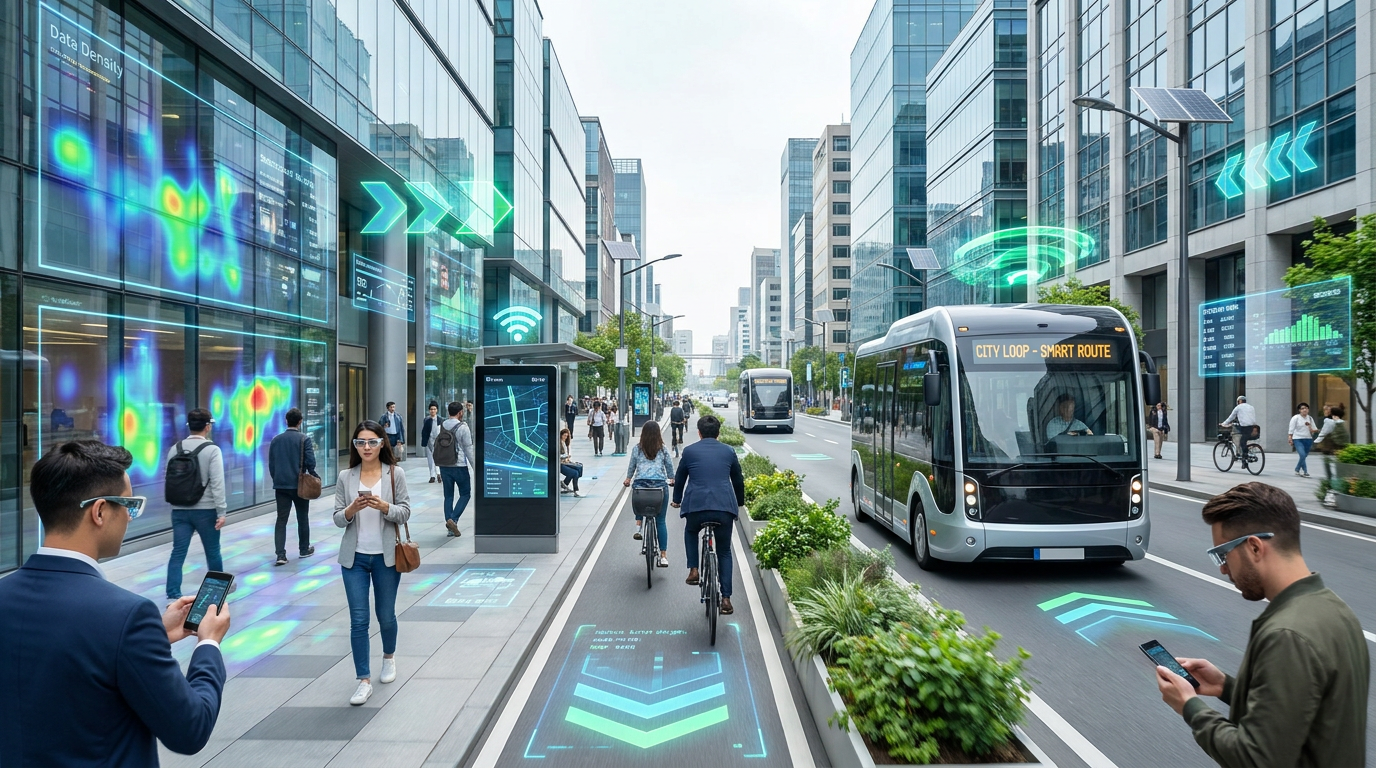
One of the clearest applications of human behavior simulation is in urban systems. Cities are dense networks of movement, consumption, choice, and coordination. Roads, transit systems, energy infrastructure, emergency services, and civic spaces all depend on patterns of human activity. A city may install smart lights, adaptive traffic controls, connected transit, and digital service portals, but these features only deliver meaningful value when they align with how residents actually live and move.
Canada offers a useful policy context. The federal Smart Cities Challenge drew interest from more than 225 municipalities, showing substantial national appetite for data-driven and resident-centered innovation. Government descriptions of smart cities emphasize quality of life, openness, interoperability, inclusion, and public value rather than technology for its own sake. That framing is important because it recognizes that successful smart-city systems are social systems first and technical systems second.
Behavior simulation helps cities move beyond static planning assumptions. Instead of modeling traffic as a simple flow problem, planners can test how commuters reroute during disruptions, how neighborhoods respond to new cycling infrastructure, or how public transit demand changes when service reliability improves. Instead of estimating energy demand from past usage averages alone, municipalities can model how households react to pricing signals, weather alerts, distributed energy resources, or electrification policies.
Natural Resources Canada has identified electrification, prosumer participation, distributed energy resources, and grid modernization as key drivers of smart-community development. Those trends are deeply behavioral. If residents adopt electric vehicles unevenly, shift charging times unpredictably, or respond differently to incentives, the grid must be designed around those patterns. In this environment, behavior simulation becomes a strategic planning instrument. It helps forecast demand, stress-test infrastructure, and identify where policy design needs adjustment before large-scale rollout.
Urban digital twins are making this even more practical. As city-scale digital twins absorb mobility data, socioeconomic indicators, environmental readings, and service usage, they can begin to represent the interplay between built infrastructure and human action. A transportation model can test not only road capacity, but also whether people trust a route recommendation. A public safety system can model not only incident location, but also crowd response and compliance patterns. This kind of intelligence is what allows a city to become adaptive rather than merely connected.
Evacuation planning and crowd safety
Emergency planning is one of the oldest and most compelling cases for behavior simulation. NIST has long highlighted the value of representing human behavior in evacuation models to improve accuracy, scope, and reliability. In emergencies, physical geometry matters, but human response matters just as much. People hesitate, look for family members, follow familiar routes, react to smoke, cluster around exits, and interpret alarms differently depending on context.
Traditional safety models that ignore those realities can underestimate risk or overestimate system performance. Behavior-aware evacuation models can simulate how different building layouts, communication strategies, and environmental conditions influence movement and decision-making. They can also reveal where signage fails, where bottlenecks form, and how vulnerable groups may require different planning assumptions. This is not only a computational exercise. It can save lives by exposing design weaknesses before a crisis occurs.
As smart buildings and urban management systems become more connected, evacuation planning is likely to become more dynamic. A future building system may not just trigger alarms. It may estimate occupancy distributions, model likely exit choices, and adjust guidance in real time based on observed crowd behavior. That kind of responsiveness depends on simulation that treats people as active decision-makers, not passive particles.
Healthcare is turning behavior simulation into personalized support
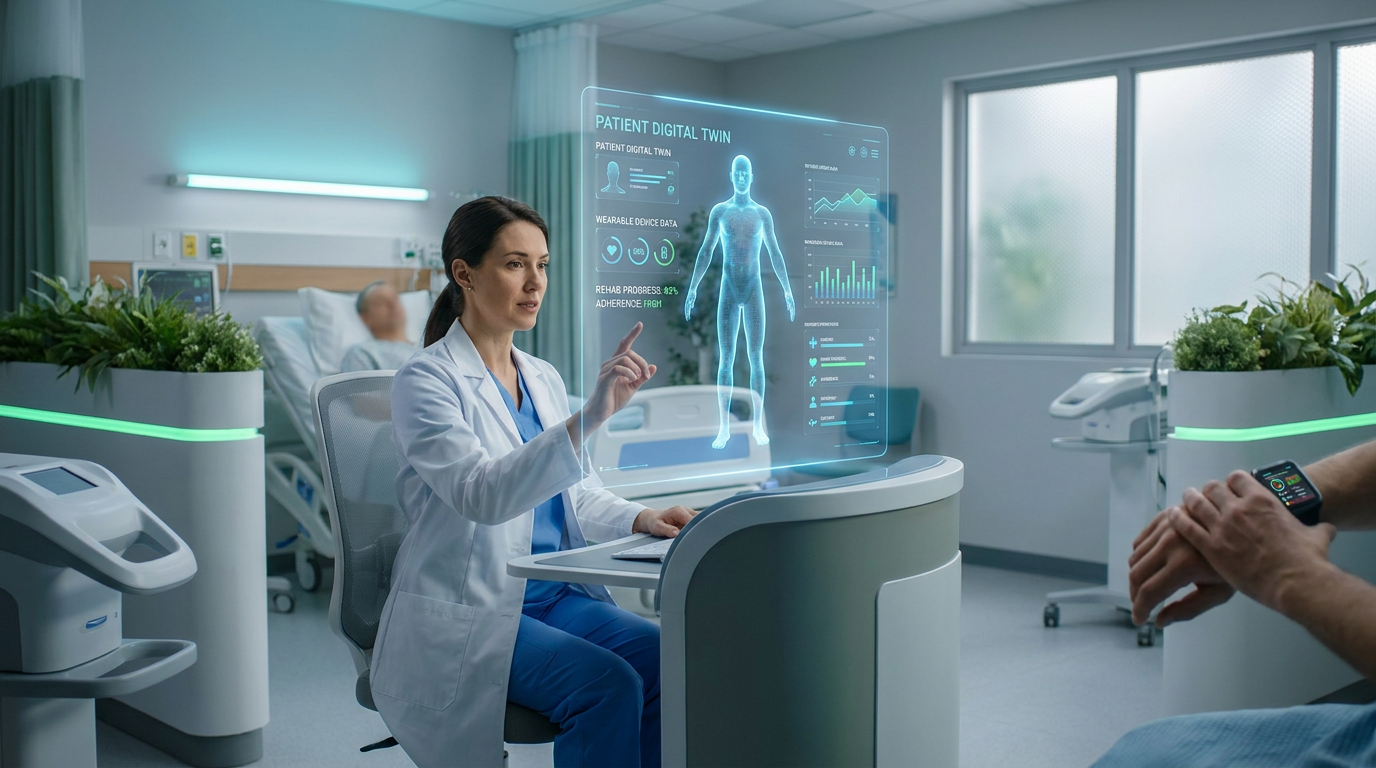
Healthcare may be the most advanced area for behavior-linked digital twins. A 2024 Nature review describes the human-body digital twin as a virtual representation updated by real-time sensor and device data to simulate and optimize health outcomes. A 2025 scoping review in npj Digital Medicine suggests that these twins are expanding well beyond organ-level modeling into monitoring, prediction, recommendation, and intervention loops. That matters because health outcomes are shaped not only by physiology, but also by behavior.
A treatment plan can be medically sound and still fail if a patient misses doses, avoids exercise, ignores alerts, or becomes discouraged during recovery. Human behavior simulation helps connect clinical insight to actual adherence patterns. In remote monitoring, for example, a system may detect that a patient is less likely to follow rehabilitation exercises after a certain time of day. In chronic care, a digital twin may estimate when a patient is drifting away from a medication routine and trigger a more personalized intervention. In preventive care, behavior-aware models can help tailor recommendations to what a person is realistically likely to sustain.
This does not mean healthcare systems can predict every personal choice. It means they can become more realistic about how care unfolds between appointments. Many of the most expensive and difficult health problems are not caused by lack of diagnosis. They are caused by the gap between recommended care and lived behavior. Simulation helps close that gap by translating abstract guidance into adaptive support.
The potential extends to hospital operations as well. Behavior modeling can help estimate patient flow, clinician workload, appointment attendance, discharge patterns, and response to communication methods. When combined with physiological digital twins, this creates a richer view of health as an interaction between body systems, routines, choices, environments, and institutional design. The result is not just better forecasting, but smarter intervention.
Where healthcare must stay careful
The healthcare use case also shows why governance matters. Behavioral models can be highly sensitive because they rely on intimate data, including movement patterns, device usage, compliance signals, and communication histories. If trust is weak, even an accurate system can fail because patients disengage. If security is weak, the consequences of misuse can be severe. NIST’s emphasis on trust and cybersecurity in digital twin systems is especially relevant here.
There is also a risk of overstating what simulation can infer. A patient who misses exercise goals may not be unmotivated. They may be in pain, financially constrained, caring for family, or responding to cultural barriers not represented in the model. Good healthcare simulation therefore needs humility. It should support clinicians and patients, not flatten lived experience into simplistic labels.
Human-AI collaboration is moving from tool use to thought partnership
Another major frontier is the workplace. Many organizations now use AI for forecasting, document review, scheduling, recommendation, anomaly detection, and strategic analysis. Yet deployment often assumes that once the model is accurate enough, human performance will improve automatically. In reality, the quality of human-AI collaboration depends on interaction design, timing, explanation quality, institutional incentives, and user confidence.
This is where behavior simulation becomes especially valuable. If organizations can model how employees seek advice, when they second-guess automated outputs, and how trust evolves after errors, they can build systems that support judgment rather than distort it. A recommendation that arrives at the wrong moment may be ignored even if it is correct. A system that explains too much may slow decision-making. A system that explains too little may trigger skepticism. These are behavioral design questions as much as technical ones.
Recent work in Nature Human Behaviour has pushed this conversation toward collaborative cognition. The idea is that intelligent systems can be engineered as complementary thought partners rather than passive tools. That framing is more demanding because it requires the system to account for how people think, not just what task they are performing. It asks whether the AI can fill gaps in memory, pattern recognition, scenario testing, or perspective taking without undermining human agency.
Behavior simulation helps make that possible. By modeling when users defer to automation, when they become overconfident, or when they require reassurance, a workplace system can shape interventions more intelligently. It can learn whether teams need concise summaries, competing scenarios, uncertainty warnings, or explanations anchored to previous decisions. That creates a more mature version of productivity technology, one focused not only on output, but on the quality of joint reasoning.

Algorithm aversion is often a design problem
One persistent misconception in AI adoption is that users simply distrust algorithms by nature. The research picture is more nuanced. NSF-supported work on algorithm aversion suggests that human advice-seeking behavior with AI can be modeled computationally and may emerge without assuming any built-in anti-AI bias. In practice, that means people may appear skeptical because they are responding rationally to uncertainty, prior mistakes, poor calibration, or limited transparency.
This is good news for system design. If trust behavior is understandable and modelable, it can also be improved. Organizations can simulate how error frequency, explanation style, interface changes, or training programs affect reliance patterns over time. Instead of viewing trust as a soft issue outside engineering, they can treat it as part of system performance. That is a major shift in how intelligent workplaces are likely to evolve.
Energy systems and smart communities depend on modeled behavior
Energy is often discussed as a technical infrastructure challenge, but it is also a behavioral one. Smart grids, distributed resources, electrification, home batteries, time-of-use pricing, and electric vehicle charging all rely on patterns of participation. A system operator can know generation capacity and network limits, yet still struggle if end-user behavior is poorly understood. Demand spikes, adoption timing, response to incentives, and household routines can all disrupt forecasts.
Behavior simulation helps translate infrastructure plans into realistic operational models. Utilities and community planners can estimate how residents respond to dynamic rates, when electric vehicle charging clusters will emerge, or whether prosumers are likely to export power under different price conditions. These estimates matter because grid modernization is only partly an engineering issue. It is also about designing incentives and interfaces that people will actually use.
In this setting, simulation can improve resilience as well as efficiency. During heatwaves or supply stress, operators may need to estimate which populations are likely to reduce consumption, which are unable to, and how communication style affects response rates. That kind of modeling supports better demand management and a fairer distribution of system pressure. It can also help identify equity risks before policies are implemented at scale.
The broader lesson is that future energy systems will not succeed through automation alone. They will succeed when technical intelligence is matched by behavioral intelligence. Without that, smart infrastructure can remain underused, misaligned, or socially brittle.
The biggest misconceptions about behavior simulation
Because the field is attracting attention, it is also accumulating confusion. Clearing up a few misconceptions helps set realistic expectations.
-
It does not predict people with certainty. Most behavior simulation produces scenario-based estimates. It is strongest when used to compare likely outcomes, stress-test plans, and support decisions under uncertainty.
-
A digital twin is not just a visual model. Authoritative definitions emphasize meaningful linkage to a real-world entity or process. A static rendering is not the same thing as an operational twin.
-
Human behavior is not fixed. Models trained in one place or one period may fail elsewhere if incentives, culture, interface design, or institutional trust change.
-
More data does not guarantee better insight. Biased inputs, weak assumptions, or poor validation can create elegant but misleading models.
-
Automation does not automatically create trust. Privacy, explainability, cybersecurity, accountability, and governance remain core requirements for deployment.
These points are not reasons to slow progress. They are reasons to pursue the field with discipline. Smart systems become more useful when they become more human-aware, but they also become more consequential. That makes rigor non-negotiable.
Ethics, trust, and the governance challenge
Behavior simulation becomes powerful precisely because it touches human judgment, vulnerability, and autonomy. That is why trust cannot be treated as an optional feature. NIST’s recent emphasis on cybersecurity and trust in digital twin technology reflects a broader reality across North America. As simulations become integrated into operational systems, the risks expand beyond technical error. There are also risks of surveillance, misuse, hidden bias, and overconfident policy decisions based on incomplete human models.
Privacy is the first major concern. Behavior-aware systems often depend on granular data from wearables, phones, service interactions, and location histories. Even when identifiers are removed, patterns can still reveal highly sensitive information about routines, health, or social behavior. Strong governance requires data minimization, clear consent structures where appropriate, access controls, and privacy-preserving methods that reduce unnecessary exposure.
Bias is the second major concern. If a model is trained on populations that are not representative, it may produce distorted assumptions about compliance, mobility, risk tolerance, or service uptake. That distortion can then become embedded in infrastructure decisions. A transportation simulation that underrepresents disabled users, for example, may recommend designs that appear efficient while quietly excluding essential mobility needs.
Overreach is the third concern. Simulations are tempting because they create a sense of foresight. But a well-designed model is still a model. It should guide planning, not replace democratic judgment, clinical expertise, or human accountability. The healthiest path forward is to treat behavior simulation as a decision support layer with transparent assumptions and clear limits.
The most trustworthy smart systems will not be the ones that claim to know people perfectly. They will be the ones that model uncertainty honestly and still help people make better decisions.
What the next generation of smart systems will look like
The trend line is clear. Smart systems are evolving from reactive automation toward more adaptive, context-aware intelligence. That shift is being driven by the convergence of digital twins, behavioral science, machine learning, and human-centered design. Future systems will increasingly model not only physical states, but also likely human responses to those states.
In cities, this could mean digital twins that integrate mobility, energy, climate risk, and resident behavior in one planning environment. In healthcare, it could mean care platforms that connect physiological monitoring with adherence forecasting and personalized intervention timing. In workplaces, it could mean AI assistants that function less like search engines and more like calibrated collaborators that understand uncertainty, trust, and cognitive load.
We should also expect stronger institutional frameworks around deployment. As behavior simulation becomes more central to public services and commercial systems, governance will move closer to the core of product design. Questions of auditability, fairness, security, and explainability will become product requirements rather than compliance afterthoughts. That is a healthy development because it aligns technical innovation with public legitimacy.
Perhaps the most important change will be conceptual. For years, many digital systems were built as if human behavior were noise around the edges. The next generation will be built on the assumption that behavior is part of the architecture. That is a more realistic, more useful, and ultimately more responsible way to design intelligence.
Final thoughts
Human behavior simulation is shaping the future not because it turns people into predictable code, but because it helps systems respect the reality that people are dynamic. We adapt, hesitate, learn, cooperate, resist, and change our minds. Any technology meant to support daily life at scale needs to account for that complexity if it wants to perform well outside the lab.
The practical applications are already visible. Smarter evacuation models can improve safety. Smart-city platforms can better align public services with resident behavior. Healthcare systems can connect treatment to adherence and daily routine. Workplaces can design AI tools that support judgment rather than frustrate it. Energy networks can plan around actual participation instead of idealized assumptions. In each case, the same principle applies: systems become more intelligent when they can model the human side of the loop.
There is still substantial work ahead. Models need better validation, better privacy protections, and stronger governance. Organizations need to resist overselling certainty. Designers need interdisciplinary teams that include engineers, behavioral scientists, public-sector experts, and ethicists. But those challenges do not weaken the case for behavior simulation. They clarify how mature the field needs to become.
If the first era of smart systems was about connectivity, the next era will be about behavioral intelligence. The systems that matter most in the years ahead will not just collect data or automate tasks. They will understand enough about human behavior to adapt in ways that are useful, trustworthy, and grounded in real life.



No Comment! Be the first one.