



Cities are built on movement. The way people travel to work, school, services, and public space determines far more than commute times. Transportation systems influence housing supply, land value, investment confidence, public health, emissions, and the long-term shape of urban growth. In today’s planning environment, transportation is no longer just a technical service delivered by roads, buses, and rail lines. It has become one of the most powerful tools available for revitalizing urban spaces and supporting more sustainable, inclusive, and resilient cities.
Table Of Content
- Transportation as City-Building Infrastructure
- Why Sustainable Mobility Is Reshaping Urban Growth
- Transit-Oriented Development and the New Urban Revitalization Model
- Innovative Transportation Systems Beyond Rail
- Zero-Emission Fleets and the Sustainability Imperative
- Accessibility, Not Just Mobility, Is the Real Metric
- The Housing Connection: Unlocking Supply Without Driving Displacement
- Implementation Challenges in Existing Urban Fabric
- What Leading Cities Are Learning
- A Strategic Framework for Sustainable Urban Mobility
- Conclusion: Building Cities Around Access, Value, and Long-Term Vision
That shift is especially important in Canada, where housing demand, infrastructure strain, and climate goals are converging at the same moment. Major cities continue to absorb population growth while facing severe pressure on affordability and mobility. At the same time, governments are increasingly recognizing that transportation investment must do more than move riders from one point to another. It must help unlock new housing, support compact development, improve access to jobs and services, and strengthen community well-being. This is where innovative transportation systems become central to the urban future.
Innovative transportation systems for sustainable cities are multimodal, data-informed, and land-use aware networks that combine transit-oriented development, complete streets, active transportation, zero-emission bus fleets, bus-priority corridors, micromobility, and coordinated station-area planning. Rather than measuring success by vehicle throughput, these systems are designed to expand access to jobs, housing, and services while reducing car dependence and emissions. Their value depends as much on governance as on technology: without zoning reform, affordability protections, and long-term capital planning, even advanced mobility tools fall short of delivering broad public benefit. When transportation and housing policy are aligned from the outset, transit investment becomes a platform for unlocking new housing supply, supporting compact development, and strengthening community access to opportunity. The result is transportation infrastructure that measures success not by vehicles moved, but by housing unlocked, communities strengthened, and long-term urban resilience achieved.
Canada’s recent policy direction reflects this integrated approach. The federal Canada Public Transit Fund is designed to provide long-term support for public transit and active transportation while encouraging higher-density housing and complete communities near transit. This is an important policy evolution because it recognizes that infrastructure and land use must work together. Transportation corridors shape growth patterns, and when that relationship is managed strategically, cities can deliver more homes, create stronger local economies, and reduce dependence on car-oriented expansion.
For developers, planners, municipalities, and communities, the message is clear. Transportation systems are not peripheral to urban revitalization. They are foundational to it. The question is not whether investment in mobility matters. The question is whether cities can translate that investment into durable, equitable, and sustainable urban form.
The most successful transportation system is not the one that moves the most vehicles. It is the one that expands access, supports housing, improves public space, and helps cities grow with purpose.
Transportation as City-Building Infrastructure
For decades, transportation planning in many urban regions was approached as a capacity problem. If roads were congested, cities expanded lanes. If travel times increased, they built larger corridors farther from established communities. That model often produced short-term relief but long-term sprawl, fragmented land use, and infrastructure burdens that became harder to finance over time. Today, a more strategic understanding is taking hold. Transportation infrastructure is not just about throughput. It is city-building infrastructure that influences where demand concentrates and whether growth can be absorbed efficiently.
This broader perspective matters because cities are now being asked to deliver more housing with fewer environmental costs and better quality of life outcomes. In that context, transportation investments can no longer be disconnected from housing supply. A rail station, bus rapid transit corridor, or mobility hub does not simply improve travel. It changes the development logic of surrounding land. It can increase certainty for investors, expand the viability of mixed-use housing, support retail and services, and reduce the need for expensive car-oriented infrastructure. In effect, transportation can make urban intensification possible where it was previously too difficult or too uncertain.
Federal policy increasingly reflects this reality. The Canada Public Transit Fund is intended not only to support long-term transit and active transportation expansion but also to unlock housing and complete communities near transit-accessible areas. That framing is significant because it treats public transit as enabling infrastructure for urban growth rather than a separate municipal service. For municipalities seeking long-term competitiveness and livability, this is the right lens. The transportation network is one of the most powerful signals a city sends about where growth should go.
From a feasibility standpoint, that signal matters. Development follows confidence. When governments commit to stable transportation investment and align it with zoning capacity, the market can respond with greater predictability. Land that is well served by mobility options becomes more suitable for higher-density housing, office uses, institutional expansion, and neighborhood retail. In urban revitalization terms, this means transportation can help transform underused corridors, aging commercial strips, surface parking lots, and station-adjacent parcels into productive urban places.
Why Sustainable Mobility Is Reshaping Urban Growth
The case for sustainable transportation is now supported by both climate policy and commuter behavior. Statistics Canada reported that in May 2025, 18.2% of Canadian commuters used sustainable transportation to get to work. Toronto, Montréal, and Vancouver posted the highest shares among major census metropolitan areas at 29.9%, 29.1%, and 29.0% respectively. These numbers are not just transportation statistics. They are indicators of urban form. Cities with stronger transit access and denser built environments tend to generate higher levels of walking, cycling, and public transit use.
This relationship between transit access and land use is critical. Sustainable commuting does not rise simply because people are encouraged to leave their cars behind. It rises when cities make alternative modes practical, reliable, safe, and integrated into daily life. That means more residents living within easy reach of transit, more complete street networks, better first- and last-mile connections, and more services located close to where people live. In other words, sustainable mobility depends on physical urban design as much as transportation operations.
For large-scale housing strategies, this creates an important opportunity. If a municipality wants to absorb growth without deepening congestion and infrastructure costs, it must direct a greater share of new housing into areas that can support sustainable travel behavior. That includes major transit station areas, bus corridors, inner-suburban redevelopment nodes, and mixed-use corridors with strong active transportation potential. These are the places where mobility investment can support compact development while reducing dependence on private vehicles. When planned properly, such areas can become engines of revitalization rather than pressure points of unmanaged density.
Sustainable mobility also helps cities compete economically. Workers increasingly value neighborhoods where they can reach jobs, education, recreation, and daily needs without being locked into long car commutes. Employers benefit from larger effective labour markets when workers can travel efficiently across the city. Households benefit when transportation costs fall, especially at a time when both housing and living costs remain under pressure. In this sense, transportation reform is not only an environmental priority. It is an affordability and productivity strategy.
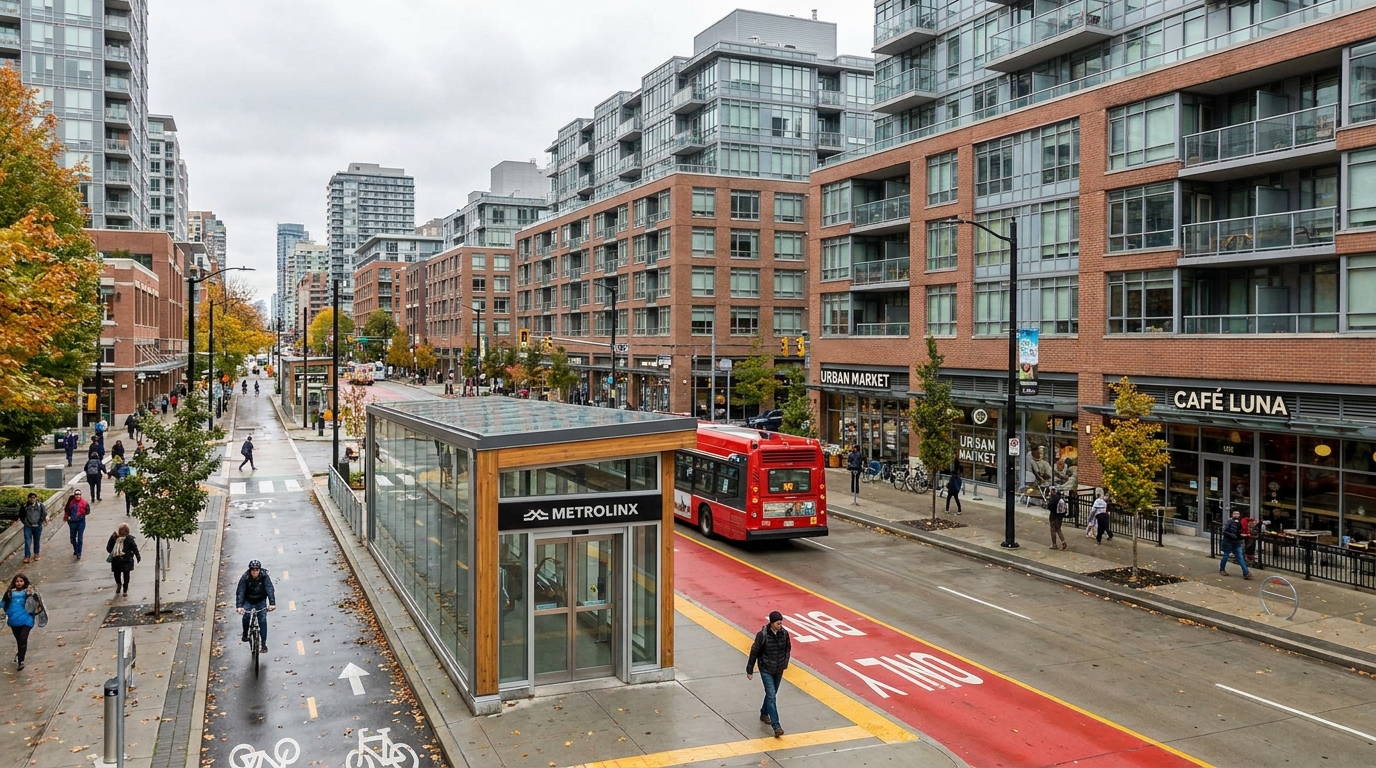
Transit-Oriented Development and the New Urban Revitalization Model
Transit-oriented development has become one of the most important frameworks for linking mobility and land use. At its core, transit-oriented development concentrates housing, jobs, services, and public space around high-quality transit access. The goal is not density for its own sake. The goal is to create complete, accessible communities where daily life can happen with lower car dependence and stronger urban efficiency. When executed well, transit-oriented development can revitalize neighborhoods, improve local business performance, strengthen transit ridership, and support more durable patterns of growth.
There is still a common misconception that transit-oriented development is only relevant to downtown high-rise districts. In practice, it applies just as strongly to suburban and inner-suburban station areas, especially where aging retail plazas, low-density commercial uses, and oversized parking fields create opportunities for reinvestment. Many of these areas are already served by transit infrastructure or could be connected by upgraded bus and rail systems. With the right zoning, servicing strategy, and urban design standards, they can evolve into mixed-use neighborhoods that add meaningful housing supply without relying on greenfield expansion.
This matters because the housing challenge in many Canadian regions is now as much about land efficiency as it is about unit counts. Revitalization must happen where infrastructure can support it. Transit-oriented development helps achieve that by directing growth toward locations with stronger connectivity and greater potential for service integration. Schools, parks, health services, employment uses, and commercial amenities all become easier to support when population is concentrated in accessible nodes rather than dispersed outward. As a result, transportation investment becomes a multiplier for broader urban value creation.
At the same time, transit-oriented development is not automatically affordable or inclusive. CMHC research has found that land cost is the biggest obstacle for developers considering affordable housing in transit-oriented developments in Canada. That finding should reshape how cities think about implementation. New transit infrastructure can increase surrounding land values quickly, which can improve redevelopment potential but also intensify speculation and displacement pressures. If municipalities want transit-oriented development to deliver social value alongside economic growth, they need policies that address affordability early rather than after land prices have already escalated.
This is where public policy becomes decisive. Station-area upzoning, inclusionary housing rules, public land strategies, density bonusing, and land value capture mechanisms all have a role to play. The transit investment creates the platform, but the development outcome depends on governance. If the surrounding regulatory framework is weak, revitalization may produce faster commutes for some households while pushing lower-income residents farther away. If the framework is strong, the same transportation investment can support mixed-income growth, stronger neighborhoods, and more equitable access to opportunity.
Innovative Transportation Systems Beyond Rail
When people hear the phrase innovative transportation systems, they often think first of large rail megaprojects. Rail is important, but today’s urban mobility innovation is far broader. Cities are increasingly moving toward multimodal systems that combine fixed-route transit, bus-priority infrastructure, active transportation, shared mobility, and more human-centered street design. This is a practical evolution. No single mode can solve every mobility challenge across a large metropolitan region. The objective is to build a network that makes sustainable travel convenient across different trip types and neighborhood contexts.
Bus rapid transit and bus-priority lanes are among the most scalable examples of this innovation. They can deliver substantial travel time improvements at a lower capital cost than rail while serving corridors that need flexible, frequent service. In revitalization terms, bus-priority investment can reshape commercial avenues and inner-suburban spines that have long been dominated by traffic but underperforming as places. Better transit service, upgraded sidewalks, improved crossings, street trees, and mixed-use zoning can together convert these corridors into more productive urban environments.
Micromobility also has a growing role. Bicycles, e-bikes, and shared scooters are not replacements for transit, but they can dramatically extend the useful reach of transit systems and reduce short car trips. Their value increases when cities design safe, protected networks rather than treating cycling as an afterthought. In land use terms, micromobility supports finer-grained accessibility, helping more residents connect to stations, main streets, schools, and parks without requiring additional vehicle capacity. That can improve the viability of denser housing in areas where every trip does not need to begin with a car.
Complete streets are another crucial innovation because they redefine how public rights-of-way function. Instead of prioritizing vehicle speed above all else, complete streets allocate space for buses, cyclists, pedestrians, accessibility needs, deliveries, and public life. They are often the missing link between transportation investment and neighborhood revitalization. A new transit line is important, but if the surrounding street remains hostile to walking, crossing, and street-level activity, the broader urban value of that investment is diminished. Transportation must be experienced not only at the station or on the vehicle, but also in the public realm between origins and destinations.
Data from North America support continued momentum for multimodal planning. APTA reported 7.7 billion total public transit trips in 2024 across the United States and Canada, a 7% increase from 2023, with continued recovery projected into 2025. That trend signals that transit remains essential to urban life, especially when systems improve reliability and integration. The emerging lesson is not rail versus roads. It is that well-designed, connected systems outperform fragmented investments. Cities that coordinate transit, walking, cycling, and street design can achieve stronger ridership, healthier communities, and more efficient land use.
Zero-Emission Fleets and the Sustainability Imperative
Sustainable cities need transportation systems that reduce emissions, but the most effective strategy is not simply fleet electrification in isolation. Zero-emission buses and cleaner transit technologies are important because they reduce local air pollution, lower long-term operating emissions, and align infrastructure with climate objectives. Federal planning documents in Canada now explicitly connect zero-emission buses, active transportation, public transit, and housing supply within a broader sustainable communities strategy. That integrated framework is exactly where the discussion needs to be.
Still, it is important to challenge a common misconception. Electric buses alone do not make a transportation system fully sustainable. The larger gains come when cleaner fleets are paired with ridership growth, better service, safe walking and cycling access, and a meaningful shift away from high car dependence. If a city electrifies its transit fleet but continues to build urban form that requires most households to drive for every daily need, the sustainability benefits are limited. Transportation technology works best when embedded in a land use strategy that reduces the need for long, emissions-intensive travel in the first place.
Zero-emission transit can, however, be a visible part of urban revitalization. Cleaner and quieter fleets improve the quality of life on busy corridors and support more attractive public spaces. They strengthen the case for reinvestment in older districts by making transit service more compatible with residential intensification and pedestrian-oriented main streets. They also signal to residents and investors that a city is serious about long-term modernization. In this way, environmental performance and urban competitiveness increasingly reinforce each other.
For municipalities and transit agencies, the challenge is sequencing. Fleet transformation requires charging infrastructure, grid coordination, capital funding, maintenance adaptation, and workforce readiness. Those investments should be planned in coordination with service expansion and land use priorities. If the goal is to support housing and revitalization, zero-emission fleet deployment should reinforce growth corridors and accessibility goals rather than functioning as a standalone environmental upgrade. Strategy matters as much as technology.
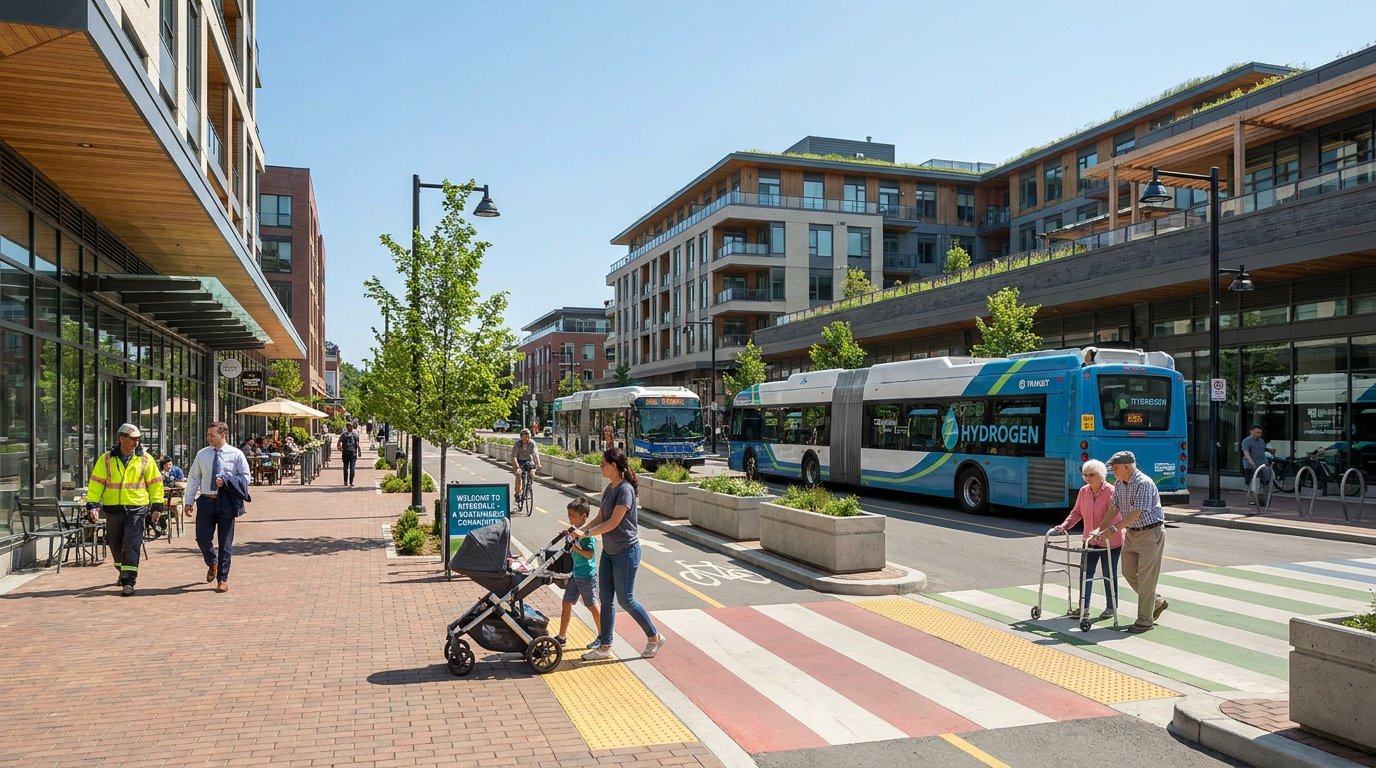
Accessibility, Not Just Mobility, Is the Real Metric
One of the most important planning advances in recent years is the shift from measuring transportation only by movement to measuring it by access. The critical question is no longer just how fast vehicles can travel. It is whether people can reliably reach jobs, schools, groceries, health care, recreation, and social opportunity. This is where spatial accessibility data is changing the conversation. Statistics Canada reported that its 2023 spatial access estimates covered 96.5% of the population in census metropolitan and census agglomeration areas, giving planners a much stronger evidence base for evaluating real-world access to daily needs.
This shift has major implications for urban revitalization. A neighborhood can sit near a transit stop and still have poor functional access if service frequency is low, walking conditions are unsafe, fares are burdensome, or nearby land use remains disconnected from essential services. High transit access does not automatically mean equitable access. Planners must look beyond stop locations to understand how mobility systems function in the full context of people’s lives. That means integrating transportation planning with public realm design, housing distribution, service location, and affordability.
For developers and municipalities, accessibility metrics can also support better investment decisions. Areas with strong access to employment and services may justify greater density and a broader mix of housing types. Areas with weak access may require transportation upgrades before major housing growth can succeed. In either case, better measurement allows cities to target infrastructure where it can generate the strongest social and economic return. This is especially valuable in a period when capital resources are constrained and project prioritization matters more than ever.
Accessibility-based planning also supports a more human view of urban success. Revitalization is not only about skyline change or rising land values. It is about whether more people can participate in city life with dignity and efficiency. Transportation systems that reduce travel friction, support daily convenience, and connect residents to opportunity help build stronger communities. They are fundamental to the concept of the sustainable city because sustainability is ultimately about how well a city supports people over time.
The Housing Connection: Unlocking Supply Without Driving Displacement
The strongest strategic case for innovative transportation systems today is their relationship to housing supply. Canadian policy now more explicitly ties transit funding to housing outcomes, especially through requirements and guidance that encourage higher-density development near transit stations and other transit-accessible locations. This is a practical response to a structural issue. Cities cannot build enough housing at scale if they continue to separate growth from mobility. New homes need infrastructure, and transit-rich locations are among the most efficient places to deliver them.
But unlocking supply is not enough on its own. New transportation investment can increase land values quickly, which improves redevelopment feasibility for some projects while making affordability harder to secure. This is why the idea that more transit automatically solves housing affordability is misleading. Transit can create value, but unless cities shape how that value is captured and distributed, the benefits may become uneven. Rising land prices, speculative holding patterns, and displacement risk can all undermine the very community outcomes that infrastructure spending was meant to support.
To address this, cities need a layered implementation strategy. Transit investments should be coordinated with zoning reform that allows meaningful density, but that density should be paired with affordability tools, tenant protections, and where possible, public land assembly or land banking. Inclusionary requirements near high-value transit nodes can help secure mixed-income outcomes. Development charges and funding tools should also be calibrated so they support growth without making projects unworkable. The objective is not simply to permit more units. It is to create a delivery system in which transportation, land, and housing policy reinforce each other.
There is also a timing issue that often gets overlooked. If zoning reform and affordability strategy lag too far behind transportation announcements, land markets can adjust before public-interest tools are in place. By the time a municipality reacts, the opportunity to influence outcomes may have narrowed significantly. This is why long-term planning matters. The most successful cities treat station-area planning, housing strategy, transit investment, and infrastructure financing as part of a single integrated process. Revitalization works best when policy arrives before speculation, not after it.
Implementation Challenges in Existing Urban Fabric
Retrofitting innovative transportation systems into existing urban areas is rarely simple. Mature cities carry inherited infrastructure patterns, fragmented land ownership, aging utilities, political complexity, and public expectations shaped by decades of car-oriented planning. Introducing bus lanes, reallocating road space, intensifying around stations, or redesigning streets often produces debate because these changes challenge long-established assumptions about convenience and land use. Yet the difficulty of implementation does not reduce the necessity of change. It only reinforces the need for strategic leadership.
One challenge is coordination across institutions. Transportation agencies, planning departments, housing divisions, utilities, school boards, and private developers often operate on different timelines and under different mandates. A new transit line may move ahead without enough alignment on station-area servicing, public realm design, or development approvals. Conversely, a municipality may upzone around transit without ensuring that service quality and capacity are sufficient. The result can be underperformance on both fronts. Integration is not a slogan. It is an operational requirement.
Another challenge is financing. Transportation projects are capital-intensive, and the broader public realm improvements needed to support revitalization add further cost. At the same time, cities must manage affordability concerns and resistance to overburdening new development with fees. This is where disciplined capital planning becomes essential. Governments need to understand where transit investment will produce the greatest housing, ridership, and land-efficiency returns, and then align fiscal tools accordingly. Not every corridor can be upgraded at once, but every major investment should contribute to a clear city-building strategy.
Community trust also matters. Residents are more likely to support change when they can see how transportation improvements will enhance daily life rather than simply increase density. Safer crossings, better bus reliability, greener streets, more local services, and improved public space all help make the benefits visible. Revitalization succeeds when communities experience transportation not as disruption, but as a better framework for living and moving in the city.

What Leading Cities Are Learning
Across North America, the most effective transportation transformations are increasingly based on a set of shared lessons. The first is that long-term funding matters. One-off projects without stable operating and capital support rarely produce the continuity needed for land markets, communities, and institutions to adapt. Canada’s move toward permanent public transit funding reflects an understanding that city-building requires predictable investment horizons. Developers, municipalities, and residents all make better decisions when infrastructure commitments are credible and sustained.
The second lesson is that street design matters as much as major infrastructure. Organizations such as NACTO have helped bring people-centered design into the mainstream, emphasizing safety, access, and public life over vehicle speed alone. This matters for revitalization because the street is where mobility and place intersect. A city can spend billions on regional transit, but if local streets remain hostile or inaccessible, the experience of the neighborhood will not fully improve. Great urban transportation systems are always grounded in the quality of the public realm.
The third lesson is that innovation is often institutional rather than technological. Better data, better zoning alignment, better project sequencing, and better interagency coordination can produce as much value as a new mode or vehicle type. Statistics Canada’s improved spatial access tools illustrate this well. When planners can measure access more accurately, they can make more intelligent decisions about where to intensify, where to invest, and where service gaps persist. Evidence-driven planning is one of the most important transportation innovations available to cities today.
The final lesson is that mobility must be tied to inclusion. Revitalization that improves access for some while displacing others is not a complete success. Transportation systems should expand opportunity across income groups, ages, and abilities. That means focusing on fare policy, universal design, safe walking connections, affordable housing near transit, and meaningful engagement with communities affected by change. Sustainable cities are not defined only by lower emissions. They are defined by fairer access to urban life.
A Strategic Framework for Sustainable Urban Mobility
For cities looking to use transportation systems as a revitalization tool, a practical framework is emerging. The first principle is to plan transportation and housing together from the beginning. Transit corridors and station areas should be identified not only for ridership potential but also for their ability to support substantial housing growth and mixed-use redevelopment. The second principle is to prioritize accessibility outcomes. Cities should invest where residents can gain the greatest improvement in access to work, services, and daily needs.
The third principle is to use multimodal design rather than relying on a single transportation solution. Rail, buses, walking, cycling, micromobility, and shared connections should reinforce one another in a networked approach. The fourth principle is to embed affordability and anti-displacement tools into transit planning from the outset. Transportation-led value creation is real, and cities need mechanisms to ensure that part of that value supports inclusive outcomes. The fifth principle is to commit to public realm quality. Revitalized streets, safe intersections, and welcoming station environments are not cosmetic upgrades. They are essential components of system performance.
Municipalities can support this framework through a series of coordinated actions:
- Align station-area zoning with realistic development capacity so that transit investment can translate into actual housing supply.
- Prioritize complete streets and active transportation links that connect neighborhoods safely to transit.
- Use accessibility data to target investment toward areas with the greatest opportunity to improve access and reduce inequity.
- Pair transit expansion with affordability measures such as inclusionary policies, public land strategies, or land value capture tools.
- Coordinate capital planning across departments so transit, utilities, schools, parks, and public realm improvements support one another.
These are not isolated tactics. Together, they form a coherent development strategy. When cities follow this path, transportation investment becomes more than an engineering initiative. It becomes a platform for urban resilience, housing delivery, economic productivity, and climate progress.
Conclusion: Building Cities Around Access, Value, and Long-Term Vision
Innovative transportation systems have the power to revitalize urban spaces because they operate at the intersection of movement, land use, and opportunity. They can unlock housing capacity, strengthen local economies, improve environmental performance, and reshape neighborhoods into more complete communities. But those outcomes are not automatic. Transportation technology, by itself, does not create a sustainable city. The broader result depends on whether governments align infrastructure investment with zoning reform, affordability protections, accessibility goals, and long-term growth planning.
Canada’s current policy direction points toward a more mature and integrated model. Transit funding is increasingly linked to housing outcomes, active transportation is being treated as core infrastructure, zero-emission fleets are part of broader sustainability strategies, and data is improving the ability to plan for real access rather than theoretical proximity. This is a meaningful shift. It acknowledges that city-building is not just about moving people efficiently. It is about creating places where more people can live well, participate fully, and thrive over time.
For urban leaders, the strategic task ahead is clear. They must think of transportation as a land-use and equity tool as much as an engineering system. They must focus investment where it can support complete communities and large-scale housing delivery. And they must ensure that revitalization creates broad public value rather than narrow private gain. The cities that do this well will not simply reduce congestion or modernize fleets. They will shape more sustainable, accessible, and resilient urban futures.
In the end, transportation is one of the clearest expressions of a city’s long-term vision. It reveals whether growth will be fragmented or coherent, exclusive or inclusive, reactive or strategic. When innovative transportation systems are planned with discipline and purpose, they do far more than move people. They help build the city we actually need next.


No Comment! Be the first one.