



Cities are entering a new phase of development. For decades, urban growth was defined mainly by visible physical systems such as roads, bridges, pipes, substations, transit corridors, and buildings. Those assets still matter, but the next generation of urban performance depends just as much on an invisible layer that connects them. Smart infrastructure refers to the combination of sensors, connectivity, software, automation, and data platforms that link physical assets together, allowing roads, water systems, electrical grids, and buildings to respond more intelligently to demand, risk, and long-term growth. Rather than functioning as isolated projects, these digital layers turn traditional infrastructure into responsive systems that can detect problems, adjust in real time, and support smarter planning decisions.
Table Of Content
- What Smart Infrastructure Actually Means
- Why Smart Infrastructure Matters More Now
- The Strategic Benefits for City Planners and Developers
- From Smart City Branding to Measurable Public Value
- Digital Twins, AI, and the New Planning Toolkit
- Smart Grids and the Electrified City
- The Governance Challenge Behind the Technology
- Cybersecurity, Privacy, and Public Trust
- Common Misconceptions That Need to Be Corrected
- What Practical Implementation Looks Like
- Why This Matters for Housing and Growth Strategy
- The Future of Urban Development Will Be Adaptive
This is not a niche technology conversation. It is a strategic urban development issue tied to housing delivery, infrastructure renewal, economic competitiveness, public service performance, and climate resilience. The United Nations reports that more than half of the world population already lives in urban areas and that this figure is expected to rise to around two thirds by 2050. At the same time, the International Energy Agency notes that cities account for more than 50% of the global population, around 80% of global GDP, two thirds of global energy use, and more than 70% of annual carbon emissions. That concentration of people, capital, demand, and environmental impact makes cities the decisive arena for infrastructure modernization.
In practical terms, smart infrastructure means using digital tools to run cities better. It can improve traffic flow, detect water leaks earlier, help utilities manage peak electricity demand, support more reliable transit, optimize building operations, and give planners better information when evaluating growth scenarios. It can also help local governments move from reactive maintenance toward predictive maintenance, which is one of the most important shifts in infrastructure management. Instead of waiting for failure, cities can identify stress, inefficiency, or deterioration before it becomes more expensive and disruptive.
For planners, developers, infrastructure agencies, and municipal leaders, the question is no longer whether technology will shape urban systems. The real question is whether cities can adopt smart infrastructure in a disciplined way that improves outcomes rather than simply layering new tools onto old problems. The winners will not be the places that install the most devices. They will be the places that align digital systems with public goals, governance standards, asset management, and long term development strategy.
Smart infrastructure should be understood as foundational urban infrastructure in its own right. It is not a marketing add on. It is becoming part of how cities manage growth, risk, cost, and service quality.
This matters especially in Canada and across North America, where many cities are balancing rapid population growth with aging infrastructure, housing shortages, electrification, and rising exposure to extreme weather. Infrastructure systems built for a different era are being asked to support higher density, more digital activity, more energy demand, and more resilience. In that environment, smart infrastructure is not just a technical upgrade. It is an operating model for the next phase of urban development.
What Smart Infrastructure Actually Means
One of the most common misconceptions about smart infrastructure is that it simply means adding more gadgets to the city. That is too narrow and often misleading. A city does not become smarter because it deploys cameras, sensors, dashboards, or mobile apps. It becomes smarter when those tools are connected to a clear service problem, integrated with existing systems, governed properly, and used to improve decisions at scale.
The National Institute of Standards and Technology describes smart cities as cyber physical systems enabled by the Internet of Things and related technologies that help integrate infrastructure and improve public services. That definition is useful because it emphasizes integration. The goal is not isolated pieces of technology. The goal is coordinated systems that allow transportation, energy, water, buildings, emergency services, and planning functions to work with better information and faster feedback loops.
In a modern urban setting, smart infrastructure may include intelligent traffic management, real time transit data, flood monitoring, digital building controls, smart grids, connected street lighting, automated meter systems, and centralized data platforms that support operations across departments. Increasingly, it also includes digital twins, which are virtual models of physical assets or entire urban districts. These tools allow planners and operators to test scenarios, monitor performance, and make more informed capital decisions before committing to expensive real world changes.
The most important point is that smart infrastructure is not a separate category from traditional infrastructure. It is becoming embedded within it. Roads increasingly depend on traffic sensing and signal coordination. Water systems depend on monitoring and pressure analysis. Electricity networks require digital controls to manage distributed energy resources and electric vehicle charging. Buildings are becoming active nodes within larger energy and data systems. The more cities grow and intensify, the more these systems must work together rather than as isolated utilities.

Why Smart Infrastructure Matters More Now
Urban development is under pressure from several directions at once. Cities must accommodate more residents, accelerate housing delivery, improve affordability, reduce emissions, and adapt to more frequent climate shocks. At the same time, many local governments are dealing with aging physical systems, constrained budgets, labor shortages, and rising public expectations for service quality. Smart infrastructure has become more important because it offers a way to increase performance without relying solely on endless physical expansion.
That distinction matters. In many mature urban regions, the future will not be built only by adding new highways, larger plants, or wider service corridors. It will also be built by using existing assets more efficiently. Better demand management, more accurate maintenance scheduling, faster incident response, and smarter energy and water use can extend asset life and create additional capacity within current systems. In a period where capital costs are high and construction timelines are long, that efficiency dividend is strategically valuable.
Climate risk is another major driver. The IEA notes that around 70% of cities are already experiencing negative impacts from extreme temperatures and more frequent or intense storms. These events put direct stress on electricity networks, transportation systems, water services, and emergency operations. Smart infrastructure can improve resilience by providing real time visibility into system conditions, helping operators isolate failures faster, prioritize repair crews, and model alternative scenarios before and during disruptions.
There is also a competitiveness angle that should not be underestimated. Cities that can support reliable energy, efficient mobility, faster permitting, and better infrastructure planning are in a stronger position to attract investment and support economic growth. As more industries depend on electrification, digital connectivity, and operational reliability, infrastructure quality becomes a deeper determinant of local opportunity. Smart infrastructure therefore sits at the intersection of livability and competitiveness. It helps cities serve residents better while also supporting the business environment needed for long term growth.
The Strategic Benefits for City Planners and Developers
For city planners and developers, the value of smart infrastructure is not abstract. It directly affects project feasibility, servicing capacity, timing, operational cost, and public acceptance. In development terms, better infrastructure intelligence can reduce uncertainty. It can reveal where systems have underused capacity, where bottlenecks exist, and where targeted upgrades can unlock growth more efficiently than broad based expansion.
Transportation is a clear example. Intelligent transportation systems can improve signal timing, reduce congestion, and give transit agencies real time information that supports reliability. When travel times become more predictable, urban land performs better. Mixed use centers become more viable, transit oriented development becomes more attractive, and municipalities can support more density without allowing transportation dysfunction to erode quality of life. That is not just a mobility benefit. It is a land value and growth management benefit.
Water and wastewater systems also stand to gain significantly. Leak detection, flow monitoring, pressure management, and predictive maintenance can reduce losses and improve service stability. In many urban areas, servicing capacity is one of the hidden constraints on housing delivery. Better data on infrastructure performance can help municipalities sequence growth more intelligently and make more defensible decisions on where expansion can proceed. Over time, that can support a more transparent and efficient relationship between infrastructure planning and land use planning.
Energy is perhaps the most strategic domain of all. Electrification is increasing demand across buildings, transportation, and industry. The IEA defines smart grids as electricity networks that use digital and advanced technologies to monitor and manage the transport of electricity efficiently while improving reliability, flexibility, and environmental performance. This matters because future cities will depend on far more dynamic electricity networks than the ones many communities inherited. Electric vehicle charging, distributed solar, battery storage, heat pumps, and peak load management all require a more intelligent grid.
The IEA also states that investment in smart grids needs to more than double through 2030 to align with its Net Zero Emissions by 2050 scenario. That is a signal of scale. Smart grids are no longer a side initiative. They are central to how cities will manage energy reliability and climate goals at the same time. For developers, this has direct implications for site planning, utility coordination, building design, and future operating costs.

From Smart City Branding to Measurable Public Value
One of the most important shifts in recent years is the move away from vague smart city branding toward outcome based implementation. This is a healthy evolution. For too long, smart city conversations were dominated by technology showcases that were difficult to scale, difficult to govern, or weakly tied to public priorities. Today, the stronger model is much more disciplined. Cities are increasingly asking whether a digital investment improves service delivery, resilience, inclusion, operational efficiency, or infrastructure lifecycle performance.
The OECD has been especially clear that smart cities should improve well being, sustainability, and inclusiveness. It also warns that digitalization can create hidden costs and inequalities when governance is weak. That warning is crucial because it corrects one of the biggest mistakes in urban modernization. Technology does not produce public value automatically. It can just as easily centralize power, deepen service gaps, or create new cost burdens if cities do not build clear rules around procurement, data ownership, maintenance responsibility, and performance evaluation.
In practice, the most successful smart infrastructure programs are not the most futuristic. They are the most specific. They solve defined problems, such as reducing permit delays, improving flood response, identifying failing assets, coordinating utility repairs, or managing peak electricity demand in high growth corridors. This is also why smaller and mid sized communities should pay attention. Smart infrastructure is not reserved for megacities with massive technology budgets. Standards based, scalable approaches can work in many local contexts when the use case is clear and the governance model is practical.
Digital Twins, AI, and the New Planning Toolkit
Among the strongest emerging trends in infrastructure development is the use of digital twins and artificial intelligence for planning, operations, and asset management. A digital twin is more than a 3D model. It is a live or regularly updated virtual representation of a real asset, district, or city system that can incorporate spatial data, operational data, condition data, and scenario testing. For urban planners, this can fundamentally improve how development options are evaluated.
Imagine testing the impact of a major housing precinct before construction begins. A digital twin can help assess traffic flow, utility loads, shadow impacts, stormwater behavior, transit demand, and emergency access under multiple scenarios. That does not replace professional judgment, but it gives decision makers a stronger evidence base. In a world where development timelines are compressed and public scrutiny is intense, better scenario modeling can improve both confidence and transparency.
AI expands this capability by identifying patterns in large datasets that would be difficult to interpret manually. It can support predictive maintenance by flagging assets with a higher risk of failure. It can help optimize transit schedules, identify anomalies in energy use, and support faster review of routine administrative processes. Used well, AI can reduce operational friction and allow technical staff to focus on higher value strategic tasks.
Still, cities should approach these tools with discipline. AI and digital twins are only as good as the data, standards, and institutional capacity behind them. Poor data quality, unclear ownership, weak interoperability, and unrealistic expectations can turn promising tools into expensive distractions. The strategic lesson is simple. Advanced tools matter most when they are embedded in a coherent operating model, not when they are deployed as stand alone experiments.
Smart Grids and the Electrified City
No discussion of smart infrastructure is complete without a serious look at energy. The urban energy system is being transformed by electrification, decarbonization, and distributed generation. Buildings are moving toward electric heating and cooling. Transportation is shifting toward electric vehicles and electric transit fleets. Rooftop solar, battery systems, and other distributed energy resources are becoming more common. These changes increase complexity across the grid and require more active management than traditional one way electricity systems were designed to provide.
Smart grids are therefore becoming a cornerstone of future urban development. They allow utilities and operators to monitor conditions in real time, balance supply and demand more effectively, integrate local generation, and respond faster to outages or system stress. In dense urban environments, where even short disruptions can affect thousands of residents and businesses, this operational visibility matters enormously.
From a development perspective, smarter electricity infrastructure can influence where growth is easiest to support and where targeted upgrades are required. It can also improve resilience in the face of storms and heat events, which are becoming more frequent and intense. If a city wants to support electric mobility, higher density housing, and lower emissions without sacrificing reliability, grid modernization is not optional. It is foundational.
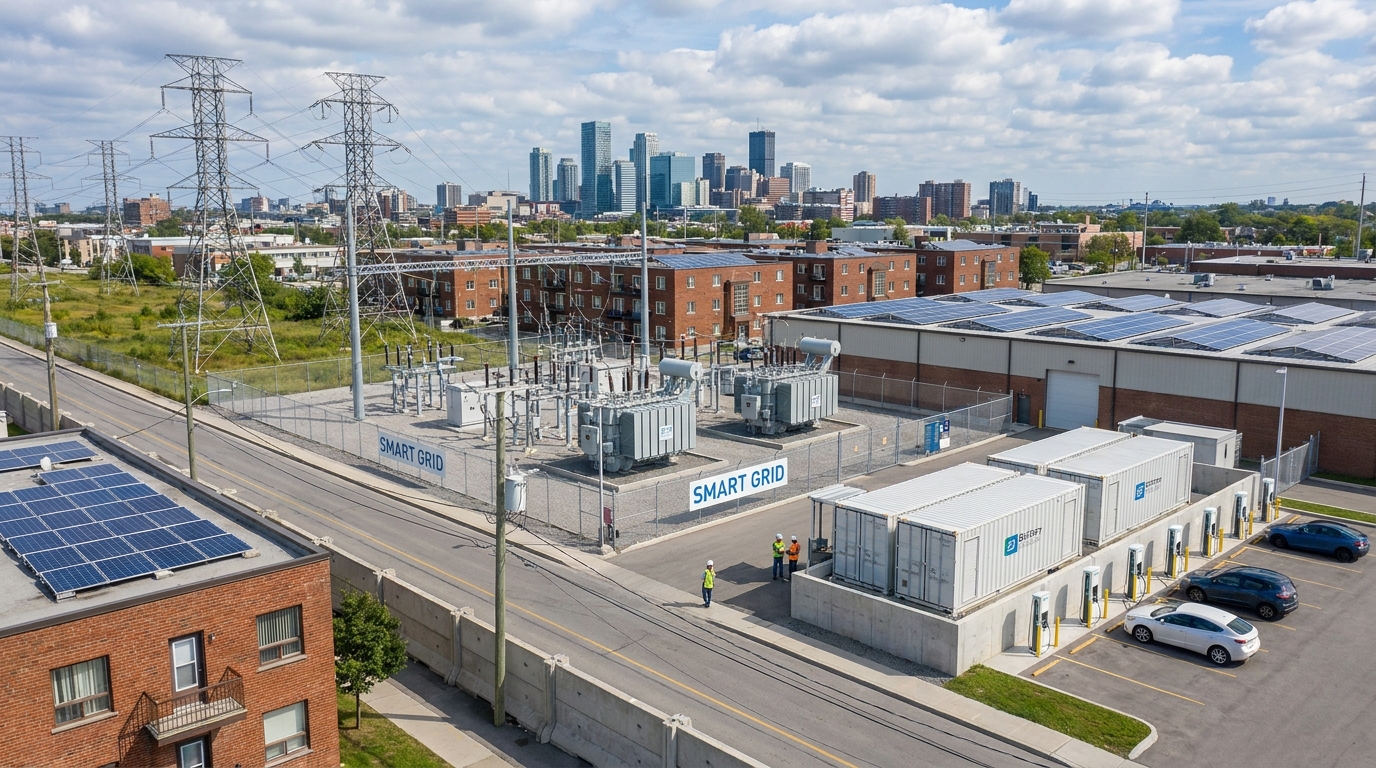
There is a broader strategic implication here as well. As cities compete for investment, energy reliability and flexibility become part of place competitiveness. Firms and residents alike need confidence that essential services can support digital activity, climate adaptation, and new mobility patterns. In that sense, smart grids are not simply utility projects. They are enablers of the urban economy.
The Governance Challenge Behind the Technology
If smart infrastructure were only about technology, implementation would be much easier. The harder part is governance. Infrastructure systems are often fragmented across agencies, utilities, private operators, and multiple levels of government. Data sits in separate platforms. Procurement rules can be rigid. Legacy systems may not communicate with newer tools. Operating teams may have uneven digital skills. All of this makes integration difficult, even when the business case for modernization is strong.
This is why smart infrastructure should be treated as a governance and coordination challenge, not just a procurement exercise. NIST and OECD both emphasize the importance of standards, interoperability, and trustworthy systems. Without those foundations, cities can end up with isolated technology stacks that increase complexity rather than reduce it. That risk is especially high when municipalities adopt vendor specific tools without a long term framework for integration, maintenance, and data portability.
Return on investment can also be difficult to prove if cities measure value too narrowly. Some benefits, such as reduced downtime or lower energy consumption, are relatively direct. Others, such as improved public trust, better planning decisions, or avoided disruption during extreme weather, are harder to quantify in a traditional budget model. Yet those broader benefits are often where the strategic value lies. Serious implementation therefore requires more sophisticated performance frameworks that capture lifecycle value, resilience value, and cross sector impacts.
Governance also includes the less visible but essential work of defining who can access data, how long it is retained, how it is secured, how it is shared, and how residents are informed about its use. Those questions are not secondary. They are central to public legitimacy.
Cybersecurity, Privacy, and Public Trust
A smarter city is not automatically a safer city. Connected systems create new capabilities, but they also create new vulnerabilities. Canada’s national security guidance has warned that smart city data and connected infrastructure can be exploited if not properly protected. That should be taken seriously by every municipality, developer, and infrastructure operator working in this space.
Cybersecurity by design is no longer optional. It must be built into procurement, system architecture, access control, software updates, vendor management, and incident response planning from the beginning. Retrofitting protection after deployment is more expensive and often less effective. If a city connects transportation systems, utilities, public buildings, and service platforms without strong security discipline, it may increase operational risk at the very moment it is trying to modernize.
Privacy is equally important. Residents are far more likely to support smart infrastructure when there are clear rules about what data is collected, why it is collected, how it is anonymized, who can use it, and what accountability mechanisms exist. Public trust is not a communications issue. It is a design issue. If governance is vague, even technically sound projects can lose legitimacy and face resistance that delays implementation.
This is particularly important in democratic urban environments where infrastructure decisions increasingly require social license. The future of smart infrastructure will depend not only on performance but on whether cities can demonstrate that digital systems serve public goals without compromising rights, security, or fairness.
Common Misconceptions That Need to Be Corrected
Several misconceptions continue to cloud the smart infrastructure conversation. The first is the idea that it is mainly about devices. In reality, sensors, cameras, and apps are only useful when they support a defined operational purpose within an interoperable and governable system. Technology without integration produces fragmentation, not intelligence.
The second misconception is that only very large metropolitan regions can benefit. In fact, many mid sized and smaller communities may gain substantially from targeted smart infrastructure investments, especially where they face staffing constraints, aging assets, or rapid growth in selected corridors. Scalable standards and focused use cases can deliver meaningful value without requiring a fully built out metropolitan technology platform.
The third misconception is that technology automatically creates sustainability or equity. It does not. A connected transportation system can still underserve certain neighborhoods. A data platform can still ignore community concerns. An energy optimization program can still leave vulnerable households exposed if policy design is weak. Outcomes depend on governance, community engagement, affordability, maintenance capacity, and political choices about who benefits first.
The final misconception is that more data always means better decisions. Data quality, context, and interpretation matter. Cities need strong institutional judgment, not blind faith in dashboards. The most resilient urban systems are those where data strengthens planning capacity rather than replacing it.
What Practical Implementation Looks Like
For municipalities and development partners, practical implementation usually begins with a service problem, not a technology wish list. A city may be struggling with traffic congestion near growth nodes, recurring water losses, unreliable transit arrivals, long permitting times, or frequent storm related outages. These are better starting points than broad promises about becoming smart. They create a measurable rationale for investment and a clearer path to public value.
From there, implementation should move through a structured framework. Cities need to identify the operational objective, map the stakeholders involved, audit legacy systems, define data requirements, and establish governance rules before procurement begins. This front end discipline is often the difference between scalable infrastructure modernization and a disconnected pilot project that never matures.
A strong implementation sequence often includes the following elements:
- Define the public outcome, such as reduced outages, faster permitting, lower water loss, better transit reliability, or improved emergency response.
- Assess current systems and interoperability to understand what data already exists, what standards are in place, and where integration barriers are likely to emerge.
- Build governance early, including cybersecurity standards, privacy protocols, data ownership rules, and accountability structures.
- Prioritize scalable use cases that can expand across departments or districts rather than solving only a narrow one time problem.
- Measure value over the asset lifecycle, including resilience benefits, maintenance savings, service reliability, and support for long term growth.
This process may sound methodical, and that is exactly the point. Smart infrastructure should be boring in the best possible way. It should be dependable, standards based, financially defensible, and aligned with real urban priorities. The excitement should come from better outcomes, not from novelty alone.
Why This Matters for Housing and Growth Strategy
Housing conversations often focus on zoning, approvals, financing, and construction cost, and those issues are critical. But infrastructure readiness is just as important. A city cannot add meaningful housing supply at scale if water systems, transit networks, road capacity, electricity distribution, and emergency services cannot support new growth efficiently. Smart infrastructure helps address that challenge by improving visibility into system performance and by allowing municipalities to plan upgrades with greater precision.
In many growing urban regions, the real constraint is not a total lack of infrastructure. It is a lack of clarity about infrastructure conditions, service thresholds, and timing. That uncertainty can slow approvals, increase development risk, and weaken public confidence in intensification. Better infrastructure intelligence can support a more transparent growth model. It helps cities identify where capacity exists, where targeted interventions can unlock new housing, and where resilience upgrades are needed before density increases further.
For developers, this can improve feasibility analysis. For municipalities, it can improve sequencing. For residents, it can improve trust that growth is being matched with service planning rather than simply imposed on already stressed systems. In that sense, smart infrastructure is not just an operations tool. It is part of the broader machinery of urban growth management.
The Future of Urban Development Will Be Adaptive
The next generation of cities will not be defined only by what they build. They will be defined by how well they adapt. Adaptation in this context means more than climate response. It means the capacity to adjust transportation systems, utility operations, land use decisions, maintenance cycles, and public services in response to real time conditions and long term trends. Smart infrastructure is what gives cities that adaptive capacity.
The strongest urban development strategies will combine physical investment with digital capability. They will connect housing growth to utility intelligence, resilience planning to predictive analytics, and infrastructure renewal to better data governance. They will use digital twins to test scenarios before committing capital. They will modernize grids to support electrification. They will design systems with cybersecurity and privacy built in from the start. Most importantly, they will evaluate technology by whether it improves public outcomes rather than by how innovative it appears.
There is a reason this conversation is becoming more central to infrastructure policy. Smart infrastructure is emerging as a core requirement for sustainable urban growth. It helps cities do more with existing assets, respond faster to disruption, plan more intelligently, and support the kind of efficient, resilient, and inclusive development that the coming decades will demand. In a period shaped by urbanization, climate pressure, and economic transition, that is not a marginal advantage. It is a structural one.
For city builders, the message is clear. The future of urban development will belong to places that treat smart infrastructure as a foundational public system, govern it seriously, and align it with long term community goals. Technology is not the destination. Better cities are.


No Comment! Be the first one.