



Mixed-use investments sit at the intersection of urban growth, portfolio diversification, and long-term income resilience. For investors looking beyond conventional single-use assets, they offer a compelling way to combine residential, retail, office, hospitality, or civic uses within one project or district. That combination can create multiple revenue streams inside a single holding while positioning capital in locations that benefit from density, transit access, and changing consumer behavior.
Table Of Content
- What Mixed-Use Investments Really Mean
- Why Mixed-Use Matters More in Today’s Market
- The Core Return Drivers Behind Mixed-Use Assets
- How Urban Growth Trends Strengthen the Investment Thesis
- How to Evaluate a Mixed-Use Investment Properly
- Key Diligence Areas
- Financing Mixed-Use Developments in a More Complex Capital Environment
- Managing Mixed-Use Properties for Stronger Long-Term Performance
- Common Misconceptions Investors Should Avoid
- Where the Best Mixed-Use Opportunities Are Emerging
- A Practical Framework for Investors
- The Long-Term Case for Mixed-Use Investments
In Canada and across North America, mixed-use development has moved from a niche strategy to a central part of how cities plan for growth. Statistics Canada has identified higher-density mixed-use development as a key element of smart growth, emphasizing its role in creating walkable, transit-friendly neighbourhoods while reducing pressure to expand outward into greenfield land and new infrastructure. For investors, that matters because assets supported by long-term policy direction often enjoy stronger entitlement pathways, better infrastructure alignment, and more durable tenant demand over time.
The appeal of mixed-use property is straightforward in principle but more nuanced in execution. Residential units can provide recurring cash flow, service retail can benefit from built-in foot traffic, and office or professional uses can capture daytime demand that supports the wider ecosystem of the property. When properly designed, these uses reinforce each other and create a place that performs more like a micro-market than a single building. That synergy is where some of the strongest return potential emerges.
This article examines how mixed-use investments work, why they are gaining importance, and how investors can evaluate them with a disciplined, results-focused lens. It will also cover financing structures, underwriting priorities, risk management, and the trends shaping the next generation of mixed-use opportunities. For investors who understand that real estate returns are often driven as much by location quality and demand layering as by cap rates alone, mixed-use assets deserve serious attention.
What Mixed-Use Investments Really Mean
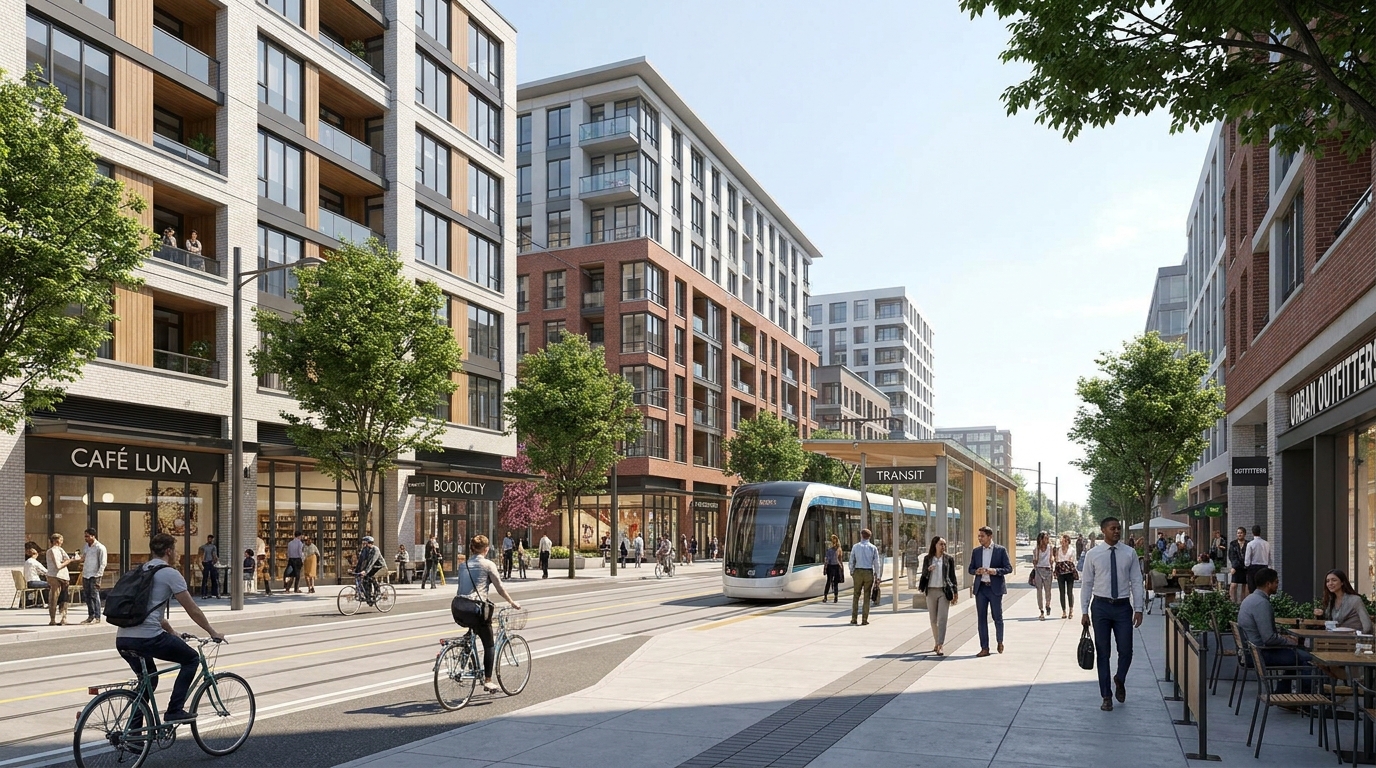
One of the most common misconceptions in the market is that any property with ground-floor retail qualifies as mixed-use. In practice, serious mixed-use investing usually involves distinct and complementary uses with separate demand drivers, separate underwriting logic, and a business plan built around more than one meaningful income stream. A residential building with a small convenience unit at grade may have some mixed-use characteristics, but it is not the same as a true multi-component asset with residential, service retail, office, or community-oriented tenancy all contributing to performance.
At its best, a mixed-use project creates a self-reinforcing operating environment. Residents generate baseline activity and support daily-needs retail. Retail and food service improve convenience, increase foot traffic, and strengthen the appeal of residential and office space. Office or medical users bring daytime population and spending, which can stabilize commercial tenant sales and improve the perception of vibrancy. This interaction can translate into stronger occupancy, better tenant retention, and pricing power that would be harder to achieve in a siloed asset.
Mixed-use can take several forms. It may be vertical, where different uses are stacked in one building, or horizontal, where multiple uses are distributed across a site or district. It can include new development, phased master planning, or adaptive reuse of underused land and aging properties. What matters most from an investment standpoint is not the label, but the economic independence and strategic compatibility of each use.
The strongest projects typically share several features. They are located in walkable, transit-accessible nodes, they respond to demonstrated local demand rather than aspirational placemaking alone, and they are designed around a use mix that functions throughout the day. In other words, they do not depend on a single traffic pattern or tenant category to succeed. That all-day demand profile is one reason mixed-use assets often outperform more isolated formats in major urban markets.
Why Mixed-Use Matters More in Today’s Market
Mixed-use investing is particularly relevant in a market defined by housing shortages, affordability pressures, construction cost sensitivity, and a renewed focus on efficient urban form. Across Canadian metros such as Toronto, Vancouver, Calgary, Montréal, and Ottawa, policy and market forces are increasingly converging around intensification, transit-oriented development, and complete communities. These are not abstract planning concepts. They directly affect where approvals happen, where infrastructure spending is prioritized, and where long-duration tenant demand is likely to remain strongest.
Statistics Canada’s research on smart growth and urban expansion reinforces this backdrop. Compact, higher-density development can reduce the pressure to push growth outward, limit infrastructure duplication, and support transit-friendly neighbourhoods. For investors, this creates a powerful macro case for infill and mixed-use strategies. Properties in established urban nodes often benefit not only from existing population and mobility networks, but also from future policy support tied to supply creation and land-use efficiency.
There is also a clear market-side premium for connected, amenitized environments. JLL reported in March 2025 that office properties in mixed-use lifestyle markets commanded 32 percent higher rents than broader U.S. office market comparables. That data point is significant because it suggests demand is not just returning to any space. It is concentrating in places where workers, residents, and consumers value convenience, experience, and access. CBRE has likewise noted that prime space in vibrant, connected mixed-use submarkets is becoming scarcer, a dynamic that can support long-term rent growth and valuation strength.
In a world where many traditional property categories face uneven fundamentals, mixed-use can offer a more adaptable model. Rather than relying on one tenant segment, it spreads exposure across multiple patterns of demand. That does not eliminate risk, but it can improve resilience when one component underperforms. This is especially valuable in urban markets where demographic shifts, hybrid work, and changing retail formats are all reshaping how space is used.
The Core Return Drivers Behind Mixed-Use Assets
Investors often approach mixed-use opportunities because they want broader diversification without giving up direct control over a physical asset. The first and most obvious return driver is income diversification. Residential rents can provide stability, especially in supply-constrained markets. Retail and service tenants can capture local spending and add margin where location quality supports strong foot traffic. Office, medical, or flexible workspace can deepen daytime utilization and improve the economics of the surrounding commercial components.
The second return driver is land efficiency. Mixed-use developments often unlock greater value from scarce urban land by increasing density and layering uses that would otherwise sit in separate buildings or parcels. In land-constrained cities, the ability to spread land cost across several revenue streams can materially improve project economics. Higher density does not automatically mean higher returns, but when design, access, and demand are properly aligned, it can support stronger long-term value creation.
The third driver is placemaking and premium positioning. Mixed-use projects that create real convenience and community interaction tend to become stronger neighbourhood anchors. This can support rental rate premiums, better absorption, and lower turnover across multiple tenancy categories. The most successful properties are not simply collections of rentable areas. They are destinations that fit how people increasingly want to live, work, shop, and move through cities.
Another important factor is inflation sensitivity. Multi-tenant, multi-use assets often have staggered lease terms and different rent adjustment mechanisms across residential and commercial components. That can provide a more dynamic income profile than a single long lease with limited reset opportunity. While this adds complexity, it may also improve an investor’s ability to reprice portions of the asset over time.
Finally, mixed-use investments can create strategic upside through redevelopment optionality. A project may begin with one use mix and evolve as surrounding demand matures. Investors with a long horizon may benefit from rezoning, density increases, improved transit connectivity, or adaptive reuse of existing space. This is one reason mixed-use is best understood not as a quick trade, but as a long-term urban infrastructure play embedded in neighborhood growth.
How Urban Growth Trends Strengthen the Investment Thesis
Urban growth trends are central to the mixed-use opportunity. Population growth, immigration, housing demand, and shifting transportation preferences are putting sustained pressure on major cities to use land more efficiently. That supports denser, infill-oriented investment strategies where residential, retail, office, and community amenities are integrated rather than separated. In practical terms, the demand for complete communities is raising the value of sites that can support multiple uses close to transit and employment.
Canada’s policy environment reinforces this direction. Housing strategies at the federal and municipal level increasingly emphasize supply creation near transit, complete communities, and mixed-use zoning frameworks that make projects more viable. CMHC project examples show mixed-use developments being paired with affordable rental housing, childcare, and commercial space. For investors, this policy alignment can influence approvals, public-private partnership opportunities, financing eligibility, and in some cases density bonuses or other incentives that improve feasibility.
CMHC’s 2025 Rental Construction Survey offers another useful signal. It found that 72 percent of developers needed more than one financing source in the prior year, highlighting how capital-intensive and structured many projects have become. At the same time, 65 percent planned to retain projects as long-term assets in 2025, up from 51 percent in 2024. That shift toward build-to-hold ownership aligns naturally with mixed-use property, where long-duration cash flow and embedded neighbourhood value often matter more than short-term disposition gains.
Statistics Canada’s recent work on housing supply has also shown that new housing growth continues to push outward in many regions. That outward growth reinforces the strategic importance of infill and intensification. Investors who can participate in denser, transit-oriented urban redevelopment may be positioning ahead of both policy demand and land scarcity. When supply challenges, mobility needs, and sustainability pressures all point toward compact communities, mixed-use assets become more than a property type. They become a direct way to invest in the future form of the city.
How to Evaluate a Mixed-Use Investment Properly
Underwriting mixed-use property requires more discipline than simply blending assumptions from residential and retail models. Investors need to assess not just each revenue stream independently, but also how the uses interact operationally and commercially. A project can look attractive in aggregate and still underperform if tenant synergy is weak, access is poorly designed, or one component drags on the economics of the whole property.
The first question should be whether the project is truly diversified. Does it have multiple meaningful income streams with separate demand drivers, or is one use overwhelmingly dominant? If the retail component is small and unsupported by local traffic, it may not materially reduce risk. If the office space is generic in a market with weak absorption, it may add cost without adding resilience. The goal is not to maximize the number of uses. It is to select uses that support each other and are justified by local market conditions.
The second question is location quality. Mixed-use investing is strongest in walkable, transit-accessible nodes with all-day demand. Investors should examine transit access, pedestrian flow, nearby employment, demographic depth, and competitive supply. Mixed-use on an auto-dependent fringe site can still work in specific contexts, but the strongest rent and occupancy performance generally comes from connected environments where daily life already supports multiple uses.
The third question is design functionality. Parking allocation, loading access, visibility for retail tenants, separate entrances, noise mitigation, shared amenities, vertical circulation, and security protocols can all affect leasing outcomes. A beautiful concept is not enough. The design must work operationally for residents, customers, delivery vehicles, service users, and staff without creating friction among them.

The fourth question is lease structure. Different uses require different lease mechanics, expense recoveries, and reserve planning. Residential turnover cycles differ from office lease terms. Retail may involve tenant improvement allowances and co-tenancy sensitivity. Service-based tenants may be more stable than discretionary retail, but they still need the right adjacency and customer profile. Investors should underwrite each stream with appropriate assumptions rather than forcing consistency where none exists.
The fifth question is phasing and absorption. Large mixed-use projects often succeed or fail based on sequencing. If too much commercial space is delivered before residential critical mass exists, tenants may struggle. If the residential density arrives without useful amenities, lease-up may be slower or pricing weaker. Phasing has to reflect market absorption, construction timing, and the economic logic of how a place matures.
Key Diligence Areas
- Zoning and entitlement flexibility: Review current permissions, density limits, parking requirements, use restrictions, and potential for future amendments.
- Tenant synergy: Assess whether each use supports the others or competes with them for access, noise tolerance, and operating hours.
- Shared area economics: Understand common area maintenance, reserve planning, and the allocation of costs between uses.
- Market depth: Test demand separately for residential, retail, office, medical, or hospitality components rather than relying on broad narratives.
- Exit optionality: Consider whether the asset could be refinanced, recapitalized, stratified, or repositioned in stages over time.
Financing Mixed-Use Developments in a More Complex Capital Environment
Capital structure is one of the defining features of mixed-use investing. These projects are often too operationally complex for a simple one-lender approach, especially during development. CMHC’s finding that 72 percent of developers needed more than one financing source in the prior year reflects a reality investors should expect. Senior debt, mezzanine financing, preferred equity, partner capital, public incentives, and specialized housing finance programs may all be part of the stack.
The reason financing becomes more layered is straightforward. Different uses can carry different risk profiles, build costs, and stabilization timelines. Residential lenders may be comfortable with one part of the plan but cautious on retail exposure. Construction lenders may want substantial pre-leasing or sponsor guarantees. Publicly supported financing may be available if the project includes affordable units, childcare, or sustainability features, but that can come with compliance requirements and timeline considerations.
For investors, the key is not simply finding capital, but matching the capital structure to the business plan. A long-term build-to-hold mixed-use project should usually be financed with enough flexibility to absorb lease-up variation and phased stabilization. Overly aggressive leverage can pressure decision-making and force concessions that weaken long-term value. A disciplined structure may appear less efficient on paper, but it often protects returns by preserving optionality.
Financing strategy should also reflect use-specific assumptions. Residential lease-up may be relatively predictable in undersupplied urban markets, while office or retail stabilization may require more patience and tenant-specific incentives. Debt terms, reserves, and covenant expectations need to reflect that reality. Investors should stress-test scenarios in which one component underperforms while the rest of the asset remains stable.
Investment insight: In mixed-use deals, the quality of the capital stack can be just as important as the quality of the site. Flexible capital often creates better long-term returns than maximum leverage.
Managing Mixed-Use Properties for Stronger Long-Term Performance
Mixed-use properties require active management because they function more like ecosystems than standalone buildings. The manager is not just collecting rent. They are balancing operational priorities across residential, retail, and office or service tenants while protecting the overall experience of the property. That includes cleanliness, security, access control, loading coordination, maintenance timing, signage standards, and public realm presentation.
Tenant mix management is particularly important. Service-oriented retail such as cafés, pharmacies, fitness, medical, daycare, and convenience uses can be more valuable than trend-driven tenants if they align with local demand and support daily traffic. The objective is not simply to fill commercial space. It is to create an environment that helps residential retention, reinforces office value, and strengthens the property’s identity as a convenient place to spend time.
Operational conflicts need to be anticipated early. Noise, odors, deliveries, parking competition, garbage handling, and after-hours activity can all create friction if uses are not properly separated or managed. Investors who underestimate these details often discover that weak operations can erode premiums that looked compelling in underwriting. Premium pricing only holds when user experience remains consistently strong across all components.
Technology and sustainability are also becoming more important in the management model. JLL’s 2025 design outlook highlighted reinvention of spaces, sustainability, and technology in mixed-use design. Efficient building systems, smart access controls, energy monitoring, and flexible shared spaces can improve operating performance while supporting leasing and valuation. As tenants and residents become more selective, operational quality increasingly influences competitive position.
Common Misconceptions Investors Should Avoid
Mixed-use is often praised as if diversification alone guarantees a lower-risk investment. That is too simplistic. Diversification helps, but only when the project is well located, well designed, and operationally coherent. A poorly conceived use mix can actually amplify complexity without creating offsetting resilience. Investors should treat diversification as a potential advantage, not an automatic outcome.
Another misconception is that retail in mixed-use is always a liability. In reality, the right service retail can materially improve property performance. When matched to neighborhood demand, it increases convenience, drives foot traffic, and supports tenant retention. The issue is not whether retail exists, but whether it is curated intelligently and scaled appropriately.
Some investors also assume mixed-use is only an urban-core strategy. While the best-known examples are often downtown or near downtown, mixed-use and complete-community planning can also work in suburban corridors, transit nodes, and redevelopment districts. What matters is whether the local environment can support multiple complementary uses over time. In many growing suburban markets, the introduction of transit and intensification policies is creating exactly that opportunity.
A final misconception is that higher density always lowers returns because it increases complexity and cost. Density can absolutely create execution risk, but it can also improve land efficiency and income potential. The determining factor is calibration. Parking, access, unit mix, amenity design, lease-up assumptions, and tenant demand all need to support the density being proposed. Good density is productive. Bad density is merely crowded.
Where the Best Mixed-Use Opportunities Are Emerging
Today’s most compelling mixed-use opportunities often come from sites that are underused relative to their location quality. Aging retail centres, obsolete office properties, parking-heavy parcels, and low-density commercial strips are increasingly being reimagined as denser mixed-income, mixed-amenity projects. This is particularly attractive in markets where entitlement momentum, housing demand, and transit investment are converging.
Adaptive reuse and reinvention deserve special attention. As some older property formats lose competitiveness, investors can create value by repositioning them into more flexible mixed-use environments. This does not mean every struggling asset should become mixed-use. It means that properties with strong land fundamentals and weak current productivity may offer unusually attractive basis relative to replacement value and future income potential.
Transit-oriented development remains one of the strongest strategic lenses for sourcing opportunities. Sites near rail, bus rapid transit, or major mobility corridors are often best placed to benefit from policy support and long-term user demand. Walkability, connectivity, and reduced car dependence are increasingly valued by residents, employers, and municipalities alike. These attributes can translate into stronger occupancy, better rent growth, and improved valuation durability.
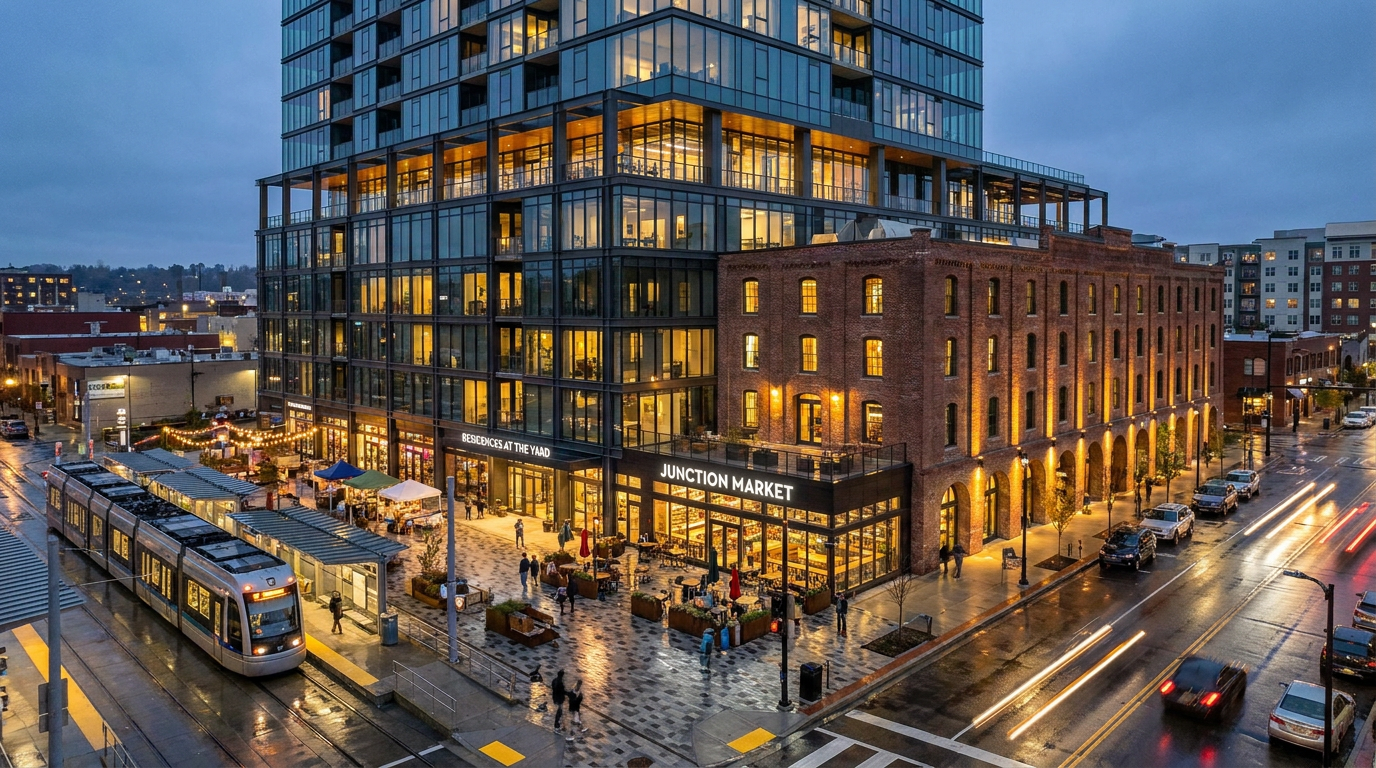
In Canada, this dynamic is especially relevant in major metropolitan areas where land scarcity and housing supply pressures are persistent. Infill projects in Toronto and Vancouver may command the most attention, but meaningful opportunity also exists in Calgary, Montréal, Ottawa, and other cities where transit, zoning reform, and redevelopment needs are evolving. The right market is not always the one with the loudest narrative. It is the one where local policy, demographic demand, and land economics are best aligned.
A Practical Framework for Investors
For investors evaluating mixed-use property, the most effective approach is to treat it as a strategic operating business anchored to real estate fundamentals. That means thinking beyond static valuation metrics and focusing on demand layering, capital flexibility, and neighborhood trajectory. The following framework can help bring discipline to the process.
- Start with the node, not the building. Analyze whether the location has transit access, population depth, employment drivers, and a realistic basis for all-day activity.
- Test each use independently. Underwrite residential, retail, office, or service components on their own merits before assuming synergy.
- Evaluate the interaction effects. Ask whether each use strengthens leasing and retention for the others or introduces operational conflict.
- Build a conservative capital stack. Structure financing around realistic stabilization timelines and the possibility that one component lags.
- Plan for long-term ownership. Mixed-use often rewards patience, active management, and phased value creation more than quick disposition strategies.
- Protect flexibility. Prioritize zoning adaptability, design resilience, and repositioning potential so the asset can evolve with market demand.
The Long-Term Case for Mixed-Use Investments
Mixed-use investing is not the easiest path in real estate, but it may be one of the most strategically aligned with how cities are growing. It reflects a market shift toward density, convenience, transit access, and integrated living patterns. It also reflects a policy shift toward complete communities, smarter infrastructure use, and increased housing supply in established urban areas. When those forces align, investors gain access to a form of real estate that can be both economically resilient and structurally relevant.
The strongest mixed-use assets are not built on novelty. They are built on practical urban logic. People want housing near daily needs. Employers and service providers want locations with built-in activity and connectivity. Municipalities want growth that uses land and infrastructure more efficiently. Investors want durable income, optionality, and assets that can hold their place in evolving neighborhoods. Mixed-use sits in the overlap between those objectives.
That does not make every mixed-use deal attractive. Sophisticated underwriting, layered financing, active management, and local market knowledge remain essential. Yet for investors willing to operate with that discipline, the reward can be more than stable income. It can be ownership in the kind of places that define long-term urban value creation.
In that sense, mixed-use investments should be viewed less as a trend and more as a structural allocation strategy. They offer portfolio diversification within a single asset, exposure to urban regeneration, and potential upside from intensification, placemaking, and policy support. For investors who are focused on maximizing returns while staying aligned with long-term market direction, mixed-use remains one of the most compelling real estate strategies available today.



No Comment! Be the first one.