



Infrastructure planning is one of the most powerful tools cities have to shape long term outcomes. It determines where growth goes, how residents move, how businesses operate, how water and energy systems perform, and whether communities can remain livable as populations expand. When planning is proactive and coordinated, infrastructure becomes more than a technical exercise. It becomes a strategic framework for sustainable urban development.
Table Of Content
- Why Infrastructure Planning Sits at the Center of Sustainable Urban Development
- From Reactive Delivery to Proactive City Building
- Land Use and Infrastructure Must Be Planned Together
- Transportation Planning Is Climate Planning
- What a Complete Mobility Strategy Looks Like
- Infrastructure Resilience Must Be Built In From the Start
- Why Green Infrastructure Matters
- Utilities, Community Facilities, and Service Access Define Urban Quality
- The Importance of Lifecycle Thinking and Asset Renewal
- Financing Sustainable Infrastructure in a Constrained Fiscal Environment
- Governance and Coordination Often Determine Success
- A Practical Framework for Decision Makers
- Conclusion: Infrastructure Planning Is the Operating System of Urban Sustainability
That matters now more than ever. Canadian cities are under pressure from housing demand, affordability constraints, congestion, aging assets, climate risk, and fiscal limitations. At the same time, local and regional governments are being asked to deliver better mobility, more resilient utilities, cleaner growth patterns, and stronger access to community services. These are not separate issues. They are connected outcomes that rise or fall based on how well infrastructure planning aligns with land use and long term development strategy.
The sustainability case is especially clear in transportation. In Canada, the transport sector accounted for 22 percent of total national greenhouse gas emissions in 2024, or 151 Mt CO2e, and transport emissions were 29 percent higher than in 1990. Those figures are a strong reminder that cities cannot meet climate goals through building standards alone. The physical structure of urban growth, including the distance between homes, jobs, schools, and services, has a major influence on emissions, cost, and quality of life.
There is also a governance reality that deserves more attention. According to the OECD, local governments across OECD countries account for 55 percent of public investment and are directly involved in water, housing, transport, infrastructure, and climate policy. In practical terms, that means sustainable urban development is implemented not just through national ambition, but through local infrastructure decisions about roads, transit, pipes, parks, drainage, civic facilities, and the timing of growth. For decision makers, mastering infrastructure planning is not optional. It is central to building cities that work.
This article explores how infrastructure planning can support sustainable urban development through integrated land use, transportation systems, climate resilience, utilities, public services, and lifecycle thinking. The goal is not simply to define best practices, but to frame infrastructure as a strategic lever for better urban outcomes over decades, not just budget cycles.
Why Infrastructure Planning Sits at the Center of Sustainable Urban Development
Sustainable urban development is often discussed in broad terms such as livability, emissions reduction, affordability, resilience, and inclusion. Yet those goals do not materialize on their own. They are built, managed, financed, and maintained through infrastructure systems. Roads influence land consumption. Transit shapes access to jobs. Water systems affect growth capacity. Parks and community facilities influence health, equity, and neighborhood value. Stormwater systems determine how vulnerable a district is to flooding and how much ecological function remains in urban landscapes.
This is why infrastructure planning must be understood as a city building discipline, not only an engineering function. Technical design matters, but the larger question is whether infrastructure supports the kind of city a region actually wants. A city that seeks lower emissions but continues to extend low density growth far from jobs and services will struggle to achieve its goals. A city that wants housing affordability but fails to coordinate servicing capacity, transit access, and community amenities will limit supply and undermine public support for intensification.
Global evidence reinforces the urgency. OECD reporting shows that only 11 percent of OECD regions have achieved end values for SDG 11, the Sustainable Development Goal focused on inclusive, safe, resilient, and sustainable cities and communities. In a sample of 637 cities, only 17 percent achieved both low air pollution exposure and balanced land consumption to population growth targets. These results make one point clear. Sustainable urban performance is difficult to achieve without disciplined coordination between infrastructure investment and urban form.
Sustainable infrastructure is not just about adding green features. It requires integrated decisions about land use, mobility, utilities, housing, public space, resilience, and long term financing.
For local governments, the challenge is not simply to build more infrastructure. It is to build the right infrastructure in the right place, at the right time, with the right performance standards and lifecycle strategy. That shift in mindset separates reactive growth management from strategic urban development.
From Reactive Delivery to Proactive City Building
Many infrastructure systems have historically been planned in response to growth rather than in anticipation of it. A subdivision is approved, then roads are widened. Traffic increases, then transit is considered. Flooding worsens, then drainage capacity is revisited. Community facilities lag until populations have already outgrown local services. This reactive model tends to be more expensive, less equitable, and less sustainable over time because it locks in inefficient patterns before corrective action is taken.
Proactive infrastructure planning works differently. It starts with a growth vision and tests what physical systems are required to support that vision successfully. It links future land use to transportation capacity, utility servicing, school needs, parks provision, emergency access, climate risks, and fiscal sustainability. Instead of asking how to catch up after growth happens, it asks how infrastructure can shape better growth from the start.
This approach is particularly important in fast growing metropolitan areas where land values, servicing constraints, and transportation bottlenecks interact. Decisions on where to extend transit, where to intensify around stations, where to preserve employment lands, and where to direct stormwater investment can influence development feasibility for years. A proactive approach creates market clarity, lowers uncertainty, and improves the ability of both public and private actors to plan capital commitments effectively.
It also supports public confidence. Residents are more likely to accept change when growth is tied to visible improvements in mobility, parks, schools, libraries, healthcare access, and public space. Infrastructure planning therefore plays a political role as well as a technical one. It demonstrates that urban growth can be managed in a way that improves daily life rather than diminishing it.
Land Use and Infrastructure Must Be Planned Together
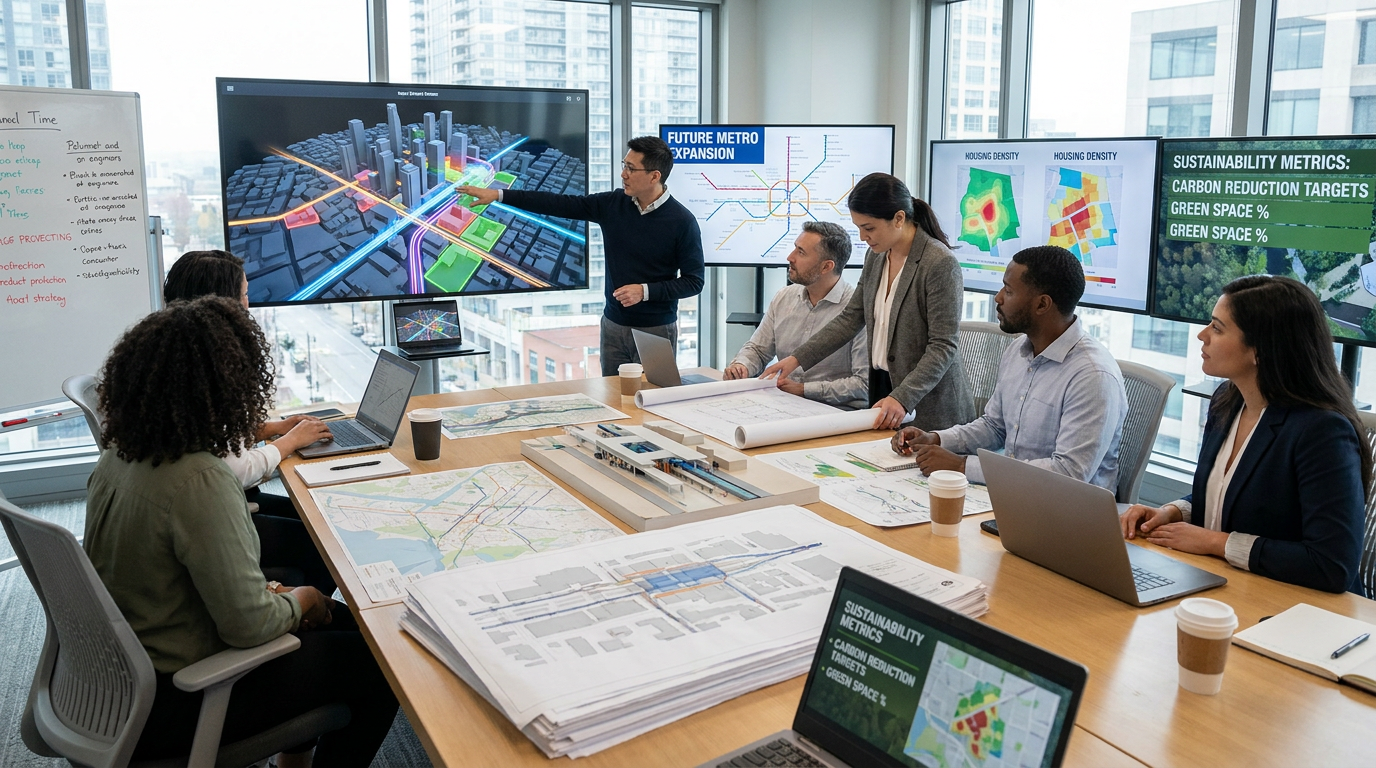
One of the most common weaknesses in urban growth policy is treating land use planning and infrastructure planning as parallel processes instead of integrated ones. In reality, every major land use decision carries infrastructure consequences. Higher density can improve service efficiency and reduce per capita infrastructure costs, but only if systems are designed to absorb that intensity. Low density expansion may appear simpler in the short term, but it often increases long term operating costs, travel distances, emissions, and maintenance burdens.
Effective land use and infrastructure integration begins with urban structure. Cities need clarity on where growth should concentrate, where protection is needed, and which corridors or nodes can support intensified development. This often points toward a pattern of compact, mixed use, transit supportive communities rather than dispersed and auto dependent expansion. The logic is straightforward. When homes, employment, retail, schools, and community amenities are located closer together, infrastructure can serve more people more efficiently and with lower environmental impact.
Concepts such as complete communities, 15 minute city planning, and compact city planning are useful because they describe this relationship in practical terms. A neighborhood that allows residents to reach daily needs through short transit, walking, or cycling trips reduces demand on roads, lowers transportation emissions, and supports healthier urban life. It also makes better use of public investment by directing population and activity to areas where infrastructure capacity can be leveraged rather than duplicated.
There is a direct connection here to housing supply. In many markets, the challenge is not simply a shortage of land. It is a shortage of development ready land with sufficient servicing, transportation access, and policy certainty. Infrastructure planning can unlock housing by identifying sequencing priorities, reducing bottlenecks, and aligning capital programs with areas suitable for intensification or expansion. In this sense, infrastructure is not just a cost item. It is a precondition for feasible and timely urban housing delivery.
Strong integrated planning usually involves several core actions:
- Aligning municipal growth forecasts with servicing and transportation capacity
- Prioritizing density in corridors and nodes with strong transit potential
- Preserving land for utilities, community facilities, and future mobility needs
- Using zoning and infrastructure phasing together rather than separately
- Evaluating cumulative impacts instead of project by project effects alone
When these actions are taken early, cities can guide growth toward outcomes that are more sustainable fiscally, socially, and environmentally. When they are ignored, urban form tends to drift toward fragmentation and higher long term cost.
Transportation Planning Is Climate Planning
If there is one area where infrastructure planning has immediate sustainability implications, it is transportation. The data from Canada is decisive. With transportation responsible for 22 percent of national greenhouse gas emissions in 2024 and emissions still well above 1990 levels, any serious urban sustainability strategy must address how mobility systems are designed. This is not only about vehicle technology. It is about the distance, pattern, and mode of travel built into the city itself.
A city that requires most residents to drive long distances for work, groceries, school, and recreation creates structural emissions. Even with cleaner vehicles, congestion, land consumption, and household transportation costs remain high. By contrast, a city that supports compact growth around reliable transit with safe walking and cycling networks can lower emissions while also improving convenience and public health.
That is why integrated land use and transit planning has gained momentum. Transit oriented development is not simply a density exercise around stations. Done properly, it creates a broader ecosystem of housing, jobs, retail, public space, and active transportation within an accessible urban framework. The result is not just ridership. It is a more efficient city where infrastructure supports shorter trips, lower dependence on private vehicles, and stronger economic concentration.
In Canada, the federal government has highlighted major public transit investment commitments, including a 25 billion dollar program to upgrade public transit systems over a decade. Investments of that scale matter, but their impact depends on surrounding development choices. Public transit alone does not solve urban sustainability if housing remains disconnected from jobs and services or if walking and cycling networks are weak. Transit must be embedded within a complete mobility strategy.
What a Complete Mobility Strategy Looks Like
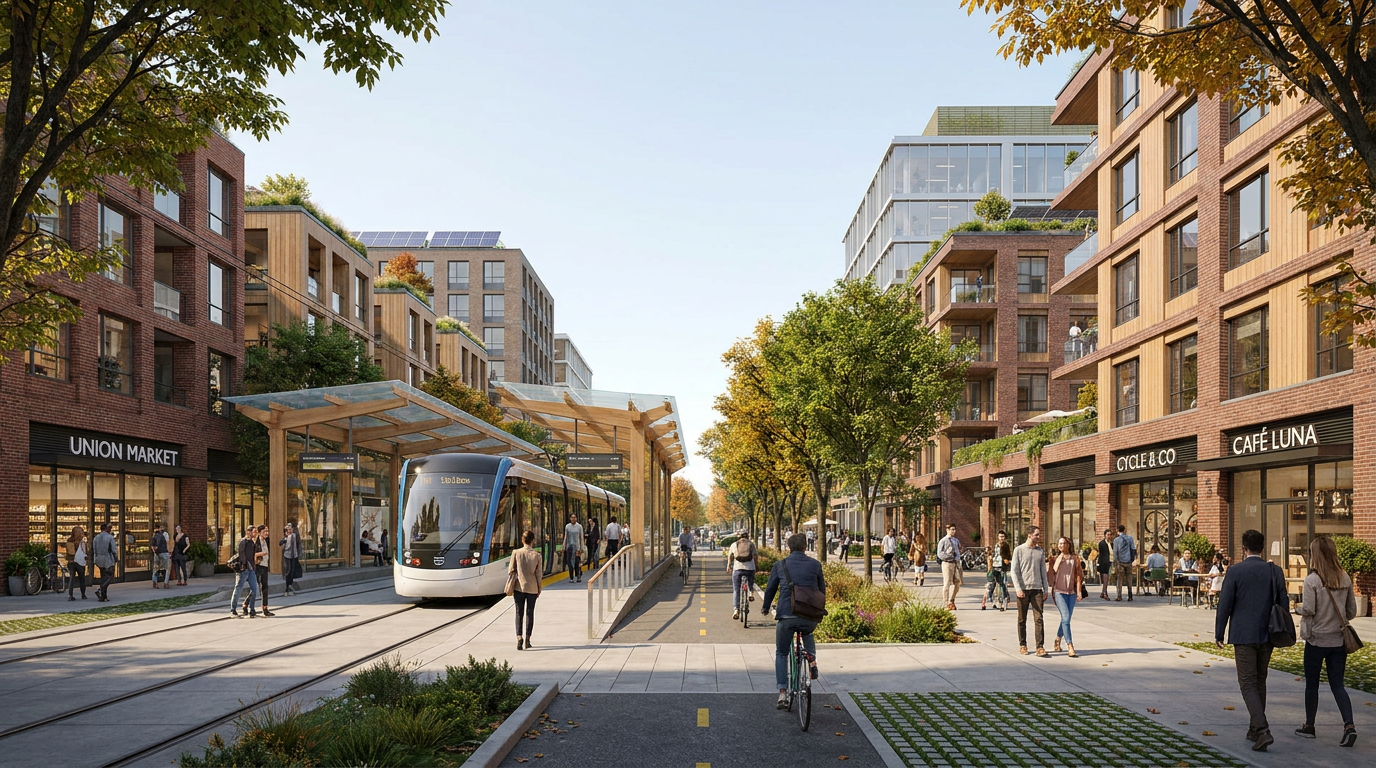
A sustainable transportation framework combines multiple systems rather than relying on one intervention. Transit is a central element, but so are active transportation, street design, curb management, freight access, and digital tools that improve network efficiency. Successful cities create mobility options that are practical, safe, and financially accessible for a wide range of users.
- Transit investment should be linked to areas where population and employment density can support strong use and long term ridership growth.
- Walking infrastructure needs to be continuous, accessible, and attractive, especially around schools, stations, retail streets, and community facilities.
- Cycling networks must be protected, connected, and integrated with transit so active transportation becomes a realistic daily option.
- Street design should balance movement with safety, placemaking, and local access rather than prioritizing vehicle speed alone.
- Freight and service planning should be included early because urban economies depend on efficient goods movement as much as passenger mobility.
When these pieces work together, cities gain more than reduced emissions. They also reduce congestion, improve street safety, support local business activity, and make higher density living more viable. This is a key point for planners and developers alike. Better transportation systems expand the practical market for urban housing and employment growth.
Infrastructure Resilience Must Be Built In From the Start
Sustainability is often discussed in mitigation terms, but adaptation is equally important. Cities are already dealing with heat, flooding, extreme precipitation, freeze thaw cycles, wildfire smoke, and aging infrastructure exposed to more volatile conditions. Climate resilience is not a side consideration that can be added later. It should influence where assets are located, how they are designed, what materials are used, and how maintenance regimes are structured.
This is where proactive infrastructure planning becomes essential. Placing growth in vulnerable flood prone areas without accounting for future storm intensity creates risk that is difficult and expensive to reverse. Failing to shade streets and public spaces in dense districts can increase heat stress and reduce urban comfort. Under sizing drainage systems or ignoring backup power needs in critical facilities can turn weather events into major service disruptions.
Resilient planning begins with risk mapping and performance standards. Municipalities need to understand where future hazards are most likely, which assets are most exposed, and what service levels are required under stress conditions. That includes transportation corridors, water and wastewater systems, energy networks, emergency routes, housing clusters, and public institutions. Once risks are identified, resilience needs to be integrated into capital prioritization, not treated as a separate policy aspiration.
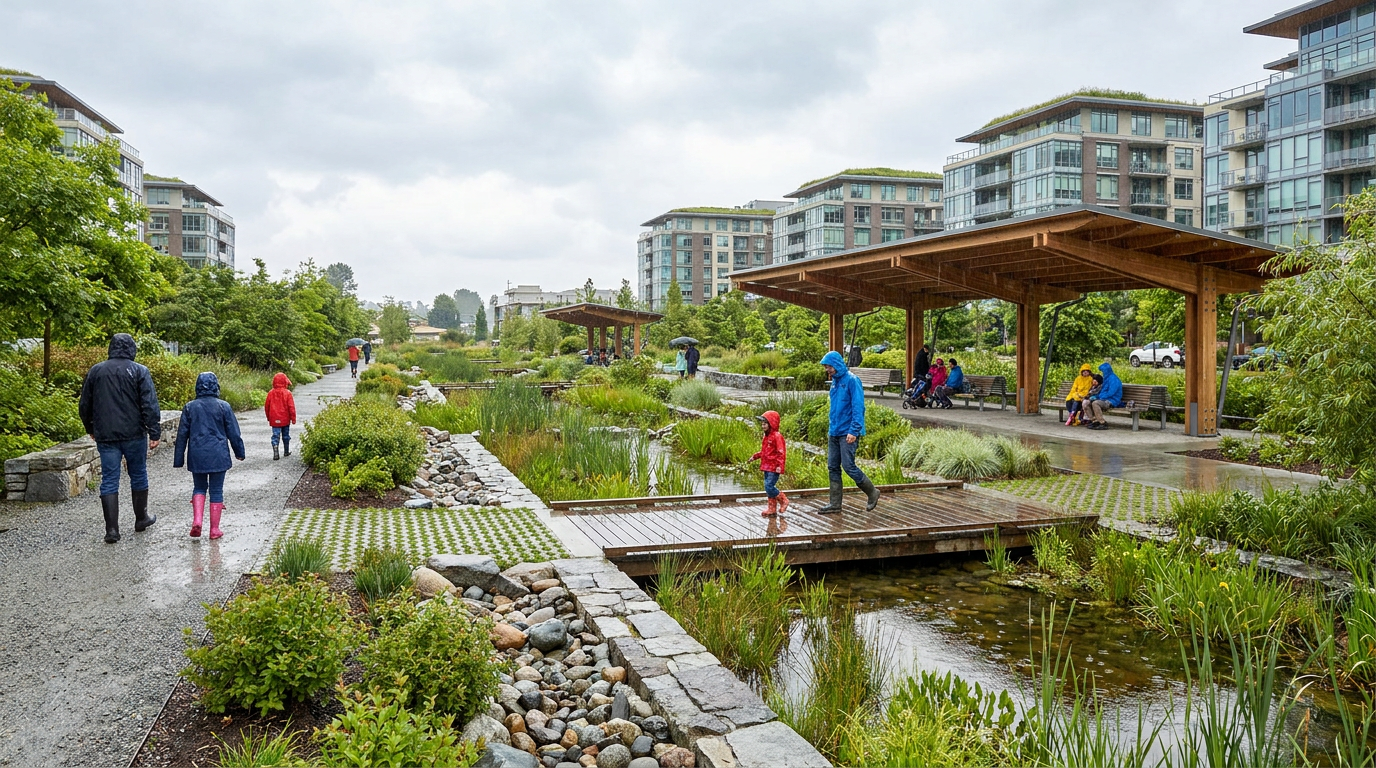
Nature based solutions are now an increasingly important part of this conversation. Urban wetlands, afforestation, permeable surfaces, bioswales, and vegetation restoration can improve flood management, reduce urban heat, support biodiversity, and make public spaces more attractive. These interventions are not just environmental amenities. They are infrastructure assets when they are planned to perform hydrological, thermal, and ecological functions in a coordinated system.
Why Green Infrastructure Matters
Green infrastructure is sometimes misunderstood as decorative landscaping. In reality, it can serve important functional roles in sustainable urban development. Tree canopy can moderate heat and improve comfort in dense neighborhoods. Wetlands and retention landscapes can absorb runoff and reduce strain on conventional drainage systems. Green corridors can connect habitats while also creating pedestrian and cycling routes. When these systems are designed intentionally, they improve both resilience and livability.
There is also a financial case for these investments. Traditional gray infrastructure remains essential, but relying on engineered systems alone can be costly and inflexible. Green infrastructure can help reduce peak loads, extend asset life, and create co benefits in health, recreation, and property value. The strongest long term strategies often combine gray and green systems rather than treating them as competing approaches.
Climate resilience should not be separated from infrastructure planning. Resilience needs to be embedded in siting, design, financing, operations, and renewal from the beginning.
Utilities, Community Facilities, and Service Access Define Urban Quality
Infrastructure planning is often reduced in public debate to transportation, but sustainable cities depend equally on less visible systems. Water, wastewater, stormwater, energy distribution, digital connectivity, waste management, schools, recreation centers, libraries, healthcare access, and emergency services all influence whether urban growth is functional and equitable. A neighborhood with new housing but weak service access is not truly complete. It is under supported development.
Utility planning is especially important because it directly affects development timing and cost. Capacity constraints in water or wastewater systems can stall housing and employment growth even in places with supportive policy. Aging or fragmented utility networks also increase maintenance burdens and can create unequal service outcomes across municipalities. Strategic infrastructure planning therefore requires long range asset management tied to realistic growth assumptions, not simply annual repair budgeting.
Community facilities deserve equal attention. Parks, childcare, schools, recreation, and civic spaces are often treated as follow up amenities, yet they are central to how residents experience urban growth. If cities want denser communities to succeed, these facilities must be planned as core infrastructure. They support social cohesion, public health, family life, and neighborhood identity. They also help maintain political legitimacy for intensification by showing that growth comes with tangible public benefit.
Equitable access is a defining principle here. Sustainable development is not only about environmental performance. It is also about whether residents across income levels, ages, and mobility needs can access essential services without excessive cost or travel time. Infrastructure plans that ignore equity tend to reinforce exclusion by concentrating advantage in already well served areas while leaving others with poor transit, weaker public realm, or limited community support.
The Importance of Lifecycle Thinking and Asset Renewal
One of the most persistent misconceptions in infrastructure planning is that sustainability can be judged mainly at the point of construction. In reality, the long term performance of infrastructure depends on operations, maintenance, adaptation, and eventual repurposing. Cities that focus only on capital delivery can create future liabilities if asset renewal costs are not understood from the outset.
Lifecycle thinking changes the question from what can we build to what can we sustain. This includes evaluating whole life cost, carbon performance, energy use, maintenance needs, flexibility, and end of life options. A lower cost short term solution may prove far more expensive if it requires frequent repair, fails under climate stress, or locks in inefficient land use patterns. Conversely, an upfront investment in durable, adaptable systems can produce substantial public value over time.
This perspective supports a growing emphasis on circular economy principles in infrastructure. Reuse, retrofit, adaptive repurposing, and strategic renewal can often deliver better sustainability outcomes than default replacement or expansion. For established cities in particular, the future of infrastructure is not only about building outward. It is about modernizing inherited systems so they can serve denser, more resilient, and lower emission urban forms.
Asset management frameworks are vital in this context. They help municipalities understand condition, performance, risk exposure, replacement schedules, and funding gaps. More importantly, they allow cities to connect renewal decisions with broader planning goals. For example, a road reconstruction project can also become an opportunity to add protected cycling infrastructure, improve stormwater management, and upgrade streetscape quality rather than merely restoring the previous condition.
Financing Sustainable Infrastructure in a Constrained Fiscal Environment
No discussion of infrastructure planning is complete without acknowledging cost. Sustainable urban development requires substantial investment, and the scale is global as well as local. OECD and related analyses estimate that annual infrastructure investment of about USD 6.9 trillion by 2030 is needed globally to align infrastructure with the SDGs and the Paris Agreement. That number illustrates the size of the transition. The issue is not whether capital is needed, but how it is prioritized, sequenced, and leveraged.
For municipalities, the challenge is intensified by limited revenue tools and expanding service obligations. Growth does not automatically pay for itself, especially when urban form is inefficient or when infrastructure is delivered ahead of sufficient tax base. This is one reason compact growth and integrated servicing matter so much. They can improve the economics of infrastructure by serving more residents and businesses within a smaller footprint and with stronger utilization rates.
Funding models will vary by jurisdiction, but several principles remain broadly relevant:
- Capital investment should follow a clear urban growth strategy rather than dispersed political demand
- Lifecycle costs should be incorporated into project evaluation from the beginning
- Development related charges and value capture tools should be assessed alongside affordability and feasibility impacts
- Public private partnerships can play a role where risk allocation and long term accountability are well structured
- Intergovernmental coordination is essential because infrastructure benefits often cross municipal boundaries
Financing is therefore not just a treasury issue. It is a planning issue. The most sustainable infrastructure programs are those where policy, land economics, and capital strategy reinforce one another instead of pulling in different directions.
Governance and Coordination Often Determine Success
Even strong technical plans can fail when governance is fragmented. Urban infrastructure decisions frequently cut across departments, utilities, agencies, transit authorities, school boards, conservation bodies, and multiple levels of government. Without coordination, one part of the system may advance while another lags. A transit corridor may be funded without supportive zoning. Housing targets may be set without servicing upgrades. Climate goals may be adopted without procurement standards or maintenance plans to support them.
Because local governments manage key areas such as water, housing, transport, infrastructure, and climate policy, institutional alignment is crucial. Cities need planning frameworks that connect policy intent with implementation responsibilities, funding timelines, and measurable outcomes. This includes shared data, common growth assumptions, integrated capital forecasting, and clear accountability for delivery.
Public engagement also matters. Infrastructure planning works best when communities understand tradeoffs and see how projects fit into a wider vision. Residents are often skeptical of growth when they experience overcrowded roads, weak transit, inadequate parks, or stressed schools. Transparent infrastructure planning can help demonstrate that sustainable development is not growth without support. It is growth organized around quality, access, and resilience.
Leadership is ultimately a major differentiator. Cities that perform well over the long term are usually those with a disciplined development strategy, the willingness to prioritize, and the capacity to think beyond election cycles. Sustainable urban development requires this kind of institutional maturity because infrastructure decisions today will shape land value, mobility, and environmental performance for generations.
A Practical Framework for Decision Makers
For planners, municipal leaders, landowners, and development professionals, the core question is how to turn these principles into a working framework. While every city has unique conditions, the most effective infrastructure planning approaches usually follow a consistent sequence. They begin by defining the desired urban form and growth pattern. They then test whether transportation, utilities, public services, and resilience systems can support that pattern. Finally, they establish phasing, financing, and governance structures that connect vision to implementation.
A practical decision making framework should address the following questions:
- Where should growth go? Identify nodes, corridors, and districts that can support compact, mixed use, and transit supportive development.
- What infrastructure is required? Assess transportation, servicing, social infrastructure, energy, and digital needs together rather than separately.
- What risks must be designed for? Incorporate climate exposure, asset vulnerability, and resilience standards from the start.
- What can be funded and maintained? Evaluate capital and operating implications across the full asset lifecycle.
- How will timing affect feasibility? Sequence infrastructure to unlock priority housing, employment, and community outcomes.
- Who is responsible for delivery? Clarify institutional roles, intergovernmental coordination, and performance accountability.
This structure helps move planning from aspiration to execution. It also improves transparency by showing how growth objectives translate into physical systems and financial commitments. In a period of rapid urban change, that clarity is essential.
Conclusion: Infrastructure Planning Is the Operating System of Urban Sustainability
Mastering infrastructure planning for sustainable urban development means recognizing that cities are shaped less by abstract goals than by the physical systems that support everyday life. Transportation networks influence emissions and access. Utility systems define growth capacity and public health. Community facilities support inclusion and livability. Green infrastructure improves resilience and environmental performance. When these elements are planned in isolation, urban outcomes become fragmented. When they are planned together, cities become more efficient, more equitable, and more adaptable.
The strategic opportunity is significant. Infrastructure planning can help address housing supply, reduce congestion, support climate targets, strengthen resilience, and improve neighborhood quality at the same time. But that only happens when cities move beyond reactive project delivery and adopt a proactive, integrated, lifecycle based approach. Sustainable development is not the result of one signature project or one funding announcement. It is the result of consistent alignment between land use, infrastructure, finance, and long term public purpose.
For Canada and other growing urban regions, this is the path forward. The transport sector emissions profile, the scale of local public investment, and the limited progress toward SDG 11 all point to the same conclusion. Infrastructure planning is not a background function. It is the operating system of urban sustainability. Cities that understand this will be better positioned to grow with resilience, affordability, and long term value. Cities that do not will continue to chase problems that smarter planning could have prevented.
In the end, the most successful urban development strategies are not those that promise the most. They are the ones that connect vision to infrastructure in a disciplined and durable way. That is how sustainable cities are actually built.


No Comment! Be the first one.