



There is something uniquely moving about a landscape that meets the water with grace. The shoreline is not simply a boundary between land and lake, river, bay, or sea. It is a threshold, a delicate place where reflection, movement, light, and texture come together to shape an atmosphere unlike any other in the garden. To design a serene waterfront landscape is to compose an experience of calm while also respecting the living systems that make that beauty possible.
Table Of Content
- The Essence of Waterfront Serenity
- Why Waterfront Design Must Balance Beauty and Resilience
- Beginning with the Site: Reading the Waterfront Properly
- Creating a Seamless Transition Between Land and Water
- The Role of Living Shorelines in Elegant Landscape Design
- Choosing Plants for Beauty, Stability, and Seasonal Calm
- How to Think in Planting Zones
- Layout Design: Organizing Space with Elegance
- Materials That Belong at the Water’s Edge
- Correcting Common Waterfront Design Misconceptions
- Maintenance as a Design Value
- Designing for Climate Adaptation Without Losing Grace
- A Practical Framework for Planning a Serene Waterfront Landscape
- The New Luxury of Waterfront Living
- Conclusion: Let the Shoreline Lead the Design
A serene waterfront landscape is one where elegant layout, native planting, and resilient shoreline design work together so a property feels calm without ignoring the realities of moving water. Successful waterfront design asks for more than visual charm; it requires an understanding of drainage, erosion, wave energy, plant communities, shoreline stability, and climate resilience, so that a space appears effortless while performing intelligently beneath the surface. The stakes for getting this right are rising. The U.S. Environmental Protection Agency notes that global sea level has risen through the 20th and 21st centuries, with evidence suggesting U.S. coastlines may see another 10 to 12 inches of sea-level rise by 2050, and Canadian federal agencies emphasize growing exposure to flooding, storm surge, and erosion across coastal and Great Lakes regions. A tranquil waterfront landscape is therefore no longer only a matter of style. It is an act of thoughtful adaptation.
This guide explores how to create waterfront outdoor spaces that feel serene, refined, and enduring. From layout and circulation to plant selection and shoreline treatment, the goal is to design landscapes that welcome relaxation while working in harmony with water. The result can be both luxurious and resilient, an outdoor setting where nature is not overruled, but beautifully understood.
The Essence of Waterfront Serenity
Serenity in landscape design is rarely created through excess. In waterfront settings, it comes from proportion, softness, rhythm, and restraint. Water already offers movement and atmosphere, so the surrounding landscape should support rather than compete with it. This often means simplifying materials, allowing open views, and using planting to frame moments rather than clutter them.
A serene waterfront garden invites the eye to travel gradually. The house transitions to terrace, the terrace dissolves into planting, and the planting gently reaches toward the shoreline. Each layer should feel intentional. Harsh interruptions, abrupt grade changes, or oversized hardscape can disturb the calm that waterfront spaces naturally offer.
There is also an emotional dimension to this kind of design. The sound of grasses in the wind, the reflection of light on water, and the quiet enclosure of a shaded seating area all contribute to a sensory experience. Serenity is not a decorative effect applied at the end. It is the result of a landscape being composed with sensitivity to scale, climate, movement, and rest.
The most elegant waterfront landscapes do not impose themselves on the shoreline. They soften, frame, filter, and reveal, allowing land and water to meet with dignity.
Why Waterfront Design Must Balance Beauty and Resilience
It is tempting to think of shoreline landscapes only in aesthetic terms, especially when the immediate goal is to create a beautiful outdoor retreat. Yet waterfront sites are dynamic environments. Water levels fluctuate, banks shift, storms intensify, and runoff can alter the health of both the land and the water itself. Designing for serenity therefore begins with accepting that these places are alive and changing.
Authoritative North American guidance increasingly supports nature-based shoreline strategies where conditions allow. According to NOAA, living shorelines use native vegetation and natural materials to stabilize shorelines, and they are generally best suited to sheltered waters such as estuaries, bays, tributaries, rivers, and lakes rather than highly exposed open-ocean beaches. The EPA likewise highlights that living shorelines can reduce erosion and flooding while improving water quality, providing habitat, and storing carbon. For homeowners, this means that practical performance and visual softness can coexist beautifully.
Resilience does not require sacrificing elegance. In fact, landscapes that respond intelligently to water often feel more natural, composed, and timeless than those built around rigid control. Vegetated edges, layered buffers, permeable surfaces, and subtle grade transitions can be far more graceful than a severe wall running along the waterline. The design challenge is not whether to protect the shore, but how to do so in a way that remains site appropriate and visually harmonious.
Some sites may call for hybrid strategies that combine living shoreline principles with selective structural reinforcement. Others may require more robust engineering because of wave exposure or severe erosion. A refined design acknowledges this spectrum. It avoids the misconception that every shoreline should be fully hardened, while also rejecting the equally simplistic idea that every site can be left entirely untouched.
Beginning with the Site: Reading the Waterfront Properly
Before selecting a single plant or paving material, it is essential to study the site. NOAA guidance for shoreline planning emphasizes the importance of understanding bank erosion rate, elevation, wind and wave direction, wave energy, soil type, existing vegetation, drainage patterns, and the conditions of adjacent shorelines. This technical foundation is what allows a landscape to feel calm in the long term rather than polished for only one season.
Elevation changes deserve particular attention. A site that appears gently sloped may still contain zones that are frequently saturated, occasionally flooded, or vulnerable to runoff. Each of these microconditions affects not only what can be planted, but also where paths, terraces, stairs, and gathering spaces should be placed. In waterfront design, successful composition begins with hydrology.
Exposure is equally important. A protected lakeside cove can support a softer shoreline edge and a more intricate planting tapestry than a site facing strong winds and higher wave action. Soil character also matters. Sandy, silty, rocky, and clay-rich shorelines each perform differently and ask for different stabilization approaches. When these site realities are ignored, even the most beautiful design can fail.
From an aesthetic perspective, site reading also includes understanding views. Where does the sun rise and set across the water. Which angle offers the most tranquil reflection. Where should privacy be created, and where should openness prevail. Good waterfront design marries environmental analysis with visual choreography so that every intervention feels grounded in place.
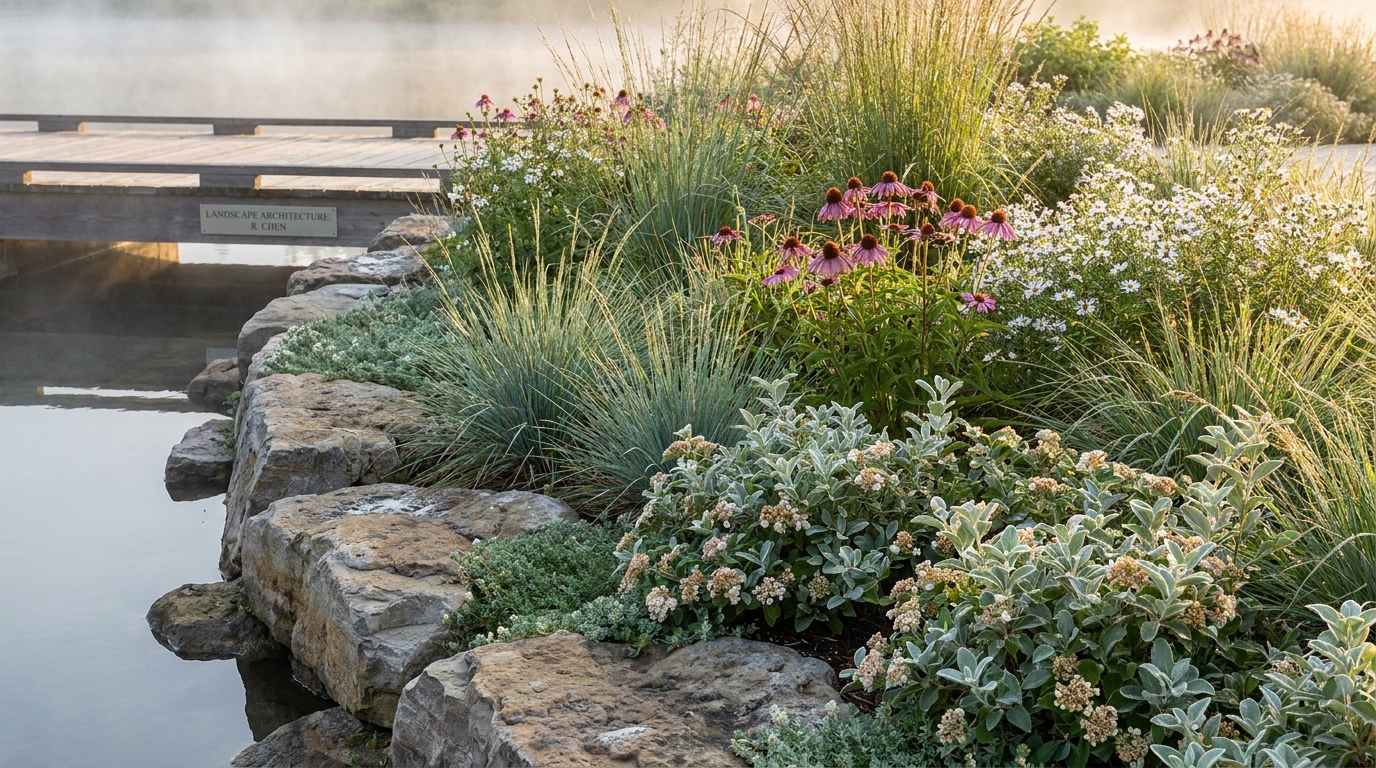
Creating a Seamless Transition Between Land and Water
The transition from garden to shoreline is where the poetry of waterfront design truly emerges. Rather than treating the water’s edge as a hard stop, the most serene landscapes shape it as a sequence. This sequence might begin with a terrace near the home, continue into a meadow-like planting zone, narrow into a path, and then dissolve into a native shoreline buffer. The eye experiences this progression as calm because no single gesture feels abrupt.
Terracing can be especially useful on sloped waterfront sites. When handled delicately, low terraces allow the land to descend in measured steps rather than in one dramatic drop. They create room for seating, improve circulation, and help slow runoff. Visually, terraces also lend order to the landscape, especially when their lines are softened with generous planting.
Permeable edges are another key principle. Instead of drawing a sharp line with a bulkhead or wall where it is not necessary, consider planted margins, gravel paths, low stone bands, or wetland shelves that ease the meeting of land and water. This kind of transition can absorb wave energy, filter runoff, and foster a richer visual conversation between solid ground and reflective surface.
Circulation should also support tranquility. Paths should feel intuitive and unhurried, inviting a slow approach to the water. A walkway that reveals the shoreline gradually can be far more evocative than one that rushes visitors directly to the edge. The choreography of movement matters deeply in waterfront landscapes because anticipation is part of the experience.
Where safety and access are priorities, steps, boardwalks, and small landings can be integrated elegantly. The goal is to maintain a feeling of continuity rather than interruption. Materials should feel honest to the setting, with wood, stone, gravel, and other natural textures often working more gracefully than overly polished finishes.
The Role of Living Shorelines in Elegant Landscape Design
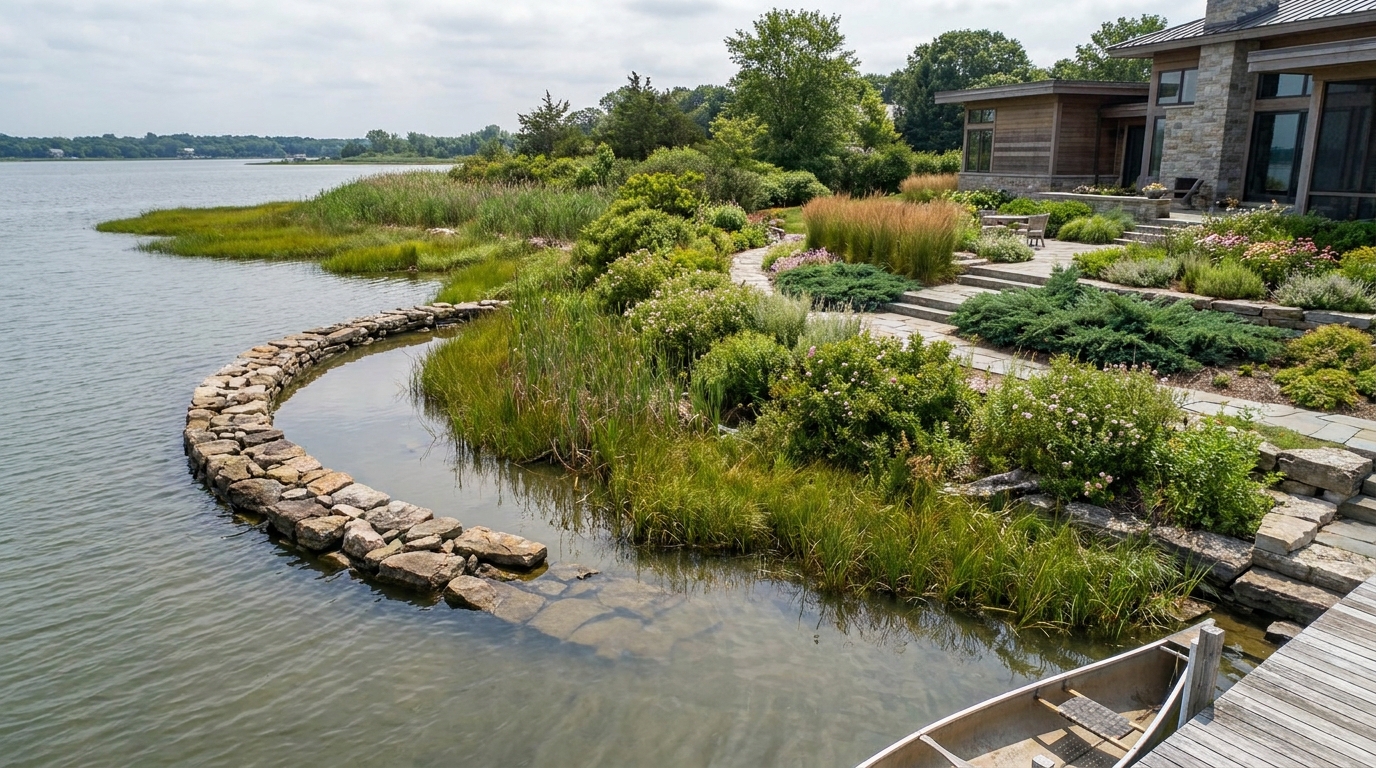
Living shorelines are sometimes misunderstood as purely ecological infrastructure, detached from the language of refined residential design. In reality, they can be remarkably beautiful. A well-designed living shoreline creates softness at the edge, movement through seasonal grasses and reeds, habitat for birds and pollinators, and a visual depth that a hardened wall simply cannot provide. It allows the shoreline to feel alive without becoming unruly.
NOAA describes living shorelines as shoreline stabilization systems made from native vegetation and natural materials, sometimes combined with features such as rock sills or shell elements. The EPA similarly distinguishes soft shorelines from hardened armoring, noting that vegetated systems can absorb wave energy, filter runoff, and hold soil in place. For many sheltered waterfront conditions, this makes them both a practical and aesthetic solution.
What makes a living shoreline feel sophisticated is not the absence of control, but the quality of its composition. Repetition of plant masses, carefully edited species palettes, clean path edges, and thoughtful layering can bring clarity to a naturalistic shoreline. The result is not messy. It is nuanced. It reflects the same discipline one would expect in any luxury landscape, simply expressed through ecological intelligence.
Hybrid shoreline systems are also becoming more relevant. Recent North American projects increasingly combine wetlands, reefs, vegetation, and selective hard structures where required. This approach is especially useful for sites that need extra protection without losing the visual softness and environmental benefits of a nature-based edge. In residential design, hybrid thinking can allow a shoreline to remain elegant while responding honestly to exposure and risk.
Choosing Plants for Beauty, Stability, and Seasonal Calm
Plant selection is one of the most expressive aspects of waterfront landscape design, yet it is also one of the most technical. The shoreline is not a uniform planting zone. It is a gradient of moisture, exposure, and soil conditions, and each layer should be planted accordingly. The best results come not from a universal species list, but from choosing locally native plants suited to each distinct zone of the site.
EPA lakeshore guidance strongly recommends reducing turf lawn near the water and replacing it with native grasses, wildflowers, shrubs, and trees. This advice is both practical and beautiful. Turf reaching to the water’s edge often increases runoff, demands more fertilizer and irrigation, and leaves the shoreline more vulnerable to stress. A layered native planting, by contrast, stabilizes the bank, filters water, and creates a richer visual tapestry.
Native shoreline vegetation also offers aesthetic refinement through texture. Fine grasses catch light in a way that feels luminous at dawn and dusk. Flowering perennials can introduce softness without excessive formality. Shrubs create depth and seasonal structure, while small trees frame views and provide shelter. These plantings can be orchestrated with the same sophistication as any ornamental border, but with a quieter, more grounded character.
For a serene effect, think in terms of drifts and layers rather than isolated specimens. Repeating forms create rhythm, while subtle variation keeps the composition alive. A restrained palette often feels more elegant than an overly colorful mix, especially against the shifting tones of water and sky. Silvers, greens, muted blues, and soft seasonal blooms often harmonize beautifully in waterfront settings.
Because regional conditions vary so widely across North America, local expertise is essential. Salinity, winter ice, fluctuating lake levels, wind exposure, and flood frequency all influence plant performance. A shoreline planting that thrives on a sheltered freshwater lake may fail on a tidal estuary. Designing with native plant communities rather than decorative preference alone is what turns a lovely concept into a lasting landscape.
How to Think in Planting Zones
One of the most useful ways to plan a waterfront landscape is to divide it into functional planting zones. The upper garden near the home can hold more structured planting, seating, and ornamental detail. Below that, a transition zone can blend perennials, grasses, and shrubs that tolerate occasional moisture and help slow runoff. Closest to the water, a buffer of riparian or wetland-adapted plants can stabilize soil and support habitat.
This zoned approach creates visual depth while also making maintenance more manageable. It prevents delicate ornamental plants from being placed where flooding or saturation will damage them, and it avoids overengineering areas that could instead perform naturally. More importantly, it allows the landscape to feel composed from every vantage point, from the house looking outward and from the water looking back.
In elegant design, the shoreline buffer should not feel like an afterthought. It should be treated as a beautiful destination in its own right, with texture, movement, and subtle seasonal change. This is where ecology and artistry meet most fully.
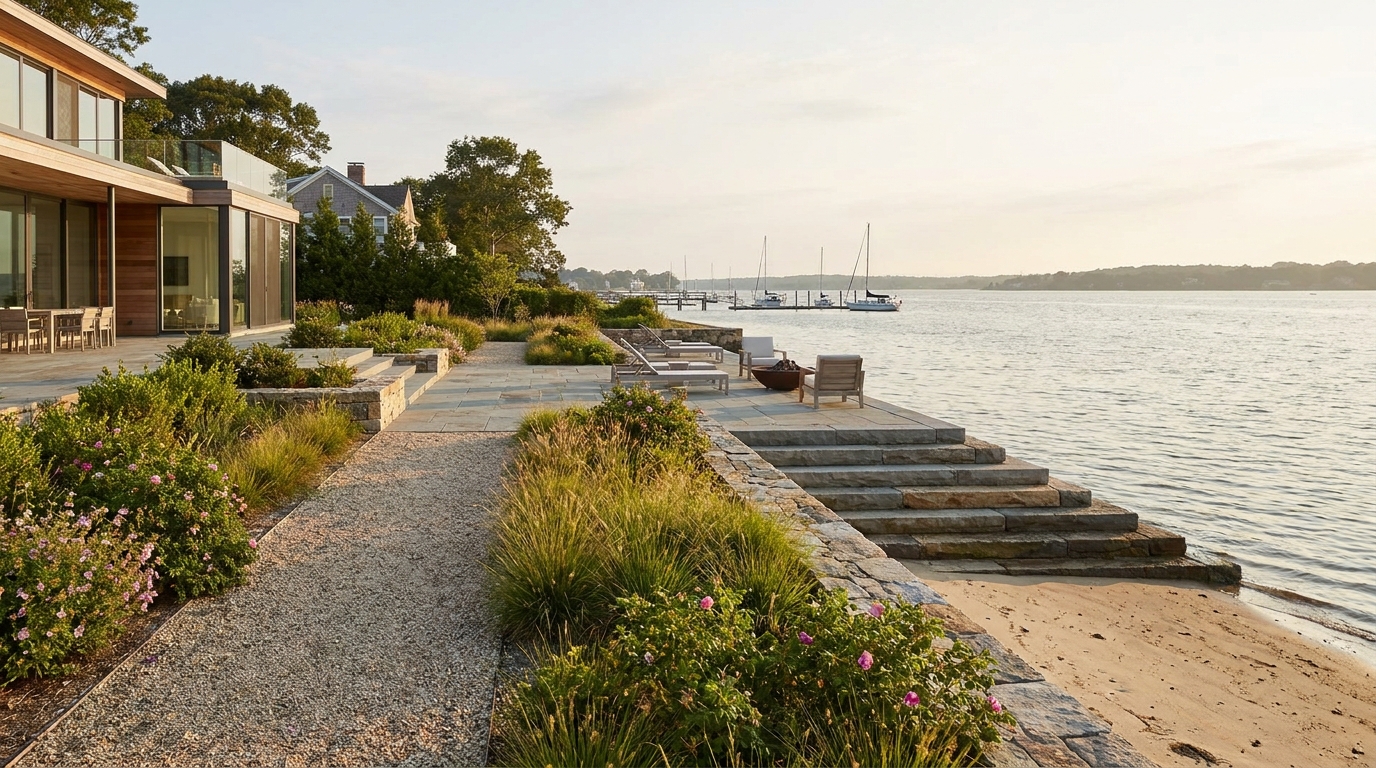
Layout Design: Organizing Space with Elegance
A tranquil waterfront landscape depends on layout as much as planting. Furniture, terraces, pathways, outlooks, and gathering spaces must be arranged to support both serenity and function. The guiding principle is usually simplicity. A few well-placed destinations are more powerful than a crowded plan full of competing gestures.
Begin by identifying the emotional heart of the landscape. In some projects, this is a dining terrace with water views. In others, it is a quiet seating platform for reading, a fire feature set back from the shoreline, or a path leading to a dock. Once that focal use is clear, the rest of the site can be organized around supporting moments rather than duplicating them.
Axes can be useful in waterfront design, but they should be handled gently. A strong central alignment from the house to the water can create drama, yet too rigid a composition may feel disconnected from the natural edge. Often, the most graceful layouts combine one or two clear organizing lines with softer peripheral planting and curved circulation. This balance preserves calm while avoiding stiffness.
Seating should be placed with microclimate in mind. Waterfront sites can be windy, exposed, and highly reflective in strong sun. A seating area that seems ideal on plan may feel uncomfortable in reality unless it is sheltered by planting, low walls, or carefully placed trees. Comfort is part of elegance. If a space cannot be enjoyed with ease, it will never feel truly serene.
Lighting should be understated and warm. The purpose is not to flood the landscape with brightness, but to extend its atmosphere into evening. Path lights, subtle step illumination, and soft uplighting on a tree or textured planting mass can create a beautiful nocturnal mood while preserving the darkness and reflection that make waterfront spaces so compelling.
Materials That Belong at the Water’s Edge
Material choice has an enormous effect on whether a waterfront landscape feels graceful or discordant. The most successful palettes tend to draw from natural tones and tactile finishes. Stone, weathered wood, gravel, and muted concrete often sit comfortably beside water because they echo the textures of the surrounding environment rather than overwhelming it.
Permeability is an important practical consideration. Hard, impermeable surfaces can accelerate runoff and make shorelines more vulnerable. By contrast, permeable paving, gravel paths, planted joints, and open-textured surfaces help manage water more gently. In visual terms, these materials also tend to feel less abrupt and more integrated into the site.
Color should be selected with sensitivity to light. Waterfront landscapes are highly reflective environments, and pale materials can become dazzling in direct sun if overused. Mid-toned stone, soft taupes, warm greys, and desaturated finishes often provide a more balanced and sophisticated effect. The goal is a palette that supports the atmosphere of calm rather than demanding constant attention.
Durability matters as much as beauty. Materials near the shoreline may face freeze-thaw cycles, moisture, salt, wind, and occasional flooding. Choosing finishes that age well is part of creating timeless elegance. A waterfront landscape should become richer with weathering, not more fragile.
Correcting Common Waterfront Design Misconceptions
One of the most persistent misconceptions in waterfront design is that a hard seawall or bulkhead is always the safest solution. In some exposed conditions, structural protection is indeed necessary. Yet for many sheltered sites, nature-based or hybrid approaches offer excellent performance while also reducing erosion, improving habitat, and preserving the soft visual quality that makes waterfronts so attractive. Safety and softness are not opposites.
Another common mistake is the belief that a lawn to the water’s edge is simple, clean, and low maintenance. In reality, turf in these areas often requires more irrigation and chemical input, increases runoff, and does little to stabilize the shore. What appears neat in the short term can create significant environmental and aesthetic problems over time.
There is also a lingering idea that ecological shoreline design must look wild or unfinished. This is simply untrue. A native buffer can be exquisitely composed through repetition, spacing, layering, and edge definition. Refinement comes from discipline in the design, not from forcing the shoreline into a rigid ornamental formula.
Finally, some readers assume that living shorelines apply only to saltwater coasts. In practice, the principles are also relevant to sheltered bays, estuaries, rivers, lakes, and other protected waters, depending on site conditions. The real question is not whether the concept is fashionable, but whether it is appropriate to the place.
Maintenance as a Design Value
Serenity is difficult to sustain in a landscape that constantly demands correction. For this reason, maintenance should be considered part of the design concept from the beginning. Waterfront gardens are more satisfying when they are planted and detailed in ways that support long-term health rather than relying on perpetual intervention.
Native shoreline plant communities are often advantageous here because they are adapted to local moisture regimes, temperature patterns, and exposure conditions. This can reduce the need for excessive watering, fertilizing, and replacement. EPA guidance also notes that living shorelines are typically lower maintenance than hardened structures, which can become costly to repair as conditions change.
Maintenance in elegant landscapes is not about forcing everything into stillness. It is about stewardship. Seasonal cutting, selective editing, monitoring erosion, checking drainage paths, and maintaining clear circulation are all part of preserving beauty. A waterfront landscape should feel cared for, but not overmanaged.
It is also wise to anticipate change. Plants will mature, views may open or close, and shoreline conditions may evolve over time. A resilient design allows for this gentle evolution rather than collapsing when the site shifts. In this sense, maintenance is less about preserving a static image and more about guiding a living composition.
Designing for Climate Adaptation Without Losing Grace
Climate adaptation has become one of the defining realities of waterfront design. Across Canada and the United States, public agencies are investing more heavily in shoreline management plans, pilot projects, and nature-based coastal resilience strategies. These initiatives reflect a broader recognition that waterfront landscapes must protect against erosion and flooding while also supporting ecological health.
For residential and hospitality landscapes, this does not mean every project must feel technical or defensive. On the contrary, climate-responsive design can produce some of the most beautiful results. Wider planting buffers, restored wetland edges, permeable surfaces, and flexible shoreline treatments often create landscapes of greater softness and richness than purely hardened solutions.
Hybrid systems are especially relevant in this era. On sites with moderate exposure, a subtle rock sill, planted bank, and carefully shaped grade may offer both structural security and visual calm. The elegance lies in discretion. Protective elements should feel integrated into the language of the landscape rather than inserted as a separate engineering afterthought.
There is also growing interest in broader ecological benefits such as habitat support, stormwater filtration, biodiversity, and blue carbon. While these concepts may sound scientific, they have a direct design dimension. A landscape that supports birds, pollinators, and healthy water systems is often more immersive, more seasonally expressive, and more satisfying to inhabit. Function deepens beauty.
A Practical Framework for Planning a Serene Waterfront Landscape
For readers beginning their own project, it can be helpful to think of the process as a sequence of decisions. The order matters because shoreline landscapes perform best when beauty is built upon sound site logic.
-
Start with a professional site assessment. Understand erosion patterns, soil, drainage, water levels, exposure, and local regulations before shaping the design language.
-
Define the desired experience. Decide whether the space is meant for quiet retreat, entertaining, family access, or visual enjoyment from the house, then let that purpose guide layout and circulation.
-
Create a layered transition to the water. Organize the landscape in zones, moving from architecture to terrace, planting, buffer, and shoreline with increasing softness.
-
Use native planting strategically. Match species to moisture and exposure conditions, reduce lawn near the shore, and compose plant masses with rhythm and restraint.
-
Choose materials that are durable and permeable. Let the palette support both stormwater management and visual harmony.
-
Select the shoreline approach by site conditions. Living shoreline, hybrid edge, or structural intervention should be determined by exposure and performance needs, not by trend alone.
-
Plan for long-term stewardship. Design with maintenance, seasonal change, and future adaptation in mind so the landscape can mature beautifully.
This framework helps ensure that serenity is not treated as a final styling layer. It becomes the result of every design decision, from grading to planting to materiality.
The New Luxury of Waterfront Living
There was a time when luxury waterfront design often leaned on spectacle alone. Grand lawns, rigid edges, and ornamental excess were used to declare ownership over the site. Today, the most compelling waterfront landscapes suggest a different kind of luxury. They express confidence through restraint, ecological intelligence, and a deeper sensitivity to place.
This new luxury is about ease. It is the pleasure of sitting on a terrace that feels naturally sheltered from the wind. It is the sight of native grasses moving in silver light. It is the assurance that the shoreline is not only beautiful for photographs, but thoughtfully designed to manage runoff, stabilize the bank, and support the life around it. Calm becomes the highest form of sophistication.
In this vision, elegance and responsibility do not compete. They refine one another. A waterfront landscape can be deeply polished without appearing artificial, and ecologically sound without losing visual clarity. This is where contemporary landscape design is at its most inspiring, when it creates places that are not merely styled, but profoundly attuned.
Conclusion: Let the Shoreline Lead the Design
Designing a serene waterfront landscape begins with listening to the site. The movement of water, the character of the bank, the rhythm of wind, and the existing ecology all offer cues for how the landscape should unfold. Rather than resisting these forces, the most beautiful projects shape them into an experience of order, softness, and calm.
By combining elegant layout planning with native planting, permeable materials, and a shoreline strategy suited to actual site conditions, it is possible to create outdoor spaces that feel both luxurious and resilient. Whether the setting is a sheltered lake, a quiet river edge, a protected bay, or a coastal inlet, the guiding principle remains the same. The transition between land and water should feel seamless, respectful, and alive.
When this is done well, a waterfront landscape becomes more than an amenity. It becomes a place of restoration in every sense, restoring the eye, the body, and the shoreline itself. That is the true art of designing for the water’s edge.


No Comment! Be the first one.