



There are some home upgrades that announce themselves loudly, and then there are the quieter ones that gently change the way a room feels. Smart mirrors belong in that second category. At first glance, they look familiar and elegant, much like the mirrors we have always relied on in bathrooms, bedrooms, and entryways. But beneath that familiar surface, they add a layer of convenience that can make daily routines feel smoother, calmer, and more beautifully supported.
Table Of Content
- What Is a Smart Mirror, Really?
- Why Smart Mirrors Feel So Natural in Today’s Homes
- The Lifestyle Benefits of Smart Mirrors
- A Better Start to the Morning
- A More Polished and Peaceful Room
- Support for Evening Wind-Down Routines
- Where Smart Mirrors Work Best in the Home
- Bathrooms
- Bedrooms and Dressing Areas
- Entryways
- Features Worth Looking For as a Beginner
- Lighting Quality
- Anti-Fog Performance
- Display Simplicity
- Touch, Voice, or App Controls
- Compatibility With Your Home Setup
- Smart Mirrors and the Atmosphere of a Home
- Privacy and Security: What Beginners Should Know
- Practical Privacy Questions to Ask Before You Buy
- Safety and Installation in Real Homes
- How to Choose the Right Smart Mirror for Your Lifestyle
- For the Minimalist Home
- For the Busy Family Home
- For Wellness-Focused Living
- For Renters and Flexible Spaces
- Common Misconceptions About Smart Mirrors
- Styling Tips for a More Beautiful Result
- Living With a Smart Mirror Long Term
- Final Thoughts: Is a Smart Mirror Worth It?
What makes smart mirrors especially appealing is that they sit at the intersection of style and function. They can reflect light, visually open up a room, and contribute to a more polished interior, while also offering useful features such as the time, weather updates, lighting controls, calendars, voice assistant access, and anti-fog technology. For homeowners and renters who want their spaces to feel more intentional without filling them with obvious gadgets, this combination is surprisingly compelling. A smart mirror does not have to dominate the room to make a meaningful difference in how the room works.
That sense of balance is a big reason the category is growing. According to Grand View Research, the North America smart mirror market was estimated at US$241.1 million in 2022 and is projected to reach US$491.3 million by 2030, with a 9.3% compound annual growth rate from 2023 to 2030. Wall-mounted models made up the largest installation segment in North America in 2022, which makes sense when you consider how naturally smart mirrors fit into bathrooms, bedrooms, and entry spaces. They are practical, they are design-forward, and they answer a very modern desire for homes that feel both beautiful and responsive.
This guide is designed for beginners, especially people who are curious about smart mirrors but unsure whether they are truly useful or simply a novelty. We will look at what smart mirrors actually are, how they can support home comfort, which features matter most, and what to consider before bringing one into your home. We will also talk honestly about privacy, safety, and realistic expectations, because the best smart home choices are the ones that feel good to live with over time.
A smart mirror is at its best when it fades into the rhythm of everyday life, helping you feel more organized, more at ease, and more connected to the atmosphere of your home.
What Is a Smart Mirror, Really?
The phrase smart mirror can sound more futuristic than it really needs to. In simple terms, a smart mirror is a mirror that includes extra technology, usually a built-in display, lighting features, wireless connectivity, touch controls, or voice integration. It still performs the core function of a mirror, but it can also show helpful information or connect with other devices and systems in your home. That means your mirror may display the weather while you brush your teeth, let you adjust lighting before you get ready for the day, or stay fog-free during a steamy shower.
It is helpful to understand that not every smart mirror is equally advanced. Some are best described as connected mirrors with a handful of added features rather than fully intelligent home hubs. A model may simply include built-in LED lighting and anti-fog settings, while another may offer app control, Bluetooth speakers, voice assistant support, or integration with a wider smart home ecosystem. This distinction matters because many people imagine that every smart mirror is deeply interactive or AI-driven, when in reality, simpler models may be the better fit for a calmer home experience.
That simplicity can actually be a strength. If your goal is a more soothing and stylish space, you may not want a mirror that constantly demands attention. In many homes, the most successful smart mirror is one that offers just enough support to improve the routine without making the room feel overly digital. A softly backlit mirror with anti-fog and dimmable controls can be just as transformative as a more complex model, depending on how you live.
Why Smart Mirrors Feel So Natural in Today’s Homes
One reason smart mirrors resonate so strongly right now is that they fit into broader changes in how people think about home. Rooms are no longer judged only by how they look in a static sense. People care deeply about how a room supports wellness, daily habits, mood, and convenience. A home that works beautifully is one that helps you move through your day with less friction, not one that simply photographs well.
Bathrooms in particular have become more than purely functional spaces. Design coverage and smart home trend reporting increasingly point to bathrooms as an important area for connected upgrades, from lighting and heated floors to voice controls and spa-like features. A smart mirror fits naturally into that shift because it provides utility while also contributing to a sleek, uncluttered visual effect. Instead of adding another screen to the counter or another device to the wall, it combines several roles into one elegant object.
There is also something emotionally appealing about technology that is integrated rather than obvious. Many people want convenience, but they do not necessarily want their homes to feel like control centers. Smart mirrors offer a softer kind of innovation. They support the routine while protecting the mood of the room, and that is a big part of their charm.
The Lifestyle Benefits of Smart Mirrors
Although smart mirrors are often discussed in terms of features, their real value is often more personal. They can make routines feel calmer, reduce visual clutter, improve the quality of light, and create spaces that feel more considered and comforting. In a busy home, those subtle benefits matter more than novelty.
A Better Start to the Morning
Mornings are one of the clearest examples of where smart mirrors can shine. Instead of moving between your phone, the bathroom mirror, and the bedroom, you can see the basics you need in one place. Time, weather, calendar reminders, or traffic updates can appear while you wash your face, style your hair, or get dressed. This creates a more fluid and less fragmented start to the day.
There is also a mental comfort in reducing the number of separate devices competing for your attention. Rather than immediately reaching for your phone and opening yourself up to messages, notifications, and news overload, a smart mirror can offer a softer level of information. You stay oriented without feeling flooded. For many people, that alone makes the morning feel a little gentler.
A More Polished and Peaceful Room
Mirrors already have a powerful impact on the feel of a room. They bounce light, create depth, and make even compact spaces feel more open. Smart mirrors build on that natural design benefit by often including soft backlighting, edge lighting, or dimmable illumination that flatters both the face and the room. The result can feel very spa-like, especially in bathrooms and dressing areas.
In homes where visual calm matters, a smart mirror can also reduce clutter. Instead of placing a clock, speaker, weather display, and separate task light on a vanity or dresser, one well-chosen mirror may handle several of those needs at once. That streamlined effect is not only practical. It also changes the mood of the room, making it feel cleaner and more intentional.
Support for Evening Wind-Down Routines
Home technology is often associated with productivity, but smart mirrors can support rest as well. Adjustable lighting is particularly helpful at night, when harsh overhead lights can feel jarring. A mirror with warm dimmable lighting can help create a softer transition into evening skincare, bathing, or getting ready for bed. If you share a bathroom, this can be especially useful when one person wants brighter task lighting and the other wants a more relaxed atmosphere.
Some people also appreciate using a mirror for gentle prompts rather than alerts. A subtle reminder to remove makeup, drink water, or prepare for tomorrow can fit naturally into the mirror environment without making the room feel stressful. In that way, the mirror becomes part of the home’s emotional rhythm, not just its technology setup.
Where Smart Mirrors Work Best in the Home
While bathrooms are the most obvious setting, they are not the only place where smart mirrors can be useful. The best location depends on your routines, the amount of wall space you have, and the kind of atmosphere you want to create. Wall-mounted smart mirrors dominate the category, and that makes them easy to imagine as part of a permanent or semi-permanent design plan.
Bathrooms
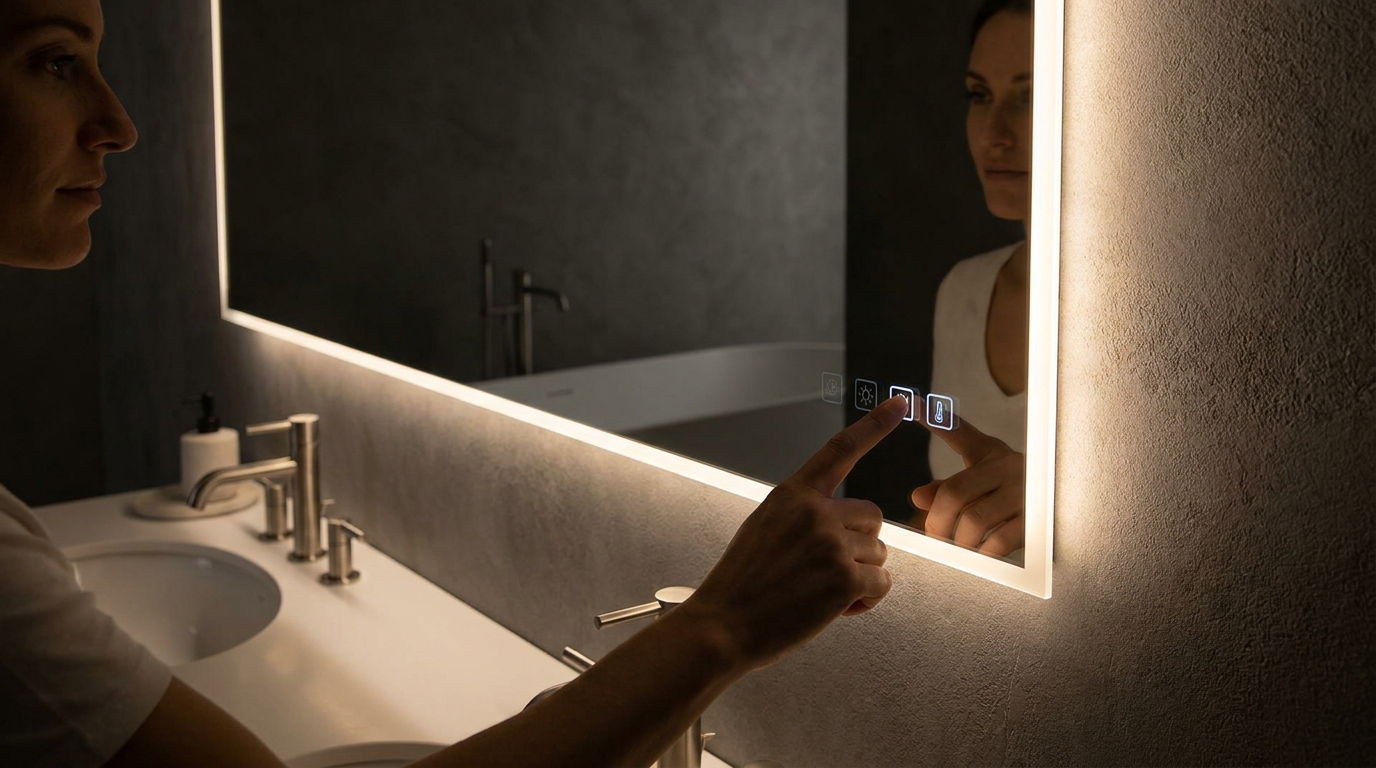
The bathroom is the natural home for many smart mirrors because so many grooming and wellness rituals happen there. Features like anti-fog surfaces, integrated lighting, and touch controls are especially practical in this space. A bathroom smart mirror can simplify everything from shaving and makeup application to skincare and early-morning planning.
Bathrooms also benefit visually from the sleekness of smart mirror design. A wall-mounted illuminated mirror can make the space feel more elevated without requiring a full renovation. If you have been trying to bring a more boutique-hotel or spa-inspired feeling into your home, this is one of the most elegant ways to do it. Custom builders are already leaning into this same idea at full scale: Kingsgate Luxury Homes recently brought a similarly luminous, spa-inspired ensuite to life in one of its North York custom builds — you can see the illuminated mirror and marble finishes in that project here.
Bedrooms and Dressing Areas
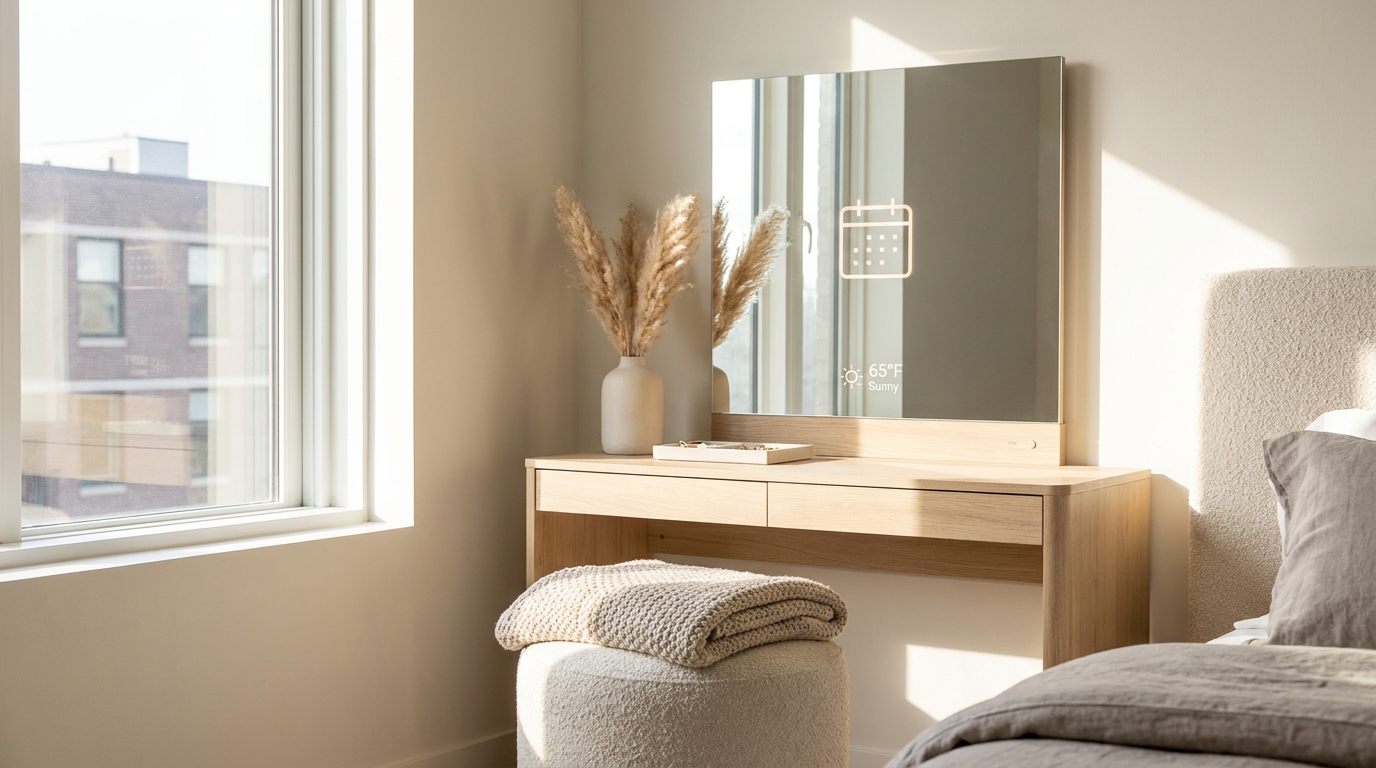
In a bedroom or dressing space, smart mirrors can support outfit planning, jewelry storage zones, and beauty routines. A mirror that shows the weather and your calendar can genuinely help when deciding what to wear. Soft integrated lighting can also make this area more functional without requiring brighter ceiling fixtures that disturb the mood of the room.
For renters, a bedroom placement may be more realistic than a bathroom installation, depending on building rules and available outlets. It still offers many of the same benefits while giving the room a refined and modern focal point. The effect can be especially lovely in smaller homes where every item needs to earn its place both practically and aesthetically.
Entryways
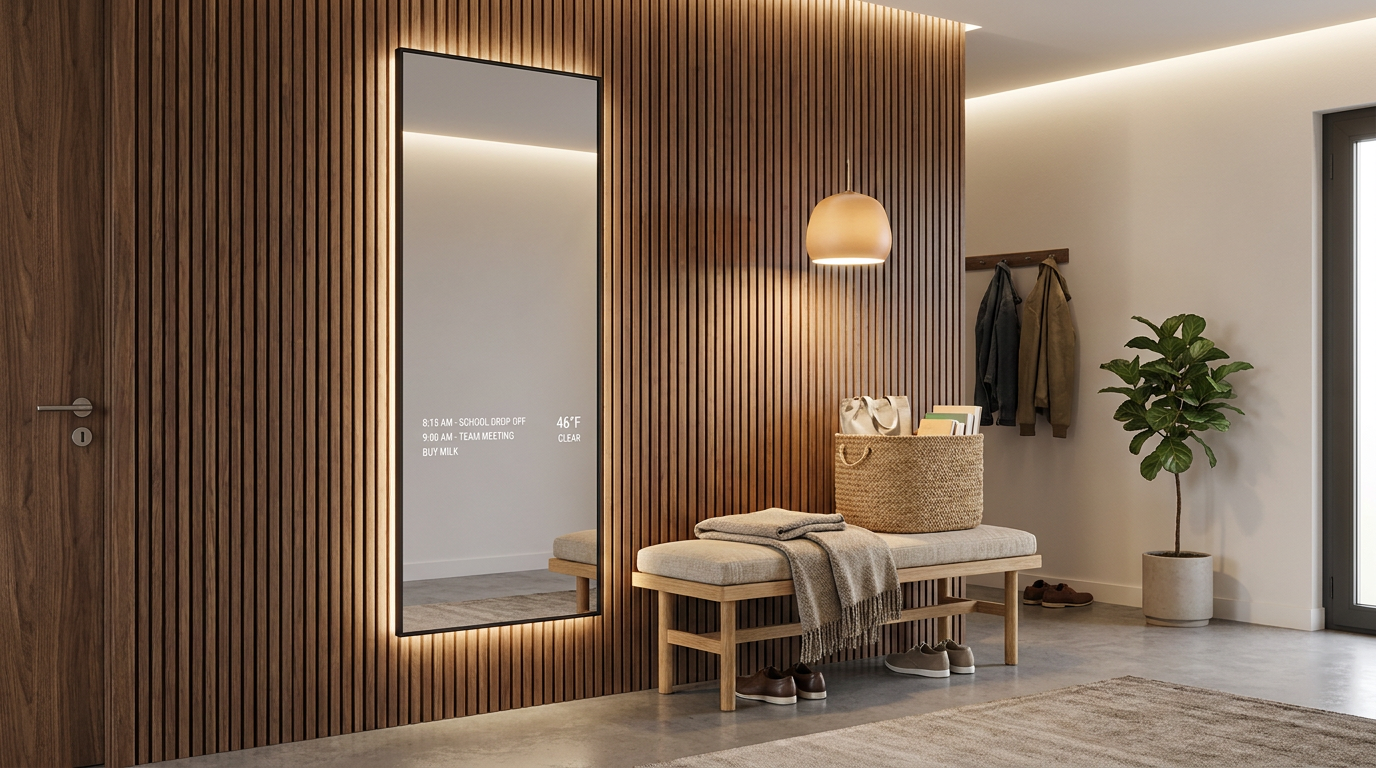
An entryway smart mirror may be one of the most underrated uses. This is where you often check your appearance before leaving, confirm the weather, glance at the time, or remember a final item on your list. A slim mirror in this zone can keep the area neat while supporting the transition between home life and the outside world.
Because entryways are often compact, the visual expansion a mirror provides is helpful in its own right. Add a subtle information display, and the mirror becomes part of a beautifully organized first impression. It can help the entire home feel more composed from the moment you step in.
Features Worth Looking For as a Beginner
When you begin shopping, the range of features can feel a little overwhelming. It helps to think less about what sounds impressive and more about what would genuinely improve your daily routine. The right smart mirror is not necessarily the one with the longest list of functions. It is the one that supports your habits while preserving the atmosphere you want in your home.
Lighting Quality
Lighting is often the most immediately satisfying feature. Look for dimmable LED lighting, flattering color temperature options, and even illumination across the mirror surface. Good light makes grooming easier, but it also shapes the emotional tone of the room. Soft warm light can feel relaxing in the evening, while brighter neutral light may be better for getting ready in the morning.
Anti-Fog Performance
If the mirror will live in a bathroom, anti-fog capability is genuinely useful. It allows the mirror to remain clear after showers, reducing frustration and keeping the room feeling more efficient. This may sound like a small detail, but practical comfort often comes from exactly these kinds of everyday improvements.
Display Simplicity
Some mirrors present information elegantly, while others feel busy. As a beginner, it is worth choosing a model with a clean interface that does not overwhelm the visual calm of the room. Time, weather, and calendar are often enough. If the display can be minimized or hidden when not in use, even better.
Touch, Voice, or App Controls
Consider how you like to interact with your home. Some people prefer touch controls built directly into the mirror, while others like app access or voice assistant integration. None of these is automatically better. The best choice is the one that feels natural in your routine and does not create unnecessary steps.
Compatibility With Your Home Setup
If you already use a smart home platform, compatibility may matter. If you do not, there is no need to force a complex ecosystem just for one product. Many people are happiest with a mirror that functions beautifully on its own. This is especially true if your goal is ease rather than experimentation.
Smart Mirrors and the Atmosphere of a Home
Perhaps the most interesting thing about smart mirrors is that their value is not just functional. They can meaningfully shape how a space feels to live in. That may sound abstract, but anyone who has adjusted a room’s lighting, cleared a cluttered countertop, or replaced a harsh fixture with a softer one knows how emotional those changes can be.
A well-placed smart mirror can make a room feel brighter, larger, and more serene. It can support the rituals that anchor a day, from cleansing your face at night to quietly preparing for work in the morning. It can also add a subtle sense of luxury, not in a flashy way, but in the quiet confidence of a home that feels thoughtfully equipped.
This is why the most successful smart mirror purchases are often guided by atmosphere first and technology second. Start by asking how you want the room to feel. More restful, more organized, more elegant, more supportive. Then choose features that serve that emotional goal. A mirror that aligns with the room’s mood will feel far more satisfying than one that simply offers the most technical capabilities.
In home living, comfort is often built through small repeated moments. Smart mirrors can enrich those moments when they are chosen with care and used with intention.
Privacy and Security: What Beginners Should Know
As lovely as smart mirrors can be, they are still connected devices, and that means privacy deserves attention. Canadian consumer guidance for internet-connected devices warns that smart home products may collect more data than users expect. If a smart mirror includes Wi-Fi, microphones, cameras, app connectivity, or voice assistant support, it may collect or transmit information depending on how it is designed and configured.
This does not mean smart mirrors are inherently unsafe, but it does mean you should approach them thoughtfully. Research from NIST has shown that many people keep using smart home devices despite privacy and security concerns because convenience often feels worth the trade-off. That is understandable, but convenience should not replace careful setup. A little diligence at the beginning can help you feel much more comfortable later.
Canadian privacy guidance also emphasizes collecting only the personal information that is needed and providing clear privacy notices when information is collected. While that guidance is aimed broadly at digital products and services, it offers a useful consumer lens as well. If a mirror or its companion app asks for permissions that feel unrelated to its core functions, pause and consider whether those features are necessary for you.
Practical Privacy Questions to Ask Before You Buy
- Does the mirror include a camera or microphone? If yes, ask whether you truly need those functions.
- Can certain features be disabled? The ability to turn off voice controls, cameras, or cloud features can offer peace of mind.
- What data does the app collect? Read the privacy information before downloading companion software.
- Can the mirror work offline? A device that still performs essential functions without constant connectivity is often more resilient and comforting to live with.
- How are updates handled? Security updates matter for connected products, especially those used in intimate spaces like bathrooms and bedrooms.
For many households, the simplest privacy strategy is also the most calming one. Choose a model with only the functions you realistically want. If all you need is beautiful lighting, anti-fog performance, and a basic display, there may be no reason to pay for more data-intensive features.
Safety and Installation in Real Homes
Bathrooms and other damp areas require extra care, and this is one part of the conversation that should never be rushed. Smart mirrors involve electricity, and some models are designed for hardwiring while others plug into a standard outlet. It is important to follow manufacturer instructions closely, purchase certified products from trusted retailers, and avoid improvised wiring or shortcuts.
In Canada and elsewhere in North America, the safest approach is to prioritize electrical certification, proper installation, and suitability for the intended room. A beautiful mirror is not worth the stress of an unsafe setup. If you are placing one in a bathroom, make sure it is rated appropriately for that environment and installed in accordance with recognized safety practices.
For homeowners, a professional installation can be a worthwhile investment, especially for wall-mounted bathroom models. For renters, the best option may be a plug-in mirror for a bedroom or dressing area, where installation is simpler and less intrusive. The smartest choice is often the one that fits both your home and your comfort level with maintenance.
How to Choose the Right Smart Mirror for Your Lifestyle
Choosing well starts with understanding your own routines. Before comparing brands or interface styles, spend a few days noticing how you use your current mirror spaces. Are you usually rushing through the morning, wishing for better light and a quick weather check? Do you want a more soothing bathroom at night? Is your entryway cluttered and in need of a more elegant solution? These questions can reveal what type of mirror will actually improve your home.
For the Minimalist Home
If you love uncluttered interiors and a calm atmosphere, focus on mirrors with understated design, soft integrated lighting, and limited display elements. Anti-fog and dimming may be all you need. A simpler model is often more aligned with a serene home than one filled with widgets and constant notifications.
For the Busy Family Home
In a household where multiple people are getting ready at once, convenience features may carry more value. Bright adjustable lighting, durable finishes, easy controls, and quick-glance information can make routines smoother. A smart mirror in a shared bathroom or entryway can help reduce morning friction in subtle but meaningful ways.
For Wellness-Focused Living
If your home is increasingly centered around wellness, a smart mirror may play a beautiful supporting role. This does not mean it has to become a health device. Often, wellness is better served by simple comforts such as flattering light, a fog-free reflection, a more peaceful room, and routines that feel less scattered. Some users may enjoy fitness prompts or integration with other wellness technology, but these features are optional rather than essential.
For Renters and Flexible Spaces
Renters should think about portability, mounting requirements, and whether the mirror can move easily to a future home. A sleek plug-in design for a bedroom or dressing corner may offer the best mix of style and practicality. It can still make the space feel elevated without requiring major installation work.
Common Misconceptions About Smart Mirrors
Because smart mirrors sound modern and slightly futuristic, they often attract exaggerated expectations. Clearing up a few common misconceptions can make shopping much easier and help you avoid disappointment.
- Not all smart mirrors are AI-powered. Many are simply mirrors with displays, lighting, and connectivity features.
- They are not automatically wellness devices. Some support fitness or health-adjacent routines, but that is not universal.
- More features do not always create a better experience. In many homes, simpler mirrors feel more elegant and easier to live with.
- Not every model suits every bathroom. Moisture rating, installation requirements, and certification matter.
- Buying a smart mirror does not solve privacy questions by default. Cameras, microphones, apps, and Wi-Fi deserve thoughtful review.
These points are worth keeping in mind because the category is still developing. The global smart mirror market was estimated by Grand View Research at US$514.6 million in 2022 and projected to reach US$1,012.6 million by 2030, with North America representing more than 45 percent of the market in one estimate. That growth signals rising interest, but it also means product quality and feature sets can vary widely. A little discernment goes a long way.
Styling Tips for a More Beautiful Result
Once you choose a smart mirror, the surrounding styling matters just as much as the technology. Because these mirrors tend to look clean and contemporary, they pair especially well with natural textures, gentle lighting, and uncluttered surfaces. Think stone trays, soft towels, a ceramic soap dish, a small vase of branches, or a simple bench beneath an entryway mirror. The goal is to let the mirror feel integrated into the room, not dropped into it.
If the mirror includes lighting, consider the rest of the room’s light sources so the effect feels balanced. You may not need as many bright task lights once the mirror is installed. In bedrooms and dressing areas, layered textiles and warm neutrals often help soften the technology and make it feel more residential and welcoming.
Also pay attention to what the mirror reflects. This is true of any mirror, but smart mirrors in particular deserve thoughtful placement. Reflecting a window, a favorite light fixture, or a calm vignette can amplify the sense of beauty in the room. Reflecting clutter, cords, or open storage will do the opposite.
Living With a Smart Mirror Long Term
The most important question is not whether a smart mirror feels exciting on day one. It is whether it continues to feel useful and lovely after six months or a year. Long-term satisfaction usually comes from comfort, reliability, and visual harmony. A mirror that looks beautiful but has a frustrating interface will quickly lose its charm. Likewise, a mirror with too many features may start to feel busy in a room that should be restful.
That is why it helps to think of a smart mirror less as a gadget and more as part of your home environment. Choose one that matches your habits, your privacy comfort level, and the emotional tone you want in the room. If possible, prioritize timeless design over novelty. A mirror that still feels elegant when the display is off is often a very good sign.
Routine maintenance matters too. Keep the software updated if the product supports updates, review app permissions occasionally, and clean the mirror according to manufacturer instructions. These small acts of care support both longevity and peace of mind. When the technology works quietly in the background, the room itself gets to remain the focus.
Final Thoughts: Is a Smart Mirror Worth It?
For many people, the answer is yes, but only when the mirror is chosen thoughtfully. A smart mirror is worth it when it enhances routines, improves comfort, and adds beauty without making the home feel more complicated. It is especially valuable in spaces where you already spend time preparing, pausing, and resetting, such as bathrooms, bedrooms, and entryways.
What makes smart mirrors special is not that they turn your home into the future overnight. It is that they offer a gentler kind of progress. They take an object you already use every day and help it do more, while still contributing to the atmosphere of the room. In a world full of loud upgrades and constant stimulation, that quiet usefulness feels refreshingly luxurious.
If you are just beginning to explore the category, start with the feeling you want to create. Look for design you genuinely love, features you will actually use, and privacy settings that help you feel comfortable. The right smart mirror should not just reflect your image. It should reflect the kind of home life you want more of, one that is calm, polished, and beautifully supportive from morning to night.



No Comment! Be the first one.