



For much of the last century, the phrase industrial city brought to mind a familiar image: smokestacks, hard edges, truck traffic, and large zones of land cut off from daily urban life. That model was efficient in a narrow sense, but it was also extractive, carbon intensive, and spatially isolating. It separated production from community, industry from ecology, and economic output from the long term health of the city around it. Today, that model is being challenged by a more sophisticated idea, one that treats industrial development not as an externality to urban growth, but as a core component of a sustainable urban future.
Table Of Content
- Why Industrial Cities Need a New Model
- From Industrial Zones to Integrated Urban Systems
- The Brownfield Advantage
- Case Studies That Redefine Industrial Urbanism
- Technopôle Angus in Montreal
- Kieran Industrial Park
- Evergreen Brick Works and Southeast False Creek
- The Design Principles Behind Sustainable Industrial Cities
- Why Energy Strategy Matters So Much
- Balancing Competitiveness, Resilience, and Livability
- The Canadian Opportunity
- What Developers, Planners, and Cities Must Do Next
- A Practical Agenda for Implementation
- Conclusion: The Industrial City as a Climate and Growth Solution
The next generation of industrial cities will not be defined by how effectively they isolate industrial activity. They will be judged by how intelligently they integrate employment, logistics, housing, utilities, mobility, environmental management, and public value. This is an important shift because cities across Canada and North America are under simultaneous pressure to add jobs, improve supply chain resilience, reduce emissions, and use land more efficiently. In that context, industrial land can no longer be planned as a leftover category. It has to be treated as strategic infrastructure.
That is where the idea of the sustainable industrial city becomes powerful. The strongest modern examples are not single use districts built around one plant or one logistics function. They are integrated systems, often built through brownfield redevelopment or eco industrial park planning, where companies share infrastructure, reduce waste, improve resource efficiency, and operate with measurable environmental performance. The industrial city of tomorrow is less about separation and more about coordination. It is a place where competitiveness, resilience, and livability are designed together.
The urgency behind this shift is not theoretical. According to the International Energy Agency, industry accounted for about 37 percent of global energy use in 2022, and fossil fuels still supplied around 65 percent of industrial energy. Heavy sectors such as steel, cement, and chemicals account for around 70 percent of direct industrial carbon dioxide emissions. Those numbers make one point very clear: if cities and countries are serious about decarbonization, they cannot ignore where and how industry is built. Industrial land use is climate policy, infrastructure policy, and economic policy all at once.
At the same time, the industrial question is also a land question. In growing metropolitan regions, developable land is limited, infrastructure is expensive, and urban expansion has real environmental and fiscal consequences. Endless greenfield growth creates more roads, more servicing costs, longer freight routes, and more pressure on agricultural and natural lands. By contrast, a sustainable industrial city model asks a more disciplined question: how can we intensify and modernize already serviced urban land in ways that support production, lower emissions, and strengthen surrounding communities?
The future of industrial growth will be won not by pushing industry farther away from cities, but by designing industrial systems that work better within them.
This is why the conversation around industrial cities has become so relevant to mega developments. Industrial districts are no longer peripheral. They are increasingly central to major regional strategies involving clean manufacturing, critical minerals, battery supply chains, hydrogen, carbon capture, logistics modernization, and resilient domestic production. In practical terms, this means the design of industrial cities will influence where investment flows, how land values evolve, how infrastructure gets prioritized, and whether urban growth becomes more sustainable or more fragmented.
Why Industrial Cities Need a New Model
The traditional industrial district was based on a simple planning logic. Heavy uses were grouped together, buffered from residential areas, and connected to transport corridors. In its time, that model solved real problems, especially around safety, land assembly, and production efficiency. But it also produced long term liabilities: contamination, inefficient land use, high transport dependence, poor public realm, and environmental burdens concentrated in nearby communities. Those costs are becoming harder to ignore as cities confront climate risk, infrastructure constraints, and housing pressure.
One of the most persistent misconceptions is that industrial activity is inherently incompatible with sustainable urban development. In reality, sustainability depends less on whether industry exists and more on how it is planned, powered, and connected. An industrial district that uses shared utilities, low carbon energy, freight efficient design, water reuse, and modern environmental controls can perform far better than scattered logistics and manufacturing uses spread across disconnected greenfield sites. The challenge is not to eliminate industry from urban regions. The challenge is to remove the inefficiencies and externalities built into old industrial patterns.
Another misconception is that the clean city and the productive city are separate ideas. For a long time, planning culture tended to place jobs, housing, mobility, and ecology into different categories. Yet the strongest urban economies are increasingly those that understand these systems as interdependent. Workers need access to jobs. Businesses need reliable infrastructure. Cities need a tax base. Residents need cleaner air, safer streets, and better environmental performance. Sustainable industrial cities emerge when these interests are aligned rather than traded against one another in a zero sum way.
There is also a national competitiveness argument. The IEA has reported that industrial energy demand has risen sharply in recent years and that industry drove about 80 percent of the increase in global final energy demand between 2019 and 2023. That means jurisdictions that can modernize industrial land with cleaner power, better logistics, and lower operating costs may gain a long term advantage. In a world of supply chain uncertainty and net zero industrial policy, industrial cities are no longer just places of production. They are platforms for resilience.
From Industrial Zones to Integrated Urban Systems
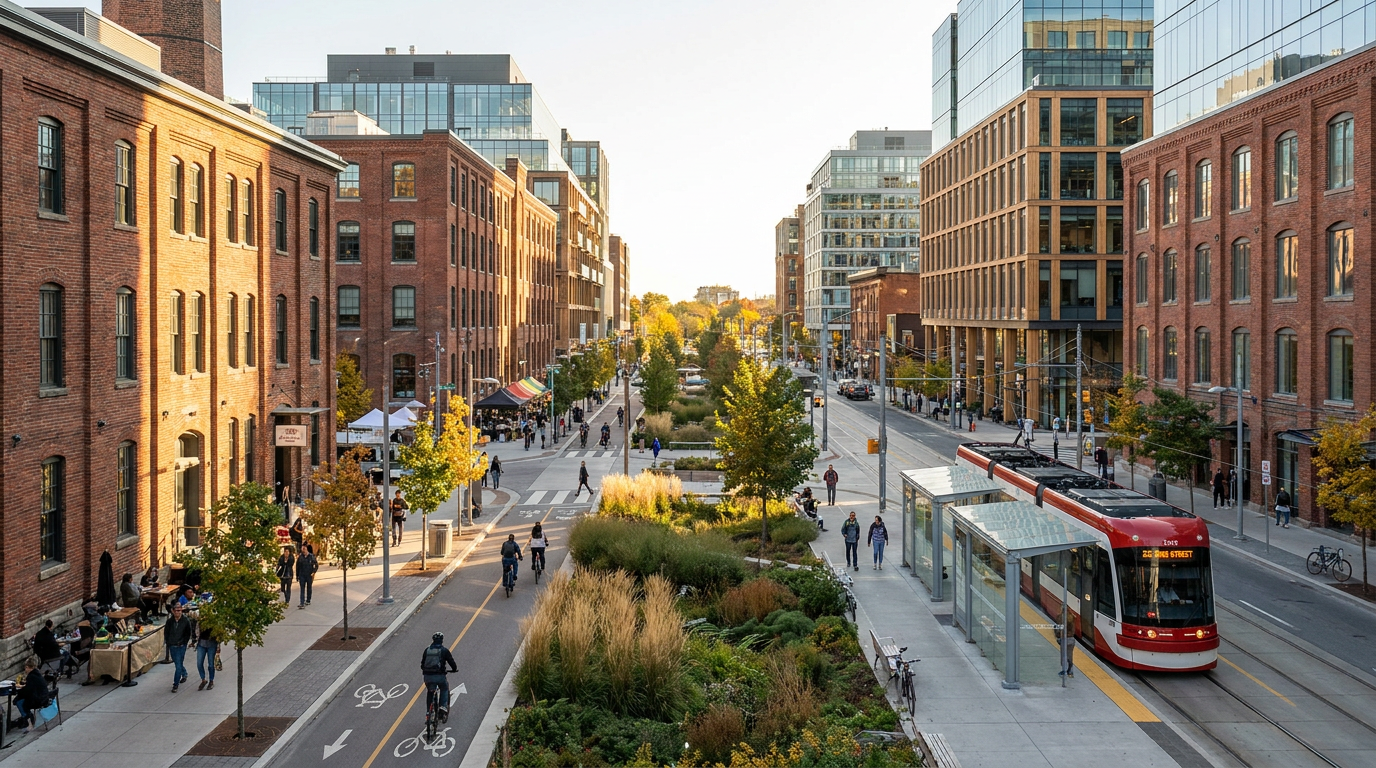
The most important conceptual shift is this: sustainable industrial cities should be planned as integrated urban systems, not isolated employment enclaves. That means thinking beyond parcel by parcel development. It means understanding how land use, energy, water, transport, ecology, workforce access, and economic clustering interact over time. When these systems are planned together, the result is not only cleaner industry. It is better city building.
UNIDO defines eco industrial parks as business communities that improve environmental, economic, and social performance through collaboration on resource and environmental issues. That definition matters because it moves the discussion away from individual buildings and toward collective performance. A sustainable industrial city is not just a set of efficient structures. It is a coordinated district where firms, utilities, municipalities, and infrastructure providers can share systems and create compound value.
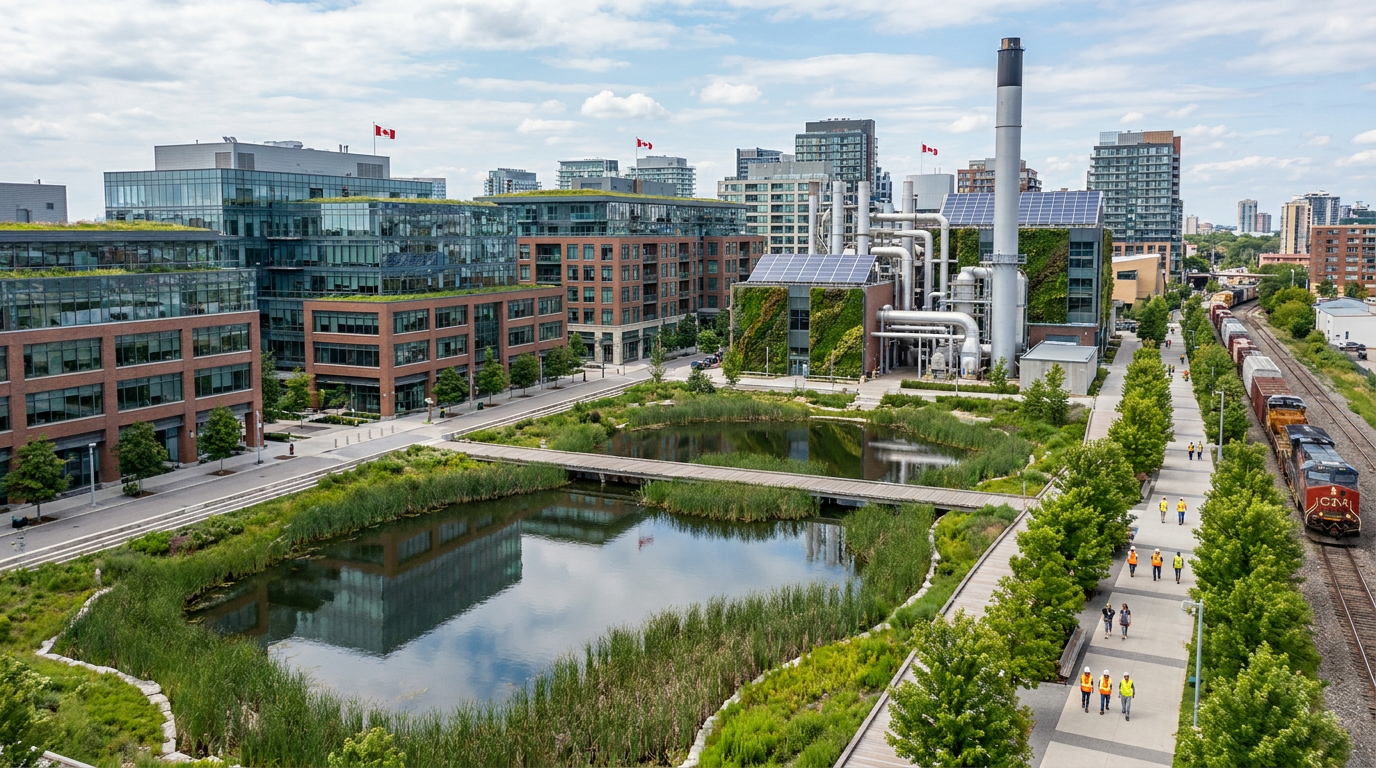
In practical terms, that coordination can take many forms. Compatible firms can be co located to reduce freight duplication and enable industrial symbiosis. Excess heat from one process can be captured and used elsewhere. Water can be reused through district systems. Energy demand can be shaped around cleaner power and storage. Green infrastructure can manage stormwater while reducing urban heat and improving local environmental quality. Freight access can be designed to function efficiently without overwhelming nearby neighborhoods. These are not cosmetic improvements. They are structural design choices that alter both environmental outcomes and economic performance.
This systems approach also changes how planners think about proximity. In the old model, distance was treated as safety. The more separated industry was from the rest of the city, the better. In the new model, the right kind of proximity creates efficiency. Being closer to transit, labour pools, existing utilities, and end markets can reduce travel demand, cut logistics costs, and make better use of public investment. The goal is not indiscriminate mixing of uses. The goal is strategic integration, with careful buffering, performance standards, and infrastructure design that make modern industrial districts functional and responsible.
The Brownfield Advantage
Brownfield redevelopment is one of the strongest tools available for building sustainable industrial cities. Former industrial lands are often located within existing urban boundaries, close to roads, transit, utilities, and established communities. These sites can be difficult and expensive to remediate, but they also offer a rare opportunity: land that has already been urbanized can be returned to productive use without pushing growth farther outward. From a city building perspective, that is a major advantage.
Canadian policy has long recognized this. Federal approaches to sustainable development and infrastructure have consistently treated brownfield remediation as a public interest investment because it improves environmental quality, health and safety, tax revenues, and land use efficiency. More broadly, it supports a more disciplined pattern of urban growth by encouraging reinvestment inside municipal boundaries rather than continuous greenfield expansion. In strategic terms, that is exactly where long term value is created: through intensification, infrastructure reuse, and smarter land recycling.
Brownfields also carry symbolic importance. They represent the industrial past, but they do not have to remain evidence of industrial decline. When remediated and redesigned well, they can become some of the most compelling districts in a city: places where jobs, sustainability, and identity align. The strongest projects do not erase industrial heritage. They reinterpret it in ways that support a new economic and environmental future.
Case Studies That Redefine Industrial Urbanism
Canada offers useful examples of how this transition can work in practice. These projects are not identical, and that is part of the point. Sustainable industrial cities are not a single template. They are a planning approach that can be adapted to local land conditions, market realities, and policy goals. What they share is a commitment to coordinated redevelopment, environmental performance, and long term urban value.
Technopôle Angus in Montreal
Technopôle Angus is one of the clearest Canadian illustrations of brownfield led industrial and employment transformation. Built on a former industrial site in Montreal, it has evolved into a green neighborhood and employment hub with about 70,000 square metres of real estate, 62 organizations, and roughly 2,700 workers. Its significance is not just in the numbers, though they are notable. Its significance lies in the way it reframed what a former industrial site could become.
The project demonstrates that economic activity and environmental renewal do not have to compete. Through coordinated redevelopment, the site became a modern district that supports employment while also improving urban design and community value. This is exactly the sort of outcome cities should seek from legacy industrial lands. Not every site will become an innovation district, but the principle remains widely relevant: industrial redevelopment should create multiple forms of value, not just a single land use outcome.
What makes Technopôle Angus especially instructive is that it sits within a broader urban fabric rather than outside it. That location allows jobs to remain connected to the city, reduces the need for outward expansion, and helps distribute the benefits of investment more efficiently. In strategic planning terms, that is a far stronger result than simply moving industrial uses to the edge and leaving former employment lands underutilized in the core.
Kieran Industrial Park
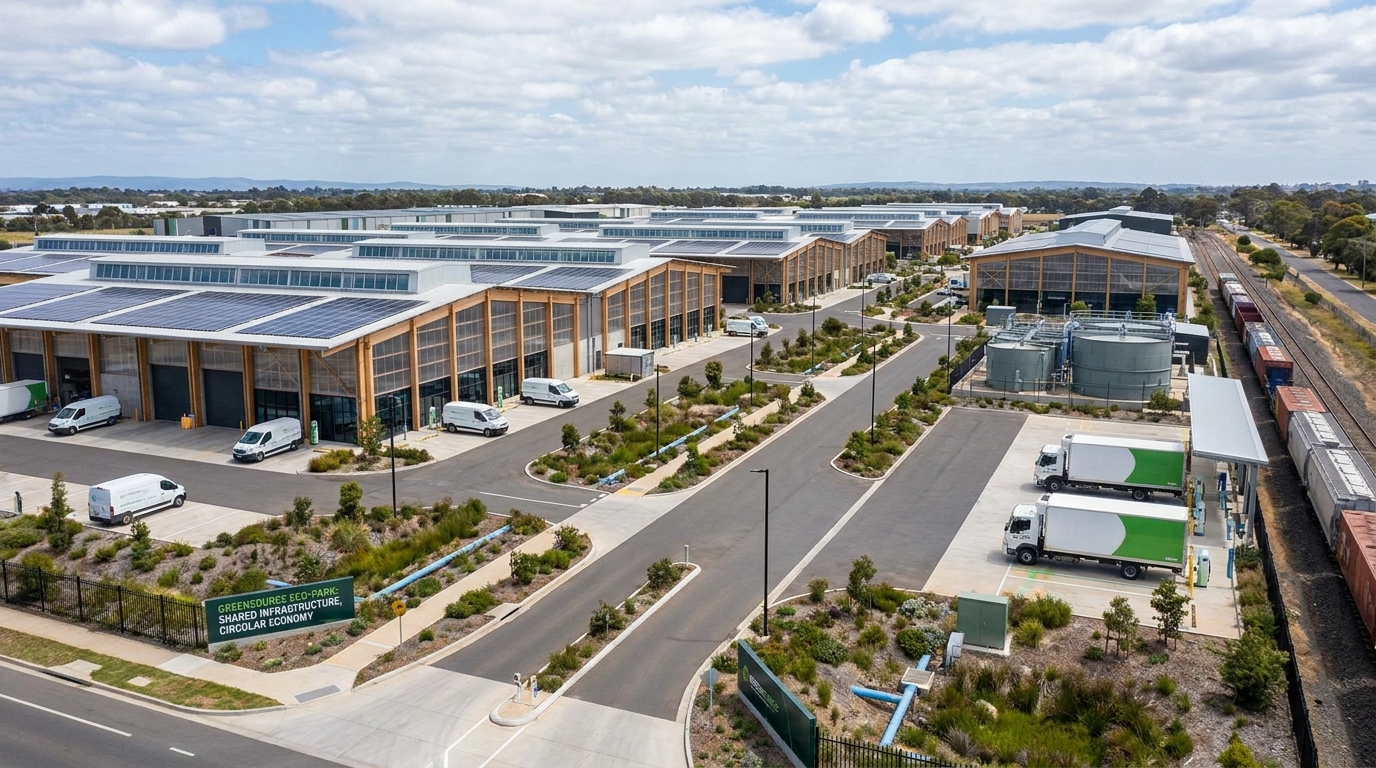
Kieran Industrial Park is another useful signal of change. Presented by its developer as Canada’s first LEED certified industrial park, it challenges the idea that industrial real estate must be environmentally blunt. Certification alone does not solve every sustainability issue, but it does show that industrial buildings can be designed for natural ventilation, daylighting, lower impact materials, and better overall performance. For the market, that matters. It establishes that sustainability can be built into industrial formats from the beginning rather than added later as an afterthought.
The strategic implication is larger than one project. If industrial parks can become lower carbon, more efficient, and more attractive to workers and investors, then the baseline expectation for industrial development begins to shift. Over time, that changes underwriting assumptions, tenant demand, regulatory standards, and municipal planning frameworks. In other words, a better industrial building can help produce a better industrial city.
Evergreen Brick Works and Southeast False Creek
Although not conventional industrial park examples, projects such as Evergreen Brick Works in Toronto and Southeast False Creek in Vancouver show the broader power of former industrial land to become high performing civic assets. They illustrate what happens when remediation, mobility, ecology, and public realm design are integrated early. These projects matter because they expand the imagination of what post industrial land can deliver. They also reinforce the central lesson that environmental repair and urban growth can be mutually reinforcing when planned at district scale.
For cities facing both housing pressure and employment pressure, these examples offer an important caution. Former industrial land should not be treated as a simple conversion opportunity where every site becomes residential. Some lands are too strategically important to lose entirely from the employment system. The stronger approach is often hybridization: preserving productive functions where they make sense, introducing cleaner and more compatible employment formats, and adding supporting uses in ways that maintain long term urban flexibility.
The Design Principles Behind Sustainable Industrial Cities
If the vision is clear, the execution still depends on design discipline. Sustainable industrial cities succeed when they are planned around shared performance rather than isolated compliance. That means designing the district itself as infrastructure. Roads, utilities, water systems, freight connections, energy networks, landscape systems, and built form standards all need to work together. The project is not just the building. The project is the ecosystem.
Several design principles consistently emerge from successful industrial redevelopment and eco industrial planning. These principles are not trends in a superficial sense. They are structural choices that determine whether industrial growth becomes cleaner, more efficient, and more resilient over time.
- Shared infrastructure: District energy, water reuse, waste management, logistics coordination, and utility planning reduce duplication and improve efficiency across multiple users.
- Circular resource flows: Industrial symbiosis allows one firm’s byproduct, waste heat, or material stream to become another firm’s input, reducing cost and environmental burden.
- Brownfield first land strategy: Reusing serviced and contaminated sites can improve land efficiency, reduce outward sprawl, and capture value from previously underperforming assets.
- Freight oriented design: Efficient truck access, rail links, and internal circulation can cut congestion, reduce emissions, and improve operational reliability.
- Low carbon energy transition: Electrification of low temperature processes, renewable integration, storage, and cleaner fuels can lower emissions while supporting industrial competitiveness.
- Green infrastructure: Bioswales, permeable surfaces, wetlands, tree canopy, and heat mitigation systems improve stormwater management, water quality, and local climate resilience.
- Transit and workforce connectivity: Workers need safe and reliable access to jobs, which means industrial districts must be connected to public transit, cycling networks, and urban services where feasible.
Each of these principles has a city building benefit beyond the industrial site itself. Green infrastructure reduces municipal runoff pressure. Brownfield reuse preserves greenfield land. Shared energy systems lower long term service demand. Better workforce connectivity broadens access to employment. Freight efficiency improves road performance. This is why sustainable industrial planning should not be viewed as a niche environmental exercise. It is a broader strategy for making urban growth more fiscally and spatially coherent.
Why Energy Strategy Matters So Much
No discussion of sustainable industrial cities is credible without addressing energy and emissions. Industrial sustainability is not achieved through landscaping and certification alone. The biggest gains depend on how industrial processes are powered and how materials are used. That is especially true in heavy industry, where process heat and direct emissions remain difficult challenges.
The IEA data underscores the scale of the problem. Industry remains heavily fossil based, and sectors like steel, cement, and chemicals dominate direct industrial emissions. This means that sustainable industrial cities must accommodate a range of decarbonization tools, not just one. Electrification can play a major role, particularly for low temperature processes where the economics and technology may already be improving. But electrification alone is not enough. Material efficiency, low carbon fuels, process innovation, carbon capture, and smarter industrial clustering all matter.
For planners and developers, the lesson is practical. Industrial cities should be designed with future energy transition in mind. Utility capacity, substation planning, district energy corridors, hydrogen readiness where relevant, and opportunities for heat recovery should all be considered early. If these systems are left unresolved until after build out, retrofitting becomes slower and more expensive. Sustainable performance is far easier to achieve when it is embedded in the land plan from the start.
Balancing Competitiveness, Resilience, and Livability
The strongest way to frame sustainable industrial cities is as a balance among three goals: competitiveness, resilience, and livability. These goals are often treated as competing priorities, but in well planned industrial districts they reinforce one another. Cleaner systems reduce long term costs. Better infrastructure improves business certainty. Smarter land use supports tax base efficiency. Stronger environmental performance builds community legitimacy. The city that gets this balance right is better positioned for growth.
Competitiveness starts with operational performance. Businesses need efficient transport links, predictable servicing, modern facilities, and access to labour. Sustainable design supports this by lowering resource waste, reducing logistics friction, and helping firms meet evolving tenant, investor, and regulatory expectations. In a world where low carbon supply chains increasingly matter, sustainable industrial districts may also become a market differentiator rather than just a compliance requirement.
Resilience is the second pillar. Industrial districts are exposed to climate risk, energy volatility, supply chain disruption, and aging infrastructure. Shared systems, diversified transport options, stormwater management, cleaner power, and circular resource planning all improve resilience. A sustainable industrial city is not only one that emits less. It is one that can absorb shocks more effectively and continue operating through change.
Livability is the third pillar, and it is often the most politically decisive. Industrial growth can generate resistance when communities believe they are being asked to absorb traffic, pollution, noise, or environmental risk without corresponding benefits. That is why modern industrial planning must include meaningful community consultation, transparent performance standards, and protections against pollution burdens being shifted onto nearby neighborhoods. Livability is not anti industry. It is the condition under which industrial growth remains socially legitimate in urban regions.
The Canadian Opportunity
Canada is well positioned to lead on this issue, but only if it treats industrial land strategically. The federal sustainable development framework explicitly includes inclusive and sustainable industrialization, and the broader policy context increasingly links industrial development to clean manufacturing, net zero pathways, and more efficient land use. This is not an abstract planning conversation. It intersects with critical minerals, EV supply chains, battery production, hydrogen, carbon management, advanced logistics, and the future geography of employment.
Canadian cities also have a specific advantage: many contain older industrial lands within established urban boundaries, often close to transit, power, labour, and market access. These lands are difficult, but they are also valuable. If remediated and repositioned correctly, they can absorb a significant share of future industrial and mixed employment growth without driving the same level of sprawl, servicing expansion, and environmental consumption that greenfield models often require.
The risk is that cities fail to protect and modernize these lands in time. In high pressure real estate markets, there is often strong temptation to convert every former industrial parcel into residential or purely commercial use. Some conversions are appropriate. Many are not. Once strategic employment lands are lost, they are extremely hard to replace. A sustainable industrial city strategy therefore requires discipline. It means identifying where industrial functions remain regionally important, where hybridization makes sense, and where full transformation is the right long term move.
What Developers, Planners, and Cities Must Do Next
Building sustainable industrial cities requires more than good intentions. It demands coordination across planning, infrastructure, finance, environmental remediation, and economic development. The challenge is large, but the direction is increasingly clear. The winning districts will be those that translate sustainability into measurable operational advantage.
For developers, that means seeing industrial land not as a commodity product but as a systems asset. Site planning should account for energy transition, district servicing, stormwater, freight, and workforce access from the earliest stages. For planners, it means moving beyond outdated zoning assumptions and using performance based frameworks that encourage compatibility, intensification, and environmental improvement. For municipalities, it means aligning approvals, infrastructure investment, and land strategy around long term productivity rather than short term land disposition.
It also means accepting that industrial sustainability is a shared governance challenge. No individual tenant can solve district energy, brownfield contamination, major freight bottlenecks, or regional transit access alone. The public sector has a central role in assembling land, funding remediation, setting standards, and coordinating infrastructure. The private sector has a central role in execution, innovation, capital deployment, and operational efficiency. The most successful industrial cities are built where these roles are aligned rather than fragmented.
A Practical Agenda for Implementation
There are several concrete actions that can accelerate progress:
- Update industrial land use policies to support eco industrial clustering, cleaner production, and selective mixed use integration where appropriate.
- Prioritize brownfield remediation funding for strategically located employment lands inside existing urban boundaries.
- Plan utility upgrades early, especially for electrification, district energy potential, water reuse, and future low carbon industrial needs.
- Protect freight corridors and improve first and last mile logistics without exporting disproportionate impacts onto nearby communities.
- Require measurable environmental performance at district scale, including stormwater outcomes, energy use, heat mitigation, and emissions intensity where feasible.
- Design industrial areas with workers in mind, including transit access, safer streets, amenities, and better public realm standards.
- Use community consultation as a design tool rather than a procedural checkbox, especially where industrial intensification occurs near established neighborhoods.
These steps are not radical. They are the practical foundations of a more mature industrial urbanism. They reflect a broader reality that industry is not disappearing from cities. It is evolving, and the places that plan for that evolution intelligently will capture more value over time.
Conclusion: The Industrial City as a Climate and Growth Solution
The idea of the industrial city deserves rehabilitation. Not as a return to the polluting, land hungry model of the past, but as a modern framework for sustainable urban growth. When designed well, industrial cities can support jobs, strengthen supply chains, enable cleaner production, and use scarce urban land far more effectively. They can transform contamination into opportunity, infrastructure into shared value, and sustainability into a competitive advantage.
This matters because cities cannot meet twenty first century growth challenges with twentieth century land use assumptions. Housing, infrastructure, climate, and economic development are now tightly connected. A region that pushes all industrial activity outward may gain short term land flexibility, but it often pays for it in congestion, emissions, servicing costs, and lost strategic capacity. A region that modernizes industrial districts within a broader urban framework can create a more resilient and productive future.
That is the deeper promise of sustainable industrial cities. They offer a way to think about urban development as an integrated long term project rather than a series of disconnected land transactions. The best examples already show what is possible. Eco industrial parks, brownfield led employment hubs, mixed use industrial districts, and low carbon manufacturing clusters are proving that industry and sustainability do not have to sit on opposite sides of the planning conversation.
The question is no longer whether industrial cities belong in the future. The question is whether we are prepared to build them well. If Canada and other North American jurisdictions can align policy, infrastructure, land strategy, and design around that goal, industrial cities may become one of the most important engines of sustainable urban transformation in the decades ahead.


No Comment! Be the first one.