


Mega developments shape the future of cities. They influence where housing is built, how infrastructure is funded, where jobs cluster, and whether growth feels connected to community life or disconnected from it. For developers, institutions, and governments, the challenge is not simply to build at scale. The deeper question is how to create places that remain economically productive, socially relevant, and physically resilient over decades.
Table Of Content
- What an innovation district really is
- Why innovation districts are so relevant to mega developments
- The urban form advantage: density, transit, and mixed use
- Why older industrial and underutilized urban land often becomes the right setting
- Case study lessons: MaRS, Buffalo Niagara Medical Campus, and Pittsburgh’s EcoInnovation District
- The inclusion challenge: growth does not become equitable on its own
- Governance is the hidden infrastructure
- Strategic recommendations for creating an innovation district inside a mega development
- Start with a real economic thesis
- Secure anchor institutions early
- Plan for mixed use intensity from the beginning
- Design around transit, walking, and cycling
- Integrate inclusion into the development model
- Use adaptive reuse where it adds identity and flexibility
- Build governance capacity before full buildout
- Measure performance beyond real estate metrics
- What the future looks like
- Conclusion: building places that compound value
Innovation districts are dense, amenity rich urban areas where research institutions, companies, startups, and civic anchors are intentionally concentrated together, as Brookings has defined them. Unlike the suburban office park model, they are mixed use, walkable, and transit connected, so commercial activity, research, community life, and urban form reinforce each other. Inside a mega development, this matters because innovation districts turn large development projects into engines of long-term value creation. They combine research, entrepreneurship, employment, housing, public realm, and mobility in one place, generating the density and interaction that modern knowledge economies rely on. Rather than simply filling land with buildings, an innovation district can anchor a project with economic purpose, support local business formation, attract investment, and strengthen the surrounding city. That is why the model has become one of the most credible strategies for linking large scale city building with sustainable, long-term economic and community value.
That distinction is critical inside a mega development. A large site may offer enough land to phase office, residential, institutional, and public investments over many years. But scale alone does not guarantee meaningful outcomes. A project can be physically large and still economically shallow if it lacks a strong organizing strategy. Innovation districts provide that strategy by aligning land use, infrastructure, institutions, and talent around a clear long term economic proposition.
This article explores why innovation districts matter in major development projects, how they function, what lessons can be drawn from leading examples, and what strategic steps are required to make them work. The goal is not to present a fashionable planning label. It is to explain why this model has become one of the most credible ways to link city building with sustainable economic and community development.
What an innovation district really is
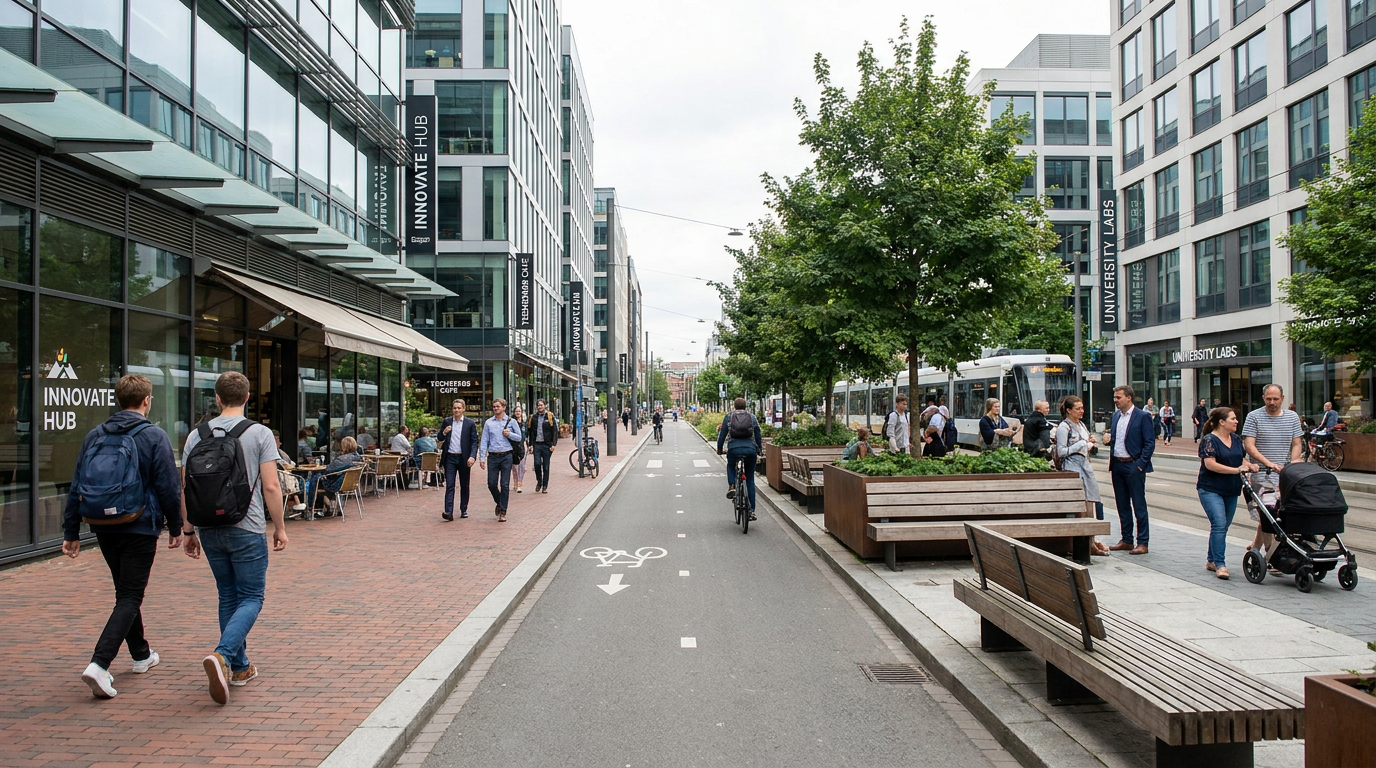
There is a common misconception that innovation districts are simply technology parks with a more urban brand. That framing is too narrow and often misleading. A true innovation district is not defined by one building type or one industry category. It is defined by the interaction of three reinforcing systems: economic assets, physical assets, and networking assets. Brookings emphasizes that all three are needed if a district is going to function as a genuine innovation ecosystem rather than a collection of unrelated projects.
Economic assets include the institutions and firms that generate ideas, research, employment, and investment. These can include universities, hospitals, laboratories, corporate innovation teams, accelerators, venture capital networks, manufacturers, and specialized service providers. In many successful districts, anchor institutions play an especially important role because they bring stability, reputation, talent pipelines, and long term commitment to place.
Physical assets include the urban ingredients that support interaction and daily life. This means mixed use buildings, housing options, quality public spaces, walkable blocks, transit access, digital infrastructure, and streets designed for people rather than just vehicles. The built environment matters because proximity increases the frequency of informal meetings, cross disciplinary collaboration, and business formation. It also matters because talented workers and growing firms increasingly prefer dynamic places over isolated employment nodes.
Networking assets are often underestimated, yet they are essential. These include programming, events, partnerships, governance structures, mentorship systems, commercialization support, and community connectors that help people and organizations exchange information and opportunity. A district cannot simply be constructed and expected to innovate on its own. It must be curated, managed, and continuously activated.
When these elements come together, an innovation district becomes more than a real estate concept. It becomes a platform for growth. That platform is especially valuable within mega developments because it can organize phasing decisions, shape infrastructure priorities, and create a clear rationale for why different uses should be integrated rather than separated.
Why innovation districts are so relevant to mega developments
Mega developments typically involve significant land assembly, long time horizons, major infrastructure coordination, and substantial capital exposure. These projects can include new neighborhoods, transit linked growth areas, hospital precincts, university expansions, waterfront regeneration sites, or large mixed use redevelopments of underutilized land. Because of their scale, they can either become transformational urban districts or expensive exercises in fragmented planning.
Innovation districts improve the odds of transformation because they give large projects an economic backbone. Instead of treating office space, housing, retail, and public amenities as separate market products, the innovation district approach treats them as interdependent pieces of one ecosystem. Employment uses help support daytime demand and long term incomes. Housing helps attract talent and reduce commuting barriers. Public space and local amenities improve quality of life and create social energy. Transit expands access to jobs and education while reducing congestion and carbon intensity.
This integrated logic is well suited to mega developments because these projects often unfold in phases over many years. A district framework can guide sequencing by identifying which anchors need to arrive first, which public investments unlock private demand, and how each phase contributes to the long term identity of the place. Without such a framework, it is easy for early phases to follow short term market signals that weaken the district’s future economic potential.
There is also a land value argument. In many large projects, especially those with transit investment or institutional adjacency, the highest and best use is not always achieved through conventional single use development. Creating an innovation district can increase absorption, improve resilience across market cycles, and deepen the value proposition of the site. A district with a recognized specialization in health innovation, climate technology, life sciences, artificial intelligence, or advanced manufacturing has a stronger long term market identity than a generic mixed use project.
Innovation districts succeed not because they are large, but because they align place, talent, institutions, and capital in a way that compounds value over time.
The urban form advantage: density, transit, and mixed use
One of the strongest findings in the research on innovation districts is that urban form matters. Brookings and related studies repeatedly identify mixed use density, walkability, and transit access as core conditions that distinguish innovation districts from older office campus models. This is not just a design preference. It is an economic advantage.
Dense urban environments support a higher volume of interaction among researchers, entrepreneurs, investors, students, workers, and residents. They reduce the friction of distance, make meetings easier to arrange, and increase the chance of informal exchange. In innovation led sectors, these small interactions often matter. Knowledge flows do not always happen in formal boardrooms. They also happen on sidewalks, in cafes, in shared workspaces, and through recurring contact within a compact geography.
Transit access expands the talent catchment area and improves equity. A district that is only reachable by car excludes too many potential workers, students, and entrepreneurs. It also creates pressure for parking and lowers the quality of the public realm. By contrast, transit linked districts can connect major job centers with surrounding communities, educational institutions, and regional labor markets. In an era of housing pressure and climate urgency, this is increasingly a competitive necessity rather than a bonus feature.
Mixed use development is equally important. Innovation workers, founders, researchers, service staff, and nearby residents all benefit when jobs are integrated with housing, retail, childcare, recreation, and public amenities. The district becomes more active across the day and evening, which supports local business vitality and improves safety through presence and use. It also helps mega developments avoid the dead zones that often emerge in office heavy projects after business hours.
For developers and public sector partners, the message is straightforward. If the goal is to create an innovation district, the physical plan must support urban intensity in a complete and livable way. Research buildings alone are not enough. The district must function as a real neighborhood and a real employment center at the same time.
Why older industrial and underutilized urban land often becomes the right setting
Many innovation districts emerge in older industrial or underused urban areas, and there are practical reasons for that pattern. These sites often sit near downtowns, transit corridors, hospitals, universities, or waterfronts. They may contain obsolete buildings, fragmented parcels, or infrastructure deficits, but they also offer the urban proximity that innovation ecosystems need. In many cities, they represent the best opportunity to connect economic modernization with regeneration.
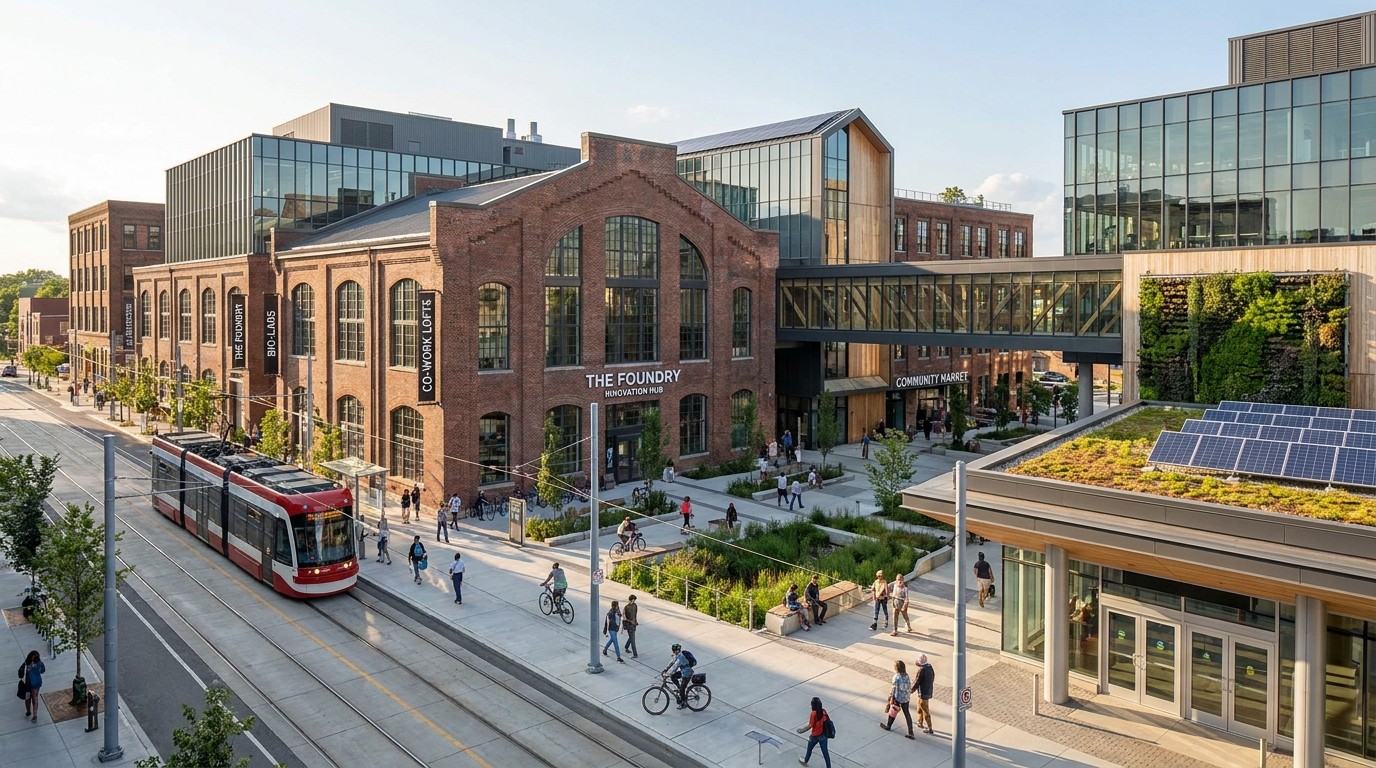
Adaptive reuse is especially powerful in these settings. Former industrial structures can be converted into labs, maker spaces, offices, incubators, educational facilities, or cultural venues. This preserves local character while reducing embodied carbon compared with wholesale demolition and new construction. It also helps create the authenticity that many successful innovation districts possess. People are often drawn to places with visible layers of history, not sterile environments with no memory.
There is a strategic urban planning benefit as well. Redeveloping underutilized urban land can relieve pressure to push growth outward. Instead of expanding the city through low density peripheral development, innovation districts can intensify areas that already have some level of servicing, mobility access, and employment logic. This aligns with broader goals around sustainability, infrastructure efficiency, and compact urban form.
That said, redevelopment is never neutral. Land values can rise quickly, and if housing, workforce access, and community benefits are ignored, the district can become exclusionary. This is why innovation districts must be planned not only as economic zones but as civic projects with inclusion strategies from the beginning. The district should create opportunity for nearby communities, not just market value for incoming capital.
Case study lessons: MaRS, Buffalo Niagara Medical Campus, and Pittsburgh’s EcoInnovation District
North American examples show that there is no single template for innovation districts, but they do reveal common strategic patterns. Toronto’s MaRS is one of Canada’s most prominent urban innovation hubs. MaRS states that it supports more than 1,200 startups and scale ups, making it a major example of how concentrated entrepreneurship support, research commercialization, and institutional presence can create a strong innovation ecosystem in a central city setting. Its value is not simply in the number of firms it touches. Its larger lesson is that proximity to hospitals, research talent, investors, and a dense urban environment can generate far more momentum than a detached office cluster.
For mega developments, the MaRS example reinforces the importance of building around real strengths rather than generic ambition. Toronto’s health, research, and commercialization assets created the basis for a distinct innovation identity. This is a critical point for cities and landowners considering similar strategies. Successful districts are not assembled through branding exercises alone. They grow from competitive advantages that already exist or can be credibly expanded.
The Buffalo Niagara Medical Campus offers another useful model. BNMC describes itself as Western New York’s premier innovation district, centered on health, entrepreneurship, and innovation. What stands out here is the role of district wide planning and mobility initiatives in supporting a cluster of institutions and employers. The lesson is that large health and research anchors can do more than occupy land. With coordinated planning, they can help structure an entire urban district around economic activity, public realm improvements, and access.
For large scale redevelopment projects, BNMC highlights the value of district management and coordination. Multiple institutions can share geography without producing a unified district. What changes the outcome is sustained collaboration around mobility, place management, branding, talent pipelines, and land use alignment. In other words, innovation districts require governance, not just adjacency.
Pittsburgh’s EcoInnovation District illustrates a newer direction in the field. It has been explicitly designed as a proof of concept for sustainable and equitable mobility, showing how innovation districts can be tied to climate goals, transit, and community outcomes. This matters because the next generation of mega developments cannot separate economic development from environmental performance. Districts that address low carbon mobility, energy efficiency, public health, and resilience are likely to be better positioned for both policy support and long term market relevance.
The broader takeaway from these examples is that innovation districts can take different forms depending on local assets. Some are rooted in health and life sciences. Some are tied to universities and entrepreneurship. Some are driven by climate and mobility innovation. What they share is intentional integration across institutions, public investment, built form, and programming.
The inclusion challenge: growth does not become equitable on its own
One of the most important misconceptions about innovation districts is that they naturally produce broad based prosperity. They do not. Brookings has noted that many innovation districts include lower wage and sub baccalaureate jobs, which creates real opportunities to connect nearby disadvantaged communities to employment and training. But that outcome only happens when developers, institutions, and public agencies design it deliberately.
Without intentional policy, innovation districts can reinforce exclusion. Rising property values can pressure existing residents and small businesses. High skill job growth can bypass nearby communities if education and training systems are not aligned. New amenities can improve a place visually while local households remain disconnected from its economic opportunities. In major development projects, these tensions can intensify because the scale of investment accelerates market change.
An inclusive innovation district needs several things working together. It needs workforce pathways linked to local employers and educational institutions. It needs affordable and attainable housing options near job centers. It needs procurement and supplier diversity strategies that create openings for local businesses. It needs public spaces and community facilities that are genuinely shared. It also needs mobility access that reduces the cost and time burden of reaching opportunity.
For mega developments, inclusion should be embedded in the business and governance model, not added later as a communications layer. Community benefit agreements, training partnerships, affordable commercial space strategies, and mixed income housing targets can all play a role. The specific tools will differ by jurisdiction and project structure, but the principle remains constant: if the district is going to claim public value, it must create public access to its benefits.
Governance is the hidden infrastructure
Physical construction often receives the most attention, but governance is what determines whether an innovation district can perform over time. The research consistently points to the growing importance of district governance models, place management organizations, and cross sector partnerships. These structures help coordinate the many actors that must work together in a complex urban ecosystem.
In a mega development, governance matters because no single participant controls every dimension of success. Developers may shape land use and phasing. Institutions may anchor employment and talent. Municipal governments may deliver zoning, transit, and public infrastructure. Nonprofit organizations may support local engagement or workforce programs. Investors may fund commercialization or scale up activity. Without a coordinating body or clearly defined partnership model, these pieces can remain fragmented.
Effective governance can help set a district vision, align capital priorities, manage public realm standards, oversee programming, collect performance data, and maintain relationships with surrounding communities. It can also preserve continuity across political cycles and market shifts. Since mega developments often unfold over a decade or more, this continuity is especially valuable.
Place management should also not be underestimated. Clean, safe, active, and well programmed public spaces affect how people use a district and whether firms want to locate there. Events, networking forums, founder support programs, research showcases, and cultural programming all contribute to the social infrastructure of innovation. This is part of what turns space into ecosystem.
Strategic recommendations for creating an innovation district inside a mega development
For cities, institutions, and developers considering this model, the central question is not whether innovation districts are desirable in theory. The real question is how to structure them so they are credible, durable, and locally grounded. The following strategic recommendations are particularly important in a mega development context.
Start with a real economic thesis
Every successful district needs a reason to exist beyond land assembly. The economic thesis should identify the sectors, institutions, talent pools, and market gaps that the district is positioned to serve. This may involve health innovation, life sciences, advanced manufacturing, climate technology, artificial intelligence, mobility systems, education technology, or another locally relevant domain. The key is specificity. A district built around authentic strengths can attract the right firms and partnerships more effectively than one defined by generic innovation language.
Secure anchor institutions early
Anchor institutions provide stability, identity, and traffic. Universities, hospitals, research centers, or major employers can help de risk early phases by creating immediate demand and signaling long term commitment. In many cases, they also bring talent pipelines, procurement spending, and international visibility. Mega developments that delay or underestimate anchor strategy often struggle to create the critical mass required for an innovation ecosystem to take hold.
Plan for mixed use intensity from the beginning
Land use planning should support a balanced mix of employment, housing, retail, community services, and public space. This does not mean every parcel must be mixed use in the same way. It means the district as a whole should support daily life, after hours activity, and a wide range of users. A rigid separation of uses weakens the ecosystem and reduces the urban energy that innovation districts depend on.
Design around transit, walking, and cycling
Mobility is a foundational economic issue, not just a transportation issue. Districts need easy access for workers, students, founders, patients, customers, and residents. High quality transit links, complete streets, bike infrastructure, and pedestrian comfort all improve access while supporting sustainability goals. In many mega developments, mobility investments should be treated as early catalysts rather than later enhancements.
Integrate inclusion into the development model
Affordable housing, workforce development, local hiring pathways, and small business opportunity should be embedded in district planning. The district should not rely on trickle down assumptions. It should define how nearby communities will participate in its growth and measure that performance over time. Inclusion is not only a moral imperative. It also strengthens labor supply, community legitimacy, and political durability.
Use adaptive reuse where it adds identity and flexibility
If the site includes industrial or institutional heritage assets, adaptive reuse can help establish character while supporting sustainability goals. Older structures often work well for incubators, maker spaces, cultural venues, and flexible offices. They can create a memorable sense of place that differentiates the district from standard commercial product. In a competitive market, this authenticity has real value.
Build governance capacity before full buildout
A district management structure should be established early enough to coordinate programming, branding, stakeholder alignment, and community relationships. Waiting until most of the real estate is complete can leave the project without the social and operational systems it needs. Governance is part of the enabling infrastructure of an innovation district and should be funded and structured accordingly.
Measure performance beyond real estate metrics
Leasing activity and land value matter, but they should not be the only indicators of success. Strong innovation districts track jobs created, startups supported, research commercialization, transit usage, public realm performance, affordable housing delivery, local procurement, emissions outcomes, and workforce participation. These metrics help determine whether the district is functioning as a place based economic engine rather than simply a profitable land play.
What the future looks like
The innovation district model is evolving. There is now greater emphasis on climate resilience, green mobility, low carbon district design, and healthy urban systems. There is also stronger focus on inclusive growth, workforce pathways, and housing affordability near job centers. In many cities, the most promising districts are emerging not from greenfield expansion but from adaptive reuse and urban regeneration, where existing infrastructure and institutions can be leveraged more effectively.
Canadian relevance is also growing. Innovation districts are not limited to the United States, and examples such as MaRS demonstrate how research commercialization, health innovation, and urban density can combine into a powerful ecosystem. As Canadian regions continue to confront housing demand, infrastructure pressure, and the need for more productive urban growth, the integration of innovation districts into larger development strategies will likely become more important.
For mega developments in particular, this model offers a way to move beyond conventional project thinking. Instead of asking how much residential or office space a site can absorb in the near term, innovation districts encourage a broader question: what long term economic role should this place play in the city and region? That shift in perspective is valuable because it aligns development with structural urban needs rather than short cycle speculation.
It also reframes public private collaboration. When a mega development is organized around a credible innovation district, governments can justify infrastructure and policy support through clear economic development outcomes. Institutions can align expansion plans with place based strategies. Communities can evaluate benefits through jobs, access, housing, and amenities. Developers can pursue value creation through ecosystem building, not just parcel optimization.
Conclusion: building places that compound value
Innovation districts matter because they connect city building with economic strategy. In an era when mega developments are expected to deliver more than floor area, this connection is essential. The strongest projects are not those that simply build big. They are the ones that create durable urban platforms for employment, housing, talent, mobility, and community life to reinforce each other over time.
Brookings’ framing remains useful here. Innovation districts draw power from density, proximity, authenticity, and vibrant place making. They depend on economic assets, physical assets, and networking assets working together. They can support inclusive and sustainable development, but only when inclusion is designed intentionally rather than assumed. For mega developments, those lessons are highly practical. They point toward a model of growth that is more resilient, more urban, and more valuable in the long run.
The opportunity is significant. Large scale projects control enough land, capital, and phasing capacity to shape whole districts rather than isolated buildings. When that scale is organized around an innovation ecosystem, the result can be transformative. Jobs and housing become linked rather than separated. Infrastructure supports productivity rather than simply servicing expansion. Public spaces contribute to collaboration, identity, and quality of life. Community outcomes become part of the development logic instead of an afterthought.
In the end, unlocking growth is not about chasing a trend. It is about recognizing that the future of urban development belongs to places that compound value across multiple dimensions at once. Innovation districts, when executed with strategic discipline and public purpose, offer one of the clearest paths to achieving that within mega developments.



No Comment! Be the first one.