
Danforth Breaks Ground: A Blueprint for Mixed-Income Growth in Toronto’s East End
Every so often a project comes along that shows what disciplined land strategy can actually deliver. The ground breaking at 1111 and 1117 Danforth Avenue in Toronto’s Pocket neighbourhood is one of those moments. Two adjoining sites, two very different ownership structures, and one coordinated build that will add more than 400 rental homes to a transit-connected corridor. This is what long term development thinking looks like when it works.
The structure of this deal deserves attention as much as the unit count. Woodbourne Canada Management and Core Development Group are advancing the market-rate tower at 1111 Danforth, a 13-storey building with 297 units and ground floor retail. Right beside it, Neighbours Community Homes is delivering 108 units at 1117 Danforth, a non-profit building that includes replacement housing for existing tenants along with new affordable and rent-controlled homes. Rather than functioning as separate developments competing for the same block, the two buildings share infrastructure and loading facilities, and the city accelerated approvals so the non-profit component could follow the same construction timeline as its market-rate neighbour. That is coordinated planning translating directly into cost efficiency and faster delivery.
Location is doing a lot of work here too. The site sits roughly 300 metres from Donlands station and 500 metres from Greenwood station, which explains the parking ratio: 305 bicycle spaces against just 19 vehicle spaces across the market-rate building. That is a deliberate bet on transit-oriented density, and it is the kind of calculation that shapes long term value far more than finishes or amenities do.
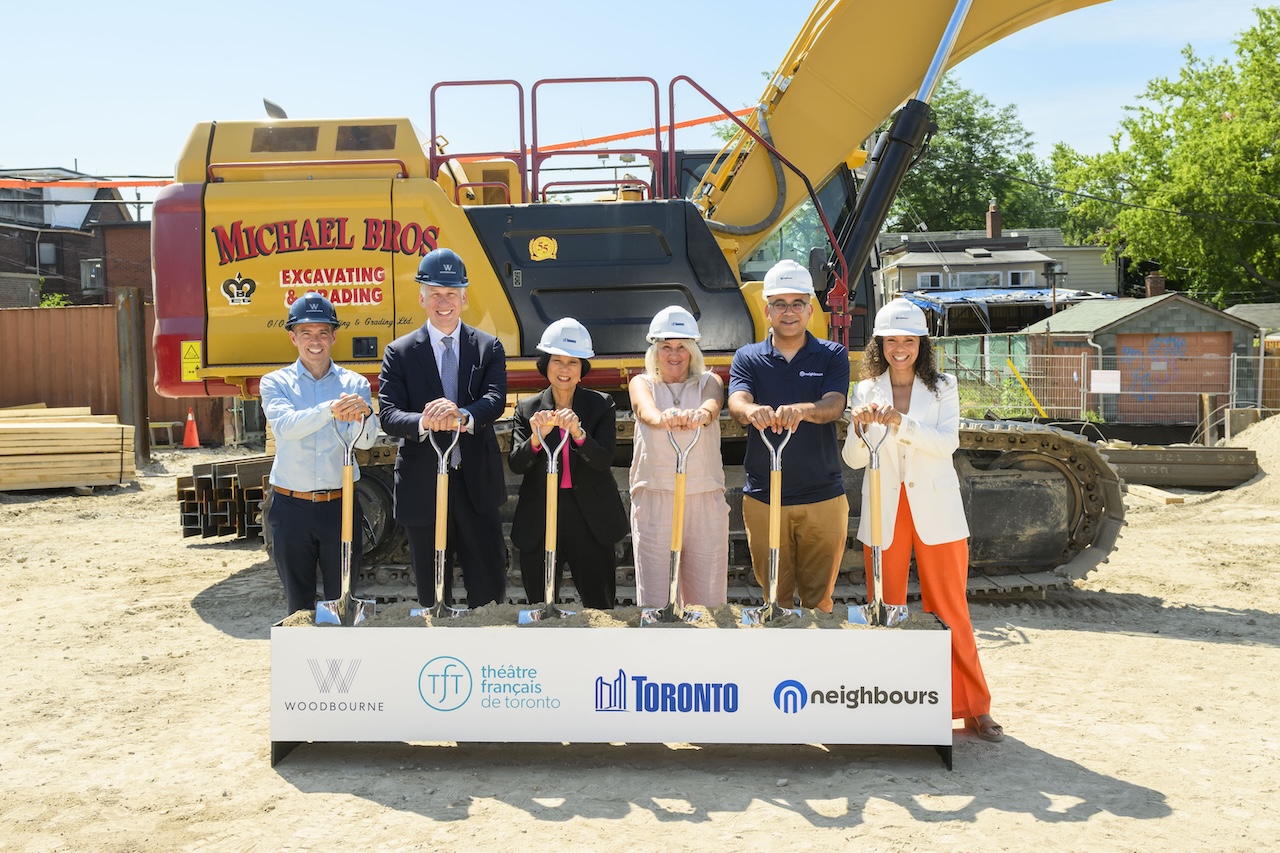
The public financing behind this project is worth studying closely. The City of Toronto is contributing more than 13 million dollars in capital funding and over 14 million dollars in incentives through its Rental Housing Supply Program. That is meaningful public capital, but it is being deployed alongside private development expertise and non-profit operating capacity, which is precisely the kind of blended structure that large scale housing supply now requires. This project is one of 50 affordable housing developments currently under construction across the city under the HousingTO 2020 to 2030 Action Plan, a pipeline expected to produce 14,000 homes, including more than 4,000 affordable rental units.
Working collaboratively with the City of Toronto and Woodbourne has helped make this project not only viable but also repeatable.
That word, repeatable, is the real headline for anyone tracking development strategy rather than ribbon cuttings. Gautam Mukherjee of Neighbours Community Homes framed the project not as a one-off but as a model, and Nick Macrae of Woodbourne echoed the same idea, describing the partnership as a demonstration of how private developers, non-profit housing operators, cultural institutions, and government can align around shared delivery timelines. The addition of a permanent home for Le Théâtre français de Toronto at the base of the market-rate building also signals something developers often underweight: cultural anchors can strengthen the long term identity and demand profile of a neighbourhood, not just its housing supply.
Occupancy is targeted for 2029, which gives the city several years to test whether this shared-infrastructure, shared-timeline model can actually be replicated at the scale Toronto’s housing targets demand. If it can, this corner of the Danforth may end up mattering less for its 400 homes than for the template it leaves behind.
Source: UrbanToronto