July’s Housing Starts Slowdown: A Signal Investors Should Not Ignore
New numbers from Canada Mortgage and Housing Corporation confirm what many investors watching the ground have already suspected: the pace of new construction across the country is losing momentum, even as the homes already in the pipeline keep landing on the market. For anyone allocating capital to residential real estate, that combination of fewer new starts and rising completions is worth reading carefully, because it points to a market that is quietly rebalancing rather than simply cooling.
The six-month trend measure for total housing starts came in at 247,377 units in July, a modest 0.5 percent dip from June. Actual monthly starts in centres of 10,000 people or more fell far more sharply, down 19 percent year-over-year to 18,834 units, with the year-to-date total off 4 percent from 2025. Builders are simply not breaking ground at the same rate they were twelve months ago, and that has direct implications for anyone underwriting future supply into a rental or resale thesis.
What makes this data set more nuanced than a simple slowdown story is the completions side of the ledger. Units under construction in larger centres held essentially flat at 373,091, while completions jumped 8.1 percent month-over-month to 19,773 units. In other words, the substantial backlog of projects started years ago is still working its way to market, temporarily cushioning supply even as the appetite to launch new projects fades. Approved permits not yet started also crept up 3 percent, a reminder that the pipeline still has fuel, just less of it being lit.
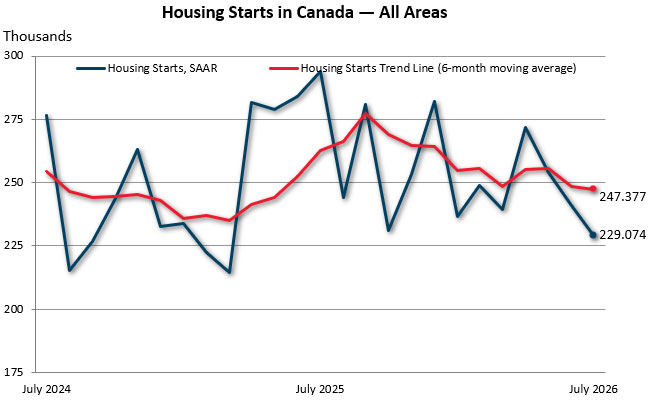
Geography matters here as much as the national headline. Montreal posted a 3 percent year-over-year increase in actual starts, driven by multi-unit activity, while Vancouver recorded a striking 42 percent decline and Toronto slipped 10 percent, both weighed down by weaker multi-unit launches. For portfolio construction, that divergence is the real story. Markets where builders are still committing capital, notably Quebec and parts of the Prairies, may see supply keep pace with demand, while investors exposed to Vancouver and Toronto should brace for a tighter development pipeline several years out even as near-term completions still flow through.
Based on the recent slowdown in activity, housing starts are likely to remain subdued over the coming months, reflecting ongoing challenges in bringing new projects to market.
That assessment, from CMHC Deputy Chief Economist Tania Bourassa-Ochoa, is the crux of the matter for capital allocators. A slower start pace today does not show up as tighter supply tomorrow, it shows up two or three years from now, once the current wave of completions is absorbed. Investors with a medium-term horizon should treat this report as an early signal to revisit supply assumptions in markets like Vancouver and Calgary specifically, where fewer new projects are being launched even as completions remain elevated in the short run.
The next monthly release lands September 16, and it will be the first real test of whether July’s pullback in starts was a blip or the beginning of a sustained retreat. Either way, the lesson for investors is the same: watch starts, not just completions, because that is where tomorrow’s supply and pricing power is actually being decided.
Source: CMHC, Monthly Housing Starts and Other Construction Data