



Future urbanism is the strategic framework for planning cities that stay livable, affordable, and resilient as populations grow inside existing metropolitan regions rather than at their edges. It brings together housing supply, transit-oriented development, climate resilience, and community-centered design into one coherent approach, rather than treating each as a separate policy file. The cities of tomorrow will not be judged by how futuristic they look. They will be judged by whether they solve pressures people already feel today: housing costs that strain household budgets, transportation systems that consume too much time, infrastructure that struggles under climate stress, and neighborhoods that separate daily needs instead of connecting them. Future urbanism is less about spectacle and more about performance, less about branding and more about building cities that work better for more people over the long term.
Table Of Content
- Why Future Urbanism Matters Now
- Defining Future Urbanism Beyond the Smart City Narrative
- The Core Principles Shaping the Cities of Tomorrow
- Compact Growth With Purpose
- Transit-Oriented Development and Complete Mobility
- The 15-Minute Neighborhood and Daily Life Urbanism
- Climate Resilience as a Design Imperative
- Housing Affordability and the Urban Form Connection
- Community-Centric Design and Social Infrastructure
- Adaptive Reuse and the Circular City
- What Future Urbanism Looks Like in Practice
- Common Misconceptions That Need to Be Retired
- A Strategic Agenda for Stakeholders
- The Cities of Tomorrow Will Be Built Through Better Decisions Today
Across Canada and North America, the case for a new urban model is becoming impossible to ignore. Statistics Canada’s 2021 Census showed that 61.2% of Canadians already live in large urban population centres with 100,000 or more people. That means the future of growth is not primarily about opening up distant land and repeating low-density expansion at the edge. It is increasingly about reworking existing urban regions through smarter land use, better infrastructure, more complete communities, and development patterns that support quality of life as much as population growth.
The global context reinforces this urgency. The United Nations projects that the world’s urban population will rise from 4.76 billion in 2025 to 6.50 billion by 2050, with the global urban share increasing from 57.8% to 67.3%. In Europe and Northern America, urbanization is projected to grow from 77.1% to 83.2% over the same period. For developed urban regions, this signals a strategic reality: growth will place increasing pressure on existing metropolitan systems, and the cities that succeed will be those that can densify, adapt, and renew without losing social cohesion or environmental performance.
This is why sustainable urban growth and community-centric design now sit at the centre of serious planning conversations. A city can add housing, transit, and jobs, but if it fails to create belonging, resilience, and access, it has not actually advanced urban life. The next generation of city building must be compact but humane, efficient but equitable, and ambitious but grounded in the realities of how people live every day. That is the promise of future urbanism, and it is also the test.
In this guide, we will explore the principles shaping the cities of tomorrow, the misconceptions that often derail public debate, and the strategic moves that municipalities, developers, planners, and communities need to make now. The core argument is straightforward: the future city will succeed not because it is more digital, but because it is more livable, more resilient, more inclusive, and more adaptable.
Why Future Urbanism Matters Now
Urban planning has always been about managing growth, but today’s growth pressures are more interconnected than in previous eras. Housing affordability, climate adaptation, infrastructure renewal, mobility reform, and social inclusion are no longer separate files. They shape one another directly. A city that fails to allow enough housing near transit increases commuting burdens, emissions, and exclusion. A city that expands outward without considering long-term infrastructure costs creates liabilities that future taxpayers inherit. A city that ignores heat, flooding, and stormwater risks will spend more later trying to repair what could have been designed more intelligently from the start.
Housing has become one of the clearest entry points into this conversation. In 2024, Statistics Canada reported that 45% of Canadians were very concerned about housing affordability. That number reflects more than market frustration. It reflects a structural mismatch between how cities have grown and what households need. When supply is constrained in high-opportunity areas, people are pushed farther from jobs, services, schools, and transit. The result is not simply expensive housing. It is a fragmented urban life with higher transportation costs, deeper inequality, and increased environmental impact.
At the same time, climate risk is changing the planning agenda. The Environmental Protection Agency notes that urban heat islands intensify as density rises and natural land cover declines, but tools such as cool roofs and urban tree canopy can lower temperatures and reduce energy demand. This matters because climate resilience is no longer a supplementary feature. It is core urban infrastructure. Shade, water management, building performance, emergency preparedness, and ecological restoration all influence whether urban environments remain safe and functional under extreme conditions.
Future urbanism matters now because it offers a more integrated answer. It recognizes that city building is not only about units, roads, or technology platforms. It is about aligning land use, mobility, public space, environment, infrastructure, and governance into a coherent model that supports daily life. In practical terms, this means the cities of tomorrow will be shaped by decisions made in zoning reform, infrastructure prioritization, public realm investment, and development approvals today.
Defining Future Urbanism Beyond the Smart City Narrative
One of the most persistent misconceptions about future urbanism is that it is primarily a technology story. The popular image is one of sensors, autonomous vehicles, facial recognition, connected devices, and data-rich control systems. While digital tools can support better operations, they are not the foundation of great city building. In fact, some of the most meaningful gains in urban performance come from far less glamorous interventions: legalizing mixed-use development, enabling missing-middle housing, improving bus priority, creating safer sidewalks, planting trees, or converting underused land into complete neighborhoods.
Future urbanism should be understood as a strategic urban model that focuses on measurable outcomes. Those outcomes include faster and more affordable housing delivery, lower emissions, greater climate resilience, more equitable access to opportunity, and stronger neighborhood livability. This shift is important because it moves the conversation away from innovation theatre and toward implementation. Cities do not become better because they install more technology. They become better because they improve how people move, live, work, gather, and adapt.
That is why the strongest future urbanism agenda in Canada and North America is rooted in land use reform and physical design. Compact growth, transit-oriented development, adaptive reuse, complete streets, district energy systems, green infrastructure, and community-serving public space are all examples of future urbanism in practice. They do not reject innovation. They simply place innovation in service of clearer public goals.
Future urbanism is not about making cities look more advanced. It is about making urban life more affordable, resilient, connected, and dignified.
This distinction also helps counter false binaries that often dominate urban debates. Densification is not inherently anti-community. Sustainability is not only about emissions. Growth is not automatically beneficial unless it is matched with services and infrastructure. The quality of urbanization matters as much as the scale, and that principle should guide every major planning decision in the decades ahead.
The Core Principles Shaping the Cities of Tomorrow
Compact Growth With Purpose
Compact city planning is becoming a central principle of future urbanism because it addresses multiple pressures at once. It can reduce land consumption, lower per-capita infrastructure costs, support transit ridership, preserve agricultural and natural areas, and create stronger conditions for local commerce. But compact growth only works politically and socially when it is paired with livability. Density on its own is not a strategy. Density linked to parks, schools, health services, public space, and mobility options is.
For North American cities, compact growth increasingly means intensification within existing urbanized areas. This includes corridor redevelopment, transit node planning, gentle density in established neighborhoods, and redevelopment of underused commercial or industrial lands. It also includes a more honest accounting of sprawl. Statistics Canada research has linked lower-density housing supply to urban sprawl with environmental and economic implications. The long-term cost of extending roads, pipes, utilities, and services across larger footprints is often underestimated in public discourse, even when the short-term political appeal is obvious.
The strategic objective is not to force every community into the same built form. It is to create a range of urban conditions that make better use of land while supporting a broader range of households. In many contexts, that means more townhomes, multiplexes, courtyard buildings, mid-rise apartments, and mixed-use blocks rather than only detached houses or high-rise towers. This middle ground is where future urbanism can deliver both scale and compatibility.
Transit-Oriented Development and Complete Mobility
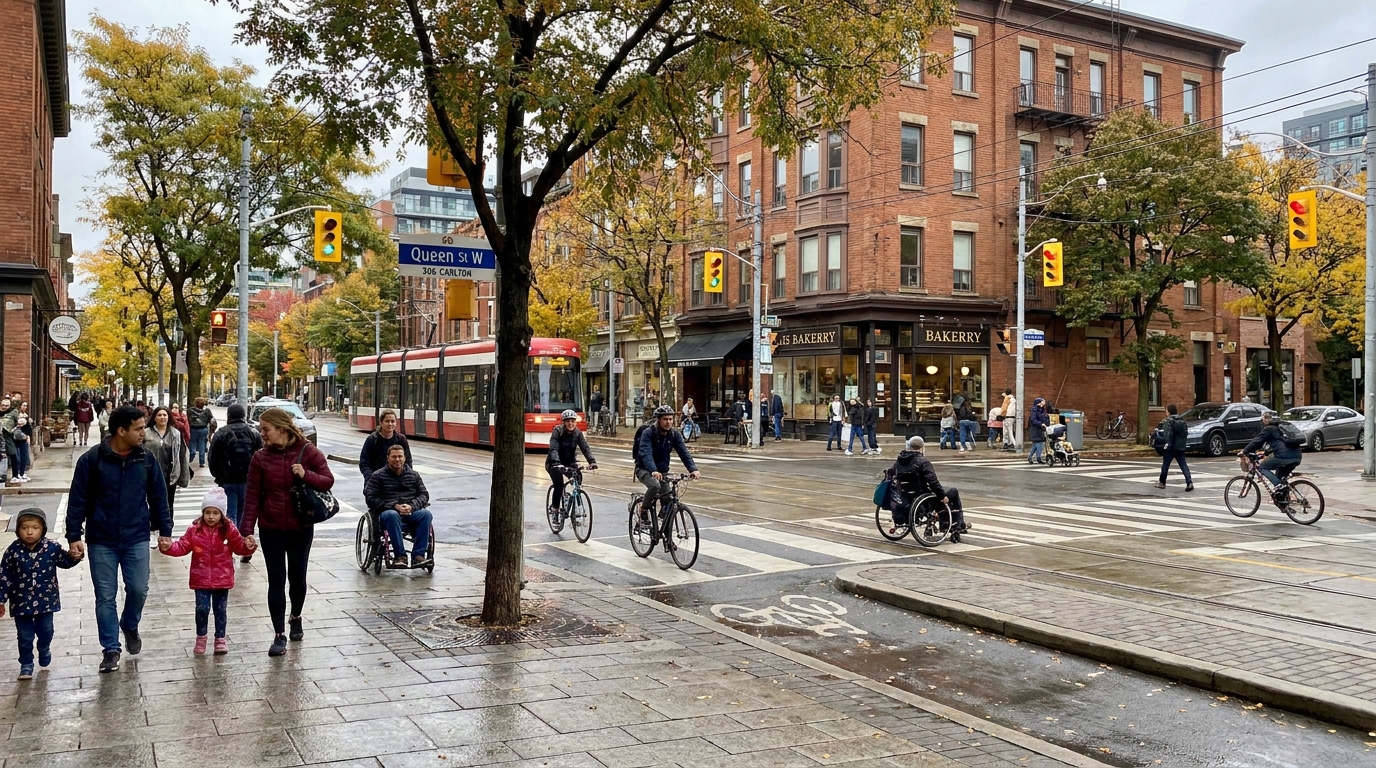
The future city must be organized around access, not distance. Transit-oriented development is one of the clearest ways to turn that principle into urban form. When housing, jobs, services, and public amenities are clustered around frequent transit, cities become more efficient and residents gain more choices in how they move. This reduces car dependence, cuts transportation costs, and improves the viability of infrastructure investments that would otherwise be underused.
Yet transit-oriented development should not be reduced to building near stations. It must also produce complete mobility systems. That means safe walking routes, protected cycling connections, universal accessibility, active ground-floor uses, and public spaces that make station areas feel like real neighborhoods rather than transfer points. The value of transit increases when the first and last portion of every trip is intuitive, comfortable, and safe.
The same logic applies to the broader idea of complete streets. A complete street is not simply a road with a bike lane added to it. It is a corridor designed to serve multiple users and support local place-making. Where streets are safe and engaging, foot traffic rises, local businesses benefit, and social interaction becomes part of daily routine rather than a special event. These are not cosmetic upgrades. They are structural investments in economic activity, public health, and urban cohesion.
The 15-Minute Neighborhood and Daily Life Urbanism
The popularity of the 15-minute city concept reflects a deeper shift in urban priorities. People increasingly want neighborhoods where daily needs can be met close to home: groceries, schools, childcare, parks, health services, transit, and small-scale retail. This is not an anti-mobility agenda. It is an efficiency and quality of life agenda. The more that routine necessities are accessible within a short walk, bike ride, or transit trip, the more time residents recover from commuting and the more resilient local communities become.
Future urbanism adopts this principle not as a slogan but as a planning discipline. It asks whether zoning allows local services, whether street networks connect rather than isolate, whether housing types are diverse enough to support different life stages, and whether public investments create complete districts rather than fragmented pieces of infrastructure. A neighborhood is not truly future-ready if residents still need to drive long distances for basic needs.
Community-centric design also matters here because proximity alone is not enough. A neighborhood can be dense and well-located yet still feel alienating if public spaces are poor, social infrastructure is thin, or development ignores local identity. The best future urbanism blends physical efficiency with emotional intelligibility. People need places they can navigate, participate in, and recognize as their own.
Climate Resilience as a Design Imperative
Climate resilience has moved from the margins of urban planning to its core. Heat waves, flooding, poor air quality, and infrastructure stress are no longer future possibilities. They are current conditions. The IPCC’s work on climate change and cities has emphasized that the built environment, mobility systems, governance, finance, and nature-based solutions all play a role in resilience. This means future urbanism must be both a mitigation strategy and an adaptation strategy.
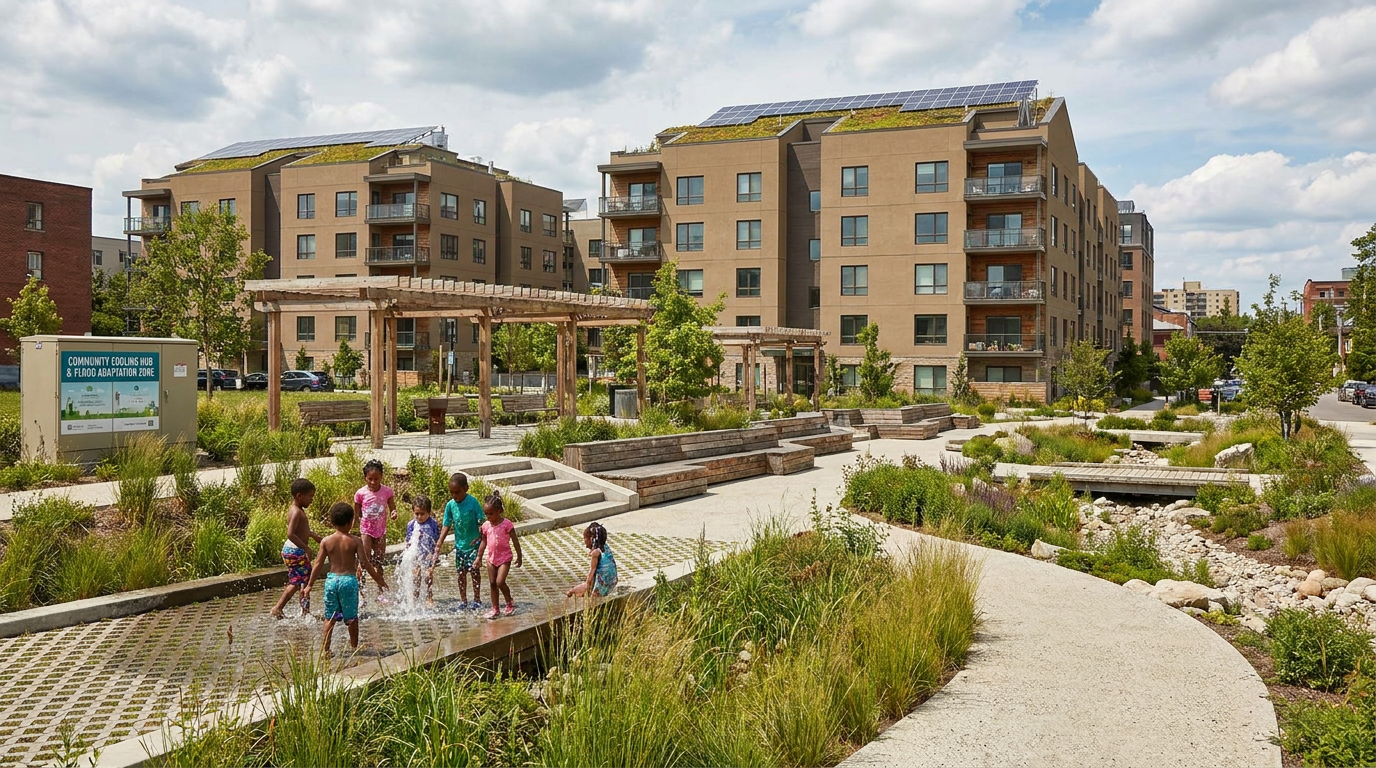
Heat is a particularly important challenge in large urban regions. Urban heat islands emerge where hard surfaces dominate and natural cover is reduced. In practical terms, that means neighborhoods with limited tree canopy, exposed asphalt, dark roofing materials, and weak building performance can become dangerous during extreme weather. Urban forestry, cool roofs, reflective materials, shaded public spaces, and building retrofits are all part of a more resilient urban system. These solutions lower temperatures, reduce energy demand, and improve comfort for residents who may not have equal access to private cooling.
Stormwater and flooding require a similarly integrated approach. Traditional engineered systems remain important, but future urbanism increasingly relies on green infrastructure and nature-based solutions to complement them. Bioswales, permeable paving, retention landscapes, restored wetlands, and water-sensitive public spaces can absorb and slow runoff while improving neighborhood aesthetics and ecological function. These are not only environmental features. They are urban assets that make communities safer and more valuable over time.
Resilience also includes redundancy and adaptability in essential systems. District energy, distributed power, resilient transit operations, modular infrastructure upgrades, and building reuse strategies can all improve a city’s ability to respond to changing conditions. A future-ready city is not one that assumes stability. It is one that is designed to keep functioning under pressure.
Housing Affordability and the Urban Form Connection
No conversation about future urbanism is credible if it avoids housing. Affordability is not simply a social issue layered onto urban planning. It is one of the main ways urban planning succeeds or fails. When a city underproduces homes in areas with access to jobs and transit, scarcity drives up prices, displacement increases, and households are pushed toward less efficient and less connected parts of the region. Urban form and housing economics are inseparable.
The future city must therefore produce more housing in more forms. This includes rental, ownership, non-market housing, supportive housing, student housing, senior housing, and family-oriented housing. It also includes permitting missing-middle housing and middle-density redevelopment in places that have historically restricted growth to detached homes. If cities want to improve affordability, they need to widen the range of legal and feasible housing choices in high-opportunity areas.
Importantly, supply should not be discussed in isolation from livability. New housing gains public legitimacy when it is paired with schools, parks, transit, local retail, childcare, and public realm improvements. Opposition often hardens when residents feel growth is being imposed without a visible local benefit. Future urbanism responds by linking increased density to tangible neighborhood improvements. This is not simply a communications tactic. It is a more complete development model.
There is also a fiscal argument. Compact housing near existing infrastructure is often more efficient than continuous edge expansion. Over time, the cost of servicing sprawl can undermine municipal budgets and create inequitable infrastructure outcomes. By contrast, well-planned intensification can improve infrastructure productivity while supporting more sustainable tax bases. The key is to ensure that density is planned, serviced, and designed well rather than treated as an afterthought.
Community-Centric Design and Social Infrastructure
One of the defining ideas in future urbanism is that city building must become more people-centered in a practical sense. The quality of housing and streets matters, but so does the quality of institutions and gathering spaces that support community life. Libraries, schools, recreation centres, clinics, childcare spaces, plazas, markets, and parks are all forms of social infrastructure. They hold neighborhoods together and shape whether density feels supportive or extractive.
Community-centric design begins with the recognition that urban residents do not experience the city as separate technical systems. They experience it as daily life. They notice whether crossings feel safe, whether benches exist for older adults, whether a park is welcoming, whether local businesses can survive, whether children can reach school easily, and whether a public square invites participation or discourages it. These details are not secondary to planning. They are the lived expression of planning.
Effective engagement is also part of this model. Cities and developers increasingly understand that public resistance is not always opposition to growth itself. It is often opposition to uncertainty, exclusion, or poor design. Community engagement processes that begin early, explain tradeoffs clearly, and demonstrate local benefits can build legitimacy and improve outcomes. Co-design does not mean every demand can be accommodated. It means people are treated as stakeholders in shaping the future of their neighborhoods, not as obstacles to be managed.
Equity-centered planning takes this one step further. It asks who benefits from growth, who bears the burden of transition, and which communities have historically been left out of investment. A future city that is efficient but socially exclusionary is not truly future-ready. Inclusion must be built into land use decisions, public investment priorities, infrastructure access, and long-term governance frameworks.
Adaptive Reuse and the Circular City
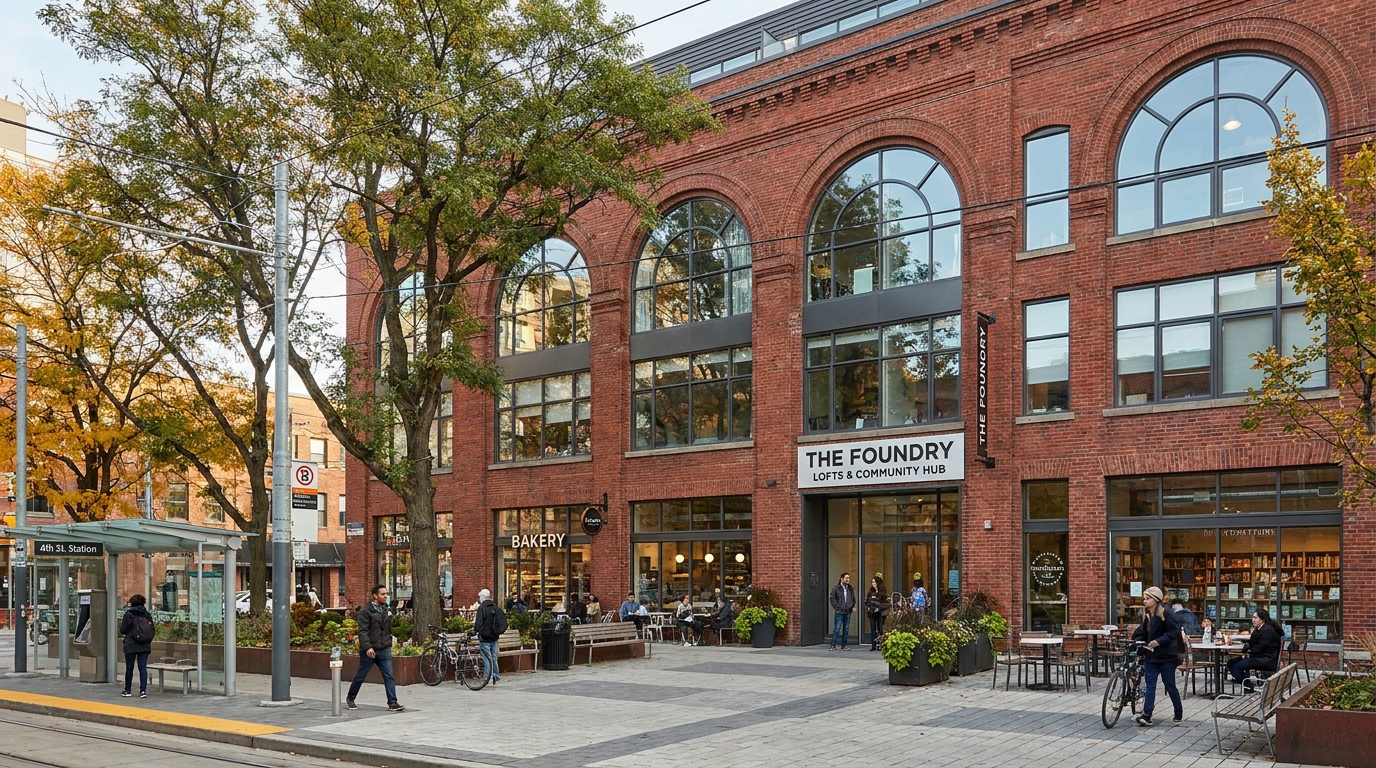
Not every future city will be built from new materials on empty sites. In fact, one of the most strategic directions in urban development is the reuse of what already exists. Adaptive reuse allows cities to convert older commercial, industrial, institutional, or office buildings into housing, employment space, cultural uses, or mixed-use projects. This can speed up delivery, preserve embodied carbon, retain neighborhood character, and reduce waste.
In many urban regions, underused properties represent some of the best opportunities for future urbanism. Aging shopping centres, surplus parking lots, obsolete office blocks, warehouse districts, and low-intensity corridors can all be repositioned as more complete and productive urban environments. This is where long-term vision matters. The question is not simply whether a site can be redeveloped, but whether it can become part of a larger pattern of district transformation.
The circular economy in cities supports this mindset. Rather than treating development as a linear process of extraction, construction, use, and disposal, a circular model values durability, adaptability, material recovery, and long-term performance. For municipalities and development teams, that means thinking more carefully about life-cycle costs, retrofit potential, waste reduction, and infrastructure integration. Future urbanism is not only about where cities grow. It is also about how intelligently they transform what they already have.
What Future Urbanism Looks Like in Practice
For stakeholders trying to move from concept to execution, future urbanism becomes clearer when translated into practical planning and development moves. The cities of tomorrow are likely to be shaped by a combination of policy reform, public investment, and market adaptation rather than by one singular breakthrough. What matters most is aligning those elements around a coherent vision.
In practical terms, that often includes the following actions:
- Reforming zoning to allow more housing diversity, mixed uses, and moderate density in well-served areas.
- Prioritizing transit-oriented growth around stations, corridors, and frequent service networks.
- Investing in complete streets so walking, cycling, and transit are realistic daily options.
- Embedding climate adaptation into site design, building standards, tree canopy strategy, and stormwater systems.
- Expanding social infrastructure in tandem with housing growth so communities remain complete and functional.
- Using adaptive reuse and infill to unlock value in underperforming urban land and buildings.
- Improving approvals and coordination so good projects can move faster and with less uncertainty.
These are not abstract ideas. They are operational levers. When municipalities, agencies, and private-sector teams use them together, urban growth becomes easier to manage and easier to defend publicly. The strategic advantage lies in integration. A city that adds density without transit creates frustration. A city that adds transit without housing limits access. A city that adds housing without parks or schools weakens public trust. Future urbanism works when systems reinforce one another.
Common Misconceptions That Need to Be Retired
Public debate around urban growth is often slowed by misconceptions that no longer fit current realities. One of the most common is that density automatically erodes neighborhood character. In practice, neighborhood character is shaped by far more than unit count. Street trees, building frontage, public spaces, local businesses, heritage retention, and social mix all play major roles. Thoughtful density can strengthen local vitality if it is accompanied by good design and meaningful amenities.
Another misconception is that suburban expansion is always the cheaper solution. It may appear cheaper on a site-by-site basis, especially when land costs are lower at the edge. But once long-term infrastructure, transportation, environmental, and service delivery costs are included, the picture changes. Sprawl can impose diffuse liabilities that are hard to see upfront and difficult to reverse later.
A third misconception is that green urbanism is mostly aesthetic. Trees, parks, and bike lanes matter, but sustainability is not a decorative overlay. It includes energy performance, resilience to extreme weather, water systems, building materials, mobility choice, land efficiency, and governance capacity. Likewise, future urbanism is not solved by a handful of digital tools. The fundamental decisions remain physical, legal, financial, and social.
Retiring these misconceptions is important because they influence policy choices. Cities need a clearer public language for explaining why compact growth, mixed-use neighborhoods, and resilient design are not ideological preferences. They are practical responses to measurable challenges.
A Strategic Agenda for Stakeholders
Future urbanism is not the responsibility of planners alone. It requires coordination among municipalities, regional governments, transit agencies, utilities, developers, designers, lenders, institutional landowners, and communities. Each of these actors shapes whether urban growth becomes fragmented or coherent. The strongest projects emerge when the long-term city-building objective is shared early and carried consistently through approvals, funding, and delivery.
For municipalities, the priority is to align regulation with stated goals. If a city says it wants affordability, sustainability, and transit use, but zoning and approvals still privilege low-density separation and prolonged uncertainty, the outcome will contradict the vision. Policy alignment matters. So does predictable execution.
For developers and landowners, future urbanism creates both responsibility and opportunity. Projects that respond to transit access, climate performance, public realm quality, and community benefit are increasingly more durable from a market and approvals perspective. The development industry is moving toward a reality in which value is tied not only to entitlement and location, but also to how well a project fits the emerging logic of city growth.
For communities, the challenge is to engage beyond reflexive opposition or idealized nostalgia. Urban change is coming whether people participate or not. The more constructive path is to shape that change so that growth brings real benefits: housing choice for different generations, safer streets, better parks, stronger retail, improved transit, and more resilient infrastructure. Community-centric future urbanism is not about avoiding growth. It is about negotiating better growth.
The Cities of Tomorrow Will Be Built Through Better Decisions Today
The future of urbanism will not arrive all at once. It will emerge through zoning amendments, corridor plans, infrastructure renewals, housing policy shifts, transit expansions, design standards, climate strategies, and neighborhood-level investments. That is why the conversation must stay grounded. The cities of tomorrow are being formed by ordinary decisions that become extraordinary in aggregate.
Canada and North America are already highly urbanized, and the next phase of growth will increasingly play out inside existing metropolitan systems. That makes the quality of planning more important than ever. The challenge is not simply to accommodate more people. It is to do so in ways that expand opportunity, improve resilience, support affordability, and create places where daily life works better. Future urbanism offers a strategic framework for that task.
The most successful cities will understand that growth, sustainability, and quality of life are not competing goals. When approached intelligently, they reinforce each other. More housing near transit can reduce displacement pressures and emissions. Better public space can support density while strengthening community. Green infrastructure can improve resilience and livability at the same time. Adaptive reuse can unlock value while reducing waste. These are not isolated wins. They are the building blocks of a more coherent urban future.
There is also a larger civic question beneath all of this. What is a city for? If the answer is simply to accommodate population and economic activity, then urbanism risks becoming purely technical. But if the answer includes belonging, health, access, safety, opportunity, and long-term stewardship, then future urbanism becomes something richer. It becomes a discipline of shaping not only places, but possibilities.
That is the real promise of the cities of tomorrow. Not that they will be frictionless or perfect, because no city ever is. It is that they can become more adaptive in the face of uncertainty, more inclusive in the distribution of opportunity, and more thoughtful in the use of land, infrastructure, and public resources. The work ahead is substantial, but the direction is clear. The future city will succeed where it makes dense urban life more affordable, healthier, more connected, and more resilient for the people who call it home.


No Comment! Be the first one.